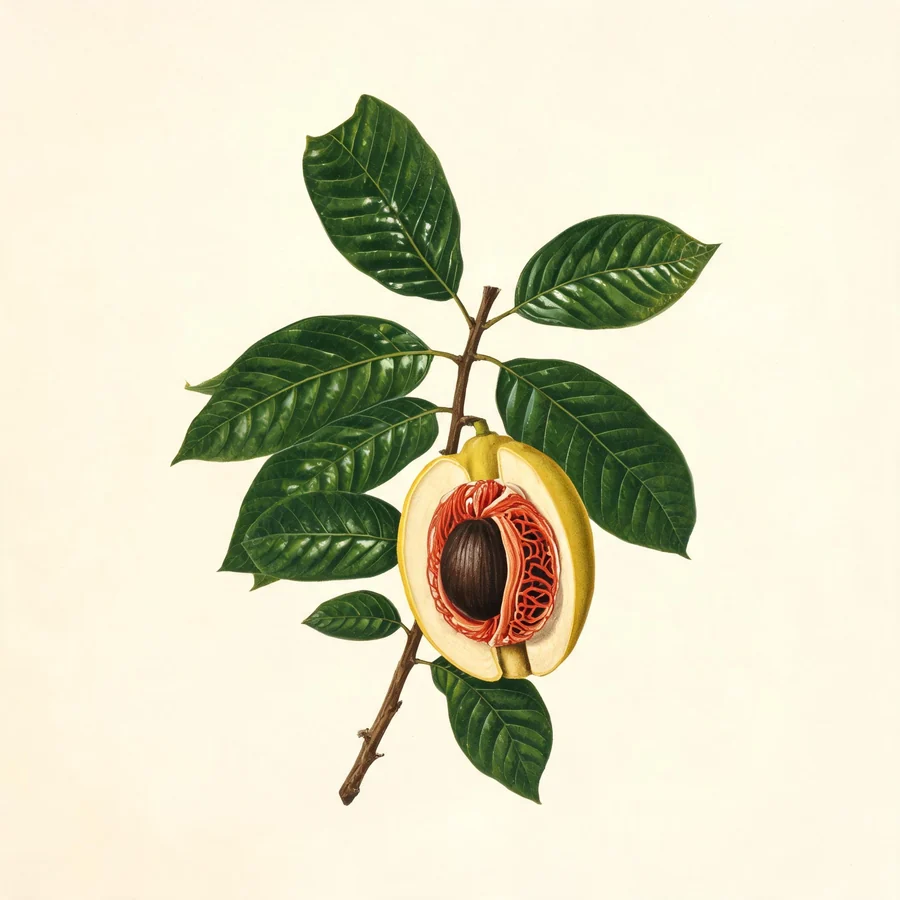
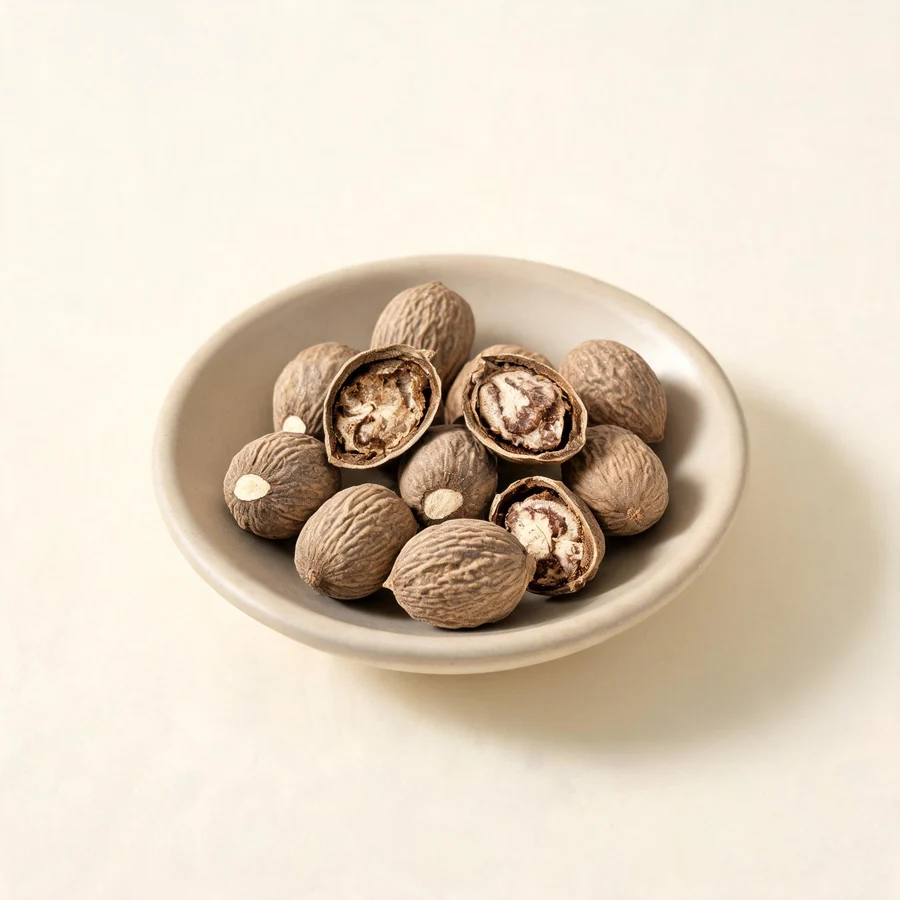
Skin profile
Where this herb sits in skin practice: the pattern it corrects, the skin signs it suits, and what it should not be used for.
Rou Dou Kou is a herb for the cold, wet terrain that keeps a skin lesion weeping, not a herb for lesions. It is chosen when the skin is cold and clammy and an old ooze will not close, in a person with a cold abdomen and loose stools, and it is stopped as soon as the skin turns hot or the ooze turns yellow. Doses stay small, the processed seed is the only form used, and pregnancy is a reason to leave it out.
Skin signs that suggest it
- Skin that is cold and clammy to the touch, pale and faintly blue at the fingertips, over a cold abdomen
- A chronic ooze that is thin and pale rather than yellow, slow to dry and slow to close
- Loose stools with undigested food and a thick white tongue coat alongside the skin trouble
- Dampness that persists in the folds, the groin or around the anus despite washing and drying
- Skin that is worse in cold wet weather and after cold drinks, and easier in warmth
When it is not the right herb
Not for hot, red, weeping lesions with yellow crusting, burning or a rapid pulse. That is damp-heat, and a warming, binding seed holds it in place and makes it worse. Not for an acute infection, a spreading redness, a fever or a pustule with pus, all of which need clearing or medical care rather than binding. Not for dry skin, a dry mouth or a hard stool, since the astringency and the warmth use up fluid. Not in medicinal doses in pregnancy, and not as raw powder: the processed seed at a small dose is the only form described here, and it is stopped as soon as the tongue coat thins.
What it does for skin
Skin-relevant actions only. Each one describes a mechanism in TCM terms and what it looks like on the skin.
Warms the middle so the Dampness stops being made
The tradition locates much skin Dampness in a Spleen and Stomach too cold to transform food and fluid, so the surface stays wet because the source stays cold. The seed warms that centre with real force, which is a different action from drying what has already leaked onto the skin. It is used where the abdomen is cold, the stool loose and the skin clammy at the same time, and it is a supporting herb rather than the lead.
Binds an ooze that has gone on too long
Astringency is the second half of the herb, and it is the half that matters for a chronic weep. Where the fluid is pale and thin and the surface has been wet for weeks, the seed is described as gathering and holding, in the way that a chronic discharge is bound. The distinction that governs its use is timing: an acute ooze is being cleared, while an old one that will not close may be bound, provided the skin is not hot and the fluid is not yellow.
Dries dampness that has settled in the folds
Skin folds stay humid, and the tradition reads persistent fold dampness with a cold body and a greasy pale coat as Dampness that the Spleen is not clearing. The seed's warmth and astringency reach that picture, and it is given with drying aromatics such as Cang Zhu rather than alone. Hot, red, macerated folds with satellite lesions are a different matter and need a diagnosis, often of a fungal infection, rather than a warming seed.
Moves the Qi that cold has stalled, so the skin is not left cold and congested
Cold slows movement, and where the middle is cold the surface can look pale, mottled and dull, with a heavy feeling in the limbs. The aromatic warmth of the seed is read as getting that movement going again, which is why it appears in formulas for a cold, damp body rather than in those for a hot one. The visible result is a warmer, drier, better-coloured surface rather than a change in any single lesion.
Skin conditions it is used for
Mapped to the condition pages on this site. The pattern column shows what the skin is doing when this herb is the right choice.
| Condition | Pattern | Why it suits | Typical setting |
|---|---|---|---|
| Cool or clammy skin sensation | Cold in the middle with Yang failing to reach the surface | Cold clamminess with a cold abdomen, a thick white coat, loose stools and a heavy body is read as Yang unable to warm the surface because cold Dampness is blocking the middle. The seed warms and binds that blockage, and it is given with Cang Zhu and Hou Po rather than alone. Sudden cold clamminess with chest pain, breathlessness or confusion is a medical emergency and has nothing to do with this pattern. | Modified Ping Wei San with Cang Zhu and Rou Dou Kou |
| Moist skin sensation | Dampness that keeps the surface wet from a cold Spleen | Skin that stays damp without much sweating, in a heavy body with a poor appetite and a greasy white coat, is read as fluid that is not being transformed rather than as heat. The seed dries from the middle so less reaches the surface, and it is used in a small dose inside a formula. Moist skin over red or yellow-weeping lesions is a different picture and is not treated this way. | Modified Wei Ling Tang with Cang Zhu and Rou Dou Kou |
| Eczema | Chronic cold-damp eczema with a pale, thin ooze | A long-standing patch that weeps pale fluid, feels cold and improves with warmth, in a person with loose stools and a thick white coat, is read as cold-damp rather than damp-heat. The seed is a minor member of such a formula, binding and warming while drying aromatics and Spleen tonics do the work. Eczema that is red, yellow-crusted or infected, or that is spreading, is the opposite picture and is not treated with nutmeg. | Si Jun Zi Tang with Cang Zhu and Rou Dou Kou |
| Anal irritation | Cold-damp settling in the lower body with Spleen deficiency | Persistent dampness and itch around the anus, with a cold abdomen, loose stools and a pale greasy coat, is read as cold-damp that the Spleen is failing to clear from the lower body. The seed's warmth and astringency suit that reading and it is given with drying and Qi-moving herbs. Itch in that area also comes from haemorrhoids, threadworm, a fungal infection and skin disease, so it is examined and diagnosed before it is treated as a pattern. | With Cang Zhu, Chen Pi and He Zi in a warming formula |
Combinations for skin
Herbs it is paired with when the skin, not an internal organ, is the target.
| Partner | Ratio | Why the pair is used |
|---|---|---|
| Cang Zhu | 3 to 6 g Rou Dou Kou with 6 to 10 g Cang Zhu | Cang Zhu is the gentler drying aromatic and nutmeg the stronger, binding one, so the pair lets a formula dry Dampness without overdoing it. It is used where cold-damp shows as clamminess on the skin and heaviness in the body, with a thick white coat. Cang Zhu can be continued for longer; the seed is the short-term strengthening, and it is dropped first. |
| He Zi | 3 to 6 g Rou Dou Kou with 6 to 10 g He Zi | Both are astringent, but He Zi is the broader of the two, holding Lung Qi as well as the bowel, while nutmeg concentrates on warming the Spleen and binding the lower passage. Together they suit a chronic ooze that travels with loose stools, and the pair is stopped when the fluid settles rather than continued as a tonic. |
| Bu Gu Zhi | 6 to 10 g each, as in Si Shen Wan | Bu Gu Zhi warms the Kidney Yang and holds, while nutmeg warms the Spleen and secures the bowel, so between them the source and the gate are both covered. The pair is used where the cold reaches the lower body: pre-dawn diarrhoea, cold limbs and a cold, damp skin. The skin connection is indirect and honest, since the treatment is aimed at the terrain that keeps the surface wet. |
| Huang Qi | 15 to 30 g Huang Qi with 3 to 6 g Rou Dou Kou | Huang Qi lifts Qi, holds the surface and helps a chronic sore to close, while nutmeg warms and binds below. The pair is used where an old erosion or a slow-healing patch weeps pale fluid in a tired, cold person, and the astringency is kept small so that the surface is not sealed over an infection. A sore that is spreading, hot or foul needs medical review. |
Formulas where it leads
- Si Shen Wan (四神丸) - The classical formula for pre-dawn diarrhoea, built on nutmeg with Bu Gu Zhi, Wu Zhu Yu and Wu Wei Zi, and the reason the seed is trusted for cold deficiency of the middle and lower body. Its skin relevance is indirect: it is the model for warming a cold terrain rather than treating a lesion, which is the only way nutmeg belongs on a skin page. The formula is not given in hot or dry pictures.
Safety for skin use
What to check before recommending or using it, including the cautions that matter most for skin patients.
Do not use, or use with caution
- Damp-heat skin: red, hot, weeping lesions with yellow crusting or a burning sensation, and a thick yellow coat. A warming, binding seed holds the heat and the fluid in, and the lesion usually spreads or becomes more painful.
- Acute infection, a spreading redness, or any fever with a rash. These need a diagnosis, and binding them is the wrong direction.
- Dry skin, a dry mouth, a hard stool or Yin deficiency with heat. The warmth and astringency of the seed take up fluid that is already short.
- Raw powder and large doses. Raw powder in amounts above roughly 5 g may bring nausea, dizziness, flushing and palpitations, and at the extreme hallucinations or convulsions, so the processed seed at a small dose is the only form used here.
- Prolonged use without review. The seed is warm and drying and is said to drain Qi if taken for too long, so a skin course is short and is stopped once the tongue coat thins.
Pregnancy and breastfeeding
Not for medicinal doses. Myristicin and safrole in the volatile oil are the reason, and the concern is not theoretical: large doses have been linked with uterine and psychoactive effects in animal work and in case reports. A pinch used to season a dish is not the issue, and the distinction matters, since nutmeg is a kitchen ingredient while a concentrated preparation is not. Topical use over a small area is not well studied either, so it is left out during pregnancy and while breastfeeding rather than adjusted.
Interactions
- Monoamine oxidase inhibitors. Myristicin itself inhibits monoamine oxidase, and agitation with hallucinations has been described when nutmeg was combined with a drug of this class. The combination is avoided rather than monitored.
- Orally taken medicines in general. The seed slows the passage of the gut and binds it, which can delay the absorption of tablets taken at the same time, so doses are separated by a couple of hours where absorption matters.
- Stimulants, anticholinergic drugs and laxatives. The volatile oil is a stimulant in higher doses, so it can add to the effects of caffeine, decongestants and anticholinergic medicines, and its binding action works against laxatives and stool softeners.
Allergy and patch testing
Nutmeg is a common spice, and reactions are uncommon but described, usually as a contact reaction in people who handle it in quantity. A herb-containing ointment or wash is patch tested for a day before wider use. Stop at once if the skin stings, burns or becomes redder, and treat wheeze, swelling or faintness as an emergency.
General safety references
General references for herbal hepatotoxicity and herb-drug interactions; they are not specific to this herb.
- Review article: Herbal hepatotoxicity - an update on traditional Chinese medicine preparations. Alimentary Pharmacology & Therapeutics, 2014. PMID: 24844799.
- Interactions between herbal medicines and prescribed drugs: an updated systematic review. Drugs, 2009. PMID: 19719333.
- Warfarin and food, herbal or dietary supplement interactions: a systematic review. British Journal of Clinical Pharmacology, 2021. PMID: 32478963.
Evidence
The classical record is quoted with its source. The modern note states the level of evidence plainly.
Classical record
主温中消食,止泄,治积冷心腹胀痛,霍乱中恶。
It warms the middle, aids digestion and checks diarrhoea, and it treats accumulated Cold with distension and pain in the chest and abdomen, cholera, and malign qi.
Kai Bao Ben Cao (Materia Medica of the Kai Bao Era) - A tenth-century entry from the maritime spice trade, and the source of the warming and binding action used on a cold, weeping surface.
土爱暖而喜芳香,故肉豆蔻之辛温,理脾胃而治吐利。
The Earth phase loves warmth and delights in fragrance, which is why the acrid warmth of nutmeg regulates the Spleen and Stomach and treats vomiting and diarrhoea.
Ben Cao Gang Mu (Compendium of Materia Medica), Li Shizhen - Li Shizhen's explanation of why a spice acts on the middle, and the clearest statement of the reasoning behind a warming herb for a cold terrain.
肉豆蔻,除寒燥湿,解结行气,专理脾胃,颇与草果相近……惟涩味较甚,并能固及大肠之滑脱,四神丸中有之。温脾即以温肾,是为中下两焦之药。
Rou Dou Kou dispels Cold and dries Dampness, frees what is knotted and moves Qi, and works chiefly on the Spleen and Stomach, much like Cao Guo, except that its astringency is stronger and it can secure the Large Intestine when it is slipping. It appears in Si Shen Wan. Warming the Spleen warms the Kidneys, which makes it a herb of the middle and lower burners.
Ben Cao Zheng Yi (Materia Medica in the Correct Sense) - The passage that separates nutmeg from the other warm aromatics: astringency is what makes it a herb for an old ooze rather than for a fresh one.
Modern evidence
Evidence status
- Laboratory work on the volatile oil, which contains myristicin, elemicin and safrole, reports antibacterial, antifungal and anti-inflammatory activity. These are laboratory findings at concentrations a decoction does not reach, and they do not establish a benefit for a weeping skin lesion.
- Clinical evidence in skin disease is absent. The medical literature on nutmeg concerns poisoning from raw powder and the pharmacology of myristicin rather than dermatology, and no trial of the seed in eczema or fold dampness exists.
- Regulatory status: the seed is an accepted herbal substance in the Chinese Pharmacopoeia as Semen Myristicae, and the bran-roasted form is the standard preparation. This page describes traditional practice and the state of the evidence; it is not a claim of proven benefit.
PubMed records
Selected real PubMed records for this herb's species or its constituents, chosen by species name and title relevance. They are references for the non-TCM discussion above, not proof that the herb treats any skin condition.
- (+)-Erythro-Δ(8')-7S,8R-Dihydroxy-3,3',5'-Trimethoxy-8-O-4'-Neolignan, an Anti-Acne Component in Degreasing Myristica fragrans Houtt.. Molecules (Basel, Switzerland), 2020. PMID: 33036279 (skin-related record).
- Effectiveness of co-cultured Myristica fragrans Houtt. seed extracts with commensal Staphylococcus epidermidis and its metabolites in antimicrobial activity and biofilm formation of skin pathogenic bacteria.. BMC complementary medicine and therapies, 2024. PMID: 39482677 (skin-related record).
- Nutmegs and wild nutmegs: An update on ethnomedicines, phytochemicals, pharmacology, and toxicity of the Myristicaceae species.. Phytotherapy research : PTR, 2021. PMID: 33987899 (safety record).
Dose and forms
Skin-practice dosing and the preparations that suit skin complaints.
| Form | Dose and notes |
|---|---|
| Decoction | 3 to 9 g of the bran-roasted, crushed seed daily inside a formula, and the smaller end of that range for a skin indication. The seed is always processed, since roasting reduces the volatile oil and strengthens the binding action. |
| Powder or pills | 1.5 to 3 g of the roasted seed, ground and taken with warm water or in pills, which is the usual way to give a small binding dose for a chronic discharge. |
| Course length | Short, a week or two, and stopped once the ooze has dried and the tongue coat has thinned. Continued use dries the mouth and drains the Qi. |
The amount is small and the margin is not generous at the top end: raw nutmeg powder becomes psychoactive at a few grams, so the processed seed at a few grams a day is a different proposition from a spoonful of ground spice. The decision is about fit rather than size. If the skin is hot or the ooze is yellow, the herb is wrong at any dose, and if the skin is dry it will make the dryness worse. Culinary use in a sauce is cooking, not treatment.
Citations and further reading
Only real sources are listed: the classical materia medica passages quoted above, and the source works behind the botanical and safety statements.
- Kai Bao Ben Cao (Materia Medica of the Kai Bao Era), tenth century - classical entry quoted above.
- Ben Cao Gang Mu (Compendium of Materia Medica), Li Shizhen, 1578 - classical entry quoted above.
- Ben Cao Zheng Yi (Materia Medica in the Correct Sense), Qing period - classical entry quoted above.
- Semen Myristicae monograph: Pharmacopoeia of the People's Republic of China - source for the accepted botanical source, the processed form and quality requirements.
- Modern evidence statement: based on laboratory and toxicological literature on the volatile oil of Myristica fragrans, summarised as a statement about the level of evidence rather than as a cited finding.
- Botanical description and identification: botanical literature on Myristica fragrans, Myristicaceae.
Educational reference for qualified practitioners. This page is not medical advice, and skin conditions should be diagnosed by a clinician before treatment.