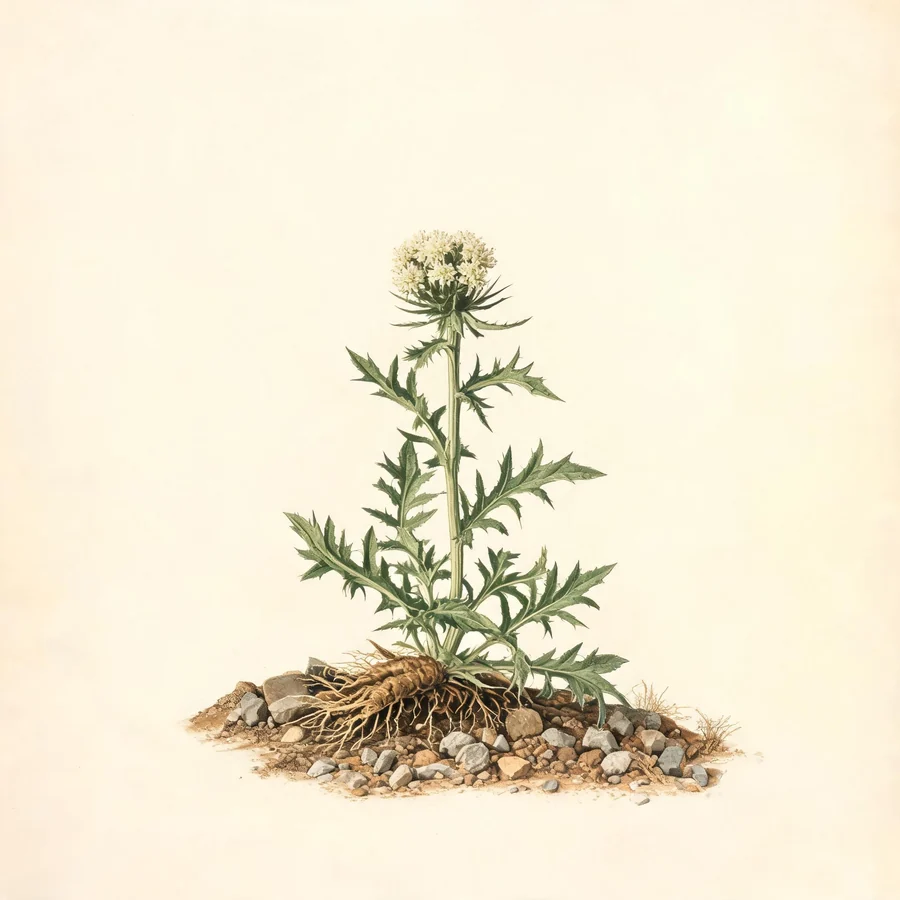
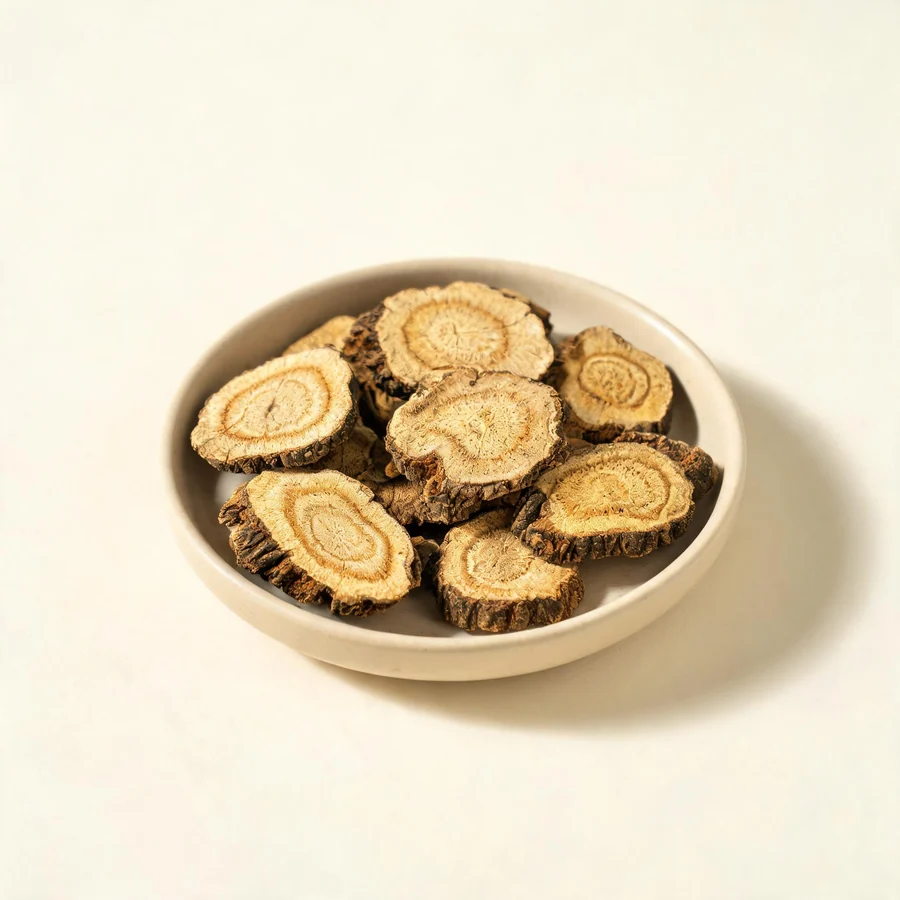
Skin profile
Where this herb sits in skin practice: the pattern it corrects, the skin signs it suits, and what it should not be used for.
Cang Zhu is chosen for skin that is wet, heavy and slow to settle, and where the tongue is thick and greasy it is one of the most reliable drying herbs available. It is stopped when the surface dries, because the same action that clears a weeping lesion will crack a dry one.
Skin signs that suggest it
- Weeping, oozing or crusted lesions with a moist surface and a heavy feeling in the limbs
- Greasy yellow scale on a red base at the scalp, eyebrows, nasolabial folds or chest
- Moist, pale, macerated skin in the folds: between the toes, in the groin, under the breasts
- Itch that is worse in humid weather and eases in dry, cool conditions
- Heaviness of the body with a thick greasy tongue coating and a poor appetite
- Puffy, soggy-looking skin that pits on pressure and feels heavy rather than tight
When it is not the right herb
Not for dry skin. Yin deficiency with dryness, blood deficiency with dry brittle skin and nails, ichthyosis-like scaling and cracked heels in cold weather all worsen with a warm drying rhizome. It is also the wrong herb where there is emptiness rather than excess: profuse sweating from Qi deficiency, a dry mouth with a red peeled tongue, and a thin rapid pulse all point away from drying. It is not for an acute hot, red, spreading eruption with fever and thirst, where cooling and toxin-resolving herbs lead. Use on broken or ulcerated skin needs supervision, and it is avoided in pregnancy unless a practitioner directs it.
What it does for skin
Skin-relevant actions only. Each one describes a mechanism in TCM terms and what it looks like on the skin.
Drains Dampness out of a wet lesion
Dampness in the skin shows as ooze, weeping, crusting and a surface that never quite dries. Its warm, acrid and bitter character is read as drawing that moisture out and freeing the Qi that Dampness has trapped, so the lesion dries from the base rather than being sealed over. It is the reason the herb appears in washes as well as in decoctions, and it is why the effect is judged by a reduction in ooze rather than by a change in redness.
Clears Wind-Dampness from the tissue beneath the skin
Where Dampness has settled into the limbs, the skin looks puffy and heavy and the joints ache in humid weather. Cang Zhu is one of the strongest drying herbs for that picture, and it is used where the skin problem and the limb or joint heaviness are part of the same disturbance. Its aroma is read as opening the surface and moving what has stagnated, which is why it can shift a soggy, immobile area that a purely bitter herb would leave unchanged.
Removes turbidity that shows as greasy scale and stale odour
Turbidity is the tradition's word for the stale, greasy, heavy quality that accompanies Dampness: a thick coating on the tongue, a greasy scalp, a musty smell to the skin and a foggy head. The volatile oil is what the tradition calls on, and the rhizome was burned to freshen rooms long before it was used on scalps. On the skin it is used where seborrhoeic scale is greasy and yellow rather than dry and white, and where the person feels heavy and dull at the same time.
Dries the moist surface that micro-organisms favour
Weeping skin, macerated toe webs and moist folds are the places where fungal and bacterial overgrowth takes hold, and the traditional washes for those areas are drying ones. Laboratory work on the volatile oil reports antibacterial and antifungal activity, which is a plausible partial explanation rather than a demonstrated clinical effect. In practice the herb is used to change the surface the organisms grow on, alongside proper treatment of an established infection rather than instead of it.
Releases the exterior when Cold and Dampness arrive together
The rhizome is also an exterior-releasing herb for the pattern where Wind, Cold and Dampness attack at once: chills, a heavy head, aching limbs and a rash that comes with them. That use is brief and belongs to the early stage of an acute illness. It is included here because the same dispersing quality explains why the herb can move a rash that has stalled at the surface, and because it is the reason the herb is not given to someone who is already sweating profusely.
Skin conditions it is used for
Mapped to the condition pages on this site. The pattern column shows what the skin is doing when this herb is the right choice.
| Condition | Pattern | Why it suits | Typical setting |
|---|---|---|---|
| Eczema | Dampness in the skin: weeping, oozing, heavy lesions | The wet flare of eczema, with ooze, crusting and a soggy surface, is the clearest skin expression of Dampness, and it is treated by drying rather than by cooling alone. Cang Zhu draws the moisture out while Huang Bo or Ku Shen handles the heat and the itch, which is why those pairs are the usual setting. It is stopped once the lesion dries, because the same action that helps a wet flare will crack a dry one. Skin barrier care and topical treatment remain the medical mainstay. | Er Miao San with Ku Shen and Bai Xian Pi, or as a cooled wash |
| Athlete's Foot | Damp-Heat pouring down into the feet | Itchy, macerated, white soggy skin between the toes, with odour and peeling, is read as Damp-Heat collecting in the lowest part of the body. The rhizome is the drying half of the classical pair for that pattern, and it is used both in a decoction and in a foot soak, which puts the drying action where the problem is. An established fungal infection still needs an antifungal; the herb addresses the moist environment that keeps it returning. | Er Miao San, or a cooled decoction soak with Huang Bo |
| Jock Itch | Damp-Heat held in the skin folds | A moist, itchy, red-brown rash in the groin folds, worse in heat and after sweating, is Damp-Heat held in a place that stays warm and damp. Cang Zhu is chosen because the drying action is needed as much as the cooling, and because the folds are exactly where a moist surface has to be changed. The area is washed and dried carefully, the herb is applied diluted, and a persistent rash is examined rather than treated blind, since candidiasis and fungal infection look alike. | Er Miao San internally, with a dilute cooled wash for the folds |
| Seborrhoeic Dermatitis | Dampness and turbidity with greasy yellow scale | Greasy yellow scale on a red base, at the scalp margins, eyebrows and nasolabial folds, fits the turbidity picture: greasy, heavy and stale rather than dry and flaking. Cang Zhu is used for the greasy quality in particular, with cooling herbs for the redness and with a wash for the scalp. It is a supporting herb rather than a cure, and medicated shampoos remain the practical treatment for the scalp. | A cooling damp-heat formula with Zhi Zi and Fang Feng, or a dilute scalp wash |
| Tinea | Damp-Heat with Wind: moist, spreading, itchy rings | A ring that spreads, itches and has a moist or scaly active edge is read as Damp-Heat with Wind, and the tradition treats it with drying, cooling and wind-diffusing herbs together. Cang Zhu supplies the drying that the moist edge needs and is applied as a wash to limited areas, since the point is to change the surface the infection grows on. Oral or topical antifungal treatment is the effective measure and should not be delayed. | A drying wash with Huang Bo and Ku Shen, alongside antifungal treatment |
| Skin Swelling | Dampness collecting under the skin: heavy, puffy swelling | Heavy, puffy swelling that is neither red nor hot, with a thick greasy coating and a foggy head, is the Damp-Phlegm pattern. The classical claim made for this rhizome is unusually strong here: the swellings that Dampness produces are said not to clear without it. In practice it is used as part of a drying formula, with Hou Po or Fu Ling, and any new or one-sided swelling needs medical assessment before it is treated as Dampness. | A drying formula with Fu Ling and Hou Po |
Combinations for skin
Herbs it is paired with when the skin, not an internal organ, is the target.
| Partner | Ratio | Why the pair is used |
|---|---|---|
| Huang Bo | Equal parts, 6 to 10 g each in decoction, the Er Miao pair | The classical pair for Damp-Heat settling in the lower half of the body: the rhizome dries the Dampness and the bark clears the Heat. On the skin it is the pairing for moist, itchy lesions of the feet, groin and lower legs, and for a yellow greasy coating with heavy lower limbs. Neither works alone, since the warmth of the rhizome feeds the Heat while the cold of the bark leaves the Dampness untouched. |
| Ku Shen | 6 to 10 g each | Ku Shen is the stronger herb against itch and lower-body Damp-Heat, and Cang Zhu is the stronger drier of tissue. Together they cover the wet, itchy lesion that will not settle: the rhizome takes the moisture away and the root quiets the itch and clears the heat in it. The pair is used internally and in washes, and the wash is kept to limited areas because both herbs are drying. |
| Bai Zhu | 6 g Cang Zhu with 10 to 15 g Bai Zhu | The two atractylodes are often confused and are best used together: Bai Zhu tonifies the Spleen and dries gently, while Cang Zhu dries forcefully and does not tonify. The proportion is the point, with the tonifying herb in the larger share, so that Dampness is moved without exhausting a person who is already tired and loose in the stool. It is the pairing for skin problems on a background of weak digestion. |
| Fang Feng | 6 to 10 g each | Fang Feng releases Wind from the surface and Cang Zhu dries the Dampness underneath it, which is the combination for a rash that is both itchy and moist and that moves about the body. It suits hives and eczema in humid weather, and it is a common pairing in the classical formulas for Wind-Dampness. Fang Feng is dispersing and Cang Zhu is drying, so the pair is not continued long in someone who is already dry. |
Formulas where it leads
- Er Miao San (二妙散) - Cang Zhu and Huang Bo, and nothing else: the clearest expression of the drying-and-cooling principle for Damp-Heat that has settled low in the body. In this edition it is the internal setting for moist, itchy lesions of the feet, groin and lower legs, and the same pair is used in washes.
- Si Miao Wan (四妙丸) - Er Miao San with Niu Xi and Yi Yi Ren, which adds a downward direction and a little more draining for Damp-Heat that has settled in the lower limbs. It is used where the feet and lower legs are heavy, swollen and itchy, and it is a short-course formula rather than a long tonic.
Topical use
Cang Zhu is used externally as a cooled wash and soak for skin that is moist, macerated or greasy, and it was traditionally burned to clear the air of a room. The volatile oil is the part that matters, so the decoction is covered while it simmers and is used the same day. External use is aimed at changing a wet surface, not at sterilising an infection, and it is kept to limited areas and short courses.
| Preparation | How and when it is used |
|---|---|
| Cooled decoction soak | 15 to 30 g of dried rhizome simmered in 1 litre of water for 15 minutes, strained and cooled to skin temperature. Soak the feet, or apply with clean gauze to the folds, for 10 minutes once daily, then dry the skin thoroughly. Make it fresh and discard what is left. |
| Dilute wash for the scalp | A weaker decoction used as a final rinse on a greasy scalp, left for two minutes and rinsed off. Keep it out of the eyes, and stop if the scalp stings or feels tighter rather than cleaner. |
| Drying dusting powder | Finely ground rhizome blended with an equal part of Huang Bo powder and applied sparingly to moist toe webs with a clean pad. Powder can cake and macerate skin further, so it is used on small areas only and never on broken skin. |
| Room fumigation | Burning the rhizome to clear a room is a traditional practice and not a skin treatment. The smoke irritates the eyes and airways, so it is not used in a room with an infant, an asthmatic or anyone with a respiratory infection. |
Patch test and cautions
Patch test on a small area of normal skin for 24 hours before first use, and do not apply to broken, cracked, ulcerated or deeply infected skin without supervision. Stop at once if burning, stinging or spreading redness develops. Keep washes away from the eyes and face, do not cover a treated area with an occlusive dressing, and wash the hands afterwards. A wash is not a sterilising treatment, so a spreading infection needs medical care.
Safety for skin use
What to check before recommending or using it, including the cautions that matter most for skin patients.
Do not use, or use with caution
- Yin deficiency with dryness: a red, peeled tongue, night sweats, a dry mouth and throat, and thin dry skin. A warm drying rhizome consumes the fluids that are already short.
- Blood deficiency with dryness: dry brittle skin and nails, scanty periods and a pale tongue. The drying action works against the nourishment that this picture needs.
- Profuse sweating from Qi deficiency: the rhizome is exterior-releasing and promotes perspiration, so it can add to a loss that is already a problem.
- Broken, cracked or ulcerated skin, and any area that is already dry and scaling. External use belongs to moist skin; on dry or open skin it stings and delays healing.
- Pregnancy, without practitioner direction: nothing in a strongly drying herb steadies the fetus, and where a gentler option exists it is the better choice.
Pregnancy and breastfeeding
Use only under practitioner supervision. The caution is not toxicity but the drying action, which is held to use up the Yin and fluids on which a pregnancy depends, and there is no calming effect on the fetus to offset it. Where there is a clear wet Dampness pattern and no gentler option, a short course at a low dose is the most that is attempted. External use on a small area is a much lower exposure than a decoction, but the same caution applies, and it is not used on the breasts or the abdomen during pregnancy or breastfeeding.
Interactions
- Insulin and oral hypoglycaemics: studies in animals have seen glucose move in both directions under the rhizome, so a person on glucose-lowering treatment should check readings more often while taking it and not add it casually.
- Digoxin and medicines sensitive to electrolytes: laboratory reports describe greater sodium and potassium loss and inhibition of the sodium-potassium pump in heart tissue, which is a reason for caution in theory rather than a recorded interaction.
- Medicines metabolised by CYP3A: a water extract induced this enzyme in animals, raising the possibility that levels of drugs handled by that pathway fall; the clinical importance is unknown.
Allergy and patch testing
Cang Zhu is a member of the daisy family, so people who react to ragweed, chrysanthemum, chamomile or other Asteraceae plants may react to it, and contact dermatitis to the rhizome has been described. Patch test any wash or powder on a small area of normal skin for 24 hours, keep the preparation away from the eyes, and stop at once if the skin becomes more irritated. Because the volatile oil is the irritant part, a covered or occluded application is more likely to react than an open one.
General safety references
General references for herbal hepatotoxicity and herb-drug interactions; they are not specific to this herb.
- Review article: Herbal hepatotoxicity - an update on traditional Chinese medicine preparations. Alimentary Pharmacology & Therapeutics, 2014. PMID: 24844799.
- Interactions between herbal medicines and prescribed drugs: an updated systematic review. Drugs, 2009. PMID: 19719333.
- Warfarin and food, herbal or dietary supplement interactions: a systematic review. British Journal of Clinical Pharmacology, 2021. PMID: 32478963.
Evidence
The classical record is quoted with its source. The modern note states the level of evidence plainly.
Classical record
暖胃消谷嗜食
It warms the Stomach, aids the breakdown of food and restores an appetite.
Ming Yi Bie Lu (Supplement to the Classic of Materia Medica) - The earliest clear statement of the middle-burner role, which is the engine of the drying action that reaches the skin.
能健胃安脾,诸湿肿非此不能除
It fortifies the Stomach, settles the Spleen, and no damp swelling is said to clear without it.
Zhen Zhu Nang (Pearl Bag of Drug Properties) - The strongest classical claim made for this rhizome, and the warrant for using it where Dampness shows as puffiness and heaviness in the skin and limbs.
苍术治湿,上中下皆有可用。又能总解诸郁
The rhizome treats Dampness and may be used alike in the upper, middle and lower body, and it resolves stagnation of every kind.
Dan Xi Xin Fa (Danxi's Heart Method) - This is what allows the herb to be used away from the digestion, in joints and in the lower body, and what ties it to the formulas for constraint.
Modern evidence
Evidence status
- Laboratory work on the volatile oil, including atractylodin, atractylon and beta-eudesmol, reports antibacterial, antifungal and anti-inflammatory activity, mostly in culture and in animals. That is a plausible reason for using a drying wash on moist skin, not a demonstration that it treats an infection.
- No adequate clinical trial of Cang Zhu alone in eczema, fungal infection or seborrhoeic dermatitis was identified. The published clinical literature is largely small studies of multi-herb washes and formulas in Chinese-language journals, which this page does not present as proof of effect.
- Burning the rhizome has been studied as a fumigant, and its smoke has shown antimicrobial activity in air. That is a claim about air, not about skin, and the smoke is an irritant, so it is described here as history rather than as a recommendation.
PubMed records
Selected real PubMed records for this herb's species or its constituents, chosen by species name and title relevance. They are references for the non-TCM discussion above, not proof that the herb treats any skin condition.
- Traditional Chinese medicine for atopic eczema: PentaHerbs formula suppresses inflammatory mediators release from mast cells.. Journal of ethnopharmacology, 2008. PMID: 18725279 (skin-related record).
- Effects of er-miao-san extracts on TNF-alpha-induced MMP-1 expression in human dermal fibroblasts.. Biological research, 2015. PMID: 25761492 (skin-related record).
- Atractylodis Rhizoma: A review of its traditional uses, phytochemistry, pharmacology, toxicology and quality control.. Journal of ethnopharmacology, 2021. PMID: 32987126 (safety record).
Dose and forms
Skin-practice dosing and the preparations that suit skin complaints.
| Form | Dose and notes |
|---|---|
| Decoction | 3 to 9 g of the dried rhizome a day for skin complaints, taken inside a formula. The raw rhizome dries hardest and is the form chosen for a wet, oozing lesion. |
| Short course | One to two weeks is the usual length for a wet flare. Stop or reduce when the lesion dries, the mouth becomes parched or the stool firms up, because those are the signs that the drying has gone far enough. |
| Bran-fried form | Bran-frying softens the harshness and turns the action towards the Spleen, which is the form chosen where the digestion is delicate or the course is longer. |
| External wash | 15 to 30 g simmered in 1 litre of water, cooled, for a foot soak or a limited-area wash once daily. |
Dryness rather than toxicity is the limit here, so how much drying a person can tolerate decides the amount, not the diagnosis on its own. A parched mouth, thirst that drinking does not relieve, constipated stool and a tongue that has shed its coating are the signs that the amount is too high. Skin practice keeps courses short and doses moderate, uses the bran-fried form when the digestion is weak, and stops the herb once the lesion has dried. It is also worth remembering that the same drying that helps a wet lesion will crack a dry one, so a change in the skin means a change in the formula.
Citations and further reading
Only real sources are listed: the classical materia medica passages quoted above, and the source works behind the botanical and safety statements.
- Ming Yi Bie Lu (Supplement to the Classic of Materia Medica), Tao Hongjing, Southern and Northern Dynasties - the line on warming the Stomach is quoted above.
- Zhen Zhu Nang (Pearl Bag of Drug Properties), attributed to Zhang Yuansu, Jin dynasty - the line on Dampness and swelling is quoted above.
- Dan Xi Xin Fa (Danxi's Heart Method), Zhu Danxi, Yuan dynasty - the line on Dampness in all three parts of the body is quoted above.
- Pharmacopoeia of the People's Republic of China, Rhizoma Atractylodis monograph - source for the accepted botanical sources, part used and quality requirements.
- Botanical literature on Atractylodes lancea and Atractylodes chinensis, Asteraceae - source for the difference between the southern and the northern material.
- Modern evidence statement: based on laboratory literature on the volatile oil and on the absence of identified single-herb skin trials, stated as a level of evidence rather than as a cited finding.
Educational reference for qualified practitioners. This page is not medical advice, and skin conditions should be diagnosed by a clinician before treatment.