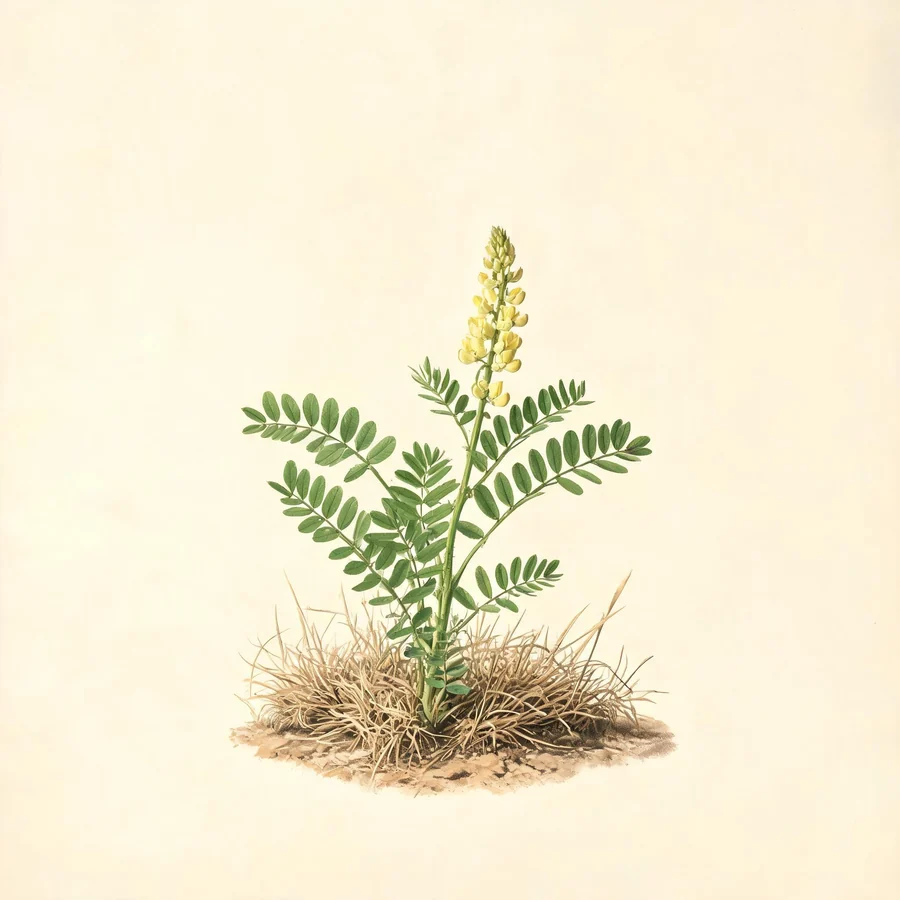
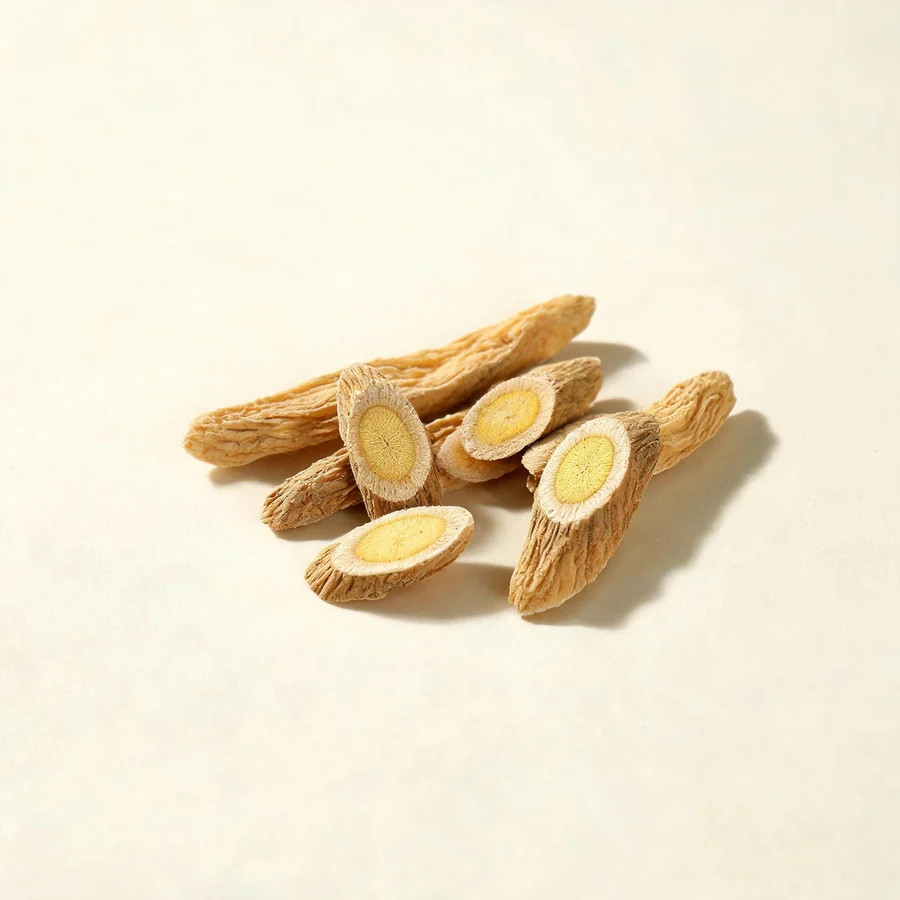
Skin profile
Where this herb sits in skin practice: the pattern it corrects, the skin signs it suits, and what it should not be used for.
Huang Qi is used where the skin cannot finish the job: the sore that will not close, the tissue that stays pale and thin, the surface that is too open. It is a repair and support herb, chosen for the deficient picture and kept out of the acute inflammatory one.
Skin signs that suggest it
- Pale, thin, dry skin that heals slowly or breaks down easily (Qi and Blood deficiency)
- Chronic erosions or ulcers with a pale base, little pus and a thin watery discharge that will not close
- An abscess or boil that refuses to point, or a wound that stalls once the inflammation has settled
- Skin that is clammy or sweaty without effort, in a person who is tired and catches colds easily
- A pale, swollen tongue with a thin white coating, and a weak pulse
When it is not the right herb
Not for a hot, red, spreading lesion, a boil that is actively discharging pus, or the first days of a feverish illness, where a sweet warming tonic can trap the pathogen and drive the Heat deeper. It is also not for Yin deficiency with active fire, where night sweats, flushing and a dry mouth are made worse.
What it does for skin
Skin-relevant actions only. Each one describes a mechanism in TCM terms and what it looks like on the skin.
Generates flesh and closes sores
This is the action that earns the root its place in skin practice. Where Qi is too weak to finish the repair, an erosion stays shallow and wet, an ulcer keeps a pale base, or a wound stalls after the acute phase has passed. Huang Qi is given to supply the Qi that builds tissue, usually with Dang Gui and with herbs that clear any remaining toxin, and the classical image is a sore that refuses to point or to close.
Tonifies Qi and strengthens the Spleen
Skin that is pale, thin and slow to repair is often the visible edge of a deeper depletion, with fatigue, a poor appetite and loose stools behind it. By strengthening the Spleen the root supports the production of Qi and Blood, which is the material the skin needs to rebuild, and it does so gently enough to be used over weeks rather than days in a depleted person.
Consolidates the exterior and stops sweating
When the defensive Qi is weak the surface is described as porous, and the person sweats without effort and catches every cold that passes. Huang Qi firms that layer from the inside, which matters in skin practice because a leaky surface and a tendency to flare go together in atopic and urticarial patterns. It leads the formulas for that picture, with Bai Zhu and Fang Feng.
Moves water and reduces swelling
Oedema in someone who is depleted is read as water that has pooled because the Qi needed to move it is weak, and the root promotes urination gently while strengthening the Spleen's transport. On the skin this shows as puffy, pale, boggy tissue around a chronic lesion or in dependent areas, and it is one reason the herb appears in formulas for chronic leg ulcers with swelling.
Skin conditions it is used for
Mapped to the condition pages on this site. The pattern column shows what the skin is doing when this herb is the right choice.
| Condition | Pattern | Why it suits | Typical setting |
|---|---|---|---|
| Atopic dermatitis | Chronic dry lichenified eczema on a background of Qi and Blood deficiency | Long-standing atopic dermatitis in a depleted person shows dry, thickened, pale or dull skin that flares with fatigue and never quite settles. Huang Qi is used in the quiet phase rather than the acute weeping one, to support repair and reduce the frequency of flares, usually with Blood-nourishing herbs. In an acute red flare the clearing herbs lead and the root is a support, not the main agent. | Modified Dang Gui Yin Zi, or Yu Ping Feng San for the flare-prone, sweaty type |
| Chronic urticaria | Wei Qi deficiency with a leaky exterior and recurrent wheals | Wheals that return for months in a tired, sweaty person who catches colds easily are read as defensive Qi failing to hold the surface. Huang Qi firms that layer while Fang Feng disperses the Wind that is already there, which is the logic of the classic two-herb pairing and of Yu Ping Feng San. It is not the herb for an acute hot urticaria with red wheals and a strong pulse. | Yu Ping Feng San with Huang Qi, Bai Zhu and Fang Feng |
| Skin erosion | Chronic non-healing erosion on Qi deficiency, with a pale base and thin discharge | An erosion that persists with a pale, wet base and little pus, in a person who is tired and slow to heal, is the tissue-generation picture. The root is given to build the flesh while other herbs deal with any residual dampness or toxin, and the classical caution is that a freely discharging sore is not the target. A spreading, painful or febrile lesion needs medical assessment first. | Tuo Li Xiao Du San, or a Qi-and-Blood formula with Huang Qi and Dang Gui |
| Skin abscess | Indolent abscess that refuses to point or resolve | The root is specified for the abscess that stalls: little pus, a pale or dusky surface, slow to point and slow to settle, in a depleted person. It supplies the Qi to push the process to a conclusion, which is why it appears in the toxin-resolving formulas for chronic rather than acute suppuration. A hot, spreading, painful abscess with fever needs urgent medical care, not a tonic. | Tuo Li Xiao Du San with Huang Qi and Jin Yin Hua |
| Skin dryness | Dry, pale, poorly nourished skin in a depleted constitution | Skin that is dry, thin and dull rather than inflamed is read as a failure of Qi and Blood to nourish the surface, not as a lack of moisture alone. The root supports the production of Blood from Qi, and it is paired with Dang Gui in the classical five-to-one proportion for exactly this picture. It will not replace emollient care, and it is slow, taking weeks rather than days. | Dang Gui Bu Xue Tang, five parts Huang Qi to one part Dang Gui |
| Senile pruritus | Dry itch in an older person with Qi and Blood deficiency | Itch in older skin that is dry, pale and thin, with fatigue and a poor appetite, is treated by nourishing and supporting rather than by clearing. Huang Qi is a supporting herb in that formula, added to Blood-nourishing and wind-quieting herbs, and emollient care remains the foundation. Unexplained generalised itch in an older person should be assessed, because systemic causes have to be excluded. | Modified Dang Gui Yin Zi with Huang Qi added |
Combinations for skin
Herbs it is paired with when the skin, not an internal organ, is the target.
| Partner | Ratio | Why the pair is used |
|---|---|---|
| Dang Gui | 15 g Huang Qi with 3 g Dang Gui, about five to one | The best known Qi-and-Blood pairing. It is chosen when long depletion has left a person tired and the skin pale, dry and poorly nourished, and the aim is that Blood can be built from restored Qi. It is slow, and it suits chronic skin that is thin and slow to heal rather than an inflamed flare. |
| Bai Zhu | 10 to 15 g each | Both strengthen the Spleen, but in different directions: Huang Qi lifts Qi and secures the surface, while Bai Zhu dries Dampness and moves fluid. Between them they cover both the shortage and the stagnation a weak Spleen leaves behind, which suits pale, puffy, slow-healing skin with a poor appetite and loose stools. |
| Fang Feng | 10 to 15 g Huang Qi with 6 to 10 g Fang Feng | The pairing on which Yu Ping Feng San is built. Huang Qi closes the surface from the inside, while Fang Feng releases Wind at the surface, so the pores can shut without trapping what is already there. It is used for the person who sweats without effort, catches every cold and flares repeatedly, and it is the standard pairing for recurrent urticaria of the deficient type. |
| Sheng Ma | 18 g Huang Qi with 3 to 6 g Sheng Ma, about five to one | A small amount of Sheng Ma acts as a guide that lifts Qi rather than as a tonic in its own right. The root restores Qi where it is made, while Sheng Ma steers the formula upward, and that is how the lifting formulas work. Its skin relevance is narrow: chronic breakdown with a bearing-down sensation, where raising the Qi is part of the repair. |
Formulas where it leads
- Yu Ping Feng San (玉屏风散) - The formula for a weak defensive layer: Huang Qi with Bai Zhu and Fang Feng. It is used for the person who sweats without effort, catches every cold and flares repeatedly, and it is the standard context for the root in recurrent urticaria and atopic skin of the deficient type.
- Dang Gui Bu Xue Tang (当归补血汤) - Two herbs only, with Huang Qi at five times the dose of Dang Gui, on the principle that Blood is built from Qi. In skin practice it is used for pale, dry, poorly nourished skin and slow-healing tissue in a depleted person, where the aim is nourishment rather than clearing.
- Bu Zhong Yi Qi Tang (补中益气汤) - The great lifting formula, built on Huang Qi with Ren Shen, Bai Zhu, Dang Gui, Chen Pi, Chai Hu and Sheng Ma. Its skin relevance is narrow but real: chronic breakdown with a bearing-down sensation and fatigue, where the aim is to raise Qi that has sunk rather than to treat the lesion directly.
Safety for skin use
What to check before recommending or using it, including the cautions that matter most for skin patients.
Do not use, or use with caution
- Yin deficiency with active fire: night sweats, a dry mouth, flushing and a red tongue without coating. A warming, ascending root can make these worse, and a high dose is the usual trigger for the dry mouth and disturbed sleep that follow.
- A cold or flu that is still in its first days, or a damp-heat picture with a greasy coat and a heavy feeling. To supplement before the pathogen has cleared is to shut the door on the intruder, and a sweet tonic can leave turbidity even harder to clear.
- An open sore that is draining freely. The tissue-generating action is for a sore that refuses to point or to close; an infection that is already discharging is not its target, and spreading redness with fever calls for medical care rather than a tonic.
- Autoimmune disease or immunosuppressive treatment. The root stimulates immune activity, so its use alongside antirejection drugs needs to be discussed with the treating team.
- A stuck Liver with distension and irritability. The lifting action can aggravate it unless the stagnation has been dealt with first.
Pregnancy and breastfeeding
Considered acceptable in food-like doses, with higher doses used only under supervision. Animal studies hint that the foetus could be affected, and human data are lacking. The ascending action is theoretically unsettling, yet the root still appears in old formulas for a threatened miscarriage in a depleted woman, so the traditional position is cautious use with supervision rather than prohibition. Self-dosing is discouraged. During breastfeeding, standard doses are used as a supportive tonic in traditional practice, but the data are insufficient, and the warming nature may not suit an infant showing heat signs.
Interactions
- Immunosuppressants such as tacrolimus. One case in the literature describes tacrolimus levels nearly halving while a formula containing the root was being taken, which is important for transplant patients; corticosteroids and similar drugs are treated with the same caution.
- Blood thinners such as warfarin and aspirin, and other antiplatelet medicines. In the laboratory the root shows anticoagulant activity of its own, so the pairing is watched rather than banned, and any unexplained bruising should be reported.
- Blood pressure medicines and diuretics. Extracts have lowered blood pressure in studies and raised sodium excretion in one small trial, so an additive effect is possible; checking readings at home and keeping hydrated are the practical safeguards.
- Diabetes medicines, including insulin, metformin and sulphonylureas. Blood sugar lowering has been reported, so monitoring covers the risk, and it may be the drug dose that needs adjusting rather than the root being stopped suddenly.
- Chemotherapy agents moved by P-glycoprotein, such as doxorubicin, etoposide and vincristine. In laboratory work the root's polysaccharides block that pump, so levels of these drugs inside cells could in theory rise. How much that matters clinically is unknown, and the treating oncology team should be told what is being taken.
Allergy and patch testing
Allergy is uncommon, and the root is a food-grade herb in common use. Reactions that have been described are usually mild skin or gut upset, and a first course is still best started at a modest dose. Stop and seek advice if a rash, wheezing or swelling develops, since any herb can cause an unexpected reaction.
General safety references
General references for herbal hepatotoxicity and herb-drug interactions; they are not specific to this herb.
- Review article: Herbal hepatotoxicity - an update on traditional Chinese medicine preparations. Alimentary Pharmacology & Therapeutics, 2014. PMID: 24844799.
- Interactions between herbal medicines and prescribed drugs: an updated systematic review. Drugs, 2009. PMID: 19719333.
- Warfarin and food, herbal or dietary supplement interactions: a systematic review. British Journal of Clinical Pharmacology, 2021. PMID: 32478963.
Evidence
The classical record is quoted with its source. The modern note states the level of evidence plainly.
Classical record
It governs abscesses and chronic sores, drains the water pathways, and supplements the body where it is empty and deficient.
Shen Nong Ben Cao Jing (Divine Husbandman's Classic of Materia Medica) - The oldest entry already describes both clinical faces of the root: the surface and the interior, and the sore and the depletion behind it.
甘,微温,无毒。补诸虚不足,益元气,壮脾胃。
Sweet, slightly warm and non-toxic. It makes good every kind of emptiness and insufficiency, benefits the original Qi, and strengthens the Spleen and Stomach.
Ben Cao Gang Mu (Compendium of Materia Medica), Li Shizhen - Li Shizhen's summary became the standard description later: a broad restorative for deficiency, not a remedy aimed at one organ.
黄芪,补肺健脾,实卫敛汗,驱风运毒之药也。
Huang Qi supplements the Lung and strengthens the Spleen; it firms the defensive Qi and restrains sweating, and it is a medicine that drives out wind and moves toxin.
Ben Cao Hui Yan (Collected Discourses on Materia Medica) - It states plainly the surface action the older text only hints at: the root closes the pores and also drives out what should not stay.
Modern evidence
Evidence status
- Laboratory and animal studies of Astragalus polysaccharides and saponins report immunomodulatory, anti-inflammatory and wound-healing activity, including effects on fibroblast and collagen behaviour. These are principally preclinical findings and not evidence of clinical benefit.
- Clinical trial evidence for Huang Qi in skin disease is limited and usually comes from multi-herb formula studies rather than from trials of the single root. No firm conclusion about efficacy in chronic wounds, eczema or urticaria can be drawn from the published literature.
- The root is recorded as non-toxic and appears on the list of substances that may be used as food as well as medicine, which is the basis for its wide dose range; the cautions in practice concern its warming and consolidating nature in heat patterns rather than toxicity.
PubMed records
Selected real PubMed records for this herb's species or its constituents, chosen by species name and title relevance. They are references for the non-TCM discussion above, not proof that the herb treats any skin condition.
- Astragali Radix and its compound formononetin ameliorate diesel particulate matter-induced skin barrier disruption by regulation of keratinocyte proliferation and apoptosis.. Journal of ethnopharmacology, 2019. PMID: 30243826 (skin-related record).
Dose and forms
Skin-practice dosing and the preparations that suit skin complaints.
| Form | Dose and notes |
|---|---|
| Decoction (internal) | 9 to 30 g of dried root daily, the top of the range being for chronic depletion, not an acute illness. It is nearly always given in a formula, and the raw or honey-fried form is chosen according to the purpose. |
| Honey-fried form | Zhi Huang Qi, the honey-fried root, is preferred where Spleen and Lung are deficient and the person is tired with little appetite, and it appears in the lifting formulas. Frying reduces the surface-securing and water-moving actions somewhat, so the raw root is kept for those. |
| High-dose use | Doses of 60 g and above are described in the classical literature for severe collapse and chronic non-healing sores, and they belong under close supervision rather than to self-treatment. |
| Course length | Weeks rather than days for chronic skin breakdown, with review. Stop or reduce if the mouth becomes dry, sleep breaks up or irritability appears, since those are the signs of the warming nature biting in a Yin-deficient person. |
The range is wide because the root is a food-grade herb with no specific toxin identified. Old practice sorts the range by what is wanted, not by body weight: a small dose closes the surface, a moderate one tonifies and lifts, and a large one builds Blood or closes a long-standing sore. In a Yin-deficient person a high dose may leave the mouth dry, the temper short and sleep broken, which is a signal to reduce rather than to add another herb.
Citations and further reading
Only real sources are listed: the classical materia medica passages quoted above, and the source works behind the botanical and safety statements.
- Shen Nong Ben Cao Jing (Divine Husbandman's Classic of Materia Medica), attributed compilation of the Han period - classical entry quoted above.
- Ben Cao Gang Mu (Compendium of Materia Medica), Li Shizhen, Ming dynasty - classical entry quoted above.
- Ben Cao Hui Yan (Collected Discourses on Materia Medica) - classical entry quoted above.
- Huang Qi monograph: Pharmacopoeia of the People's Republic of China - source for the accepted botanical source, part used and quality requirements.
- Modern evidence statement: based on laboratory literature on Astragalus polysaccharides and saponins, summarised as a statement about the level of evidence rather than as a cited finding. No clinical trial is presented as proof of effect.
- Botanical description and identification: botanical literature on Astragalus membranaceus, Fabaceae.
Educational reference for qualified practitioners. This page is not medical advice, and skin conditions should be diagnosed by a clinician before treatment.