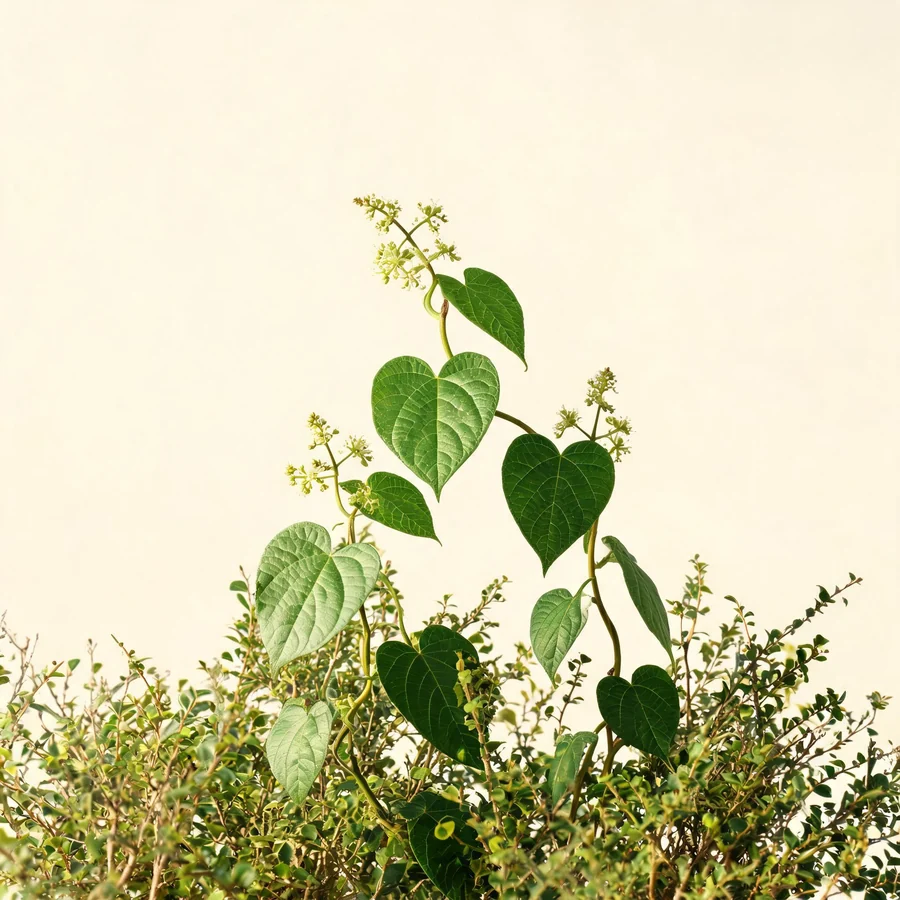
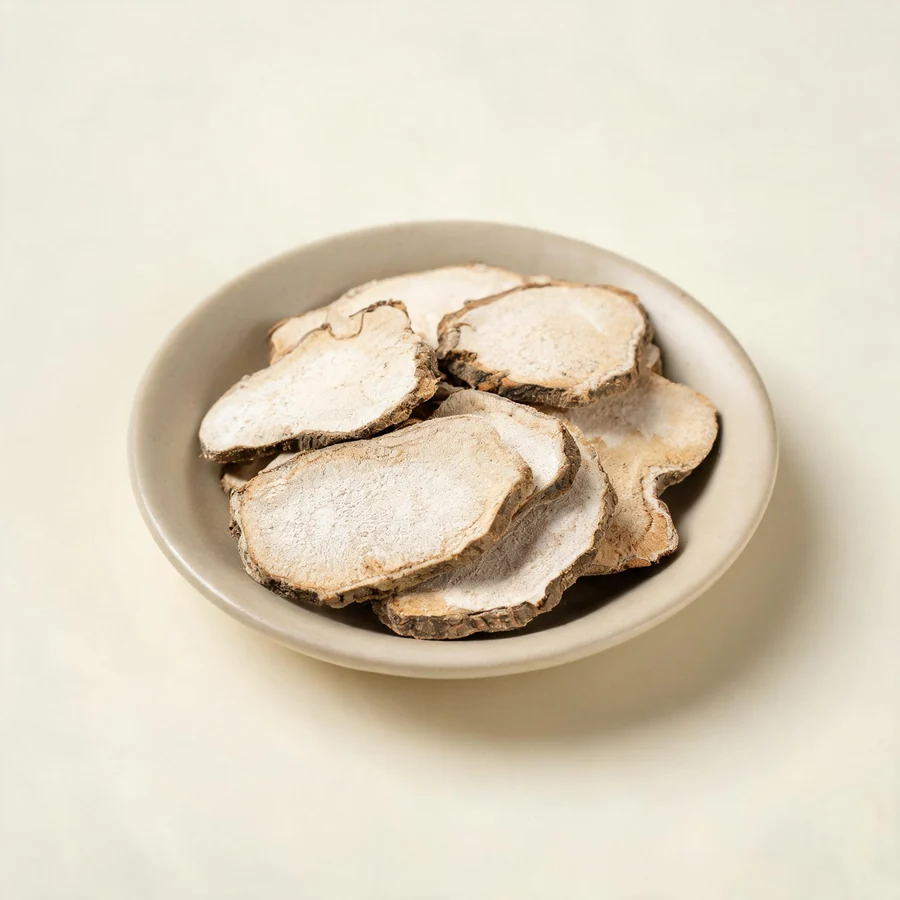
Skin profile
Where this herb sits in skin practice: the pattern it corrects, the skin signs it suits, and what it should not be used for.
Bi Xie is chosen when dampness has settled and stays: legs that weep, folds that stay wet, a rash that returns with the weather. It drains without much cooling, so it is the herb for a chronic damp picture that would be made worse by a colder, sharper drainer.
Skin signs that suggest it
- Weeping, oozing eczema on the lower legs, with a sticky or watery discharge and puffy surrounding skin
- A chronic ulcer or eroded patch on the leg that discharges and will not dry
- A recurring fungal rash of the feet or groin, with maceration, itch and a musty smell
- Damp skin disease that returns whenever the weather is humid or the digestion is poor
- A greasy tongue coating, a heavy feeling in the body and cloudy urine alongside the skin problem
When it is not the right herb
Not for dry skin with no dampness, and not where the skin is thin, red and dry from Yin deficiency with empty heat: a drying, draining root makes that picture worse. It is used cautiously where the Spleen is deficient with loose stools, and it is wrong where the problem is leakage from deficiency rather than obstruction, such as incontinence or dribbling urine in a depleted person. A weeping leg that is hot, spreading and febrile needs medical assessment, because infection and a contact reaction can look like a damp flare.
What it does for skin
Skin-relevant actions only. Each one describes a mechanism in TCM terms and what it looks like on the skin.
Drains Dampness downward
Bitter and descending, the rhizome's first effect is to carry excess moisture out of the lower half of the body. On skin that means the places where dampness gathers: shins, ankles, groin and the spaces between the toes. Discharge lessens as the tissue dries, which is why a chronic case takes weeks rather than days; the moisture feeding the lesion is being removed, not just the lesion itself.
Separates clear fluid from turbid
The action the name encodes. Water metabolism is a sorting task: what the body can use is retained, what it has spent leaves as urine. When sorting fails the fluid turns turbid, and cloudy urine, a sticky discharge and a weeping skin are read as one failure showing on different surfaces. Restoring the sorting dries the skin by opening a proper outlet.
Dries weeping and macerated skin
Where skin stays wet it softens, splits and becomes vulnerable to infection, and the folds and the lower leg are the places where this happens most. The root reduces the moisture without the sharp cold of Huang Bai, so it can be used on skin that is damp but not hot, and on an older person whose legs weep but whose circulation is poor. It is stopped when the surface is dry, or the skin becomes tight and cracked.
Clears damp-heat below when paired with a cooler
The root is neutral, so on its own it does not clear Heat. Where the lesion is red, hot and angry, it is combined with a bitter cold herb such as Huang Bai, and the pair gives both the draining and the cooling. That is the ordinary structure of a formula for weeping eczema of the leg, and it is why the neutral temperature is an advantage rather than a limitation.
Skin conditions it is used for
Mapped to the condition pages on this site. The pattern column shows what the skin is doing when this herb is the right choice.
| Condition | Pattern | Why it suits | Typical setting |
|---|---|---|---|
| Eczema | Damp-heat pouring downward, with weeping lower-limb eczema | Eczema that oozes and settles on the shins is what this root was chosen for: the fluid is dampness made visible, and its direction is downward, which matches the herb's. It lowers the moisture feeding the lesion without the chill of a cold drainer, so treatment can continue while the skin settles. Infection and contact dermatitis look similar, so heat or spread calls for examination. | Bi Xie Shen Shi Tang, or the root with Huang Bai and Yi Yi Ren |
| Foot and lower leg rashes and fungal infections | Dampness sinking to the lowest part, with rashes and fungal infection | The lower legs and feet are where dampness collects by gravity as well as by pattern, and the tradition reads a rash there as dampness that has sunk to the lowest point. The root drains that moisture and dries the macerated skin between the toes, and it is used internally with a topical antifungal rather than instead of one. Spreading redness with fever, or an open sore, is a medical matter. | Bi Xie Shen Shi Tang, with a conventional antifungal for the feet |
| Jock itch | Dampness pooling in the groin, warm and occluded | The groin is warm, occluded and damp, so the moisture that the root drains tends to collect there. It is used where the rash is damp and recurring rather than acutely hot, and it is combined with a cooling herb when the skin is red and burning. The practical measures matter as much as the herb: dry the area properly, avoid tight synthetic clothing, and treat the feet at the same time because the same fungus is often in both places. | A modified Bi Xie Shen Shi Tang with Huang Bai and Ku Shen |
| Vulval eczema | Lower burner dampness with discharge and itch | Vulval eczema with a discharge is read through the Liver channel, with dampness collecting in the lower burner, and the root's sorting action addresses the discharge as well as the skin. It is used where the discharge is thin and the itch is damp rather than dry, and it is combined with a cooling herb if the skin is red and inflamed. Persistent vulval itch, bleeding or a change in the skin needs examination rather than a longer course. | Bi Xie with Huang Bai and Yi Zhi Ren in a modified formula |
| Tinea | Dampness, Heat and Wind lodging in the skin and recurring | Ringworm is described as dampness, heat and wind lodging in the skin, and it only takes hold where the inside is already damp. The root drains the moisture that the fungus colonises, which is why it is used in formulas for recurrent tinea rather than for an acute single patch. A confirmed fungal infection needs an antifungal as well, and the feet, groin and nails should be considered together. | Bi Xie Shen Shi Tang, with a conventional antifungal where indicated |
Combinations for skin
Herbs it is paired with when the skin, not an internal organ, is the target.
| Partner | Ratio | Why the pair is used |
|---|---|---|
| Huang Bai | 9 to 15 g Bi Xie with 6 to 10 g Huang Bai | A bitter cold bark drains damp-heat from the lower body powerfully, while the neutral rhizome does the draining and restores the sorting of clear from turbid. That is the usual shape of a formula when skin is hot as well as damp: the bark cools the angry red area, the root removes the wetness beneath it. Weeping eczema, leg ulcers and fungal rashes with yellow discharge are its indications. |
| Yi Yi Ren | 15 to 30 g Yi Yi Ren with 9 to 15 g Bi Xie | Coix seed drains dampness, supports the Spleen and expels pus, which makes it the more versatile dampness herb; the rhizome alone can restore the sorting of clear from turbid. The pair suits a chronic weeping eruption on a background of weak digestion, where draining by itself would leave the patient tired and the Spleen colder. |
| Yi Zhi Ren | 9 to 12 g each | One drains turbidity while the other warms Kidney Yang and secures essence, so the pair drains without depleting. Classically it belongs to cloudy urine on a cold Kidney background; in skin work it is used where a chronic weeping eruption sits on a cold, depleted constitution. This is a practitioner combination rather than a domestic one. |
Formulas where it leads
- Bi Xie Shen Shi Tang (萆薢渗湿汤) - The classical skin formula for damp-heat pouring downward, and the context in which the root is most often taught. The root leads, with Yi Yi Ren, Huang Bai and the other drainers clearing the damp-heat that feeds a weeping eruption on the lower body. It is a formula for a chronic or subacute picture, given for weeks with review rather than for a single acute flare.
Safety for skin use
What to check before recommending or using it, including the cautions that matter most for skin patients.
Do not use, or use with caution
- Empty heat from Kidney Yin deficiency. Where no genuine dampness exists below and the urinary dribbling or the skin dryness comes from deficiency with flaring fire, a drying drainer aggravates the problem.
- Weak Spleen with loose stool. Draining can loosen an already loose bowel further, and the distinction that matters is between Dampness needing an outlet and deficiency needing to be held.
- Leakage caused by deficiency rather than obstruction. Incontinence, dribbling urine or a discharge that stems from the Kidney's failure to secure is worsened by draining, and the old texts are blunt that the wrong prescription here makes the illness distinctly worse.
- A hot, spreading, febrile skin infection. The root is neutral and slow, and it has no place as the treatment for a rapidly spreading lesion, which needs medical assessment.
Pregnancy and breastfeeding
Standard doses under guidance. The issue is fluid rather than the womb: draining Dampness also removes volume, and pregnancy is a period when fluid balance is delicate. Nothing in the classical record forbids it and no uterine action has been documented, so it is not prohibited, but it is given only where the damp picture genuinely needs treating, briefly, within the usual range, with normal antenatal care in place. Breastfeeding mothers are usually advised to reserve it for a clear indication and to check whether feeding or stool alters.
Interactions
- Urate-lowering drugs. The saponins have been reported to increase uric acid excretion, so allopurinol, febuxostat or probenecid might, in theory, push urate lower than intended; anyone on one of them should have the level monitored rather than assuming the two act independently.
- Diuretics. Because the rhizome increases urine flow, adding it to a diuretic may step up fluid and electrolyte loss, a particular concern in older people and in heart failure. This is watched rather than prohibited.
- Antidiabetic medicines. Related yam saponins have altered blood glucose in animal studies, so people on insulin or a sulphonylurea should check their readings when beginning a course.
- Tea. The classical texts advise against tea while taking the herb, on the reasoning that tannins bind it; the practical version is to leave an hour or two between the decoction and strong tea.
Allergy and patch testing
Reactions to the dried rhizome are uncommon, but a herb taken for a damp eruption can be blamed for a flare that is really the condition changing. If the skin becomes hotter, redder or more itchy after starting, stop and reassess rather than increasing the dose. Check the identity of the material as well, because other Dioscorea and Smilax rhizomes are sold under the same name and a substitute is a plausible cause of an unexpected reaction.
General safety references
General references for herbal hepatotoxicity and herb-drug interactions; they are not specific to this herb.
- Review article: Herbal hepatotoxicity - an update on traditional Chinese medicine preparations. Alimentary Pharmacology & Therapeutics, 2014. PMID: 24844799.
- Interactions between herbal medicines and prescribed drugs: an updated systematic review. Drugs, 2009. PMID: 19719333.
- Warfarin and food, herbal or dietary supplement interactions: a systematic review. British Journal of Clinical Pharmacology, 2021. PMID: 32478963.
Evidence
The classical record is quoted with its source. The modern note states the level of evidence plainly.
Classical record
萆薢,味苦,平。主腰背痛强,骨节风寒湿周痹,恶疮不瘳,热气。
Bitter in taste, level in nature. Its chief indications are stiffness and pain of the lower back, painful obstruction of the joints and bones from wind, cold and damp running through the body, foul sores that will not heal, and heat.
Shen Nong Ben Cao Jing (Divine Husbandman's Classic of Materia Medica) - The oldest record names both halves at once: the joints and the foul sores that will not heal, which is the classical warrant for the skin use.
萆薢之功,长于袪风湿,所以能治缓弱顽痹、遗浊、恶疮诸病之属风湿者。
Li Shizhen puts its strength in driving out wind and dampness. That is why it can be used for flaccid weakness, for stubborn painful obstruction, for turbid discharge and for obdurate sores, all of them conditions that belong to wind and dampness.
Ben Cao Gang Mu (Compendium of Materia Medica), Li Shizhen - Li Shizhen supplies a single organising idea - wind and dampness - and every later description follows it, with a long trail of consequences that includes the sore that will not heal.
Modern evidence
Evidence status
- Laboratory work on the steroidal saponins, dioscin and diosgenin among them, reports anti-inflammatory, antifungal and urate-lowering activity in animal and cell studies. These are the findings most often cited for the skin use, and they remain preclinical.
- No adequate clinical trial of the single herb in eczema, tinea or a weeping leg ulcer was identified for this edition. Published clinical work on the damp-heat skin formula is about the compound, so the root's own contribution cannot be separated.
- Identity is the practical issue. Several Dioscorea species and some Smilax rhizomes are sold under the same name, the powdery and cottony commercial types are different articles, and the pharmacopoeia names specific sources; a clinician buying by name alone may not get the same material twice.
PubMed records
Selected real PubMed records for this herb's species or its constituents, chosen by species name and title relevance. They are references for the non-TCM discussion above, not proof that the herb treats any skin condition.
- Research Progress on the Biological Activities and Clinical Applications of Pseudoprotodioscin.. Current issues in molecular biology, 2025. PMID: 41296431 (pharmacology or review record).
- Chemical Comparison and Identification of Xanthine Oxidase Inhibitors of Dioscoreae Hypoglaucae Rhizoma and Dioscoreae Spongiosae Rhizoma by Chemometric Analysis and Spectrum-Effect Relationship.. Molecules (Basel, Switzerland), 2023. PMID: 38138603 (pharmacology or review record).
Dose and forms
Skin-practice dosing and the preparations that suit skin complaints.
| Form | Dose and notes |
|---|---|
| Decoction | 9 to 15 g of dried rhizome a day. Nine or ten grams fits a supporting role or mild dampness; 12 to 15 g fits the rhizome as the main drainer in a weeping lower-leg eruption. |
| Higher supervised doses | Up to 30 g is on record for severe dampness, and some contemporary practitioners go that far. Such figures belong to supervised care and are not a domestic ceiling. |
| Course length | Weeks rather than days for chronic dampness, reviewed as it goes, because this is a draining herb and not a building one. Stop if the skin turns dry and tight or the stool loosens. |
| Prepared forms | Salt frying aims it at the Kidney for urinary purposes, dry frying reinforces its work on the Stomach and on Dampness, and wine frying suits wind-dampness. For most skin use the raw rhizome is the article. |
Quantity tracks the amount of dampness to be moved rather than any toxic threshold, the herb being non-toxic. The danger lies in what the action does: removing Dampness removes fluid too, so a thin, dry person with deficiency heat is wrong for it at any dose. Whether the batch is the powdery or the cottony commercial type is a genuine trade distinction and belongs on a prescription.
Citations and further reading
Only real sources are listed: the classical materia medica passages quoted above, and the source works behind the botanical and safety statements.
- Shen Nong Ben Cao Jing (Divine Husbandman's Classic of Materia Medica), attributed compilation of the Han period - entry quoted above.
- Ben Cao Gang Mu (Compendium of Materia Medica), Li Shizhen, 1578 - passage quoted above.
- Yao Xing Lun (On the Nature of Medicines), Tang dynasty - the passage on cold wind and retained water that connects the joint and urinary uses.
- Pharmacopoeia of the People's Republic of China - Bi Xie monograph: accepted Dioscorea sources, part used and quality requirements.
- Modern evidence statement: based on laboratory literature on Dioscorea steroidal saponins and on pharmacognostic work on the material traded as Bi Xie, summarised as a statement about the level of evidence rather than a cited finding.
- Botanical description and identification: botanical literature on Dioscorea spongiosa and Dioscorea hypoglauca, Dioscoreaceae.
Educational reference for qualified practitioners. This page is not medical advice, and skin conditions should be diagnosed by a clinician before treatment.