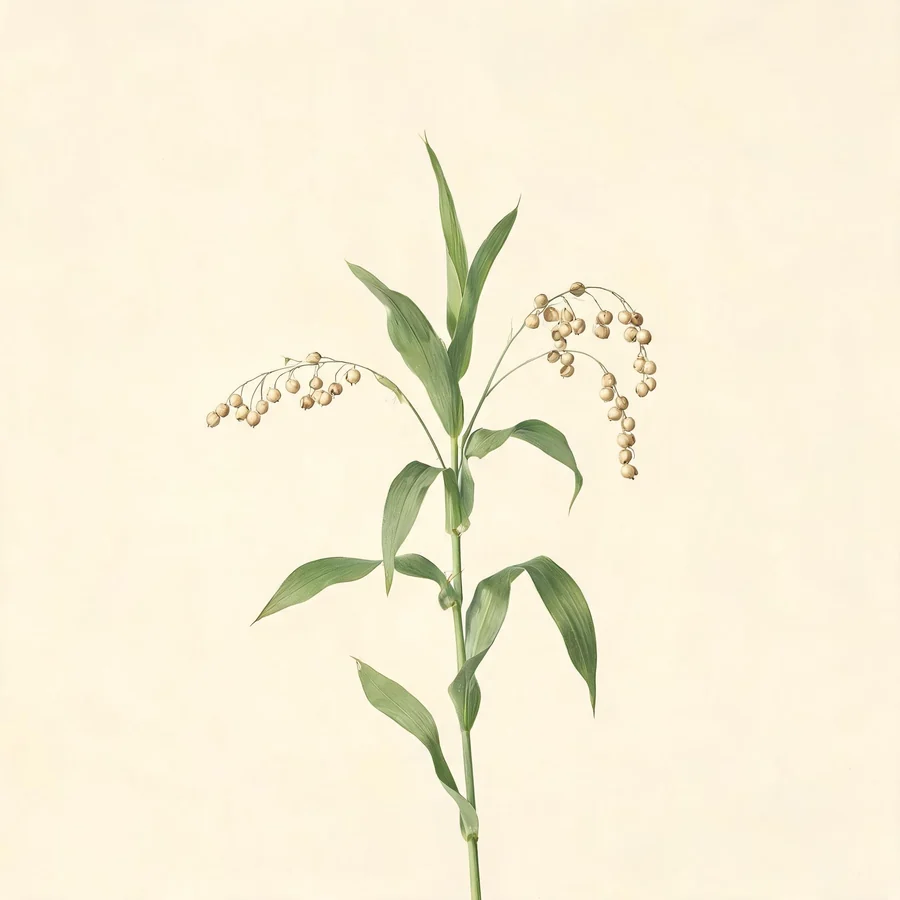
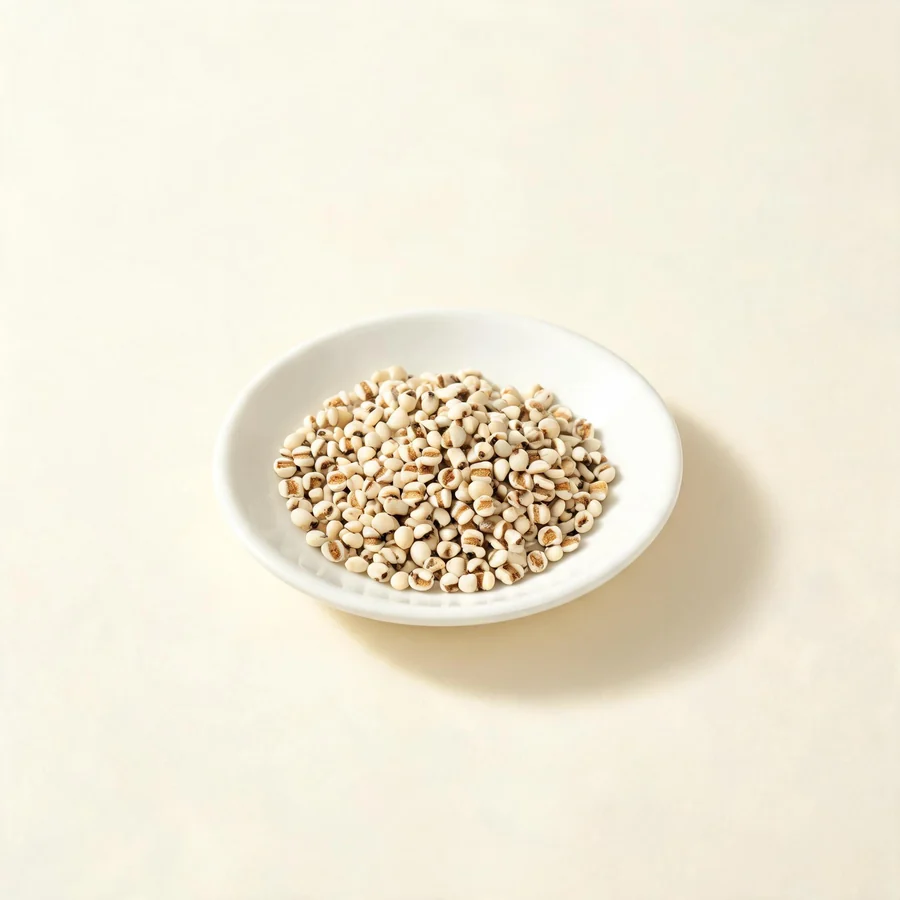
Skin profile
Where this herb sits in skin practice: the pattern it corrects, the skin signs it suits, and what it should not be used for.
Yi Yi Ren suits skin that is wet, puffy and slow: the weeping fold, the macerated groin, the heavy leg with an oozing rash. It is a food-grade herb and a slow one, so it is given in large weights for weeks, and the caution that matters most is the freshness of the grain.
Skin signs that suggest it
- Weeping, macerated patches in the skin folds with a sticky clear or yellowish discharge
- Puffiness of the face, eyelids or legs with a heavy, sluggish feeling and a greasy tongue coating
- Flat warts or small firm skin-coloured papules on the face or hands, with little or no inflammation
- Itch and ooze that worsen in humid weather and ease when the skin is kept dry and warm
- A swollen, pale tongue with a greasy white or yellow coat and a slippery pulse
When it is not the right herb
Not for dry skin. A grain that removes moisture by design makes ichthyosis, dry eczema and finely cracked skin worse. Not for constipation with dry stools, not for a dry mouth with night sweats and a red tongue without coat, and not for frequent clear urination, since all three are losses of fluid that a draining herb adds to. Not in pregnancy in large daily amounts, and never when the grain smells of old oil.
What it does for skin
Skin-relevant actions only. Each one describes a mechanism in TCM terms and what it looks like on the skin.
Drains Dampness so the skin stops weeping
The bland taste gives a gentle seeping action rather than a harsh purge, and on the skin that shows as a reduction in ooze, crusting and the sticky discharge that keeps a fold macerated. It is a slow herb and is given in large weights for that reason, and it works best where the dampness is obvious: puffiness, a heavy body, a greasy coating and a lesion that is wet rather than dry.
Strengthens the Spleen so dampness is not remade
Draining alone leaves the source of the dampness in place, and this grain is unusual in doing both jobs. Its sweetness is held to nourish the Spleen while the seepage clears what has already gathered, which is why it suits a weeping eczema on a background of poor digestion, fatigue and loose stools. The bran-fried form is preferred when the Spleen work matters more than the draining.
Expels pus from a hot lesion
The cool, draining quality is also used where dampness and heat have formed pus in the skin, and it is the reason the grain appears in formulas for abscess and for purulent lesions rather than only in formulas for swelling. It is a supporting herb in that setting, working beneath the toxin-resolving medicines rather than replacing them.
Disperses nodules and dries the dampness feeding a wart
The traditional wart use is the least intuitive and the best recorded: large doses of the grain, taken for several weeks, are given for flat warts on the face and hands. The reasoning is that a wart is a nodule fed by dampness, and that a grain which dries dampness slowly and safely can starve it. It is a slow treatment, and the evidence for it is clinical observation rather than controlled trial.
Skin conditions it is used for
Mapped to the condition pages on this site. The pattern column shows what the skin is doing when this herb is the right choice.
| Condition | Pattern | Why it suits | Typical setting |
|---|---|---|---|
| Flat warts | Dampness and toxin feeding a flat, non-inflamed growth | The grain's reputation for warts rests on large doses taken for weeks, and it is the clearest example of its dispersing and dampness-drying action applied to a nodule. It is used for flat, smooth, skin-coloured warts on the face or hands rather than for deep plantar lesions, and it is given alone or with a Spleen-supporting herb. Because it acts slowly, a course is measured in weeks and the wart is reviewed rather than assumed to be responding. | Large-dose decoction, taken alone or with Bai Zhu to protect the digestion |
| Eczema | Dampness with a weeping, macerated flare | When an eczema flare is wet rather than dry, with ooze, crusting and maceration in the folds, the grain drains the dampness that keeps it wet and supports the Spleen that produced it. It is the mild base of the formula rather than its strongest ingredient, and it is paired with drying and itching herbs for the lesion itself. A dry, lichenified eczema is the wrong picture for it. | Si Miao San, or with Huang Bai and Cang Zhu for a lower-limb damp-heat flare |
| Tinea | Damp-heat in the skin folds with itch and scaling | Ringworm and the itchy, scaly patches of the skin folds are read as damp-heat lodged in the surface, and the herb is a supporting drainer in the formulas used for them. It adds the Spleen-strengthening part as well, which matters because these infections recur in people whose digestion and fluid metabolism are sluggish. It does not replace an antifungal, and a spreading or nail infection needs proper treatment. | With Huang Bai, Cang Zhu and Ku Shen in a damp-heat formula |
| Skin abscess | Dampness and heat forming pus in the skin | In a damp-heat abscess the grain works beneath the toxin-clearing herbs, draining the dampness that carries the pus and helping the collection to empty. It is a supporting medicine, included for its pus-expelling and dampness-draining qualities rather than for any strong antimicrobial action. A large or deep abscess needs drainage, and the formula is an adjunct to that. | With Bai Jiang Cao and Jin Yin Hua in a pus-expelling formula |
| Damp itchy skin | Itch driven by dampness, with ooze rather than dryness | Itch that comes with moisture, a heavy feeling and a greasy coating is dampness itch, and the grain addresses the cause rather than the sensation. It is used where the skin is wet and puffy and the person feels sluggish, and it is combined with the drying and itch-quieting herbs that act on the surface. Itch from dry, thin, cold skin is the opposite picture and is made worse by draining. | With Fu Ling and Bai Zhu, or in Si Miao San for a lower-body itch |
Combinations for skin
Herbs it is paired with when the skin, not an internal organ, is the target.
| Partner | Ratio | Why the pair is used |
|---|---|---|
| Fu Ling | 15 to 30 g each | Two sweet, bland herbs that both move dampness out through the urine. The pair is used where fluid is obviously in excess: swollen ankles, loose stools, a weeping lesion, a white vaginal discharge. Poria is the neutral, stronger diuretic; the grain brings joint relief and a pus-expelling action Poria lacks. Both go in at the top of the usual range. |
| Bai Zhu | 10 to 15 g each | This is a Spleen pair for loose stools, puffiness and a weeping skin lesion. Atractylodes is warm and bitter and builds the Spleen so that dampness stops forming; the grain removes what has already collected. Equal weights are usual, and the two sit at the centre of the classical Spleen formulas that use this grain. |
| Cang Zhu | Two parts Yi Yi Ren to one part Cang Zhu | Warm and aromatic, atractylodes dries dampness forcefully; the grain is cool and bland, seeping it out instead. The two temperatures balance each other, and the combination suits damp painful obstruction and damp-heat skin in the lower body, especially where the coating is thick and greasy. The draining herb takes the lead and the drying one supports it, which is why the grain takes the larger share. |
| Huang Bai | 15 to 30 g Yi Yi Ren with 6 to 10 g Huang Bai | Huang Bai is the bitter cold herb for damp-heat below the waist, and the grain gives it a route out through the urine while shielding the digestion from the bitterness. The pair suits eczema of the legs and feet, intertrigo in the groin and a weeping rash with a yellow greasy coating. Huang Bai is drying, so the grain's mildness keeps the formula from over-drying the skin. |
Formulas where it leads
- Si Miao San (四妙散) - A four-herb formula for damp-heat in the lower body, in which the grain works beside Huang Bai, Cang Zhu and Niu Xi. It is used for red, weeping, itchy skin on the legs and feet, for the macerated groin fold and for a heavy aching lower limb with heat in it, and the grain supplies the draining and Spleen-supporting part of the action.
- San Ren Tang (三仁汤) - A formula for damp-heat with a heavy head, a stifling chest and a greasy coating, in which the grain is one of the three seeds that open the dampness in three regions of the body. Its skin relevance is the dampness that produces a dull, puffy, slightly oozing complexion rather than a single named eruption.
Safety for skin use
What to check before recommending or using it, including the cautions that matter most for skin patients.
Do not use, or use with caution
- Constipation with dry stools. Removing moisture is what this grain does, so a bowel that is already dry will produce harder stool. Of all the cautions this is the plainest, and the one most often broken, because the grain is treated as food rather than as medicine.
- Where Yin is deficient and dryness is marked, with night sweats, a dry mouth and a red, bare tongue, moisture is already short, so a draining grain pulls against the direction treatment needs. Dry skin without ooze belongs in the same group.
- Pregnancy, in large or prolonged amounts. The classical texts list it as a caution because of a slippery, descending nature, and animal work with the oil has excited uterine muscle. A soup-sized serving is not the same as a prescribed decoction, yet a large bowl taken daily is still best left out.
- Rancid grain, or grain of unknown storage. This is an oily, starchy seed, and aflatoxin is the hazard, so the pharmacopoeia requires testing, and material that smells of stale oil belongs in the bin rather than in a decoction or a congee.
Pregnancy and breastfeeding
The classical lists advise caution, citing a slippery, descending nature that is held to disturb pregnancy, and animal work with the oil has excited uterine muscle. A soup-sized serving is not the same as a prescribed decoction, but the herb is not given as a treatment in pregnancy, and a large daily bowl is best avoided. During breastfeeding it is widely eaten across East Asia and treated as compatible at food amounts, with coolness the only practical caution.
Interactions
- Blood sugar medicines are the main theoretical interaction. Because the seed's polysaccharides and the expressed oil have lowered glucose in animals, insulin, metformin and the sulphonylureas could in principle add to that effect when the grain is eaten daily in quantity. Anyone with diabetes should check their readings more often once the grain becomes a regular food.
- Anticoagulants have no recorded interaction in patients. Because the oil is high in unsaturated fat and has shown small lipid effects in laboratory work, warfarin and similar drugs remain a theoretical worry at food doses rather than a practical one, and nothing beyond routine review is needed.
- Immunosuppressants are a theoretical concern, because laboratory work suggests the grain can shift immune cell activity in the direction opposite to medicines used after transplant or for autoimmune disease. How large that effect is in people is unknown, and it is worth mentioning to the prescriber rather than acting on.
Allergy and patch testing
Allergy to the grain itself is uncommon and no cross-reaction pattern is well documented, but this is a stored cereal and dust from mouldy grain can provoke respiratory symptoms in sensitive people. Buy clean, tested stock, keep it sealed and cool, and discard anything musty. A rash, wheeze or swelling after eating the grain is a reason to stop and have it assessed.
General safety references
General references for herbal hepatotoxicity and herb-drug interactions; they are not specific to this herb.
- Review article: Herbal hepatotoxicity - an update on traditional Chinese medicine preparations. Alimentary Pharmacology & Therapeutics, 2014. PMID: 24844799.
- Interactions between herbal medicines and prescribed drugs: an updated systematic review. Drugs, 2009. PMID: 19719333.
- Warfarin and food, herbal or dietary supplement interactions: a systematic review. British Journal of Clinical Pharmacology, 2021. PMID: 32478963.
Evidence
The classical record is quoted with its source. The modern note states the level of evidence plainly.
Classical record
It governs wind-damp painful obstruction and strengthens the Spleen and Stomach.
Shen Nong Ben Cao Jing (Divine Husbandman's Classic of Materia Medica) - The joint and digestive uses are both ancient, and the skin use grows out of the same draining action rather than being a later addition.
It is sweet and bland, slightly cool, and its nature descends and seeps, so it removes dampness and promotes urination. Its power is very gentle, and when it serves as an assistant the dose should be doubled.
Ben Cao Zheng (Corrected Materia Medica) - Where the practical rule comes from: this grain is weighed in unusually large amounts, which is why it looks extravagant beside a root.
It removes dampness without the dryness of the two Atractylodes, clears heat without the injury to Yin that Huang Qin and Huang Lian can cause, and benefits Qi without adding damp-heat as ginseng and Atractylodes may. It is truly a key medicine for the middle Qi.
Ben Cao Shu (On Materia Medica) - A Qing-era defence of the grain as the mildest of the dampness herbs, and the reason it can be eaten daily for weeks rather than days.
Modern evidence
Evidence status
- Laboratory work on the seed's polysaccharides and on coixenolide reports anti-inflammatory activity and effects on immune measures in cell and animal models. These are not trials in people and do not establish a benefit in eczema, warts or any other skin condition.
- A purified oil extract of the seed exists as an injected pharmaceutical used as an adjunct in cancer treatment in China. That product's existence tells us nothing about eating the grain, and the wart and eczema uses described here rest on traditional and clinical observation rather than on controlled trials.
- The safety literature is dominated by the material rather than the herb: aflatoxin is the hazard, the pharmacopoeia demands testing, and rancid grain has to be thrown away. That is a storage and sourcing rule rather than a dose rule.
PubMed records
Selected real PubMed records for this herb's species or its constituents, chosen by species name and title relevance. They are references for the non-TCM discussion above, not proof that the herb treats any skin condition.
- Coicis Semen for the treatment of malignant tumors of the female reproductive system: A review of traditional Chinese medicinal uses, phytochemistry, pharmacokinetics, and pharmacodynamics.. Frontiers in pharmacology, 2023. PMID: 36909176 (pharmacology or review record).
Dose and forms
Skin-practice dosing and the preparations that suit skin complaints.
| Form | Dose and notes |
|---|---|
| Decoction | 15 to 30 g of dried seed daily for damp-heat skin, painful obstruction or a weeping lesion. The seed is dense: an hour or two in water before decocting draws more out of it, and the pot is kept going until the grains split. |
| Bran-fried form | 9 to 15 g when the aim is to strengthen the Spleen and stop loose stools. Frying the grain with wheat bran softens its coolness and makes it gentler, and that version is the one chosen for a weeping eczema on a background of poor digestion. |
| Large dose for warts | 30 to 60 g daily, taken for several weeks, is the recorded clinical range for flat warts. That is a practitioner's decision, not a home measure, and the digestion is reviewed as the course goes on. |
| As food | A handful cooked in congee or soup, often with adzuki beans or lotus seed. This is a food use and not a therapeutic dose, and it is not a substitute for a decoction when a lesion needs treating. |
The two weights that matter are not the headline number but the form: the bran-fried grain serves a weak Spleen, while the raw grain serves heat, dampness and pus, which is why the same herb is given at such different doses according to the job. A food dose taken daily is also not the same as a fortnight of therapeutic decoction. Buy tested material in small amounts, store it sealed and cold, and discard anything with a stale-oil smell.
Citations and further reading
Only real sources are listed: the classical materia medica passages quoted above, and the source works behind the botanical and safety statements.
- Shen Nong Ben Cao Jing (Divine Husbandman's Classic of Materia Medica), attributed compilation of the Han period - classical entry given above.
- Ben Cao Zheng (Corrected Materia Medica) - classical entry given above and the source of the large-dose rule.
- Ben Cao Shu (On Materia Medica) - classical entry given above.
- Semen Coicis monograph: Pharmacopoeia of the People's Republic of China - accepted botanical source, part used and the aflatoxin requirement referred to above.
- Modern evidence statement: based on laboratory literature on coix polysaccharides and coixenolide, summarised as a statement about the level of evidence rather than as a cited finding.
- Botanical description and identification: botanical literature on Coix lacryma-jobi, Poaceae, including the wild bead variety sold as a substitute.
Educational reference for qualified practitioners. This page is not medical advice, and skin conditions should be diagnosed by a clinician before treatment.