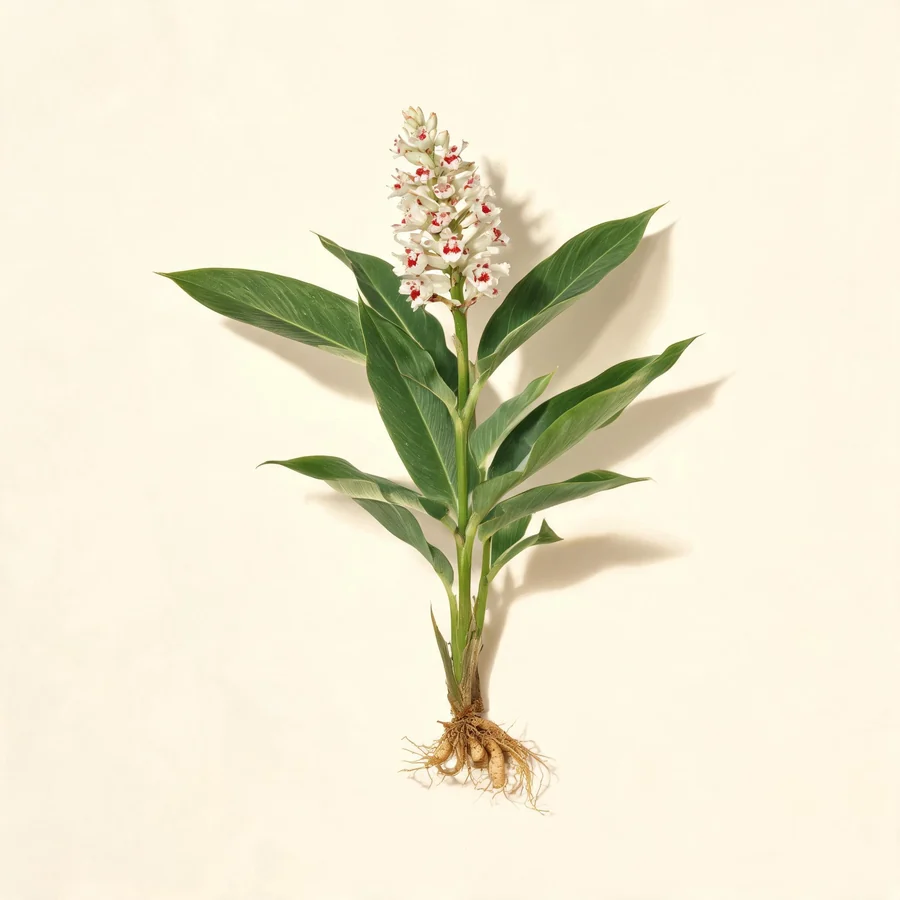
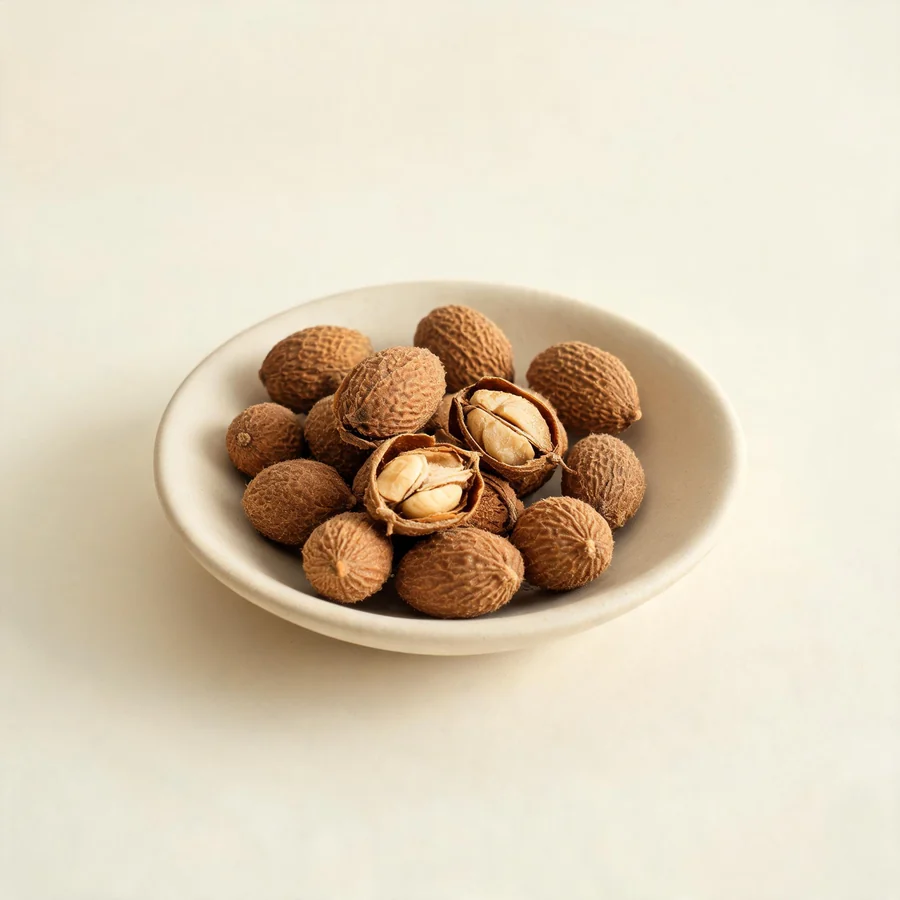
Skin profile
Where this herb sits in skin practice: the pattern it corrects, the skin signs it suits, and what it should not be used for.
Yi Zhi Ren is here for the cold and clammy end of skin practice, not for lesions. The signs that fit are a cool damp surface, sweating without effort, pale urine and a deep weak pulse; the signs that rule it out are redness, heat and any yellow discharge. It is a support within a warming formula, and its drying quality means the course is short and the mouth and stool are watched.
Skin signs that suggest it
- Skin that feels cold and slightly damp to the touch, with sweating that begins without exertion
- A pale, dull surface that stays moist after washing and dries slowly
- Night sweats, or sweats on slight effort, in someone who chills easily and passes pale urine often
- Cold hands and feet with a heavy, sodden feeling in the skin through winter
- A wet coating on a pale, swollen tongue, with a deep pulse that is weak
When it is not the right herb
Not for skin that is red, hot or oozing yellow fluid, because adding warmth to damp-heat intensifies both the inflammation and the itch. It is equally wrong in Yin deficiency with heat, where a red tongue without coating, a dry throat and night sweats that feel hot already describe a body that needs cooling and moistening rather than warming and holding. Anyone with an urgent, burning stool should leave it alone, and a lesion that is not healing deserves assessment instead of a longer course of a warming fruit.
What it does for skin
Skin-relevant actions only. Each one describes a mechanism in TCM terms and what it looks like on the skin.
Warms Yang so the surface can hold
Fluid is kept in its place, in this tradition, by the Kidney as the lower gate and by the Spleen as the organ that transforms what is drunk. When both are cold the pores stay slack, sweat leaks out and the skin never quite dries. The fruit warms that pair of organs, and the surface tightens as a result of the warmth rather than from anything the herb does to the skin directly.
Astringes a cold, damp surface
Because the fruit both warms and gathers, it suits moisture that has no heat in it: a clammy trunk, permanently damp feet, a shallow lesion that stays wet on a pale, cold person. It belongs with other warming and drying herbs, and it is not interchangeable with the bitter roots that dry a weeping rash by clearing inflammation. Used in the wrong picture it holds heat in and makes the itch worse.
Warms the Spleen that makes flesh
Cold digestion produces thin, pale, slow-healing tissue, and the aromatic warmth of the fruit is used to relight it, usually beside Atractylodes and yam. The gain arrives over weeks, as appetite and stool settle, and it shows in the skin only as better colour and quicker healing. It would be dishonest to sell it as a way to plump or brighten skin on its own.
Gives a formula its holding quality
In a warming prescription the fruit contributes restraint: where other herbs warm and move, it gathers, so the effect stays rather than dispersing. That is why it appears in formulas for leakage of every kind, and why a skin formula built on warming herbs may include it to keep the surface from losing what the treatment has restored.
Skin conditions it is used for
Mapped to the condition pages on this site. The pattern column shows what the skin is doing when this herb is the right choice.
| Condition | Pattern | Why it suits | Typical setting |
|---|---|---|---|
| Cool or clammy skin | Yang Deficiency with Cold-Damp | Skin that feels cool and clammy, with cold limbs, sweating without exertion and a wish for warmth, is read as Yang failing to reach the surface. Yi Zhi Ren is a supporting herb for that picture: it warms the Kidney and Spleen at the root, and its astringency keeps the surface from leaking. It is added to formulas built on warming and Qi-tonifying herbs rather than used alone, and sudden cold clamminess with chest pain is an emergency rather than a pattern. | Suo Quan Wan with Huang Qi and Fu Xiao Mai added |
| Moist skin sensation | Damp-Cold held at the surface | Skin that feels permanently damp without being hot, in a person with cold limbs and loose stools, points to damp-cold rather than damp-heat. The fruit warms the Spleen so that dampness is transformed, and its astringency gathers the moisture that has already escaped. It is a minor partner in a drying, warming formula, and any dampness with heat, redness or a greasy yellow coating calls for a different approach. | Modified Ling Gui Zhu Gan Tang with Yi Zhi Ren and Cang Zhu |
| Chilblains | Yang Deficiency with Cold-Damp in the extremities | Chilblains recur because warmth is not reaching the fingers and toes, and the tradition treats them by warming the root as well as the limbs. The fruit is a supporting herb here, chosen when the whole picture is cold: cold hands, pale urine, loose stool and a liking for warmth. It does nothing for the acute swollen, itchy nodule on its own, and a chilblain that breaks down or becomes infected needs clinical care. | Dang Gui Si Ni Tang with Yi Zhi Ren and Huang Qi |
| Wrinkled and shrunken skin | Spleen and Kidney Qi Deficiency with cold | Loose, thin, sunken skin in an older person who feels the cold is read as the Spleen and Kidney failing to supply and to hold. The fruit warms the two organs the pattern names, but it adds no substance, so it is an adjunct in a formula built on tonics rather than a treatment in itself. It is stopped if the mouth dries, the stool hardens or the skin becomes visibly drier. | Modified Liu Wei Di Huang Wan with Yi Zhi Ren and Huang Qi |
Combinations for skin
Herbs it is paired with when the skin, not an internal organ, is the target.
| Partner | Ratio | Why the pair is used |
|---|---|---|
| Wu Yao | 6 g each in a warming decoction | Lindera moves Qi and drives cold out of the lower body, while the fruit warms and gathers, so between them they cover the weakness that lets fluid escape and the congestion that makes a bladder irritable. On the skin the same reasoning serves a cold, damp surface that will not settle. The two are the core of the old prescription for frequent urination, and the habit of pairing them explains why the fruit is trusted wherever something is leaking. |
| Shan Yao | 10 to 15 g Shan Yao with 3 to 6 g Yi Zhi Ren | Yam supplies substance and the fruit supplies warmth, which is the pairing needed when skin is thin, pale and slow to heal in a cold person. The yam tonifies the Spleen and Kidney without drying and offsets the drying quality of the fruit, so the combination can be continued long enough to change something. Neither herb is expected to clear an active rash. |
| Huang Qi | 15 to 30 g Huang Qi with 3 to 6 g Yi Zhi Ren | Huang Qi lifts Qi to the surface and closes the pores, and the fruit warms the root from which that Qi comes. Together they are used for sweating that will not stop in a depleted, cold person, and for skin that stays damp and cool however often it is dried. The ratio is weighted towards Huang Qi because it carries the surface action. |
| Fu Xiao Mai | 20 to 30 g Fu Xiao Mai with 3 to 6 g Yi Zhi Ren | Light wheat grain stops the sweat and clears the low heat that often goes with it, while the fruit supplies the warmth that a cold, depleted person needs. The two are paired when sweating is the visible skin problem and the underlying picture is cold deficiency rather than empty heat, and the choice between them turns on whether the person feels hot or cold at night. |
Safety for skin use
What to check before recommending or using it, including the cautions that matter most for skin patients.
Do not use, or use with caution
- Heat of any kind in the skin: redness, warmth, oozing yellow fluid, pustules or a spreading rash. Warming and astringing a damp-heat lesion makes it worse, and the mistake is easy to make because both pictures can look wet.
- Yin deficiency with false heat: a red tongue without coating, a dry mouth and throat, night sweats that feel hot and restless sleep. The fruit dries and warms, and both qualities work against this picture.
- Damp-heat diarrhoea, burning urine or any discharge that is yellow and foul. The classical sources prohibit the fruit here, and a warming astringent holds in what should be expelled.
- Long courses without review. The drying quality is the limiting factor rather than any toxicity, and a dry mouth, a reddening tongue or constipation means it should stop.
Pregnancy and breastfeeding
It is not one of the herbs that pregnancy forbids outright, and some classical sources put it in prescriptions for a pregnancy threatened by bleeding and miscarriage, so it was evidently not regarded as inherently unsafe. The caution comes from its warmth and pungency: in a pregnancy with heat signs, a red tongue or restless sleep, adding more heat is the wrong move and the herb should be left out. Use only on a clear cold-deficiency indication, at ordinary doses, under practitioner supervision. For the skin this means no self-treatment of a rash in pregnancy with a warming fruit, and there is no topical tradition to fall back on either.
Interactions
- Anticholinergic medicines used for urinary urgency, and drugs for an overactive bladder. The warm, fluid-holding action of the fruit points the same way as the drug, so the combination could in theory add to retention, and anyone on such treatment should tell the prescriber.
- Sedatives and medicines for dementia. Laboratory work and network models have raised a question about cholinesterase, which is a theoretical concern for drugs acting on the same pathway; no clinical interaction has been recorded, so this is a prompt to disclose rather than a warning to avoid.
- Glucose-lowering treatment. There is no established interaction, but a fruit taken regularly alongside insulin or a gliclazide tablet should be covered by the usual glucose checks rather than assumed to be inert.
Allergy and patch testing
No allergic reaction specific to the fruit is documented, and the commoner problem is intolerance of its warmth rather than an immune response. A person who reacts to other members of the ginger family, including cardamom and galangal, should be cautious, and any herb taken by mouth can produce a rash in a susceptible person. Stop if a new rash, itching or swelling appears after starting it, and do not apply the fruit to the skin, since it has no topical tradition.
General safety references
General references for herbal hepatotoxicity and herb-drug interactions; they are not specific to this herb.
- Review article: Herbal hepatotoxicity - an update on traditional Chinese medicine preparations. Alimentary Pharmacology & Therapeutics, 2014. PMID: 24844799.
- Interactions between herbal medicines and prescribed drugs: an updated systematic review. Drugs, 2009. PMID: 19719333.
- Warfarin and food, herbal or dietary supplement interactions: a systematic review. British Journal of Clinical Pharmacology, 2021. PMID: 32478963.
Evidence
The classical record is quoted with its source. The modern note states the level of evidence plainly.
Classical record
止呕哕。治遗精虚漏,小便余沥,益气安神。
It stops vomiting and hiccups, and it is used for seminal emission with the leakage of deficiency, for the dribbling that follows urination, and to benefit Qi and settle the spirit.
Ben Cao Shi Yi (本草拾遗), Tang dynasty - The earliest entry, and the one that fixes the identity of the fruit as a gathering medicine. The salted decoction described in the same passage is the ancestor of the salt-frying method used today.
益智子仁,以其敛摄,故治遗精虚漏,及小便余沥。
Its kernel is valued for the way it gathers and restrains, which is why it is prescribed for emission with the leakage of deficiency and for dribbling after passing water.
Ben Cao Jing Shu (本草经疏), Ming dynasty - Miao Xiyong's reasoning is the one a skin reader needs: the herb works by gathering what is escaping. That is the same logic used when it is chosen for a cold, damp surface.
Modern evidence
Evidence status
- Laboratory work on the volatile oil, nootkatone and the diarylheptanoids of the fruit reports anti-inflammatory and antioxidant activity, mostly in cell and animal systems. None of that work measures a skin outcome, and none of it substitutes for a clinical study.
- No controlled clinical trial of the fruit in eczema, pruritus or any other skin disease is cited on this page. The skin reasoning comes from the warming and astringent classification, which is a record of use rather than a demonstration of effect.
- Regulatory status: the fruit has a pharmacopoeial monograph and appears in the national catalogue of substances used both as food and as medicine. That speaks to its safety record and says nothing about dermatological benefit.
PubMed records
Selected real PubMed records for this herb's species or its constituents, chosen by species name and title relevance. They are references for the non-TCM discussion above, not proof that the herb treats any skin condition.
- Alpinia oxyphylla Miq extract ameliorates cardiac fibrosis associated with D-galactose induced aging in rats.. Environmental toxicology, 2019. PMID: 30367734 (pharmacology or review record).
- Tectochrysin Attenuates the Chemoresistance of Hepatocellular Carcinoma Cells to Sorafenib by Inhibiting the PI3K/AKT Signaling Pathway and ABCG2 Expression.. Molecular biotechnology, 2026. PMID: 42599637 (safety record).
Dose and forms
Skin-practice dosing and the preparations that suit skin complaints.
| Form | Dose and notes |
|---|---|
| Decoction, salt-fried | Three to ten grams of crushed fruit daily, usually salt-fried for the warming and holding action, in a formula rather than alone. The salt preparation is the one dispensed when the aim is to steady the surface. |
| Raw fruit | The untreated fruit is more drying and is used where the intention is to warm the Spleen and dry a damp surface. Crushing it before it goes into the pot releases the aromatic oil, and a long boil drives that oil off. |
| Course length | Short courses of two to four weeks with review. Stop if the mouth dries, the tongue reddens or the stool hardens, all of which mean the drying quality has begun to outweigh the benefit. |
| Children | There is real paediatric use of the fruit in formulas for bedwetting, at between a third and a half of the adult amount above three years. Persistent drooling or bedwetting still needs a proper look for other causes. |
The range is narrow because warmth and dryness set the limit. Three to six grams warms without scorching, and six to nine grams is reserved for the colder pictures with urinary or intestinal leakage. Above that, dryness shows up first as a parched mouth and a harder stool. The salt-fried form serves the surface and urinary uses, the raw fruit the digestive cold.
Citations and further reading
Only real sources are listed: the classical materia medica passages quoted above, and the source works behind the botanical and safety statements.
- Ben Cao Shi Yi (Supplement to the Materia Medica), Chen Cangqi, Tang dynasty - classical entry quoted above.
- Ben Cao Jing Shu (Commentary on the Materia Medica), Miao Xiyong, Ming dynasty - classical entry quoted above.
- Kai Bao Ben Cao (Materia Medica of the Kai Bao Era), Song dynasty - the source of the warm, pungent and non-toxic classification used here.
- Alpiniae Oxyphyllae Fructus monograph: Pharmacopoeia of the People's Republic of China - accepted botanical source, part used and quality requirements.
- National catalogue of substances used both as food and as medicine - the basis for treating the fruit as a food as well as a medicine.
- Botanical description and identification: botanical literature on Alpinia oxyphylla, Zingiberaceae.
Educational reference for qualified practitioners. This page is not medical advice, and skin conditions should be diagnosed by a clinician before treatment.