Understanding Tinea
The tradition describes tinea as an invasion of external pathogens, mainly dampness, heat and wind, that lodge in the skin when there is an internal weakness.
The Spleen is usually at the centre of the story: when it fails to transform fluids, dampness accumulates inside the body and creates the conditions the fungus needs. That is why dietary advice carries so much weight on this page.
Damp-Heat gives weeping macerated skin with blisters, intense itch worse with warmth and moisture, and a foul sticky exudate. When the same pattern affects the trunk or limbs rather than the feet, the classical literature calls it Damp-Heat invading the Spleen, with digestive signs alongside.
Dry, scaly thickened patches with itch worse at night are read as Blood deficiency with external wind. Dark purplish thickened plaques with fixed stabbing itch are read as Blood stagnation, and bright red inflamed patches that spread quickly are read as heat in the Blood.
External pathogens need an opening. Dampness, heat and Wind can settle in the skin only where the interior is already out of balance, and the Spleen is usually the weak point. When it fails to transform fluids, the inside becomes humid, which is the same warm moist environment the fungus prefers. That internal dampness combines with heat from a hot constitution or from spicy greasy food, and the mixture moves outward to the skin or downward to the lower body.
Site is a clue to the pattern. When damp heat sinks, it shows between the toes as macerated weeping skin. When it sits in the Spleen, the trunk or groin is affected and digestion complains with bloating, nausea and heaviness. Tinea that has been present for years tells another story: Blood and fluids have been used up by illness, poor diet or age, so the skin turns dry, scaly and thick, and the dryness stirs an internal Wind that itches worse at night. In the most stubborn cases the pathogens damage Blood until it congeals, and the plaques turn dark, fixed and hard to shift.
Conventional view
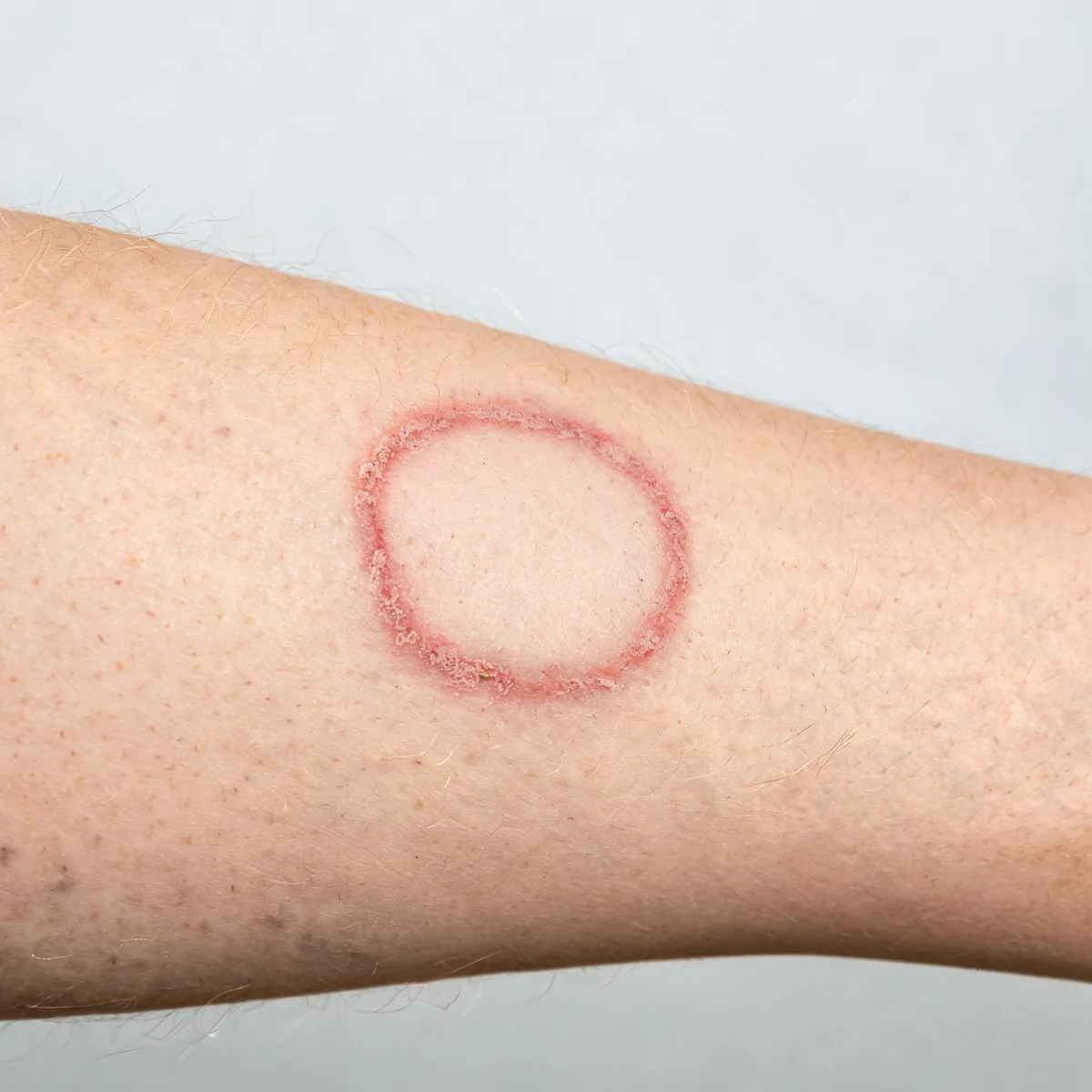
Tinea is an infection caused by dermatophytes, fungi that live on keratin and can affect skin, hair or nails. It appears as athlete's foot between the toes, jock itch in the groin, ringworm on the trunk and limbs, and scalp infection in children. The classic lesion is a red scaly ring with a raised active edge and a clearer centre, though moist peeling between the toes and dry thickened plaques are also common. Itching and burning are usual, and the rash spreads by contact with skin, footwear, towels or contaminated floors.
Diagnosis is often clinical, with a skin scraping for potassium hydroxide microscopy or culture where the picture is unclear or treatment has failed. Topical antifungals in cream, spray or powder form clear most limited cases, and oral terbinafine or fluconazole is used for widespread, stubborn, scalp or nail disease. Keeping the skin dry, changing socks, avoiding shared towels and treating footwear reduce recurrence, and treatment is usually continued for a period after the rash clears.
Antifungals kill the organism but do not change the terrain that allowed it to overgrow, so recurrence is common in people who sweat heavily or stay damp. Oral agents put pressure on the liver and can interact with other drugs, and they do little for the dry thickened plaques that develop in some people. Above all, conventional care treats all tinea as one problem, while a weeping foot and a dry scaly trunk patch may have entirely different roots, which is the distinction this page is built around.
Selected PubMed records
Real PubMed records for the conventional discussion above, selected by condition name and title relevance. They are references, not a claim that any treatment is proven for this condition.
- Tinea pedis: an updated review.. Drugs in context, 2023. PMID: 37415917.
- Tinea versicolor: an updated review.. Drugs in context, 2022. PMID: 36452877.
How it is assessed
Diagnosis looks at moisture, scale, colour and where the lesions sit.
What a practitioner looks for
- Moisture: weeping macerated lesions suggest Damp-Heat; dry scaly patches suggest Blood deficiency.
- Colour and hardness: purplish thickened plaques suggest stagnation; bright red spreading patches suggest heat in the Blood.
- Distribution: feet and groin suggest the Lower Burner; trunk and limbs suggest the Spleen pattern.
- Digestive signs: bloating, sticky taste and loose stools support the damp pattern.
The practitioner reads the lesion closely: colour, moisture, thickness and distribution, together with onset and triggers. Location carries weight, because feet and groin point to the lower burner while widespread lesions on the trunk and limbs point to the Spleen. Whether the surface is wet or dry, and whether the border is raised and scaly or boggy and macerated, decides most of the rest.
Active wet lesions with vesicles, maceration and intense itch, a tongue that is red under a thick greasy yellow coat, and a slippery rapid pulse indicate Damp-Heat in the Lower Burner. The same moisture on the trunk or groin with bloating, loose stools and heaviness, a greasy coat and a soft or slippery pulse indicate Damp-Heat invading the Spleen. Chronic dry thickened scaly plaques with night itch, a tongue that is pale with little coating, and a fine pulse indicate Blood Deficiency with External Wind. Dark red or purple infiltrated plaques that resist treatment, a purple tongue with stasis spots and a choppy pulse indicate Blood Stagnation. A sudden bright red spreading flare with a rapid pulse and a red tongue with a thin yellow coat indicates Heat in the Blood.
TCM patterns in Tinea
Five patterns are described for tinea, and the work starts with two questions: wet or dry, and where. Wet, weeping skin points to damp heat; dry, thickened skin points to deficiency or stagnation. Site separates the two damp pictures, since feet and groin belong to the lower burner and trunk or limbs to the Spleen. Damp-Heat in the Lower Burner gives blisters and maceration between the toes with a foul sticky exudate, itch worse in warmth and damp, and heavy legs. Damp-Heat invading the Spleen brings the same moisture to the trunk or limbs, with bloating, nausea, a sticky taste and loose stools. Blood Deficiency with External Wind gives dry scaly patches and night itch. Blood Stagnation gives dark, hard, infiltrated plaques that do not respond. Heat in the Blood gives a sudden bright red flare that spreads quickly. Mixed pictures are common, and a moist flare can settle into stagnation.
| Pattern | Key signs | The itch | Tongue | Main formula |
|---|---|---|---|---|
| Damp-Heat in the Lower Burner | Weeping macerated skin with blisters between toes; Heavy tired legs | Intense itch worse with warmth and moisture | Body: Red, slightly swollen, with a coating thickest at the rootCoat: Yellow and greasy | Not specified |
| Damp-Heat invading the Spleen | Oozing blisters on trunk or limbs | Not specified | Body: Red, often swollen with teeth marksCoat: Thick, yellow and greasy at the centre and root | Not specified |
| Blood Deficiency with External Wind | Dry scaly thickened skin patches | Itch worse at night | Body: Pale and thin, sometimes slightly dryCoat: Thin, white and a little dry | Not specified |
| Blood Stagnation | Dark purplish or dusky red plaques; Fixed stabbing pain in the lesions | Itch and pain worse at night | Body: Purple, dusky or with dark stasis spots; sublingual veins dark and distendedCoat: Often thin white; a yellow coat would suggest Heat as the cause | Not specified |
| Heat in the Blood | Bright red inflamed patches; Burning sensation in the skin | Not specified | Body: Deep red, often with red points or pricklesCoat: Thin, yellow and dry | Not specified |
Damp-Heat in the Lower Burner
The moist foot and groin picture with itch and odour.
Damp heat arrives either from outside, through humid weather and damp footwear, or from inside, when a weak Spleen fails to move fluids. Either way it collects and sinks, because dampness is heavy, and it collects in the skin around the toes and in the groin. That area becomes warm and wet, which suits fungal growth. Dampness makes the skin weep, macerate and blister, heat drives the itch, the redness and the smell, and the picture worsens in hot humid weather that adds more damp heat from outside.
The tongue is red with a thick greasy yellow coat, most marked at the root; the pulse is slippery and rapid, often stronger at the rear position. Hot humid weather, sweaty shoes, greasy spicy sweet food, alcohol and coffee all aggravate it, while keeping the skin dry, a cool dry environment, cotton socks and avoiding damp public floors help. Long Dan Xie Gan Tang drains damp heat from the lower body by way of the Liver and Gallbladder channels, with Long Dan Cao and Ku Shen named, and SP-9 Yinlingquan, SP-6 Sanyinjiao and LR-3 Taichong as points.
Signs
- Weeping macerated skin with blisters between toes
- Intense itch worse with warmth and moisture
- Foul sticky exudate
- Heavy tired legs
- Dark scanty or burning urine
Diet and lifestyle for this pattern: Avoid greasy, spicy and sugary food that generates internal Dampness and Heat. Keep the feet clean and dry in breathable cotton socks changed daily, choose well-ventilated shoes, avoid walking barefoot in damp public areas such as locker rooms, and limit alcohol and rich heavy meals.
Damp-Heat invading the Spleen
Weeping blisters on trunk or limbs with a digestive picture.
A diet built on greasy or sweet food, and stress that knots Liver Qi and disturbs digestion, leave the Spleen unable to process what it is given. Dampness builds, heat joins it, and the mixture overflows to the skin rather than being transformed. Because the Spleen is involved, the rash is not confined to the feet: blisters and oozing appear on the trunk or limbs, and digestion reports the same problem with bloating, nausea, a sticky taste and sticky incomplete stools.
The tongue is red with a yellow greasy coat thickest at the centre and root, sometimes swollen with teeth marks; the pulse is soggy and rapid or slippery and rapid. Greasy spicy and sweet food, humid weather, stress and overeating worsen it, while a light bland diet with congee and barley, a cool dry room, gentle exercise and dry skin help. Gan Lu Xiao Du Dan clears heat, drains dampness and resolves toxicity, with Huo Xiang, Huang Qin, Yi Yi Ren and Ku Shen named, and REN-12 Zhongwan, SP-9 Yinlingquan, ST-36 Zusanli, LI-11 Quchi and SP-10 Xuehai as points.
Signs
- Oozing blisters on trunk or limbs
- Bloating and upper abdominal fullness
- Nausea or poor appetite
- Loose sticky stools
- Greasy or sticky taste
Diet and lifestyle for this pattern: Avoid greasy, fried, spicy and heavily sweetened food, which generate Damp-Heat. Base meals around lightly cooked grains, vegetables and small amounts of lean protein, with congee containing Job's tears especially helpful, keep the skin clean and dry in loose breathable clothing, limit alcohol, and walk daily so the Spleen's Qi moves and clears Dampness.
Blood Deficiency with External Wind
Dry scaly thickened patches with night itch.
When Blood is insufficient the skin is undernourished, so it dries, scales and thickens. That dryness generates an internal Wind, and external Wind from cold dry weather joins it, producing the itch that comes and goes and is worst at night. This is the chronic end of tinea: the patches are dry and cracked rather than weeping and red, and they persist because the material needed to rebuild the skin is missing.
The tongue is pale and thin with a thin white, slightly dry coat; the pulse is fine, wiry at the left Guan and floating at the right Cun. Cold dry weather, exposure to wind, spicy drying meals, emotional strain and overwork all aggravate it, while moisturising creams, a warm humid environment, iron rich foods, gentle exercise and restful sleep help. Dang Gui Yin Zi builds Blood, moistens dryness, expels Wind and settles itch, with Dang Gui, He Shou Wu and Fang Feng named, and SP-10 Xuehai, SP-6 Sanyinjiao, GB-20 Fengchi and LI-11 Quchi as points.
Signs
- Dry scaly thickened skin patches
- Itch worse at night
- Pale or sallow complexion
- Aversion to wind and drafts
- Dull brittle nails
Diet and lifestyle for this pattern: Eat blood-nourishing food such as bone broth, eggs, dark leafy greens, black sesame and small amounts of red meat, and avoid spicy, fried and drying food that depletes fluids. Keep the skin well moisturised with natural creams, protect yourself from draughts and cold dry wind, and walk gently to circulate Blood without exhausting it.
Blood Stagnation
Dark purplish, thickened, hard plaques with fixed pain.
When damp heat or Wind dryness stays in the skin long enough, it damages Blood and the Blood congeals. The lesions turn dark purple or dusky red, thicken, and feel hard and infiltrated, and the channels through them are blocked. Blocked channels explain the stabbing pain that pressure and the night both sharpen, and they explain why the rash becomes stubborn and slow to respond to anything directed only at the surface.
The tongue is purple or dusky, possibly with stasis spots, with distended dark sublingual veins and a thin white coat; the pulse is choppy or wiry. Cold dry weather, prolonged sitting, stress, nighttime and heavy greasy food all make it worse, while warmth applied locally, gentle exercise, spices that move blood such as turmeric and ginger, and avoiding pressure help. Xue Fu Zhu Yu Tang breaks stasis, moves Qi and quickens Blood, with Tao Ren and Hong Hua named, and SP-10 Xuehai, BL-17 Geshu, LR-3 Taichong and SP-6 Sanyinjiao as points.
Signs
- Dark purplish or dusky red plaques
- Fixed stabbing pain in the lesions
- Itch and pain worse at night
- Thickened rough dry skin
- Lesions feel hard
Diet and lifestyle for this pattern: Eat warming, blood-moving food such as turmeric, ginger, black vinegar and small amounts of red meat, and avoid cold raw food and iced drinks that congeal the blood. Gentle daily walking or stretching keeps Qi and blood flowing, and a warm compress on the lesions can ease pain and itching.
Heat in the Blood
Bright red inflamed patches that spread quickly.
This is an acute excess pattern in which heat passes through the surface and into the Blood. The Blood becomes agitated and overheated and pushes inflammation outward, so patches appear quickly, are bright red and spread. The heat also burns off cooling fluids, which is why the skin feels hot and itchy, why there is thirst for cold drinks, and why tiny bleeding points can appear within the rash. It can stand alone or sit on top of a damp picture.
The tongue is red with red spots or prickles and a thin yellow dry coat; the pulse is rapid and wiry, sometimes slippery, and has force. Spicy greasy fried food, alcohol, coffee, hot weather, hot showers and stress all add fuel, while cooling compresses, cold drinks, cooling foods, rest and a calm mind reduce it. The formula named for this pattern clears heat from the blood level, cools the Blood and stops bleeding, with Chi Shao, Mu Dan Pi and raw rehmannia root as the named herbs and SP-10 Xuehai, LI-11 Quchi and LR-3 Taichong as points.
Signs
- Bright red inflamed patches
- Rapid onset and spread
- Burning sensation in the skin
- Possible tiny red spots or bleeding points
- Thirst for cold drinks
Diet and lifestyle for this pattern: Avoid all heating food and drink: alcohol, coffee, spicy dishes, lamb and deep-fried food. Embrace cooling, hydrating food such as cucumber, watermelon, mung beans and chrysanthemum tea, keep the affected skin clean and dry but avoid hot showers or scrubbing, and rest, since overexertion or emotional stress can fan the internal Heat.
Treatment approach
How the tradition treats tinea, with the herbs, formulas and points used for it.
Principles
- Drain dampness and clear heat in the moist patterns, treating the Spleen as the root.
- Nourish Blood and moisten the skin where it is dry and scaly.
- Move Blood and resolve stasis where lesions are dark, hard and thickened.
- Keep the skin dry and treat the whole affected area, not only the visible edge.
- Treatment works on two fronts at once: clearing whatever pathogen has lodged in the skin, whether dampness, heat, Wind or stasis, and strengthening the terrain so the fungus cannot return. External washes, soaks and compresses cool, dry and soothe the surface, while internal formulas correct the Spleen, the Blood or the heat underneath. A weeping foot needs bitter cold herbs that drain downward; a dry scaly trunk patch needs Blood nourishment and Wind calming. Many people run mixed pictures, so the formula shifts from clearing towards nourishing as the skin settles.
Herbs used
Formulas
Acupoints
- SP-9 (Yinlingquan)
- SP-6 (Sanyinjiao)
- LR-3 (Taichong)
- zhongwan-ren-12
- ST-36 (Zusanli)
- LI-11 (Quchi)
- SP-10 (Xuehai)
- GB-20 (Fengchi)
- BL-17 (Geshu)
What to expect
- Moist patterns are described as improving within two to four weeks with treatment and skin care.
- Dry and thickened patterns take longer.
- Reinfection from footwear, towels or household contacts is common and needs addressing.
- Itch and spread usually reduce within one to two weeks, and external washes give quicker relief from burning and moisture. Acupuncture runs once or twice weekly with a daily formula. An acute damp heat attack can clear within a month, while chronic dry or thickened tinea takes at least two to three months to rebuild the skin. Progress is gradual: itch and redness settle, lesions shrink from the edge inward, and old skin may peel as healthy tissue replaces it.
Safety and when to get help
Seek medical help urgently for
- Signs of bacterial superinfection: increasing pain, warmth, red streaks or oozing pus.
- Fever or chills.
- A rapid spread of redness or swelling in the affected area.
For anything severe, sudden or spreading quickly, read when a skin problem needs urgent care.
Cautions
- Tinea is contagious: avoid sharing towels, footwear and bedding.
- Onychomycosis and scalp tinea need medical treatment.
- Do not use strong topical preparations on broken skin without advice.
Using this alongside conventional care
- TCM is described as complementary to conventional care: antifungal treatment can continue alongside herbs, with medical review for superinfection or nail and scalp involvement.
- Topical antifungals and herbal soaks can be combined, provided they are spaced apart, for example an herbal soak early in the day and an antifungal cream later on. Anyone taking oral terbinafine or fluconazole should tell the TCM practitioner, because several heat and dampness clearing herbs affect liver enzymes and may change how the drug is handled. A history of liver problems means gentler herbs, more acupuncture and more reliance on external treatment, and a full medication list should come to the first appointment.
Diet and lifestyle
- The key rule is to reduce what generates dampness and heat: sugar, refined flour, dairy, fried food and alcohol.
- The central rule is to stop feeding dampness and heat. Sugar, refined flour, deep fried food, rich dairy, alcohol and very spicy dishes are reduced first, because these are the conditions the fungus thrives in. Meals built on cooked vegetables, whole grains such as barley and millet and a modest amount of lean protein give the Spleen less to struggle with, and bitter greens and mung beans help clear damp heat. Warm water is preferred to iced drinks, which blunt the Spleen's work of transforming fluids.
If you're pregnant
Damp heat patterns still occur in pregnancy and can be treated, but internal herbs need care. Formulas that drain with bitter cold herbs, Long Dan Xie Gan Tang among them, are generally avoided, since they may disturb the fetus and can provoke diarrhoea or contractions of the uterus. Even blood nourishing formulas such as Dang Gui Yin Zi contain Dang Gui, which at high doses may stimulate the womb, so a modified version at lower dose is used only under close supervision. External washes with Ku Shen, Huang Bai and Ma Chi Xian are the safest first line, points below the waist are avoided in the first trimester, and LI-11 Quchi and SP-10 Xuehai are used cautiously.
If you're breastfeeding
External washes and creams are the safest route while nursing, because absorption into milk is minimal. Internal formulas need more care, since bitter cold herbs such as Long Dan Cao and Huang Qin can pass into milk and may cause diarrhoea or colic in the infant. Where internal treatment is needed, milder Spleen friendly options such as Yi Yi Ren and Fu Ling drain dampness gently, and blood nourishing formulas are generally considered safer, with the baby watched for digestive upset. Keeping the affected skin dry and clean matters before any skin to skin contact.
If treating a child
Children often develop scalp or body ringworm after close contact with pets and other children. In TCM the picture is almost always damp heat, frequently over a Spleen deficiency from an immature digestion and a liking for sweets, so lesions are moist, oozing and itchy, with a greasy coating and loose stools. External washes with Ku Shen and Huang Bai are safe and well tolerated, internal doses are cut to between a quarter and a half of the adult amount, and younger children are treated with acupressure or paediatric tuina rather than needles. Cutting greasy, sugary and dairy food often clears the skin faster than herbs alone.
If treating an elderly patient
In older people tinea tends to become chronic, with dry thickened fissured plaques that point to dryness and Blood deficiency, so the Dang Gui Yin Zi picture predominates. The barrier is weaker and healing slower, and many take anticoagulants or diabetes drugs, which makes interaction checks essential. Blood moving herbs such as Tao Ren and Hong Hua need caution alongside warfarin or aspirin. Treatment emphasises gentle Blood nourishment and external moisturising, internal doses run at about two thirds of the adult amount, courses last months, and needling is shallow because the skin is fragile.
Urgent-sign guidance is based on standard sources: NHS anaphylaxis, NHS cellulitis, NHS Stevens-Johnson syndrome, NHS melanoma.
Evidence
Evidence status
Compiled for this page from the classical and modern literature; not a systematic review, so treat it as a pointer to sources rather than clinical guidance.
The evidence is modest but consistent in direction. A randomised trial of a multi-herb foot soak reported reduced itching, scaling and erythema with a higher mycological cure rate and less recurrence than placebo, and laboratory work has shown antifungal activity for herbs including Ku Shen and Huang Bo. Antifungal drugs remain the standard treatment; herbal soaks are studied as adjuncts.
Herbal foot baths containing Ku Shen, Huang Bai and Di Fu Zi have been tested repeatedly in tinea pedis, with reductions in itch, scaling and fungal load that are comparable to topical antifungals, and one 2025 trial reported better clinical cure and less recurrence than placebo. The studies are small, often unblinded and sometimes published only in Chinese, and systematic reviews describe the overall quality as limited by these flaws. TCM is therefore best placed as a complement, particularly for chronic or recurrent cases rather than as a first line antifungal substitute.
Studies often cited
In a randomised controlled trial of a multi-herb soak including Sophora flavescens, Phellodendron amurense and Kochia scoparia, the herbal group showed greater reduction in itching, scaling and erythema than placebo, with a higher mycological cure rate and lower recurrence at follow-up. Pakistan Journal of Pharmaceutical Sciences. 2025.
Laboratory testing showed strong antifungal activity in vitro, and a small clinical cohort reported symptom improvement in tinea corporis and cruris with minimal side effects. Hong Kong Medical Journal. 2005;11(Suppl 2):44.
Classical record
Tinea arises from wind, heat and dampness evils invading the skin; when stagnation persists it transforms into blood dryness, causing thickened, dry and cracked skin.
- Yi Zong Jin Jian (Golden Mirror of Medicine), chapter on skin diseases.
癣者,风湿邪气,客于腠理,复值寒湿,与血气相搏,则血气否涩,发此疾也。
Tinea arises when wind and damp evil qi lodge in the spaces between skin and flesh; meeting cold and dampness, it contends with Blood and Qi so that their flow becomes blocked, and this produces the disease.
Tinea from wind, dampness and cold (Zhu Bing Yuan Hou Lun) - Classical citation: for this page: Zhu Bing Yuan Hou Lun, in the chapter on tinea.
Common questions
Can herbs clear tinea?
The tradition describes internal treatment for the damp pattern and local care, with improvement over weeks. Antifungal treatment is compatible and often necessary.
Why does tinea keep returning?
The framework explains it as dampness that was never resolved, plus reinfection from footwear, towels or household contacts.
Is it contagious?
Yes. It spreads by contact, so avoiding shared towels, footwear and bedding is part of management.
Do nails need separate treatment?
Yes. Nail and scalp involvement need specific medical treatment rather than skin-directed herbs.
Can TCM clear ringworm?
The tradition describes clearing tinea by correcting the internal imbalance that lets the fungus thrive, using internal formulas and external washes together, which clear dampness, heat and Wind and also feed the skin. For many people that also lowers the chance of recurrence, which is the usual frustration with antifungal creams alone. Antifungal treatment remains compatible and is often necessary.
Does acupuncture help a fungal infection?
Not by killing the fungus directly. Points such as SP-9 Yinlingquan and ST-36 Zusanli strengthen the Spleen so it transforms dampness, and Blood moving points address thickened chronic plaques, which changes the internal environment the infection depends on. It is usually combined with herbs rather than used alone.
How long does treatment take?
An acute weeping athlete's foot often improves noticeably in two to four weeks with daily soaks and internal medicine. Where it has been there for months or even years, with skin that has turned dry and cracked, two to three months is more realistic, because the skin has to be rebuilt rather than simply cleared.
Which foods should I avoid?
The ones that create dampness and heat: greasy, fried and very sweet food, dairy, alcohol and rich meat. Cooling drying foods such as barley, mung beans, bitter greens and vegetables lightly cooked are favoured instead. Keeping the diet simple reduces the internal environment the fungus relies on.