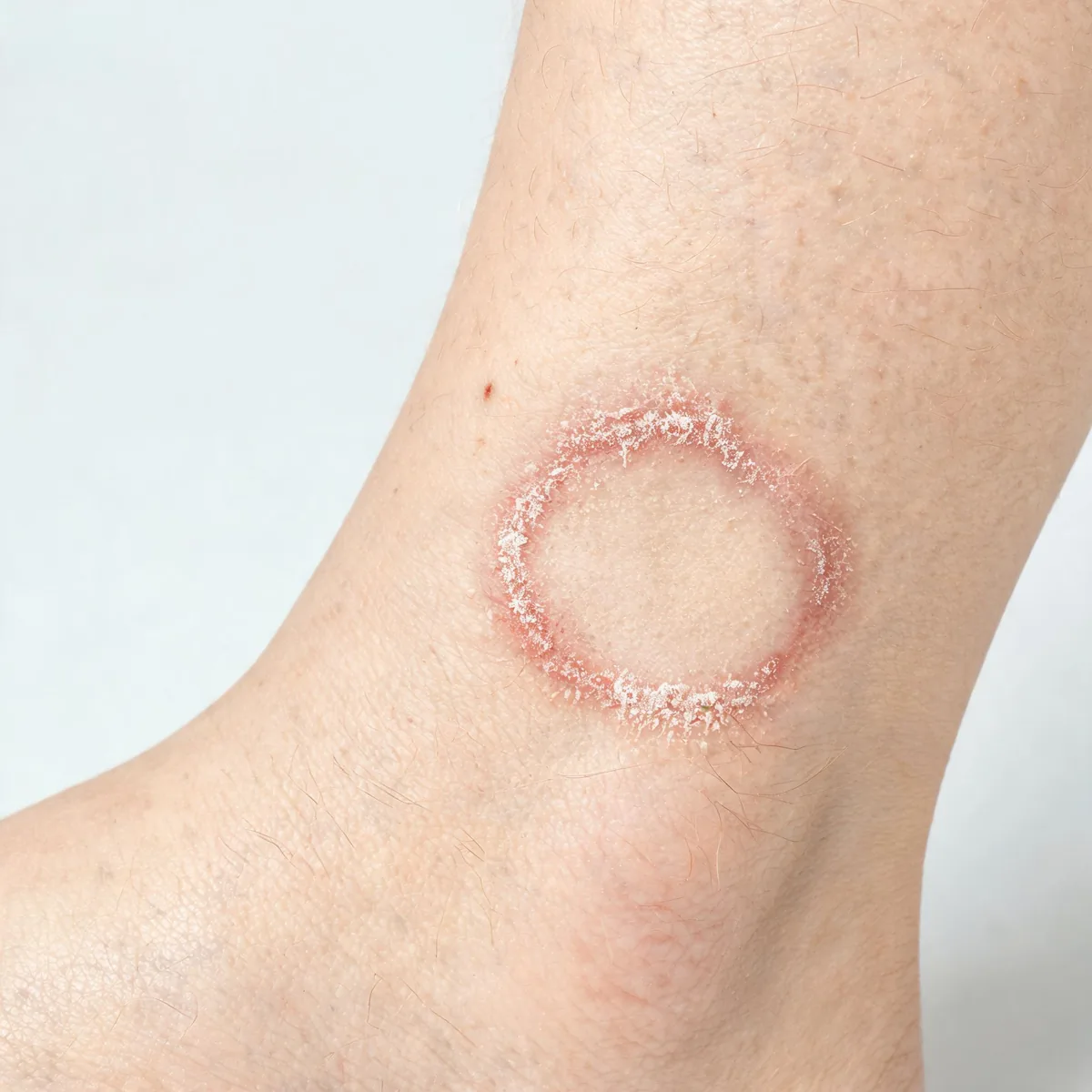
Understanding Foot and lower leg skin rashes and fungal infections
The tradition describes lower limb skin problems as internal disharmony involving dampness, heat, the Spleen and the Blood. Dampness is heavy and sinks downward, so it tends to collect in the legs and feet.
Damp-Heat in the Lower Burner gives a moist red itchy rash with small blisters or oozing, heavy tired legs, foul odour from the skin and a thick yellow greasy coating.
Spleen deficiency with dampness gives thickened scaly skin with recurrent fungal infection, heaviness, bloating, loose stools and fatigue. That is the pattern behind repeated infection.
Blood deficiency with external wind gives dry cracked scaly skin on the feet or lower legs with intense itch worse at night, a pale complexion and an aversion to drafts. Heat in the Blood gives bright red rapidly spreading rash with intense itch, internal heat, restlessness and thirst.
Dampness explains most of what happens on the lower leg, because of the way it behaves. It is heavy and turbid, so it drifts downward, and the feet and ankles are where it collects. Skin that is moist from the inside stays warm and damp on the surface, which is exactly the setting in which tinea and recurrent rashes take hold and keep coming back.
The Spleen is the pivot here, since it transforms and transports fluids. A poor diet, long working hours and unrelieved stress all wear it down, fluids are handled badly, and Dampness builds. Heat from spicy food, frustration or humid weather can join that Dampness and produce a rash that is red, hot and weeping. Where Blood and Yin are low instead, the skin is undernourished, so it dries and cracks and itches, and internal Wind accounts for itch that wanders and worsens at night.
Conventional view
Problems on the feet and lower legs usually turn out to be tinea pedis, contact dermatitis or eczema, and a bacterial infection can complicate any of them. Dermatophytes need warmth and moisture, which is why tight shoes and sweaty socks matter so much, and the rash shows as itching, redness, scaling, blisters and cracking. A doctor usually diagnoses by inspection, with skin scrapings or culture where the picture is unclear.
Fungal infection is treated with an antifungal cream, powder or spray, and inflammatory rashes with a corticosteroid cream. Widespread or stubborn infection may need oral terbinafine or itraconazole. Prevention rests on the same unglamorous work: wash and dry the feet properly, change socks more than once a day, and choose footwear that lets air through.
The limit is recurrence. Antifungals clear the active infection but leave the susceptibility that allowed it, and athlete's foot returns in many people. Steroid creams suppress inflammation without correcting anything deeper and thin the skin if used for long. That gap is where pattern-based treatment aims, at the damp, heated or deficient internal setting rather than the surface alone.
Selected PubMed records
Real PubMed records for the conventional discussion above, selected by condition name and title relevance. They are references, not a claim that any treatment is proven for this condition.
- What's new with common, uncommon and rare rashes in childhood.. Current opinion in pediatrics, 2015. PMID: 25689452.
How it connects
Foot and lower leg rashes frequently appear alongside athlete's foot because both are fuelled by Damp-Heat in the Lower Burner: the warm moist environment between the toes is a perfect breeding ground for fungus, and the same Damp-Heat can spread up the leg or appear as eczema-like rashes, so treating it often resolves both. Where Spleen deficiency with Dampness underlies the problem, a weak Spleen fails to manage fluids and chronic Dampness sinks to the feet, creating a persistent low-grade damp environment that invites recurrent fungal infection and scaly thickened skin. The fatigue, bloating and loose stools that come with it are the clue that this is a reflection of digestive weakness rather than a local skin problem.
How it is assessed
The practitioner assesses moisture, chronicity and circulation.
What a practitioner looks for
- Moisture: oozing blisters suggest Damp-Heat in the Lower Burner.
- Recurrence: recurrent infection with thickened skin suggests Spleen deficiency with dampness.
- Dryness: dry cracked scaly skin suggests Blood deficiency with wind.
- Red flags: spreading redness, fever, open sores or diabetes.
The practitioner begins with the rash itself: how red it is, whether it oozes or blisters, how thick or scaly the skin has become, and what the itch feels like. The tongue and pulse are read next, because one patch of skin can come from quite different internal states. Red, swollen, weeping skin with a hot, fierce itch points to Damp-Heat settling in the Lower Burner, with a red tongue under a thick yellow greasy coat and a slippery, rapid pulse. Flares often follow humid weather or a stretch of rich, greasy meals.
Thickened scaly skin that cracks rather than weeps, with a duller red colour and a persistent damp itch, suggests Spleen Deficiency with Dampness. A pale, swollen tongue with teeth marks and a sticky white coat belongs here, the pulse is weak and slippery, and the person is tired, bloated and loose in the bowel. Long-standing dry rashes that scale and itch badly at night belong to Blood Deficiency with External Wind, with a pale tongue, little coating and a thin choppy pulse. A sudden bright red flare that spreads fast and burns is Heat in the Blood, showing a deep red tongue, a yellow coat and a rapid forceful pulse, and it needs cooling promptly before the skin is damaged further.
TCM patterns in Foot and lower leg skin rashes and fungal infections
Four patterns are separated here by how much fluid the skin holds and how much heat sits behind it. Damp-Heat in the Lower Burner is the wettest and angriest: red, swollen skin that oozes or blisters, an unpleasant smell and a hot itch, worst in humid weather and tight shoes. Spleen Deficiency with Dampness is the pattern behind repeated infection, where the skin is thickened and scaly rather than hot, the itch is duller, and the person is tired, bloated and loose in the bowel. Blood Deficiency with External Wind gives the dry version, pale or dull red skin that scales and cracks with a fierce itch at night. Heat in the Blood is the acute excess picture, bright red and spreading fast, often after stress, alcohol or heating food. Tongue and pulse decide which is active, and mixed pictures are common, with a deficient base and an acute flare on top.
| Pattern | Key signs | The itch | Tongue | Main formula |
|---|---|---|---|---|
| Damp-Heat in the Lower Burner | Heavy tired feeling in the legs; Foul odour from the affected skin | Moist red itchy rash with small blisters or oozing | Body: Red, slightly swollen, with a coating thickest at the rootCoat: Yellow and greasy | Not specified |
| Spleen Deficiency with Dampness | Thickened scaly skin with recurrent fungal infections | Not specified | Body: Pale and swollen, often with teeth marks along the edgesCoat: White, greasy and moist, thick in the middle | Not specified |
| Blood Deficiency with External Wind | Dry cracked scaly skin on feet or lower legs; Pale or sallow complexion with dull skin | Intense itch worse at night | Body: Pale and thin, sometimes slightly dryCoat: Thin, white and a little dry | Not specified |
| Heat in the Blood | Bright red rapidly spreading rash | Intense itch worse at night | Body: Deep red, often with red points or pricklesCoat: Thin, yellow and dry | Not specified |
Damp-Heat in the Lower Burner
Moist red itchy rash with blisters, heavy legs and odour.
When Dampness and Heat gather in the lower half of the body they travel downward through the channels to the feet and lower legs, and the skin becomes wet and warm, which is precisely what rashes and fungal infections need. The result is a red, weeping, intensely itchy eruption that often smells unpleasant, like a stagnant puddle left in the sun.
The tongue body is red under a yellow greasy coat that is thickest at the root, and the pulse is slippery and rapid, most marked at the rear position. Hot, humid weather and occlusive shoes hold moisture and warmth against the skin, while greasy or spicy food and alcohol add Damp-Heat from within. Sandals, light meals and keeping the feet dry starve it. The formula is Si Miao San, with Huang Bo, Ku Shen and Yi Yi Ren, and the points Sanyinjiao (SP-6), Yinlingquan (SP-9), Fenglong (ST-40) and Quchi (LI-11).
Signs
- Moist red itchy rash with small blisters or oozing
- Heavy tired feeling in the legs
- Foul odour from the affected skin
- Thick yellow greasy coating
Diet and lifestyle for this pattern: Keep the feet as dry and cool as possible, changing socks often and choosing breathable leather or sandals over plastic shoes. Eat light, plain food such as cucumber, celery, mung beans and barley, and cut back on greasy, spicy and sugary food that brews Dampness and Heat; a short salt or herbal foot soak helps if the feet are dried thoroughly afterwards.
Spleen Deficiency with Dampness
Thickened scaly skin with recurrent fungal infection.
The Spleen transforms and transports fluids, and when poor diet, overwork or long illness weaken it, fluids are left half-processed and Dampness accumulates. That Dampness is heavy and sinks into the lower limbs, so the skin of the feet stays permanently moist and fungi keep returning. Because the root is a deficiency rather than an excess, the skin is thickened and scaly, without the redness and heat of an acute flare, and it resists quick fixes.
The tongue is pale and swollen with teeth marks, a white greasy coat and a moist surface, and the pulse is soggy and slow, soft and lacking force. Humid weather, cold raw or greasy food, fatigue and long hours on the feet all make it worse, while warm cooked meals, rest, dry air and breathable footwear help, and gentle movement keeps Qi circulating so Dampness cannot settle. Shen Ling Bai Zhu San is the base formula, with Bai Zhu and Fu Ling, supported by Zusanli (ST-36), Yinlingquan (SP-9) and Sanyinjiao (SP-6).
Signs
- Thickened scaly skin with recurrent fungal infections
- Heaviness in the limbs
- Abdominal bloating and loose stools
- Fatigue
Diet and lifestyle for this pattern: Focus on warm, cooked, easy food such as soups, stews and congees, and avoid raw, cold, greasy and dairy-rich food that burdens the Spleen and creates Dampness. Keep the feet clean and dry, change socks often, choose breathable footwear, and walk gently to circulate Qi and dry Dampness.
Blood Deficiency with External Wind
Dry cracked scaly skin with night itch.
When Blood has been insufficient for a long time the skin loses its nourishment and turns dry, rough and liable to crack. That dryness is read as internal Wind, the force behind itching that appears suddenly and rashes that drift about and then subside. The feet and lower legs end up with stubborn scaly patches that itch fiercely at night, when Blood withdraws inward and the surface is moistened even less.
The tongue is pale and thin with a thin white, slightly dry coat, and the pulse is fine, sometimes wiry in the left middle position and superficial enough to float. Dry windy weather, drafts, overwork, stress and heating foods all aggravate it, while moisturising, rest, a warm sheltered environment and a Blood-building diet ease it. Dang Gui Yin Zi is the formula, carried by Dang Gui, Bai Shao and Shu Di Huang, with Xuehai (SP-10), Zusanli (ST-36), Sanyinjiao (SP-6), Fengchi (GB-20) and Quchi (LI-11).
Signs
- Dry cracked scaly skin on feet or lower legs
- Intense itch worse at night
- Pale or sallow complexion with dull skin
- Aversion to wind and drafts
Diet and lifestyle for this pattern: Eat blood-nourishing food such as bone broth, dark leafy greens and small amounts of red meat, and avoid drying food such as hot peppers, coffee and alcohol. Moisturise the skin with natural oils, protect the feet and legs from wind and cold draughts, and keep exercise gentle so Blood circulates without strain.
Heat in the Blood
Bright red rapidly spreading rash with internal heat.
Heat that has entered the Blood level behaves like fire inside the vessels, driving redness and warmth out to the surface as a bright red eruption that spreads quickly over the ankles and feet. The Heat stirs the Blood and raises internal Wind, which is why the itch is so severe, and a flare often follows emotional stress or a meal of heating food that adds fuel to it.
The tongue is red with red spots or prickles and a thin yellow dry coat, and the pulse is rapid, often wiry and forceful. Spicy food, alcohol, stress, hot showers and scratching all make matters worse, while cold compresses, cool water, cooling foods such as cucumber and deliberate rest calm it. Treatment uses the classical formula that clears Heat from the Blood level, with Sheng Di Huang, Mu Dan Pi and Zi Cao, and the points Xuehai (SP-10), Quchi (LI-11), Taichong (LR-3) and Dazhui (DU-14).
Signs
- Bright red rapidly spreading rash
- Intense itch worse at night
- Internal heat with restlessness
- Thirst for cold drinks
Diet and lifestyle for this pattern: During flares, avoid spicy, greasy and fried food as well as alcohol and coffee, which add Heat to the Blood. Drink plenty of water and eat cooling food such as cucumber, watermelon and mung bean soup, keep the affected skin cool and dry, avoid hot showers or baths, and manage stress, since emotional upset stirs up Heat.
Treatment approach
How the tradition treats foot and lower leg skin rashes and fungal infections, with the herbs, formulas and points used for it.
Principles
- Use antifungal treatment where infection is present; herbs do not replace it.
- Drain dampness and clear heat where the rash is moist and oozing.
- Support the Spleen where infection recurs.
- Nourish Blood where the skin is dry and cracked, and treat spreading redness as urgent.
- Treatment works on the branch and the root together. Where Dampness, Heat or Wind are active, the first job is to drain and cool, which is why Si Miao San suits Damp-Heat pouring downward and Dang Gui Yin Zi suits dry, Wind-driven skin. Where the base is deficient, as in Spleen Deficiency with Dampness, Shen Ling Bai Zhu San strengthens the Spleen so fluids are handled properly and the moist setting that feeds infection does not return. External soaks sit alongside internal herbs, and when a deficiency underlies an acute flare the urgent pattern is treated first and the foundation afterwards.
Herbs used
Formulas
Acupoints
- SP-9 (Yinlingquan)
- ST-40 (Fenglong)
- LI-11 (Quchi)
- SP-6 (Sanyinjiao)
- ST-36 (Zusanli)
- SP-10 (Xuehai)
- GB-20 (Fengchi)
- LR-3 (Taichong)
- DU-14 (Dazhui)
What to expect
- Moist damp patterns improve within two to four weeks with treatment and skin care.
- Recurrence is common without addressing footwear, moisture and the Spleen pattern.
- Cellulitis and diabetic foot problems need medical care.
- Change usually starts with the itch and the redness, often within two to four weeks, while thickened or long-standing skin takes longer, commonly six to twelve weeks of steady treatment. Recurrence tracks humidity, footwear and diet, so a maintenance plan matters as much as the first course, and people with a Spleen or Blood deficiency often notice better energy and digestion as the skin settles.
Safety and when to get help
Seek medical help urgently for
- Rash with spreading redness, warmth and fever - possible cellulitis.
- Open sores or ulcers on the lower leg or foot.
- Any foot infection in someone with diabetes.
For anything severe, sudden or spreading quickly, read when a skin problem needs urgent care.
Cautions
- Fungal infection is contagious; avoid sharing towels and footwear.
- Diabetic foot problems need urgent review.
- Do not use strong steroid creams on fungal infection.
Using this alongside conventional care
- TCM is described as complementary to conventional care: antifungal treatment continues alongside herbs, with medical care for infection.
- Herbal medicine and acupuncture can run alongside topical antifungals and steroid creams, and oral antifungals such as terbinafine and itraconazole are not generally reported to interact badly with the herbs used here. Tell each practitioner what the other has prescribed, taper strong topical steroids gradually rather than stopping at once, and never abandon a prescribed medicine on your own. Spreading redness with fever, or a foot that is hot and swollen in someone with diabetes, needs medical assessment before herbal treatment, and antibiotics for a bacterial superinfection are not something herbs replace.
Diet and lifestyle
- Avoid dampness-forming food such as sugar, refined flour, dairy and greasy food.
- The general rule is to cut what manufactures Dampness and Heat and to protect the Spleen's handling of fluids. That means less fried and greasy food, sugar, dairy, alcohol and hot spices, and warm cooked meals in place of iced drinks and raw salads. Barley, millet and adzuki beans help drain Dampness, and during a wet, angry flare cucumber, mung beans and bitter greens are useful. Where the Spleen is the weak point, regular warm meals and congee support it, and where the skin is dry and Blood is low the emphasis shifts to nourishing, easily digested food rather than raw cooling salads.
If you're pregnant
Damp-Heat tends to intensify in pregnancy, because fluid volume rises and the growing uterus presses on the lower body, so a wet, itchy rash can become more troublesome. Strong bitter and cold herbs such as Huang Lian and Da Huang are avoided because they can disturb the pregnancy. Milder damp-draining herbs such as Yi Yi Ren and Fu Ling are preferred, and external washes with Ku Shen are considered safe for local relief.
Blood Deficiency becomes more common as pregnancy advances, since the mother's Blood is nourishing the fetus. Dang Gui Yin Zi is adapted by reducing or leaving out Dang Gui where there is any risk of miscarriage, leaning on Bai Shao and Shu Di Huang instead. Acupuncture is used cautiously and only by a practitioner experienced in pregnancy, with points such as Sanyinjiao (SP-6) and Zusanli (ST-36) chosen with care.
If you're breastfeeding
Bitter and cold herbs such as Huang Lian and Huang Qin are avoided while breastfeeding, since a cooling nature of this kind passes into breast milk and can cause loose stools or digestive upset in the baby. For Damp-Heat, Fu Ling and Yi Yi Ren drain dampness more gently. External soaks with Ku Shen and Jin Yin Hua carry little risk and often work well.
Where Blood Deficiency is the pattern, Dang Gui and Bai Shao are generally regarded as safe and may even support milk production, which depends on ample Blood. Acupuncture is a good option in this period because nothing passes to the infant, and treatment can be aimed at the root pattern.
If treating a child
In children the usual patterns are Damp-Heat and Spleen Deficiency with Dampness, because a child's Spleen is immature and readily overloaded by rich food or humid weather. The rash often shows as little blisters that weep, or as reddened patches between the toes. Diagnosis rests on looking at the rash and at the child's behaviour, since irritability, poor appetite and loose stools commonly accompany a weak Spleen.
Doses are scaled to the child's age and size, at a quarter to a half of the adult amount. Shen Ling Bai Zhu San is well suited to children: it builds the Spleen and drains dampness gently. Washes with Jin Yin Hua and Ku Shen are mild enough for a child, and parents generally prefer them to internal medicine. Acupressure or paediatric tui na on points such as Yinlingquan (SP-9) and Zusanli (ST-36) can replace needling.
If treating an elderly patient
In older people these rashes are more often chronic, dry and scaly than acutely weeping, which usually points to Blood Deficiency with External Wind, or to Dampness left over from a weak Spleen. Skin is thinner and more fragile with age, and the itch can be severe at night. The tongue is often pale and thin and the pulse weak and fine, which reflects the deficiency underneath.
Treatment is gentle and aimed at nourishing and moisturising rather than drying the skin aggressively. Dang Gui Yin Zi does much of the work here, given at roughly two thirds of the usual adult dose so the digestion is not burdened, and topical moisturising oils or creams help. Acupuncture is well tolerated, and points such as Zusanli (ST-36) and Xuehai (SP-10) support local circulation and Blood. Check for interactions where several medicines are being taken.
Urgent-sign guidance is based on standard sources: NHS anaphylaxis, NHS cellulitis, NHS Stevens-Johnson syndrome, NHS melanoma.
Evidence
Evidence status
Compiled for this page from the classical and modern literature; not a systematic review, so treat it as a pointer to sources rather than clinical guidance.
Evidence is emerging. Trials of Chinese herbal foot soaks containing Ku Shen and Huang Bo report comparable results to clotrimazole, though most are small and lack rigorous blinding. Acupuncture has been less studied specifically for foot fungal infection, but its evidence in chronic eczema and pruritus is more promising, including one randomised trial of acupuncture combined with conventional care.
Small trials of herbal foot soaks, particularly combinations of Ku Shen and Huang Bo, report clearing comparable to clotrimazole, although the samples are small and blinding is often absent. Acupuncture has been little studied for fungal infection itself, so its case rests on wider work in chronic eczema and pruritus, and one randomised trial suggested that acupuncture with herbs may lower the recurrence rate of tinea pedis compared with cream alone. The signal is supportive rather than conclusive, and larger trials with standardised outcomes are still needed.
Studies often cited
Trials report comparable results to the antifungal cream, with small samples and limited blinding. Clinical trials (as recorded in the source)
One randomised trial suggested benefit when combined with conventional treatment; specific evidence for fungal infection is thinner. Randomised controlled trial (as recorded in the source)
Classical record
Foot damp-qi is due to damp-heat pouring downward; over time it generates worms (fungus), the skin produces white scales, and the itching and pain are unbearable.
- Wai Ke Zheng Zong (Orthodox Manual of External Medicine), chapter on skin diseases. The Chinese original is not reproduced here: it could not be recovered reliably from the source record, and is not guessed.
癣者,风湿邪气客于腠理,与血气相搏,蕴积皮肤,故痒而有癣也。
Tinea arises when wind and dampness lodge in the interstices of the skin, contend with the Blood and Qi, and accumulate there, which is why it itches and forms patches.
Zhu Bing Yuan Hou Lun on the origin of tinea - Classical citation: Zhu Bing Yuan Hou Lun (Treatise on Causes and Symptoms of Diseases), Volume 35, chapter on Xuan (tinea).
Common questions
Why do fungal infections return on my legs?
The classical literature reads recurrence as Spleen deficiency with dampness sinking downward. Footwear and moisture sources need treating too.
When is a red leg urgent?
Spreading redness with warmth and fever suggests cellulitis and needs prompt care.
Can herbs clear it?
The tradition describes draining dampness and supporting the Spleen; antifungal treatment is still needed for the infection.
Is diabetes relevant?
Yes. Foot and leg infections in diabetes are more serious and need urgent specialist review.
Can Chinese medicine cure athlete's foot?
It is better described as treating the tendency rather than the patch. An antifungal cream kills fungus on the surface, while herbs and acupuncture work on the Dampness, Heat or deficiency that let it take hold, so clearance is followed by far less recurrence. Repeated and long-standing cases suit this approach best, and treatment usually continues for a while after the skin looks normal.
How long does it take to see results?
Itch and redness commonly ease within two to four weeks. Thickened or long-standing skin takes longer, often two to three months, and treatment is deliberately continued past the point where symptoms settle so that the pattern behind the rash is addressed.
Can I use Chinese herbs alongside my antifungal cream?
Yes. Many people combine a topical antifungal with internal herbs and acupuncture and find that healing moves faster. Tell your practitioner about every cream, powder and tablet you use so the formula can be adjusted, and do not stop a prescribed medicine without your doctor's agreement.
Is acupuncture effective for foot rashes?
Acupuncture works on two levels: it regulates the organs that manufacture Dampness and Heat, and it improves local circulation through the legs. Spleen and Stomach channel points drain dampness, while Xuehai (SP-10) cools the Blood and settles itch. Most people report less itch and inflammation after a few sessions.