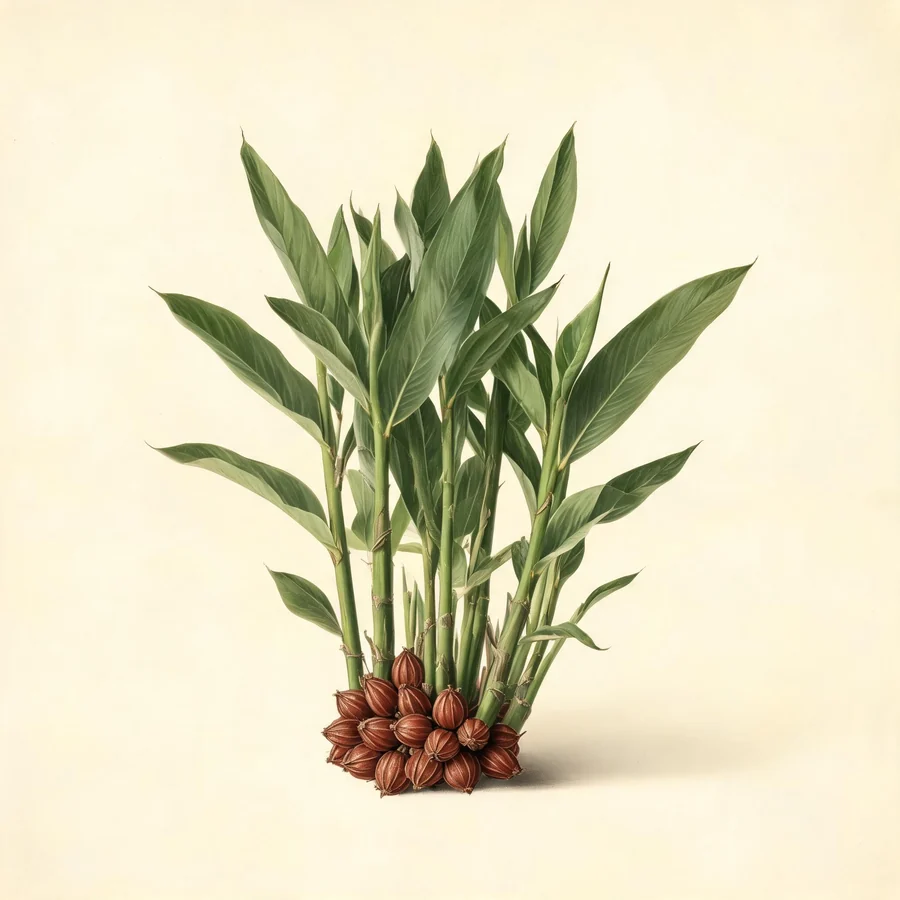
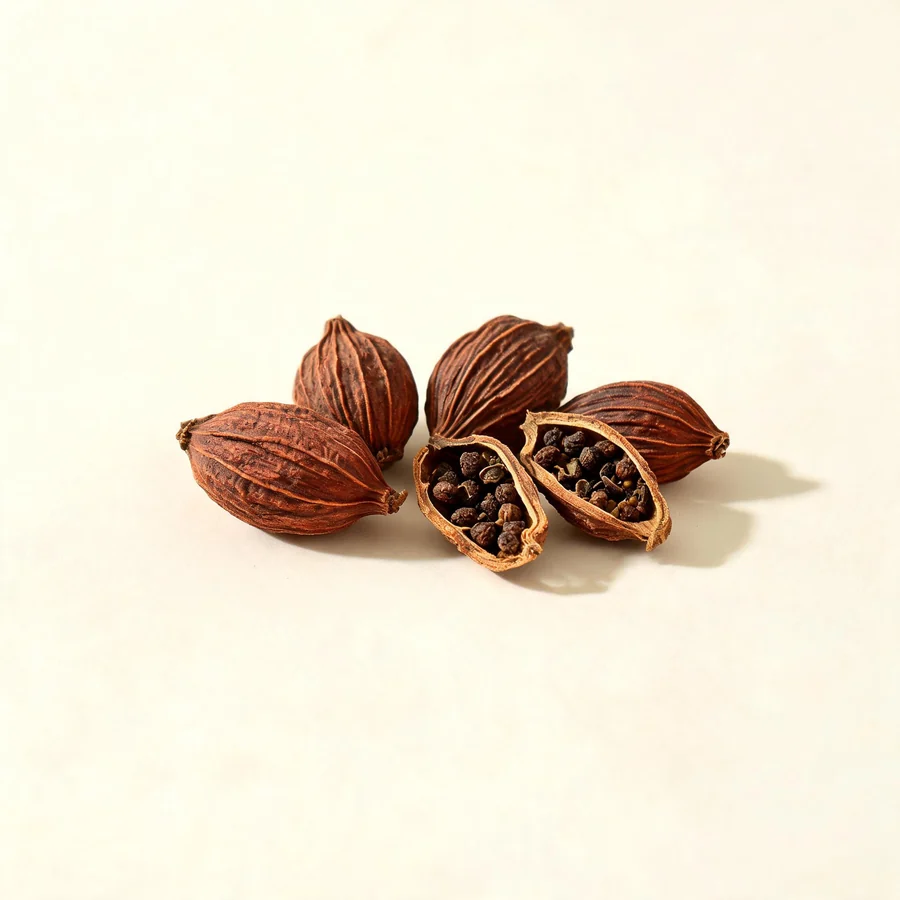
Skin profile
Where this herb sits in skin practice: the pattern it corrects, the skin signs it suits, and what it should not be used for.
Cao Guo is the narrowest herb on this list and the one most easily misused. It is chosen for cold, clammy, greasy skin in a cold, heavy person, and it is stopped as soon as the tongue coat thins. It has no place in a hot, red or dry skin picture, and it is not a substitute for treating a skin infection.
Skin signs that suggest it
- Skin that feels cold and clammy to the touch, with a greasy sheen over it
- A thick white greasy tongue coat, a full heavy epigastrium and a poor appetite
- Loose stools carrying undigested food, a cold belly and cold limbs alongside the skin trouble
- Limbs that feel heavy and a body that feels damp, worse in cold wet weather
- Dampness that returns whenever the digestion is unsettled or the diet is rich
When it is not the right herb
Not for dry skin, and not for Yin deficiency with thirst, night sweats and a tongue that is red and peeled: a warm drying fruit only sharpens that dryness. Not for hot, red, inflamed or yellow-weeping lesions, which are damp-heat and need clearing rather than warming. Not for a feverish illness without a greasy coat. It is also not for long courses, since the drying quality is the very thing that limits it.
What it does for skin
Skin-relevant actions only. Each one describes a mechanism in TCM terms and what it looks like on the skin.
Warms the Middle so Cold-Damp stops being produced
The tradition locates the origin of much skin Dampness in a Spleen and Stomach too cold to transform food and fluid. Cao Guo warms that centre with real force, which is a different action from drying what has already collected on the surface. It is used where the digestion is heavy, the abdomen cold and the stool loose, and the skin is wet and cold at the same time.
Dries greasy, clammy moisture from the surface
Its acrid warmth is described as drying Dampness wherever the Dampness sits, and the visible result on the skin is less clamminess and less of the sticky sheen that keeps folds damp and irritated. It is combined with milder aromatics so the drying is distributed rather than concentrated, and small amounts are used because the effect is strong.
Moves the Qi that has stalled behind the Dampness
Dampness and Qi stagnation reinforce each other: fluid does not move because Qi is not moving, and Qi cannot move because fluid weighs it down. The fruit's aroma is read as penetrating, and it frees the middle so the Dampness can be shifted. That is why it appears in formulas for a stuffed, distended abdomen rather than in single-herb prescriptions.
Reaches thick, turbid Dampness that lighter aromatics leave behind
Aromatic herbs differ in strength, and this is the strong one: it is chosen when the coating is thick and greasy, the phlegm is turbid and the heaviness is pronounced. The same quality makes it unsuitable for delicate cases, where a gentler aromatic belongs. In skin work the turbidity shows as a greasy layer over damp, cold skin.
Skin conditions it is used for
Mapped to the condition pages on this site. The pattern column shows what the skin is doing when this herb is the right choice.
| Condition | Pattern | Why it suits | Typical setting |
|---|---|---|---|
| Cool or clammy skin sensation | Cold-damp in the middle with Yang not reaching the surface | Cold clamminess in a person with a cold abdomen, a thick white coat and a heavy body is read as Yang failing to warm the surface because Dampness is blocking the middle. Cao Guo warms and dries that blockage, and it is used with Cang Zhu and Hou Po rather than alone. Sudden cold clamminess with chest pain or breathlessness is a medical emergency. | Modified Ping Wei San with Cang Zhu and Hou Po |
| Moist skin sensation | Persistent Dampness that keeps the surface wet | Skin that stays damp without much sweating, in a body that feels heavy and a climate that is wet, is read as fluid metabolism that has slowed rather than as Heat. The fruit dries the Dampness from the middle so less reaches the surface, and it is given in a small dose within a formula. Moist skin over hot, red lesions is a different pattern and is not treated this way. | Modified Wei Ling Tang with Cang Zhu and Cao Guo |
| Oily or clammy skin sensation | Cold-Damp with a waxy sheen from a sluggish Spleen | A waxy, sticky sheen with a heavy head and a greasy coat is read as Dampness the Spleen is not clearing, and the fruit is chosen when the picture is cold rather than hot. It is used with Cang Zhu and Chen Pi so the Dampness is moved and dried at the same time. It is a supporting measure and is stopped as soon as the coat thins, because prolonged drying takes the skin's own moisture with it. | Modified Ping Wei San with Cang Zhu and Chen Pi |
| Skin swelling | Cold-Damp fluid with heaviness and cold limbs | Puffy, heavy swelling in a cold person with scanty urine and a greasy coat is fluid that has collected because the middle is not transforming it. The fruit warms and dries the source while draining herbs move the fluid, so it is a supporting component of a formula rather than the treatment itself. Swelling of one leg, breathlessness or sudden weight gain needs medical assessment. | Modified Wu Ling San with Cang Zhu and Gui Zhi |
Combinations for skin
Herbs it is paired with when the skin, not an internal organ, is the target.
| Partner | Ratio | Why the pair is used |
|---|---|---|
| Hou Po | 3 to 5 g Cao Guo with 6 to 10 g Hou Po | Hou Po shifts Qi and eases distension, and the fruit dries Dampness and scatters Cold, so a stuffed heavy abdomen is attacked from two directions. The pair is used where the skin is cold and clammy and the digestion is loaded, and the proportion shifts according to whether heaviness or bloating leads. Neither herb is given for long. |
| Cang Zhu | 3 to 5 g each | Cang Zhu is the milder drying aromatic and Cao Guo the stronger one, so the pair lets a formula dry Dampness without overdoing it. It is used where cold-damp shows on the skin as clamminess and in the body as heaviness, with a thick white coat. Cang Zhu can be continued longer; the fruit is the short-term strengthening. |
| Zhi Mu | 3 to 5 g Cao Guo with 6 to 10 g Zhi Mu | Zhi Mu belongs to the cold herbs that clear Heat; the fruit warms and dries Cold. The classical pairing is used where cold and heat are mixed, so that treating one side would drive the problem further in. In skin practice it suits a damp picture with a hot, dry mouth, and the ratio is adjusted to whichever element predominates. |
| Sha Ren | 3 to 6 g each | Two warm aromatics with a similar reach: Sha Ren regulates Qi and checks nausea, where the fruit dries harder. The pair suits cold-damp with nausea and a thick coat, and Sha Ren is the gentler partner when the stomach is delicate or the course runs longer. |
Formulas where it leads
- Da Yuan Yin (达原饮) - The classical formula for damp-turbidity lodged between the surface and the interior, from the treatise on epidemic disease. Cao Guo is a deputy in it, and the formula is the origin of the idea that a fiercely aromatic substance can reach turbidity that ordinary herbs miss. Its skin relevance is indirect: the same reasoning underlies using the fruit when Dampness is thick and cold.
Safety for skin use
What to check before recommending or using it, including the cautions that matter most for skin patients.
Do not use, or use with caution
- Yin deficiency with dryness: thirst, a tongue that is red and peeled, sparse dark urine and a pulse that is fine and rapid. Warmth and drying of this order sharpen dryness further, and the skin ends drier rather than calmer.
- Hot, red, inflamed or yellow-weeping lesions, which are damp-heat rather than cold-damp. Warming them drives the problem further in, and the classical exclusion lists are explicit on this point.
- A feverish illness without a greasy tongue coat, and any skin flare that is spreading quickly. Neither is a cold-damp picture, and warming treatment is the wrong direction.
- Prolonged use at medicinal dose. Drying of this strength uses up fluid, leaving thirst, a sore throat and a hard stool.
Pregnancy and breastfeeding
The current Chinese Pharmacopoeia neither prohibits nor cautions against it in pregnancy, and no uterine action is known, so a blanket ban is not warranted. That is not a recommendation. Yin and Blood are already under strain in pregnancy, and the fruit is warm and drying, so it is kept to a clearly cold-damp picture at the smallest dose that works, and stopped once that picture clears. Culinary amounts while breastfeeding are not a concern, but at medicinal doses the warmth and dryness could in theory reach the milk, so use is guided and brief.
Interactions
- Diabetes medicines: laboratory and animal work shows the extract blocking alpha-glucosidase and reducing blood glucose, so effects could add to insulin, metformin, acarbose or a sulfonylurea. Glucose monitoring is the sensible response, and the risk is greatest where control is already tight.
- Anticoagulants: no bleeding has been reported, but spice oils of this kind can nudge platelet behaviour, so the usual care applies to anyone on warfarin or a similar medicine. At culinary doses neither interaction is realistic.
- No clinical interaction studies exist for the fruit, so the notes above are reasoned from laboratory work. The practical rule is disclosure to a prescriber, particularly when several medicines are taken.
Allergy and patch testing
Allergy is uncommon, but the fruit is a spice in the ginger family and reactions to that family occur. Contact reactions from herb-containing creams are a separate matter and are patch tested. Because the fruit is strongly aromatic, a first medicinal dose is best kept small.
General safety references
General references for herbal hepatotoxicity and herb-drug interactions; they are not specific to this herb.
- Review article: Herbal hepatotoxicity - an update on traditional Chinese medicine preparations. Alimentary Pharmacology & Therapeutics, 2014. PMID: 24844799.
- Interactions between herbal medicines and prescribed drugs: an updated systematic review. Drugs, 2009. PMID: 19719333.
- Warfarin and food, herbal or dietary supplement interactions: a systematic review. British Journal of Clinical Pharmacology, 2021. PMID: 32478963.
Evidence
The classical record is quoted with its source. The modern note states the level of evidence plainly.
Classical record
草果,辛温燥烈,善除寒湿而温燥中宫,故为脾胃寒湿主药。
Cao Guo is pungent, warm and fiercely drying. It is good at removing cold-dampness and at warming and drying the middle palace, which is why it is the principal herb for cold-dampness of the spleen and stomach.
Ben Cao Zheng Yi (Materia Medica in the Correct Sense) - The line that settled its standing in the materia medica, and the basis for the drying action described here.
凡疟不由于瘴气;心痛胃脘痛由于火而不由于寒;湿热瘀滞,暑气外侵而成滞下赤白、里急后重及泄泻暴注、口渴;湿热侵脾因作胀满或小水不利,咸属暑气温热,皆不当用。
Where malaria does not come from miasmic air; where pain in the heart or the stomach comes from fire rather than cold; where damp-heat and summer-heat produce dysentery with red and white mucus, straining, or sudden watery diarrhoea with thirst; where damp-heat in the spleen causes distension or difficult urine: in all these the condition is warm or damp-heat, and Cao Guo should not be used.
Ben Cao Jing Shu (Commentary on the Materia Medica) - A classical list of exclusions, written against precisely the mistake a modern reader makes when a warm aromatic is reached for on red or hot skin.
草果,与知母同用,治瘴疟寒热,取其一阴一阳无偏胜之害,盖草果治太阴独胜之寒,知母治阳明独胜之火也。
Cao Guo, used together with Zhi Mu, treats the chills and fevers of miasmic malaria: one is yin and one is yang, so neither predominates to cause harm. Cao Guo treats the cold that dominates in the Taiyin, and Zhi Mu treats the fire that dominates in the Yangming.
Ben Cao Gang Mu (Compendium of Materia Medica), Li Shizhen - The pairing with Zhi Mu is the classical answer to mixed cold and heat, and it is the reasoning behind using a warming aromatic beside a cooling herb in a stubborn damp picture.
Modern evidence
Evidence status
- Laboratory studies of the volatile oil, which is rich in cineole and citral, report antibacterial, antifungal and alpha-glucosidase-inhibiting activity. These are laboratory findings, and they do not establish a skin benefit.
- No clinical trials of Cao Guo in skin disease exist, and the fruit is studied far more as a spice and as a component of antimalarial formulas than as a dermatological treatment. The skin use described here is traditional reasoning rather than evidence.
- Regulatory status: the fruit appears in the Chinese Pharmacopoeia, where its food and medicine uses are both recognised. This page describes traditional practice and the state of the evidence; it is not a claim of proven benefit.
PubMed records
Selected real PubMed records for this herb's species or its constituents, chosen by species name and title relevance. They are references for the non-TCM discussion above, not proof that the herb treats any skin condition.
- Analysis of chemical composition, antibacterial activity, antioxidant properties, and cytotoxicity of essential oils from four plant fruits.. Microbial pathogenesis, 2025. PMID: 41135723 (safety record).
Dose and forms
Skin-practice dosing and the preparations that suit skin complaints.
| Form | Dose and notes |
|---|---|
| Decoction | 3 to 6 g of the shelled, crushed seed daily within a formula. The lower figure is for mild cold-damp and for use beside other aromatics, the higher for pronounced obstruction with distension. |
| Preparing the seed | The shell comes off and the seeds are crushed, then dropped in five to ten minutes before the end of decoction, since the working constituents are volatile. |
| Course length | Short, a week or two at most for a skin indication, and stopped once the tongue coat thins. Continued drying leaves the mouth dry and the skin drier than before. |
Three things decide the dose: whether the obstruction is mild or marked, whether other warming aromatics are already in the formula, and how dry the person is to begin with. The fruit is a spice as much as a medicine, and a spoonful in a braised dish is cooking rather than treatment. Because the action is drying rather than nourishing, the smallest amount that changes the tongue coat is the right one.
Citations and further reading
Only real sources are listed: the classical materia medica passages quoted above, and the source works behind the botanical and safety statements.
- Ben Cao Zheng Yi (Materia Medica in the Correct Sense), Qing period - classical entry quoted above.
- Ben Cao Jing Shu (Commentary on the Materia Medica), Ming period - classical entry quoted above.
- Ben Cao Gang Mu (Compendium of Materia Medica), Li Shizhen, 1578 - classical entry quoted above.
- Cao Guo monograph: Pharmacopoeia of the People's Republic of China - source for the accepted botanical source, part used and food-medicine status.
- Modern evidence statement: based on laboratory literature on the volatile oil of Lanxangia tsao-ko, summarised as a statement about the level of evidence rather than as a cited finding.
- Botanical description: botanical literature on Lanxangia tsao-ko, formerly Amomum tsao-ko, Zingiberaceae.
Educational reference for qualified practitioners. This page is not medical advice, and skin conditions should be diagnosed by a clinician before treatment.