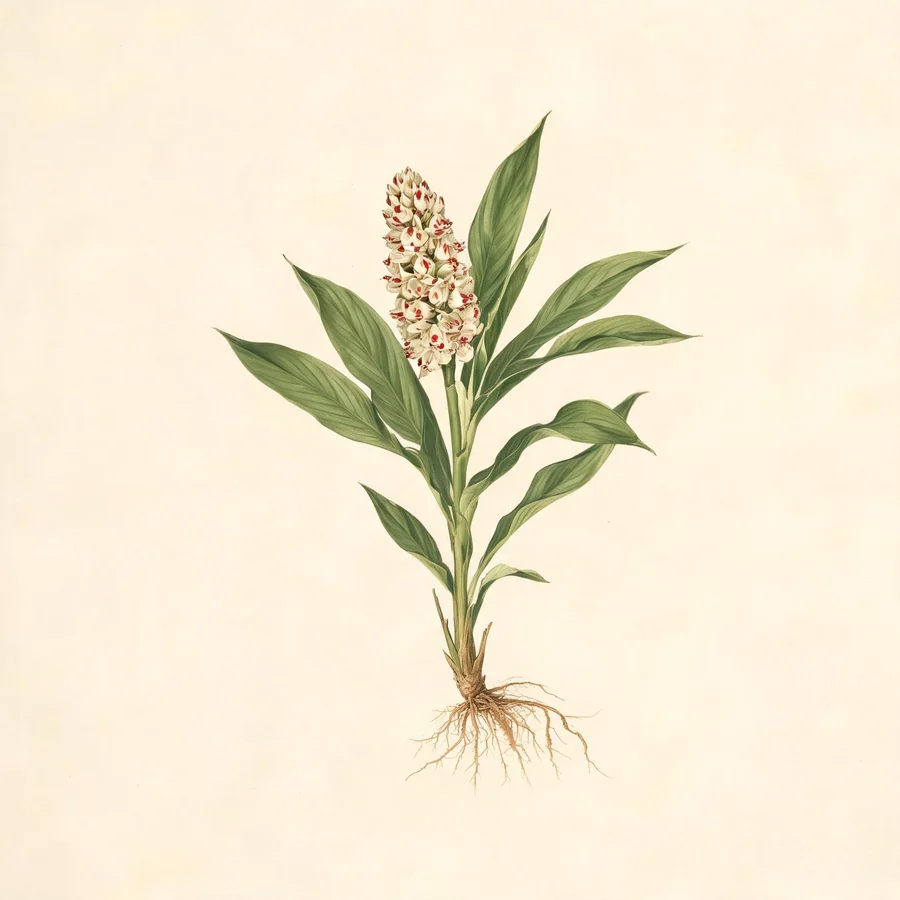
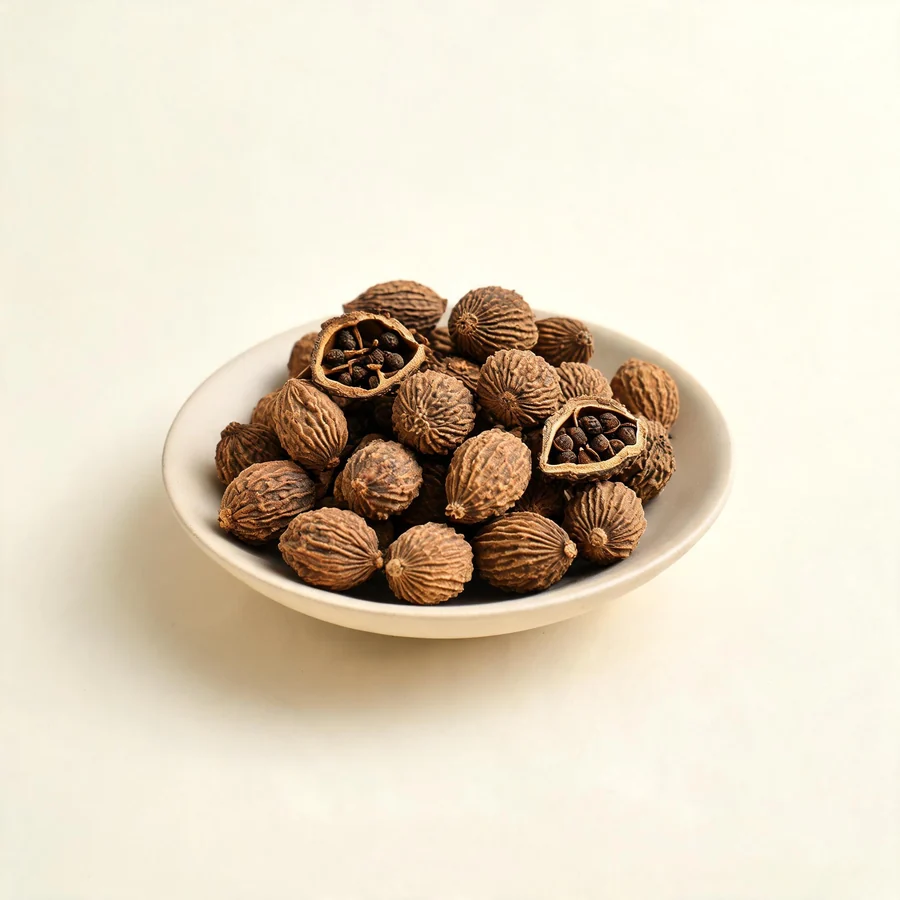
Skin profile
Where this herb sits in skin practice: the pattern it corrects, the skin signs it suits, and what it should not be used for.
Sha Ren is an assistant on a skin page. It is added in small amounts to dry a damp terrain and, more often, to keep a rich prescription from sitting in a weak stomach. It is chosen for greasy, clammy, heavy skin with a coated tongue, never for dry or inflamed skin, and it is stopped when the coat clears.
Skin signs that suggest it
- Skin that is oily or clammy, with a greasy sheen and a heavy, full feeling in the abdomen after eating
- A thick greasy white tongue coat, a poor appetite and a heavy, dull taste that lingers, alongside the skin trouble
- Loose stools with undigested food and a bloated middle that worsens through the day
- A greasy scalp with adherent pale scale that returns quickly after washing
- Dampness that flares after rich, fried or creamy food, and settles when the diet is plain and warm
When it is not the right herb
Not for dry skin, a dry mouth or a tongue that is red with little coating: the fruit is warm, aromatic and drying, and it takes up fluid that is already short. Not for hot, red, inflamed or weeping skin, which is damp-heat and needs clearing rather than warming. Not for a dry cough from Lung Heat, since this fruit never enters the Lung channel, and warmth added to heat makes a cough worse. It is also not a treatment in its own right: a skin problem with a damp middle still needs the skin looked at, and a greasy scalp that is red, itchy and spreading needs a diagnosis rather than a spice.
What it does for skin
Skin-relevant actions only. Each one describes a mechanism in TCM terms and what it looks like on the skin.
Transforms Dampness, so the surface stops being fed
The tradition treats much greasy, clammy skin as Dampness produced in a Spleen that cannot transform food and fluid. The fruit's aroma is read as waking the Spleen so the Dampness is processed rather than pushed out to the skin. That is an indirect action, and it is why the herb is used in small amounts beside drying and Qi-moving herbs rather than as the lead. The visible signals of success are a thinner coat, a lighter abdomen and less greasiness on the surface.
Keeps a rich skin formula from sitting heavily
Prepared rehmannia, ass hide glue and other rich Blood and Yin herbs are the backbone of formulas for chronic dry, scaly and itchy skin, and they are notoriously hard to digest. The classical technique crushes a small quantity of fruit and mixes that with the sticky herb before decocting, so the aroma cuts the richness while the warmth keeps the middle moving. This is the most common reason the fruit appears in a skin prescription at all.
Warms the middle where cold has slowed it
Where cold has weakened the Spleen, food sits, the abdomen distends and the stool becomes loose with undigested food. The fruit is described as warm without being fierce and as moving Qi without breaking it, which is why it can be given for longer than most warm aromatics. On the skin the result is a warmer, drier surface, and it is the reason the herb suits the cold-damp rather than the hot-damp end of the greasy spectrum.
Settles nausea so a skin formula can be taken
Many of the cooling and bitter herbs used for inflamed skin are hard on the stomach, and a proportion of people cannot continue them because of nausea. The fruit settles the Stomach and checks vomiting, so it is added to keep a necessary prescription down. It is a practical rather than a therapeutic role, and it explains why a skin formula for a sensitive patient often carries a gram of an aromatic fruit that has nothing to do with the lesion.
Skin conditions it is used for
Mapped to the condition pages on this site. The pattern column shows what the skin is doing when this herb is the right choice.
| Condition | Pattern | Why it suits | Typical setting |
|---|---|---|---|
| Oily or clammy skin sensation | Dampness with a sluggish Spleen, cold rather than hot | An oily, clammy surface with a heavy head, a full abdomen and a greasy white coat is read as Dampness the Spleen is not clearing, and the fruit is chosen when the picture is cool rather than hot. It is given with Chen Pi and Cang Zhu so the Dampness is moved and dried together. Where the same surface is red, hot and inflamed, the reading is damp-heat and this herb is the wrong tool. | Modified Ping Wei San with Sha Ren and Chen Pi |
| Moist skin sensation | Dampness held in the middle with a pale greasy coat | Skin that feels damp without sweating, in a heavy person with a poor appetite and a soft stool, is read as fluid that is not being transformed rather than as heat or as a sweat problem. A small amount of the fruit within a broader drying formula wakes the Spleen so that less fluid reaches the surface. Moist, weeping, red lesions are a different picture, and the distinction is made on colour and on the tongue. | Modified Xiang Sha Liu Jun Zi Tang |
| Dandruff | Greasy scale from Dampness in a cold Spleen | Pale, greasy, adherent scale that returns within days of washing, in a person with a coated tongue and a heavy middle, is read as Dampness rising to the scalp rather than as dryness. The fruit is a supporting herb that dries the source, and it is given with Chen Pi, Cang Zhu and Fu Ling. A red, inflamed, itchy scalp with yellow scale is seborrhoeic dermatitis of the damp-heat type and needs a different approach. | Modified Ping Wei San with Sha Ren and Cang Zhu |
| Eczema | Chronic eczema treated with rich tonics in a weak digestion | Chronic eczema in a depleted person is often treated with Blood and Yin tonics, and a weak digestion can refuse them: the abdomen bloats, the tongue coats and the stool loosens, and the patient stops the formula. The fruit is added in a small dose to keep that prescription moving, which is a technical service to the treatment rather than a treatment of the eczema. It is never used where the eczema itself is red, weeping and hot. | Si Wu Tang or Dang Gui Yin Zi with a small amount of Sha Ren |
Combinations for skin
Herbs it is paired with when the skin, not an internal organ, is the target.
| Partner | Ratio | Why the pair is used |
|---|---|---|
| Chen Pi | 3 to 6 g Sha Ren with 6 to 10 g Chen Pi | Chen Pi is the everyday Qi regulator and the fruit is the more aromatic, more warming one, so the pair covers a stagnant middle at two depths. It is used where the skin is greasy and the abdomen full, with belching and a poor appetite. Chen Pi is continued for longer; the fruit is the shorter, sharper element and is dropped when the coat thins. |
| Bai Zhu | 6 to 10 g Bai Zhu with 3 to 6 g Sha Ren | Bai Zhu tonifies the Spleen and dries Dampness, and the fruit aromatically clears what Bai Zhu has dried, so the pair avoids the flatness that a drying tonic can leave. It is the usual answer when a weak Spleen leaves the middle bloated, and on a skin page it is used when clammy, greasy skin sits on that terrain. Bai Zhu supplies the strength and the fruit keeps the result from stagnating. |
| Mu Xiang | 3 to 6 g each | Mu Xiang moves Qi in all three burners and is the stronger, more dispersing partner, while the fruit warms and wakes the Spleen. Together they are the fragrant pair behind the formulas for distension with a poor appetite, and they are used where a skin flare arrives with a tight, bloated abdomen. Neither is given for long, and the pair is reduced as soon as the abdomen feels lighter. |
| Shu Di Huang | 10 to 15 g Shu Di Huang with 1 to 2 g Sha Ren | Prepared rehmannia is the richest Blood and Yin herb in the materia medica and the one most likely to sit in the stomach of a patient whose skin needs nourishing. A gram or two of the crushed fruit, mixed with the rehmannia before decocting, cuts the stickiness and keeps the digestion moving. The pairing is the classical answer to the problem of tonifying someone who cannot digest tonics, and it is used in the formulas for chronic dry skin in a depleted person. |
Formulas where it leads
- Xiang Sha Liu Jun Zi Tang (香砂六君子汤) - The formula named after the fruit and Mu Xiang, built on the Six Gentlemen with Chen Pi and Ban Xia to tonify the Spleen while moving the Dampness it cannot clear. Its skin relevance is indirect and is stated as such: it is the model for adding a small aromatic to a tonifying prescription so that the patient can keep taking it. It is not a skin formula and it is not given in dry or hot pictures.
Safety for skin use
What to check before recommending or using it, including the cautions that matter most for skin patients.
Do not use, or use with caution
- Yin deficiency with dryness: a dry mouth and throat, night sweats, a red tongue with little coating and dry, scaly skin. The fruit is warm and aromatic and takes up fluid that is already short.
- Heat patterns: red, hot, inflamed or weeping skin, a sore throat with fever, or a cough from Lung Heat. This fruit never enters the Lung channel, and its warmth adds to heat.
- Damp-heat with dark urine, a bitter taste and a yellow greasy coat. Warming a hot damp picture drives it further in, and the skin usually flares.
- Prolonged use at a drying dose. Used as a daily aromatic for months it leaves the mouth dry and the skin drier, so it is given for the length of the prescription it is supporting and no longer.
Pregnancy and breastfeeding
The tradition actively indicates this fruit in pregnancy, for nausea and for a restless fetus, and it is a component of the classical prescription for threatened miscarriage. Amounts stay at three to six grams, under guidance rather than self-prescribed. The exception is restlessness arising from Blood Heat, where warmth is the wrong instrument. On a skin page the point is narrower: if the fruit is being used to keep a skin formula down in pregnancy, the whole formula is reviewed rather than the fruit alone.
Interactions
- Anticoagulants and antiplatelet medicines. Laboratory work reports that the fruit can inhibit platelet clumping and lengthen clotting time, so it is a theoretical addition to warfarin, heparin, aspirin or clopidogrel. No case has been reported at the small doses used, and the sensible response is disclosure rather than avoidance.
- Glucose-lowering medicines. Extracts have lowered post-meal glucose in laboratory work, probably by blocking an intestinal enzyme, so readings are worth checking in anyone on insulin or a sulfonylurea.
- Any medicine where absorption matters. The fruit alters the movement of the gut, stimulating and then slowing it, so the rate at which a tablet is absorbed could in theory change. That matters most for medicines with a narrow margin, and doses are separated where it is easy to do so.
Allergy and patch testing
The fruit is a ginger-family spice, and reactions to that family occur, usually as a mild rash or itch after oral use rather than as a contact reaction. A first medicinal dose is kept small, and a herb-containing wash or ointment is patch tested for a day. Stop if the skin or the mouth becomes more irritated, and treat swelling, wheeze or faintness as an emergency.
General safety references
General references for herbal hepatotoxicity and herb-drug interactions; they are not specific to this herb.
- Review article: Herbal hepatotoxicity - an update on traditional Chinese medicine preparations. Alimentary Pharmacology & Therapeutics, 2014. PMID: 24844799.
- Interactions between herbal medicines and prescribed drugs: an updated systematic review. Drugs, 2009. PMID: 19719333.
- Warfarin and food, herbal or dietary supplement interactions: a systematic review. British Journal of Clinical Pharmacology, 2021. PMID: 32478963.
Evidence
The classical record is quoted with its source. The modern note states the level of evidence plainly.
Classical record
Acrid in flavour and warm in nature, and free of toxicity.
Kai Bao Ben Cao (Materia Medica of the Kai Bao Era) - Song dynasty. The shortest early entry, and the basis for counting the fruit as non-toxic and as a food.
Acrid and warm in flavour, with a rich fragrance: the aroma reaches the Spleen and the acridity has a moistening effect on the Kidneys; the tradition therefore counts it indispensable in opening the Spleen and Stomach and as a leading agent for harmonising the middle Qi. In Kidney deficiency where the Qi will not return to its root, no formula succeeds unless this fruit guides it.
Ben Cao Jing Shu (Commentary on the Materia Medica) - The rationale behind the salt-prepared form and the Kidney entry, and the reason a Spleen aromatic appears in formulas for the lower body.
It warms the middle and harmonises the Qi: acrid, fragrant and penetrating, warm without ferocity, moving without depleting, harmonising without contention. It opens the Triple Burner and warms the six Fu, rouses the Spleen, nourishes the Stomach and Kidneys, and settles a stagnant Liver and Gallbladder, which is why it is valued for steadying a pregnancy.
Ben Cao Hui Yan (Collected Discourses on the Materia Medica) - The passage behind the claim that this fruit is safe in pregnancy, and the basis for calling it the gentlest of the warm aromatics.
Modern evidence
Evidence status
- Laboratory work on the volatile oil, which is rich in bornyl acetate and camphor, reports antibacterial, antifungal and anti-inflammatory activity, and extracts have been shown to affect gut motility. These are laboratory and animal findings, and they do not establish a benefit for any skin condition.
- No clinical trial of the fruit in skin disease exists. It is studied as a digestive herb and as a spice, and where it appears in dermatological formulas it is an assistant whose contribution has never been separated from the rest of the prescription.
- Regulatory status: the fruit is an accepted herbal substance in the Chinese Pharmacopoeia, and it is on the list of substances that are both food and medicine. This page describes traditional practice and the state of the evidence; it is not a claim of proven benefit.
PubMed records
Selected real PubMed records for this herb's species or its constituents, chosen by species name and title relevance. They are references for the non-TCM discussion above, not proof that the herb treats any skin condition.
- Fructus Amomi extract attenuates nasal inflammation by restoring Th1/Th2 balance and down-regulation of NF-κB phosphorylation in OVA-induced allergic rhinitis.. Bioscience reports, 2022. PMID: 35274678 (skin-related record).
Dose and forms
Skin-practice dosing and the preparations that suit skin complaints.
| Form | Dose and notes |
|---|---|
| Decoction | 3 to 6 g of the dried fruit daily, added to a decoction in its last five to ten minutes. One to two grams is enough when the fruit is only there to keep a rich formula moving. |
| Powder and pills | 1 to 2 g of the ground fruit, taken with warm water or folded into pills, which avoids losing the aroma in steam and suits a short course. |
| Course length | As long as the prescription it is supporting, and no longer. The fruit is stopped when the tongue coat clears and the abdomen feels light, because from that point it dries without benefit. |
Amounts are small because the aroma does the work, and that aroma is volatile: crushed just before use and added at the end of decoction, it works, while a twenty-minute boil leaves a brew that smells of nothing. The classical technique of crushing one or two grams and mixing it with prepared rehmannia before decocting is the practical version of the same idea. The margin is wide, since the fruit is a food spice, and the limit on a skin course is dryness rather than toxicity.
Citations and further reading
Only real sources are listed: the classical materia medica passages quoted above, and the source works behind the botanical and safety statements.
- Kai Bao Ben Cao (Materia Medica of the Kai Bao Era), Song dynasty - classical entry translated above.
- Ben Cao Jing Shu (Commentary on the Materia Medica), Ming period - classical entry translated above.
- Ben Cao Hui Yan (Collected Discourses on the Materia Medica), Ming period - classical entry translated above.
- Fructus Amomi monograph: Pharmacopoeia of the People's Republic of China - source for the accepted botanical source, part used and quality requirements.
- Modern evidence statement: based on laboratory and animal literature on the volatile oil of Amomum villosum, summarised as a statement about the level of evidence rather than as a cited finding.
- Botanical description and identification: botanical literature on Amomum villosum, Zingiberaceae.
Educational reference for qualified practitioners. This page is not medical advice, and skin conditions should be diagnosed by a clinician before treatment.