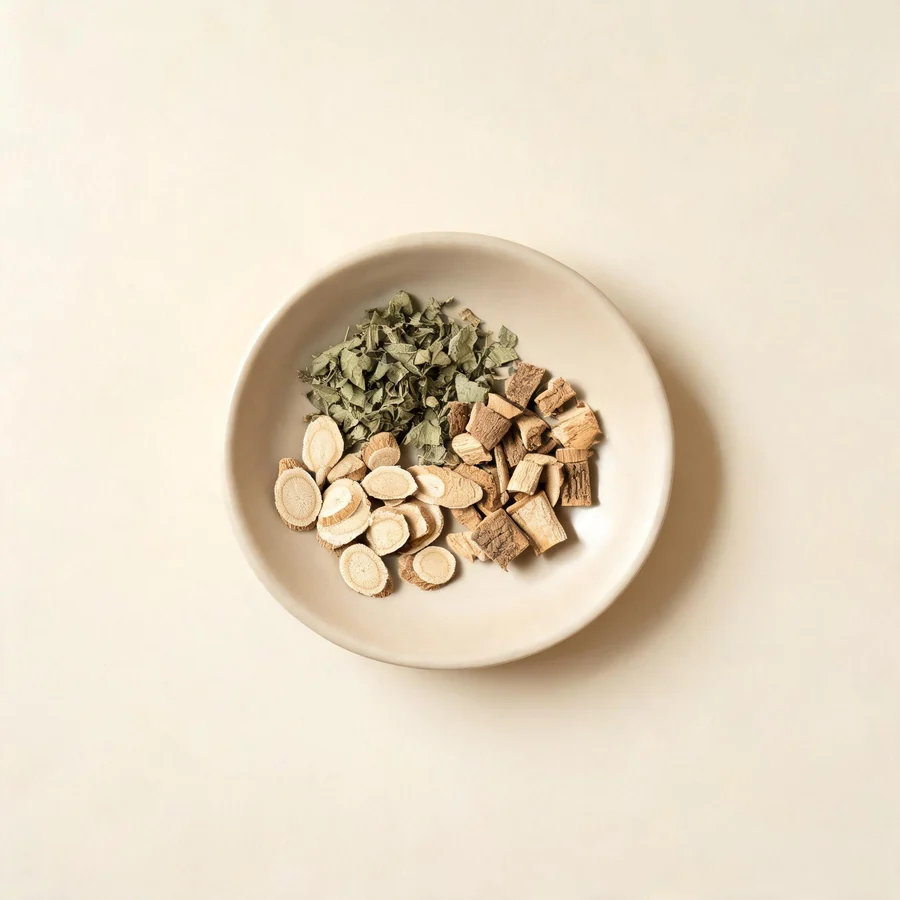
Understanding Oily or clammy skin sensation
The tradition describes oily or clammy skin as almost always a sign of Dampness, a heavy sticky pathological fluid that accumulates when fluid metabolism is impaired.
The Spleen and Stomach transform food and drink. When they are sluggish, fluids are not fully processed and dampness accumulates, showing on the surface as a film or stickiness rather than a healthy glow.
Damp-Heat in the Stomach and Spleen gives oily greasy skin on face and scalp with a sticky taste, bloating after meals and incomplete bowel movements. Spleen deficiency with dampness gives a milder clamminess with fatigue worse after meals and loose stools.
Liver and Gallbladder damp heat adds irritability, a bitter taste especially in the morning, and oily skin with redness and itching. Phlegm-Dampness in the Middle Burner is the thickest version: skin that feels coated with a greasy film rather than merely shiny, with a heavy sluggish body.
Dampness rarely travels alone. Heat from spicy food, alcohol or frustration can join it, and the result is skin that is not only oily but red, itchy and inflamed, with the Stomach and Spleen or the Liver and Gallbladder involved. Where the Spleen is simply too weak to push fluids along, the clamminess feels cool and is joined by fatigue and poor digestion. Where dampness has been present for years it thickens into Phlegm, and the film on the skin becomes heavy and coated rather than merely shiny.
That is why one person notices the film after a rich meal, another during a stressful week, and a third all day whatever is eaten. The tongue and pulse tell the practitioner where the dampness comes from and whether heat is part of it, and treatment follows that reading rather than the sensation alone.
Conventional view
Western medicine reads oily skin as the sebaceous glands making too much sebum, under the influence of hormones, genetics or skincare habits, and clammy skin as excessive sweating or the sensation of cool moisture that comes with anxiety, autonomic imbalance or a metabolic condition. The diagnosis rests on history and examination, and treatment is aimed at the surface.
Topical retinoids, salicylic acid and benzoyl peroxide reduce oiliness, and severe cases may be offered oral isotretinoin. For clamminess and sweating, antiperspirants, iontophoresis, botulinum toxin injections or medication that reduces sweating are used, alongside gentle cleansing and lighter moisturisers.
These approaches control the surface but do not address why the skin overproduces in the first place. Isotretinoin loads the liver, antiperspirants can irritate sensitive skin, and every case of oily or clammy skin is handled as one problem rather than as dampness, heat, deficiency or Phlegm with its own logic.
Selected PubMed records
Real PubMed records for the conventional discussion above, selected by condition name and title relevance. They are references, not a claim that any treatment is proven for this condition.
- Hyperhidrosis: Management Options.. American family physician, 2018. PMID: 30215934.
- Treatment of Hyperhidrosis: An Update.. American journal of clinical dermatology, 2022. PMID: 35773437.
How it connects
Oily or clammy skin seldom appears alone, because it is the surface expression of internal dampness. Acne gathers with bad breath, and with a bitter taste in the mouth, when Damp-Heat rises from the digestive system, so the same turbid heat that greases the face also produces spots and a taste or odour that is unpleasant. Abdominal distension and sticky, incomplete stools belong to the same picture: they show that the Spleen is failing to transform and transport fluids, and the dampness that clams the skin is the dampness that bloats the belly.
How it is assessed
The practitioner assesses the quality of the film and the digestive picture.
What a practitioner looks for
- Thickness: a shine suggests Damp-Heat; a thick greasy film suggests Phlegm-Dampness.
- Digestive signs: bloating, sticky taste and incomplete stools support the damp patterns.
- Emotional signs: irritability with a bitter morning taste suggests Liver and Gallbladder damp heat.
- Red flags: clammy skin with fever, stiff neck, confusion or spreading redness is an emergency.
The first question is what the skin actually feels like: greasy, clammy or both, and when. A yellow greasy coating on the tongue points to heat, a pale swollen tongue carrying white fur points to deficiency, and the digestive symptoms, energy and mood then locate the dampness in a particular organ system.
Shiny skin with red inflamed lesions, a craving for rich or spicy food, a red tongue under a thick yellow greasy coating, and a pulse both slippery and rapid describe Stomach and Spleen Damp-Heat, usually with bloating, heaviness and sticky or constipated stools. Clammy skin with chronic tiredness, loose stools and a poor appetite, a tongue that is pale, puffy and marked by teeth, and a pulse weak as well as slippery describe Spleen Deficiency with Dampness, where redness is slight because the body has too little strength to move its fluids.
Irritability with oily red itchy skin, a bitter taste, a dry mouth, a red tongue with yellow grease and a pulse that is wiry and rapid points to Liver and Gallbladder Damp-Heat. A thick heavy film with cystic lesions or nodules, a thick greasy coating, a slippery pulse and a heavy chest or head point to Phlegm-Dampness in the Middle Burner.
TCM patterns in Oily or clammy skin sensation
Four patterns account for most oily or clammy skin, and they differ in practical ways: how thick the film feels, whether heat sits behind it, which organ carries the dampness, and how much energy the body has to work with it. A shine that returns quickly with redness and irritation is a different problem from a cool clamminess that arrives with tiredness. Reading the tongue and pulse beside the digestion separates them. A yellow greasy coat with a rapid pulse means heat; a tongue that is pale and swollen, coated white, with a weak pulse means deficiency; a thick coating with a slippery pulse means Phlegm. In practice the patterns blend, most often when long-standing dampness from a weak Spleen finally generates heat, or when stress stirs Liver fire into dampness that was already there. The signs below describe each as it usually takes shape, and treatment follows whichever dominates.
| Pattern | Key signs | The itch | Tongue | Main formula |
|---|---|---|---|---|
| Damp-Heat in Stomach and Spleen | Oily greasy skin on face and scalp | Not specified | Body: Red, possibly swollen with teeth marksCoat: Thick, yellow and greasy in the centre and root | Not specified |
| Spleen Deficiency with Dampness | Oily or clammy skin on face and scalp | Not specified | Body: Pale and swollen, often with teeth marks along the edgesCoat: White, greasy and moist, thick in the middle | Not specified |
| Liver and Gallbladder Damp-Heat | Rib-side pain or distension | Oily skin with redness and itching | Body: Red, with redder sidesCoat: Thick, yellow and greasy | Not specified |
| Phlegm-Dampness in the Middle-Burner | Skin feels coated with a thick greasy film | Not specified | Body: Pale and swollen with teeth marksCoat: Thick white greasy and wet | Not specified |
Damp-Heat in Stomach and Spleen
Oily greasy skin on face and scalp with a sticky taste and bloating.
The Spleen and Stomach are the body's processing plant for food and fluid. Load them with fried, rich or heavily spiced food and they cannot keep up, so what should have been transformed stays behind as a sticky turbid dampness. Heat from the same food, from alcohol or from a hot humid climate joins it, and the mixture rises like steam to the face and scalp, which is why the skin feels greasy and looks inflamed rather than simply damp.
The tongue is red, sometimes swollen with teeth marks, under a thick yellow greasy coat at the centre and root. The pulse is soggy and rapid, often slippery. Symptoms worsen with rich, fried or spicy food, alcohol, humid weather, overeating and irregular meals, and ease with light bland meals, plenty of water, gentle walking, a cool dry room and smaller more frequent meals. San Ren Tang is the formula, with Yi Yi Ren, Huang Qin and Cang Zhu, and the points ST-36 (Zusanli), SP-9 (Yinlingquan), ST-44 (Neiting) and REN-12 (Zhongwan).
Signs
- Oily greasy skin on face and scalp
- Bitter or sticky taste in the mouth
- Bloating after meals
- Sticky incomplete bowel movements
Diet and lifestyle for this pattern: Eat light, easy food such as steamed vegetables, congee and mung beans, and avoid greasy, fried, spicy and very sweet food as well as dairy and alcohol. Drink plenty of warm water and mild herbal teas such as chrysanthemum, keep moving gently such as walking or stretching, and keep the skin clean and dry in hot humid conditions.
Spleen Deficiency with Dampness
Mild clamminess with fatigue after meals and loose stools.
Here the dampness comes from lack of power rather than excess. A Spleen weakened by fatigue, worry or an irregular diet cannot manage fluids, so a sticky, heavy dampness gathers inside and rises to the skin, which feels clammy or greasy on the face and scalp. There is no heat in it, so the skin is not red or inflamed; the body is simply too tired to move its fluids properly.
The tongue is pale and swollen with scalloped edges, a white greasy coat and a moist surface. The pulse is soggy and slow, soft to the touch and without force, sometimes slippery. Symptoms worsen with overeating or irregular meals, rich or cold raw food, humidity and mental fatigue, and ease in warm dry weather, with gentle exercise, light warm meals, warm drinks and proper rest. Shen Ling Bai Zhu San, with Bai Zhu and Fu Ling, is the foundation, and the points ST-36 (Zusanli), SP-6 (Sanyinjiao) and REN-12 (Zhongwan).
Signs
- Oily or clammy skin on face and scalp
- Fatigue that worsens after meals
- Loose unformed stools
- Bloating with heaviness
- Pale complexion
Diet and lifestyle for this pattern: Eat warm cooked meals such as soups and congees, and avoid cold, raw or greasy food that burdens the Spleen. Gentle daily walking or yoga circulates Qi and dries Dampness, and a regular, moderate eating schedule without skipping meals or overeating matters as much as the food itself.
Liver and Gallbladder Damp-Heat
Oily skin with redness and a bitter morning taste.
Stress and frustration stall Liver Qi, and Qi that does not move generates heat over time. That heat meets dampness from the diet or from a constitutional weakness, and travels along the Liver and Gallbladder channels to the face and skin, leaving an oily surface that is also red and itchy. The emotional trigger and the skin flare usually arrive together.
The tongue is red, especially at the sides, under a thick yellow greasy coat. The pulse is wiry, slippery and rapid. Symptoms worsen with stress and suppressed anger, greasy fried or spicy food, alcohol and caffeine, and humid weather, and ease with calming practice, cooling food such as cucumber and mung beans, cool showers, gentle walking and by avoiding alcohol and spicy food. Long Dan Xie Gan Tang, with Long Dan Cao, is the classical formula, and the points LR-3 (Taichong) and SP-6 (Sanyinjiao).
Signs
- Irritability and short temper
- Bitter taste especially in the morning
- Oily skin with redness and itching
- Rib-side pain or distension
Diet and lifestyle for this pattern: Focus on cooling, Dampness-draining food such as cucumber, celery, mung beans and bitter greens, and avoid greasy, fried and spicy food as well as alcohol, which fuel Damp-Heat. Prioritise stress management through gentle movement, meditation or time in nature so Liver Qi keeps flowing.
Phlegm-Dampness in the Middle-Burner
A thick greasy film with a heavy sluggish body.
When a weak Spleen is left with dampness for long enough, the dampness thickens into a turbid substance the tradition calls Phlegm. It congests the Middle Burner, the digestive and fluid-processing centre, so fluids are neither transformed nor eliminated and reach the surface as a greasy film so heavy that it feels coated rather than merely shiny. In time the Phlegm clumps under the skin and produces cystic lesions and nodules.
The tongue is pale and swollen with teeth marks, a thick white greasy coat and excessive moisture. The pulse is slippery, slow or moderate, and soggy on pressure, most of all at the right middle position. Symptoms worsen with rich fried food, dairy and sugar, cold raw food, humidity and a sedentary life, and ease with light warm cooked meals, a warm dry room, gentle walking, ginger tea and dry skin brushing. Er Chen Tang, with Ban Xia, Cang Zhu and Fu Ling, is the formula, and the points ST-40 (Fenglong), ST-36 (Zusanli), REN-12 (Zhongwan) and SP-9 (Yinlingquan).
Signs
- Skin feels coated with a thick greasy film
- Heavy sluggish body and limbs
- Bloating and fullness after eating
- Sticky greasy taste in the mouth
Diet and lifestyle for this pattern: Avoid greasy, fried and heavy food as well as dairy, sugar and cold raw food, which create more Dampness and Phlegm. Focus on warm cooked meals with plenty of lightly steamed vegetables and whole grains, and keep moving gently so Qi circulates and internal Dampness dries.
Treatment approach
How the tradition treats oily or clammy skin sensation, with the herbs, formulas and points used for it.
Principles
- Dry dampness and support the Spleen, which is the source of the problem.
- Clear damp heat where there is redness, a bitter taste and irritability.
- Transform phlegm-damp where the film is thick and the body feels heavy.
- Reduce dampness-forming food, which the classical literature treats as the main driver.
- Every pattern begins with transforming and eliminating Dampness, and then diverges. Damp-Heat is cleared and dried with cooling herbs, Spleen deficiency is tonified and drained gently, Phlegm-Dampness needs stronger drying and transforming herbs, and Liver involvement needs the Liver soothed and its channel cleared.
- Points follow the organ at the centre of the pattern, so a Damp-Heat presentation leans on San Ren Tang and ST-44 (Neiting) while a Phlegm picture leans on Er Chen Tang and ST-40 (Fenglong). Diet is treated as part of the prescription rather than as advice.
Herbs used
Formulas
Acupoints
- ST-36 (Zusanli)
- SP-9 (Yinlingquan)
- ST-44 (Neiting)
- zhongwan-ren-12
- SP-6 (Sanyinjiao)
- LR-3 (Taichong)
- ST-40 (Fenglong)
What to expect
- The tradition describes reduced stickiness and improved digestion over weeks.
- Recurrence follows diet and digestive weakness if the pattern is not maintained.
- Clammy skin with systemic symptoms needs medical assessment, not herbal treatment.
- Acupuncture is usually weekly and the formula is taken daily. Digestion and the sense of heaviness often improve within the first fortnight, with the film on the skin following more slowly and six to eight weeks of consistency the usual horizon for a clear change.
- The skin may seem to purge at the start as dampness is expelled, which is temporary. Maintenance sessions every few weeks hold the result, and the pattern tends to return with the diet that produced it.
Safety and when to get help
Seek medical help urgently for
- Sudden clammy skin with high fever, stiff neck or confusion - possible meningitis or serious infection.
- Rapidly spreading redness, swelling and pain on the skin.
- Cold clammy skin with dizziness, chest pain or fainting.
For anything severe, sudden or spreading quickly, read when a skin problem needs urgent care.
Cautions
- Do not over-wash; frequent harsh cleansing worsens the cycle.
- Persistent clamminess with sweating needs medical review for systemic causes.
- Diabetes and thyroid disease can present with skin and sweating changes.
Using this alongside conventional care
- TCM is described as complementary to conventional care: prescribed treatment continues, and systemic causes of clamminess need medical review.
- Topical retinoids or benzoyl peroxide can continue while herbs work internally, but systemic treatment needs coordination. Oral isotretinoin and other medicines that load the liver should be declared to both the dermatologist and the TCM practitioner, because herbs such as Long Dan Cao also act on the liver and the dose may need adjusting. Bring the full medication list to the consultation, and do not stop a prescribed drug on your own.
Diet and lifestyle
- Eat light warm easily digestible food such as barley, millet and steamed vegetables, and avoid greasy, sweet and raw food.
- The base is light, warm and easy to digest: cooked grains such as barley and millet, steamed vegetables and a little lean protein, with dairy, sugar, fried food, alcohol and a lot of cold raw food reduced, since all of them add dampness. Warm water or ginger tea taken through the day supports the Spleen. For Damp-Heat add mung beans, cucumber and bitter greens and cut alcohol; for Spleen deficiency keep every meal warm and cooked and eat at regular times; for Liver and Gallbladder Damp-Heat favour cooling damp-draining food and avoid caffeine; for Phlegm-Dampness remove dairy and sugar and keep meals light.
If you're pregnant
Pregnancy gathers Qi and Blood to nourish the fetus, and underlying dampness and heat can flare with it, most often as Stomach and Spleen Damp-Heat or as Liver and Gallbladder Damp-Heat. Strong bitter-cold herbs with a fire-draining, dampness-drying action, Long Dan Cao and Huang Qin among them, are as a rule avoided, since they may disturb the pregnancy. Milder formulas such as San Ren Tang are preferred, and points like ST-36 (Zusanli) and SP-9 (Yinlingquan) can regulate the Spleen and resolve dampness gently. Herbs in pregnancy should not be self-prescribed.
If you're breastfeeding
Bitter-cold herbs that clear Damp-Heat, including those in Long Dan Xie Gan Tang, pass into milk and can upset an infant's digestion, so gentler Spleen-strengthening formulas such as Shen Ling Bai Zhu San, or dietary change, are preferred while nursing. Acupuncture is the safer route because nothing reaches the baby. Where herbs are needed, a practitioner chooses mild food-grade ones and watches the infant's response.
If treating a child
In children the picture is usually one of Spleen Deficiency with Dampness, or of food stagnation that generates damp-heat, with greasy skin on the forehead and nose, a poor appetite and loose stools. Doses run from a third to a half of the adult amount, scaled by age and weight, and drying herbs are used with care. Acupressure or paediatric tui na at ST-36 (Zusanli) and BL-20 (Pishu) strengthens the Spleen without internal medicine.
If treating an elderly patient
In older people the cause is more often Spleen and Kidney Yang deficiency that cannot transform fluids, so the skin feels cool and clammy instead of hot and greasy. Treatment stays gentle and warming, and drying or cold herbs are avoided because they can weaken the constitution further. Shen Ling Bai Zhu San with added warming herbs suits this picture, and moxibustion at ST-36 (Zusanli) and REN-4 (Guanyuan) warms the fluid metabolism. Progress is slower and drug interactions need checking.
Urgent-sign guidance is based on standard sources: NHS anaphylaxis, NHS cellulitis, NHS Stevens-Johnson syndrome, NHS melanoma.
Evidence
Evidence status
Compiled for this page from the classical and modern literature; not a systematic review, so treat it as a pointer to sources rather than clinical guidance.
There is no evidence specific to this sensation, but sebum production has been studied. A meta-analysis of 43 randomised trials found acupuncture reduced acne lesion counts and was comparable to topical treatment, with reduced oiliness noted as a secondary outcome, and a 12-week trial of 120 participants found a herbal damp-heat formula significantly reduced sebumeter readings compared with placebo. Both studies use acne as the model, so they support the oiliness component rather than the sensation itself.
The detail is borrowed from acne and seborrhoeic dermatitis research, where oiliness is a leading feature. The 2016 review of acupuncture trials in acne reported fewer inflammatory lesions and a possible effect on sebum production, while the 12-week trial of 120 people found that a formula aimed at Stomach and Spleen Damp-Heat lowered sebumeter readings against placebo. Herbal trials often report less oiliness, but most appear in Chinese-language journals without rigorous blinding. These therapies are best read as adjuncts, with realistic expectations and a licensed practitioner.
Studies often cited
Acupuncture significantly reduced acne lesion counts compared with no treatment or placebo and was comparable to standard topical treatments. Several studies also noted reduced skin oiliness, although this was a secondary outcome. Cao H, Yang G, Wang Y, et al. Evid Based Complement Alternat Med. 2016.
In a 12-week randomised trial of 120 participants with moderate acne, the herbal group showed a significant decrease in sebumeter readings and lesion counts compared with placebo. The formula targeted Damp-Heat in the Stomach and Spleen. Li X, Zhang Y, et al. J Tradit Chin Med. 2018.
Classical record
When dampness lodges in the skin, the skin becomes sticky and greasy.
- Zhu Bing Yuan Hou Lun (Treatise on the Origins and Symptoms of Diseases), volume on dampness.
油风乃血虚不能濡养肌肤,湿热上蒸所致,头皮光亮,毛发脱落。
Oil Wind comes of Blood deficiency that cannot nourish the skin, together with damp-heat steaming upward; the scalp turns bright and greasy and the hair sheds.
Wai Ke Zheng Zong - Wai Ke Zheng Zong (Orthodox Manual of External Medicine), chapter on Oil Wind, recorded from the reference.
Common questions
Why does my skin feel sticky?
The classical literature reads it as dampness from impaired fluid metabolism, with the Spleen and Stomach at the centre.
Is clammy skin dangerous?
Clammy skin with fever, confusion or a stiff neck is an emergency. Cold clamminess with chest pain or fainting is also urgent.
Can herbs reduce the stickiness?
The tradition describes drying dampness and supporting the Spleen, with gradual improvement over weeks.
Should I wash more?
Gentle cleansing is fine, but over-washing disrupts the skin and does not address the internal pattern.
Why does my skin feel oilier after a greasy meal?
Greasy and fried food overloads the Spleen and Stomach, and the Dampness and Heat that result rise to the skin. Cutting back on those foods is one of the quickest ways to see a change, often within days.
Can acupuncture really reduce oily skin?
The tradition describes it as strengthening the Spleen, clearing Heat and restoring fluid metabolism, so oil production settles rather than being stripped. Many people notice calmer, less greasy skin after three or four weekly sessions.
Do I have to take herbs indefinitely?
No. Formulas are usually taken for some weeks or a few months to correct the imbalance, then stopped or tapered, with diet holding the result. Some people return to herbs seasonally for a tune-up.