Skin profile
Where this herb sits in skin practice: the pattern it corrects, the skin signs it suits, and what it should not be used for.
Lian Zi is support, not treatment: it works on the digestive weakness behind a chronic ooze and on the discharge that irritates the vulval skin. It is the wrong herb for an active, hot flare.
Skin signs that suggest it
- Chronic, mildly oozing eczema in a tired person with a poor appetite and soft stools
- Pale, puffy, cool skin that flares after rich food, overwork or a digestive upset
- Vulval itch with a thin, pale discharge, fatigue and a bearing-down feeling
- Eczema in a child who is slow to gain weight, with loose stools and a pale tongue
- A pale tongue with a white coat and a weak, soft pulse
When it is not the right herb
Not for a red, hot, weeping eczema that is actively flaring, which needs cooling and drying herbs rather than a tonic. Not for constipation or dry hard stools, because the astringency binds the bowel further. Not for a bloated, heavy abdomen with a thick greasy tongue coat, where the problem is stagnation rather than deficiency. Not during an acute infection or fever. It is also the wrong herb for a dry, thin, itchy skin with no ooze and no digestive weakness, because there is nothing for it to secure.
What it does for skin
Skin-relevant actions only. Each one describes a mechanism in TCM terms and what it looks like on the skin.
Strengthens the Spleen so the skin stops weeping
The Spleen is said to transform fluid, and when it is weak the fluid becomes Dampness that looks for a way out through the skin. The seed is a gentle, food-like tonic for that weakness, and it is used over weeks in a formula rather than for an acute flare. The sign that it is working is a drier lesion, a better appetite and a firmer stool together.
Astringes ooze and discharge
The seed's slight astringency is described as a closing quality, and it is used where a surface or an orifice leaks a thin fluid: a chronic oozing patch, a pale leucorrhoea, a dampness that will not resolve. It is a mild astringent, not a drying herb, and it is not used where the discharge is thick, yellow or offensive, which suggests infection.
Settles the spirit when itch and sleeplessness feed each other
The seed enters the Heart and is described as nourishing it gently, and it is used where a chronic itch disturbs sleep and the broken sleep makes the skin worse. It is not a sedative and it will not stop an acute itch, but it is a sensible background herb in a long formula for an exhausted person.
Suits children and convalescents
Because it is a food, the seed can be given to a child with eczema and poor digestion in a congee or a soup, at a fraction of the adult dose, and it can be continued for months. The lotus heart is removed for this use, because the bitter embryo is a different medicine with a cold, clearing action.
Skin conditions it is used for
Mapped to the condition pages on this site. The pattern column shows what the skin is doing when this herb is the right choice.
| Condition | Pattern | Why it suits | Typical setting |
|---|---|---|---|
| Atopic dermatitis | Spleen Deficiency with Dampness | Atopic eczema in a child or an adult with a poor appetite, loose stools and a pale, puffy skin is read as Spleen deficiency making Dampness. The seed is not the herb that clears the flare; it is the tonic that supports the middle so the flares come less often. It is used in the formula built on the four gentle herbs, with poria, yam and Job's tears, and the skin still needs its own cooling and itch-quieting herbs during an active phase. | Shen Ling Bai Zhu San |
| Eczema | Spleen Deficiency with Dampness, chronic and mildly oozing | A chronic eczema that oozes a little rather than a lot, in a tired person with a coated tongue and a soft stool, fits the Spleen-deficient damp pattern. The seed is a background tonic in a formula that drains the Dampness and settles the itch. It is stopped if the lesion becomes red, hot and wet, because that is a different pattern and a tonic is the wrong tool. | Shen Ling Bai Zhu San, modified with Bai Xian Pi and Fu Ling |
| Vulvar eczema | Spleen Deficiency with Dampness and a thin discharge | Vulval itch with a thin, pale discharge and a general tiredness is read here as the Spleen failing to hold and transform fluid. The seed's astringency and its Spleen-tonifying action are both relevant, and it is paired with euryale and yam to secure the discharge while the formula dries the Dampness. A thick, yellow or offensive discharge needs a diagnosis first, because infection is the more likely cause. | Shen Ling Bai Zhu San with Qian Shi and Shan Yao |
| Candidiasis | Spleen Deficiency with Dampness, recurrent and depleted | Recurrent thrush in a person who is tired, pale and prone to loose stools is read as Dampness that keeps returning because the Spleen is weak. The seed does not kill Candida and is not a substitute for antifungal treatment. Its place is the longer formula that supports the middle and reduces the conditions in which the infection returns, and it is used only after the acute episode has been treated. | Shen Ling Bai Zhu San, alongside conventional antifungal treatment |
Combinations for skin
Herbs it is paired with when the skin, not an internal organ, is the target.
| Partner | Ratio | Why the pair is used |
|---|---|---|
| Shan Yao | 10 to 15 g of each | Two gentle foods that both support the Spleen and bind, and the pair appears in the great Spleen formula and in ordinary congee. Yam nourishes yin and also benefits the Lung, while the lotus seed secures the bowel and calms the Heart. Together they suit a chronic oozing eczema in a thin, tired person who cannot tolerate strong medicine. |
| Qian Shi | 10 to 15 g of each | Euryale is the stronger astringent and the lotus seed the gentler tonic, so the pair both secures and supports. It is the combination used for a thin discharge, a leaky bowel and the vulval irritation that follows, and it is the core of the classical formula for securing the essence. Both are neutral and can be taken for weeks. |
| Fu Ling | 10 g Lian Zi with 15 g Fu Ling | Poria drains the Dampness that is already there and the lotus seed strengthens the Spleen that keeps making it, so the pair works on the leak and its source. It is used for a pale, puffy skin with a little ooze and a heavy, tired body, and it appears in the same Spleen formula as the yam. |
| Bai Zhu | 10 g of each | Atractylodes is the drying, strengthening Spleen herb and the lotus seed is the mild, securing one, so the pair covers both the weakness and the leak. It is used where a chronic eczema is accompanied by loose stools, a poor appetite and a pale tongue, and it is gentle enough for a child's formula. |
Formulas where it leads
- Shen Ling Bai Zhu San (参苓白术散) - The great Spleen formula, with ginseng, atractylodes, poria, yam, lotus seed, Job's tears, cardamom and platycodon. Its skin use is the chronic, mildly oozing eczema of a depleted person, and it is taken for weeks while the skin herbs are adjusted around it.
- Jin Suo Gu Jing Wan (金锁固精丸) - The formula for securing the essence, with euryale, lotus seed, dragon bone, oyster shell, dodder and plantain seed. Skin practice uses it narrowly, for the thin discharge and vulval irritation that accompany a leaking, deficient picture, and it is not a treatment for infection.
Safety for skin use
What to check before recommending or using it, including the cautions that matter most for skin patients.
Do not use, or use with caution
- Constipation or dry hard stools. The astringent quality binds the bowel and can make the stool harder to pass.
- Abdominal bloating, a thick greasy tongue coat or food stagnation. The starchy, heavy seed can worsen fullness when the problem is stagnation rather than deficiency.
- Acute infection, fever or an excess heat pattern. A tonifying astringent can keep the pathogen in, so the seed is stopped during the acute phase and resumed afterwards.
- A dry-heat constitution or marked yin deficiency with dryness, where an astringent may further reduce fluid.
Pregnancy and breastfeeding
Regarded as suitable in food-level amounts. The flesh of the seed is mild, neutral and nourishing, with no recorded effect on the uterus, and it has long been eaten during pregnancy. The lotus heart is a different matter: its bitter cold nature and its alkaloids have relaxed uterine muscle in laboratory work, so the heart is taken out in pregnancy and the seed is not used above standard doses without advice. While breastfeeding the seed is widely eaten in soups and porridges and is considered compatible, again with the heart removed.
Interactions
- Diabetes medicines. Extracts of lotus seed skin have blocked alpha-glucosidase in laboratory studies, so large quantities taken with insulin or a sulfonylurea could in theory lower glucose further. Readings should be watched.
- Sedatives. The seed contains GABA and compounds that may act on GABA-A receptors, so it could in theory add to benzodiazepines or other sedatives. The effect at food doses is not established.
- Antihypertensive and cardiac medicines, if the lotus heart is left in. The heart's alkaloids have produced hypotensive and antiarrhythmic effects in animals, so it is removed unless a practitioner intends it.
Allergy and patch testing
Lotus seed allergy is uncommon but possible, and people with lotus pollen allergy should be cautious. A reaction to the seed in food, with itching, rash or swelling, is a reason to avoid it. There is no established topical use, so any preparation applied to the skin is patch tested first.
General safety references
General references for herbal hepatotoxicity and herb-drug interactions; they are not specific to this herb.
- Review article: Herbal hepatotoxicity - an update on traditional Chinese medicine preparations. Alimentary Pharmacology & Therapeutics, 2014. PMID: 24844799.
- Interactions between herbal medicines and prescribed drugs: an updated systematic review. Drugs, 2009. PMID: 19719333.
- Warfarin and food, herbal or dietary supplement interactions: a systematic review. British Journal of Clinical Pharmacology, 2021. PMID: 32478963.
Evidence
The classical record is quoted with its source. The modern note states the level of evidence plainly.
Classical record
主补中、养神、益气力。
It mainly supplements the Centre, nourishes the spirit and strengthens Qi.
Shen Nong Ben Cao Jing (Divine Husbandman's Classic of Materia Medica), Han compilation - The oldest entry is a Spleen and spirit line, with nothing about the skin. The skin use follows from the Spleen action rather than from the text.
莲之味甘,气温而性涩,禀清芳之气,得稼穑之味,乃脾之果也。
The taste of lotus is sweet, its Qi warm yet astringent in nature. It carries a pure fragrance and the flavour of the harvest, making it the fruit of the Spleen.
Ben Cao Gang Mu (Compendium of Materia Medica), Li Shizhen, 1578 - Li Shizhen's phrase, the fruit of the Spleen, is the reason the seed anchors so many digestive formulas, including the ones used behind a chronic eczema.
莲子甘平,甚益脾胃,而固涩之性,最宜滑泄之家,遗精、便溏,极有良效。
Lotus seed is sweet and neutral and greatly benefits the Spleen and Stomach. Its consolidating, astringent nature suits those with slippery discharge, and it is very effective for seminal emission and loose stools.
Yu Qiao Yao Jie (Jade Pivot Explanation of Materia Medica), Qing dynasty - The Qing text states the leakage indications, and it is this securing quality that is borrowed for a thin discharge and a chronically oozing patch.
Modern evidence
Evidence status
- Laboratory work on lotus seed and its skin has reported antioxidant, anti-inflammatory and alpha-glucosidase-inhibiting activity, and the embryo alkaloids have been studied for cardiac and sedative effects. These are laboratory and animal findings, and they do not establish a benefit in eczema, vulval irritation or any skin disease.
- No controlled clinical trial of Lian Zi in a skin condition was identified. Its skin use rests on the Spleen-deficiency formula tradition, in which the seed is one of several herbs, and on its long dietary use rather than on measured skin outcomes.
- Regulatory status: the seed is both a food and an accepted article in the Chinese Pharmacopoeia. The bitter embryo is a separate medicine, and the quality question is whether white seed has been bleached or whether the harder Shi Lian Zi has been sold in its place. What this page describes is traditional practice and the state of the evidence, not a claim of proven benefit.
PubMed records
Selected real PubMed records for this herb's species or its constituents, chosen by species name and title relevance. They are references for the non-TCM discussion above, not proof that the herb treats any skin condition.
- An Updated Review on Nelumbo Nucifera Gaertn: Chemical Composition, Nutritional Value and Pharmacological Activities.. Chemistry & biodiversity, 2024. PMID: 38327030 (pharmacology or review record).
- Alkaloids from lotus (Nelumbo nucifera): recent advances in biosynthesis, pharmacokinetics, bioactivity, safety, and industrial applications.. Critical reviews in food science and nutrition, 2023. PMID: 34845950 (safety record).
Dose and forms
Skin-practice dosing and the preparations that suit skin complaints.
| Form | Dose and notes |
|---|---|
| Decoction | 6 to 15 g of dried seed daily in a formula. Six to nine grams suits the Heart-calming use, and nine to fifteen grams suits the Spleen and securing use. |
| Food and congee | 15 to 30 g cooked in congee or soup is a common food dose, after soaking the seeds for several hours. This is the form used for children and for long-term support. |
| Higher dose | As much as 30 g in decoction for a pronounced Spleen deficiency is a practitioner's dose, not a household one, and it is reviewed rather than continued indefinitely. |
| Preparation | Crush the seed lightly before decocting so that more is extracted, and remove the green embryo unless the aim is calming the Heart and clearing mild heat from it. |
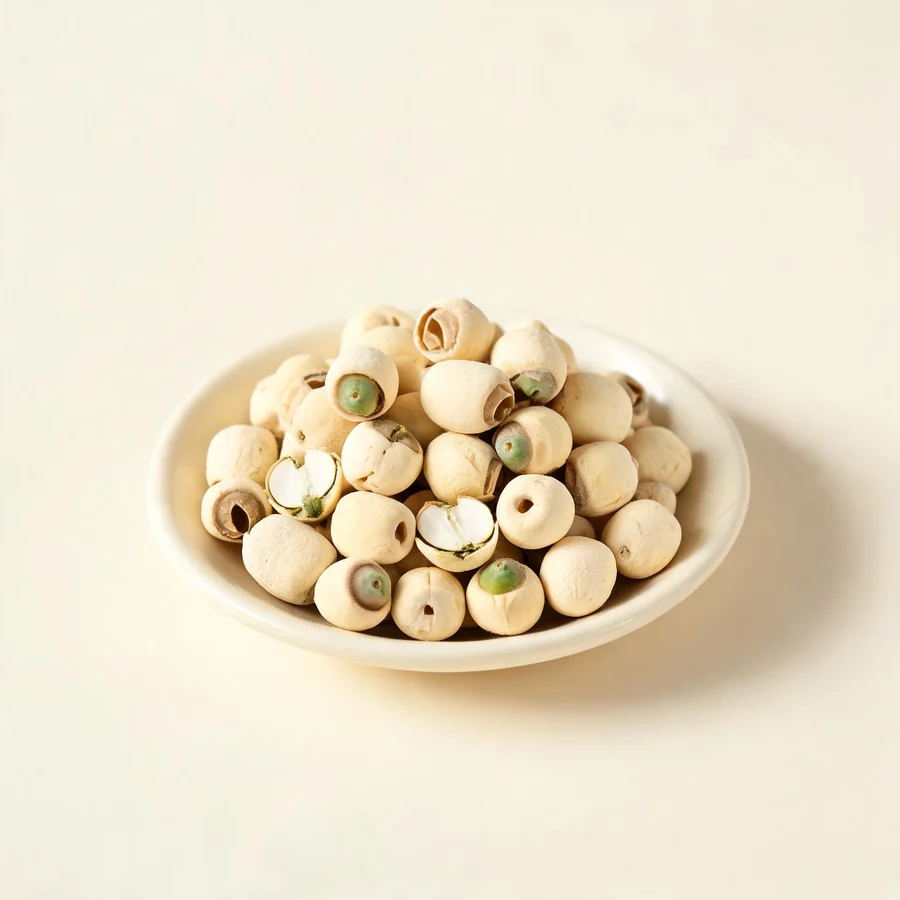
A food-grade seed with a wide margin. The alkaloids sit mainly in the embryo, which is a separate and more bitter article, so the seed meat is the gentle form. The bran-fried seed is preferred when stronger astringency is wanted for a chronic discharge or a leaky bowel, and the raw seed is the form for general Spleen support.
Citations and further reading
Only real sources are listed: the classical materia medica passages quoted above, and the source works behind the botanical and safety statements.
- Shen Nong Ben Cao Jing (Divine Husbandman's Classic of Materia Medica), Han compilation - the Centre and spirit passage is quoted in the original above.
- Ben Cao Gang Mu (Compendium of Materia Medica), Li Shizhen, 1578 - the passage naming the lotus the fruit of the Spleen is quoted in the original above.
- Yu Qiao Yao Jie (Jade Pivot Explanation of Materia Medica), Qing dynasty - the passage on slippery discharge is quoted in the original above.
- Nelumbinis Semen monograph, Pharmacopoeia of the People's Republic of China - accepted source, part and quality requirements.
- Modern evidence statement: based on published laboratory and animal work on lotus seed constituents, presented as a statement about the level of evidence.
- Botanical description and identification: botanical literature on Nelumbo nucifera, Nelumbonaceae.
Educational reference for qualified practitioners. This page is not medical advice, and skin conditions should be diagnosed by a clinician before treatment.