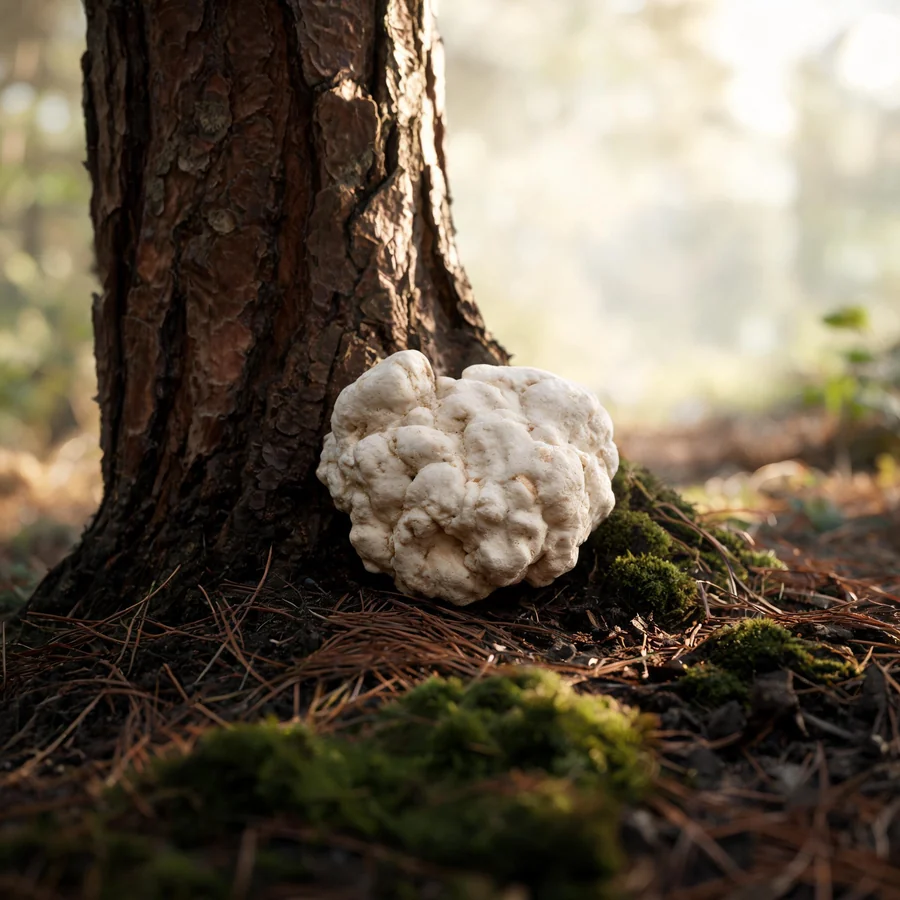
Skin profile
Where this herb sits in skin practice: the pattern it corrects, the skin signs it suits, and what it should not be used for.
Fu Ling is the quietest herb in most of the formulas it appears in: it neither cools nor warms, and its whole contribution is to move water and steady the digestion that let the water gather. That is also its limitation, because nothing about it will turn a red, spreading or infected lesion around.
Skin signs that suggest it
- Puffy, pale, waterlogged skin that holds a dent and looks heavy
- Weeping or oozing lesions with clear fluid and little redness
- A moist, clammy feel in the skin folds, with maceration at the edges
- A heavy, tired body, loose stools and a poor appetite alongside the skin problem
- A pale, wet tongue with a greasy coat
When it is not the right herb
Not for dry, thin, hot skin, and not for a dry, scaly eczema or ichthyosis, where there is no fluid to move. Not where urine is already copious and clear, or where there is thirst, a peeled tongue and scanty concentrated urine, since the draining action adds to the loss. Not a treatment on its own for a spreading infection, a hot weeping flare or a severe itch; it is the quiet partner in those formulas, not the active ingredient. Material coated with cinnabar, once used for sleep, is no longer used because of the mercury.
What it does for skin
Skin-relevant actions only. Each one describes a mechanism in TCM terms and what it looks like on the skin.
Drains dampness and takes the water out of a boggy lesion
Blandness is described as seeping: it draws surplus fluid downward and out by way of the bladder, and on the skin that shows as ooze lessening and puffiness going down. It achieves this without heating the body or drying it out, which is why months of use are possible and why, of all the draining herbs, it is the one least likely to deplete a weak patient. Clear weeping with little redness is the clearest indication; hot yellow discharge is not.
Strengthens the Spleen so that dampness is not remade
When the Spleen cannot transform and transport fluid, the result is loose stool, a poor appetite, heaviness and skin that stays boggy however much is drained from it. Fu Ling clears what has already gathered and strengthens the organ that allowed it to gather, so cause and product are treated in one move. That double action explains its presence in nearly every Spleen-tonifying formula and why a skin course can be tapered rather than stopped dead.
Resolves phlegm-damp that shows as grease and heaviness
Thickened Dampness is Phlegm, and Phlegm sitting in the middle gives greasy scale, a muzzy head and a loaded chest. Through the same pair of actions Fu Ling cuts the production of Phlegm and carries off what has formed, and it is mild enough to continue in a depleted patient, which the stronger phlegm herbs are not. Greasy scalp and greasy tongue coat are treated as a single picture.
Settles the spirit when itch and skin disease disturb sleep
The spirit rests in the Heart, and the Blood it rests in is made by the Spleen, so a Spleen worn down by a long skin complaint leaves the spirit unsettled and the nights broken. Fu Ling reaches the Heart channel and quietens the spirit without sedation, doing so by removing the fluid that disturbs it. The portion cut from where the pine root passed through, Fu Shen, is reserved for this, and it is the form chosen when sleep is the complaint.
Skin conditions it is used for
Mapped to the condition pages on this site. The pattern column shows what the skin is doing when this herb is the right choice.
| Condition | Pattern | Why it suits | Typical setting |
|---|---|---|---|
| Atopic dermatitis | Spleen deficiency with dampness and a weak digestion | The dry, lichenified patches of chronic atopic eczema sit on a background that is often Spleen-deficient, with loose stools, a poor appetite and a puffy face, and Fu Ling is the herb that supports the digestion while the Dampness is drained. It is not an itch treatment and does not replace the cooling or moistening herbs a flare needs. Its value is cumulative, and in a long course it is what allows the rest of the prescription to be tolerated. | Yi Gong San or Si Jun Zi Tang with Fu Ling, plus Bai Xian Pi for the itch |
| Eczema | Dampness with clear ooze and puffiness | A weeping eczema with clear fluid rather than yellow, little redness and a puffy surrounding skin is the damp type that Fu Ling suits, and it works by draining the fluid and steadying the Spleen rather than by cooling inflammation. It is combined with drying herbs when the ooze is the main problem and with warming herbs when the skin is cold and pale. A hot, red, infected flare needs a different formula and often a clinician. | Modified Er Chen Tang, or Si Jun Zi Tang with Yi Yi Ren |
| Seborrhoeic dermatitis | Phlegm-damp rising with greasy scale | Greasy yellow scale with a heavy head and a greasy coat is phlegm-damp, and Fu Ling supplies drainage that the drying herbs cannot manage alone, so the scale does not simply re-form. It sits in the Er Chen structure alongside Ban Xia and Chen Pi, with Huang Qin added where there is redness. The scalp changes slowly and the herb is judged over a month, not a week. | Er Chen Tang with Huang Qin |
| Jock itch and fold rash | Dampness pouring downward into the folds | A moist, macerated rash in the groin folds is Dampness pouring downward, and the bland, seeping action is directed exactly there, with Fu Ling carrying fluid out through the urine and reducing the wet surface the rash feeds on. It is an internal support rather than a topical antifungal, and the area also needs drying, air and, where the skin is broken, medical treatment. | Bi Xie Fen Qing Yin style formulas with Fu Ling and Ze Xie, plus local care |
| Puffy, waterlogged skin | Fluid retention with Spleen deficiency | A face and eyelids that are puffy on waking, ankles that swell by evening, a heavy body and a pale wet tongue together mean fluid that is neither transformed nor excreted. Fu Ling is the mildest and safest of the draining herbs for that picture, given with warming herbs when the person feels cold and with cooler draining herbs when there is heat. Swelling that arrives suddenly or is marked needs a clinician, because it may be heart, kidney or thyroid disease. | Wu Ling San with Zhu Ling, Ze Xie, Bai Zhu and Gui Zhi |
Combinations for skin
Herbs it is paired with when the skin, not an internal organ, is the target.
| Partner | Ratio | Why the pair is used |
|---|---|---|
| Bai Zhu | 9 g each | Bai Zhu tonifies and dries the Spleen while Fu Ling drains the Dampness that has already collected, so the pair stops production and clears the product at the same time. It is the core of Si Jun Zi Tang, and it is why a puffy, loose-stooled eczema patient can be treated for months without the Dampness returning the moment the herbs stop. |
| Ban Xia | 12 g Fu Ling with 9 g Ban Xia | Ban Xia, warm and drying, transforms Phlegm and dries Dampness, while Fu Ling drains the fluid beneath and supports the Spleen so that fewer new accumulations form. Er Chen Tang is built on the pair, and Fu Ling tempers the warmer drying herb by opening a way out through the urine instead of leaving the Phlegm to be baked in place. |
| Gui Zhi | 12 g Fu Ling with 6 g Gui Zhi | Gui Zhi warms Yang and sets it moving, while Fu Ling drains the water that cold Yang has let gather; the classical literature treats the two as one mechanism, since warmth without drainage has nothing to shift and drainage without warmth moves water the body cannot transform. The result is used for a pale, cold, puffy skin with dizziness and a sense of water rising, and Ling Gui Zhu Gan Tang is built on it. |
| Ze Xie | 9 g each | Both drain Dampness by way of the urine, yet Ze Xie is cold, stronger and aimed at the Kidney and Bladder, whereas Fu Ling is neutral, gentler and strengthens the Spleen as well. One covers the Spleen side of fluid metabolism and the other the Kidney side, and Wu Ling San is built on the combination; it suits real swelling in a tired person. |
Formulas where it leads
- Si Jun Zi Tang (四君子汤) - The foundational Qi-tonifying prescription, in which Fu Ling carries off the Dampness that would otherwise obstruct the tonics. In skin practice it is the base for atopic eczema with a weak digestion, modified with itch-quieting or cooling herbs rather than used alone.
- Er Chen Tang (二陈汤) - The foundational phlegm-transforming prescription, where Fu Ling supplies the drainage that Ban Xia and Chen Pi cannot and where its Spleen action addresses the source of the Phlegm. It is used for greasy scale, a heavy chest and a boggy complexion.
- Wu Ling San (五苓散) - The classical prescription for fluid that is not being transformed, with Fu Ling leading a group that drains by way of the urine and warms the Bladder. The skin sign is puffiness and waterlogged tissue with scanty urine, and it is used only where the swelling has been assessed.
Safety for skin use
What to check before recommending or using it, including the cautions that matter most for skin patients.
Do not use, or use with caution
- Copious clear urine or urinary incontinence from Kidney deficiency. The draining action adds to a loss that is already excessive.
- Dryness with thirst, a peeled tongue and small amounts of dark urine point to depleted fluid rather than to Dampness.
- Qi sinking, with a dragging bearing-down sensation, prolapse or long-standing exhaustion, where a descending and draining herb pulls against the lift the body needs.
- Use as the only treatment for an acute, spreading or febrile skin infection, which needs medical assessment.
- The cinnabar-coated form, Zhu Fu Ling, which carries mercury and is no longer used.
Pregnancy and breastfeeding
Within the ordinary dose range it is usually treated as safe; the Ri Hua Zi Ben Cao numbers it among the herbs that settle the fetus, which is remarkable in a draining herb. Swelling in pregnancy is still something to be assessed rather than a Dampness pattern to be drained at home, and a woman who is already dry or thirsty should use it sparingly. For a skin complaint in pregnancy there are simpler measures, so the herb is a practitioner decision rather than a household one.
Interactions
- Diuretics such as furosemide, hydrochlorothiazide or spironolactone. The fluid loss adds up, so watch for light-headedness when standing, thirst, muscle cramps and shifts in kidney function.
- Medicines with a narrow margin that depend on the kidney, lithium in particular, where increased urine output can raise the level and monitoring is needed.
- Insulin and oral hypoglycaemics. Fu Ling has shown glucose-lowering activity, and a pooled analysis of prescriptions that include it reported better glucose measures alongside conventional diabetes care, so glucose is monitored when a course starts.
- Nothing important has been shown for the liver's cytochrome P450 enzymes, but any herb taken with prescription medicine should be declared to the prescriber.
Allergy and patch testing
Reactions are rare and usually mild: redness, itching or a scattered rash after the first few doses. The material is a fungus, so a person with mould sensitivity is worth watching, and an external application, which is uncommon, should be patch tested. Stop if a rash appears and does not settle within a few days.
General safety references
General references for herbal hepatotoxicity and herb-drug interactions; they are not specific to this herb.
- Review article: Herbal hepatotoxicity - an update on traditional Chinese medicine preparations. Alimentary Pharmacology & Therapeutics, 2014. PMID: 24844799.
- Interactions between herbal medicines and prescribed drugs: an updated systematic review. Drugs, 2009. PMID: 19719333.
- Warfarin and food, herbal or dietary supplement interactions: a systematic review. British Journal of Clinical Pharmacology, 2021. PMID: 32478963.
Evidence
The classical record is quoted with its source. The modern note states the level of evidence plainly.
Classical record
It governs chest and abdominal bindings and pain, and the fright and palpitations of water Qi.
Shen Nong Ben Cao Jing (Divine Husbandman's Classic of Materia Medica) - The water and palpitation indications in the oldest record remain the two centres of the herb's use.
Fu Ling's flavour is bland and seeping. Its nature moves upward, generating fluids and opening the pores, and it nourishes the source of water so that it descends and promotes urination. Zhang Jiegu therefore called it Yang, floating and rising, which describes its nature; Li Dongyuan called it Yin within Yang, descending, which describes its effect.
Ben Cao Gang Mu (Compendium of Materia Medica), Li Shizhen, on ascending and descending - The apparent contradiction explains why a draining herb is also used for a dry mouth and for palpitations: it is said to move in both directions depending on what the body needs.
Fu Ling: its blandness opens the orifices, its sweetness supports Yang, and it is the supreme herb for removing Dampness.
Yong Yao Xin Fa (The Art of Using Drugs) - The phrase supreme herb for removing Dampness is the source of its reputation and of its place in almost every formula that has to deal with fluid.
Modern evidence
Evidence status
- Polysaccharides, especially beta-glucans, are the main subject of laboratory work on Poria, and extracts are reported to have anti-inflammatory, diuretic and immune-modulating effects in cell and animal studies. These findings do not establish a benefit for skin disease.
- A pooled analysis of multi-herb formulas containing Fu Ling reported improvements in glucose measures alongside conventional diabetes treatment. The formula rather than the single herb was studied, and that finding, rather than any dermatological one, is the strongest clinical signal attached to the material.
- Regulatory status: the sclerotium is an accepted pharmacopoeial drug and a permitted food in China. Because the material is a fungus, quality depends on the species, on the absence of starch adulteration and on whether the blocks were sulphur-fumed.
PubMed records
Selected real PubMed records for this herb's species or its constituents, chosen by species name and title relevance. They are references for the non-TCM discussion above, not proof that the herb treats any skin condition.
- Poria cocos Wolf extracts represses pigmentation in vitro and in vivo.. Cellular and molecular biology (Noisy-le-Grand, France), 2018. PMID: 29729698 (skin-related record).
- Beneficial Effect of Gastrodia elata Blume and Poria cocos Wolf Administration on Acute UVB Irradiation by Alleviating Inflammation through Promoting the Gut-Skin Axis.. International journal of molecular sciences, 2022. PMID: 36142744 (skin-related record).
Dose and forms
Skin-practice dosing and the preparations that suit skin complaints.
| Form | Dose and notes |
|---|---|
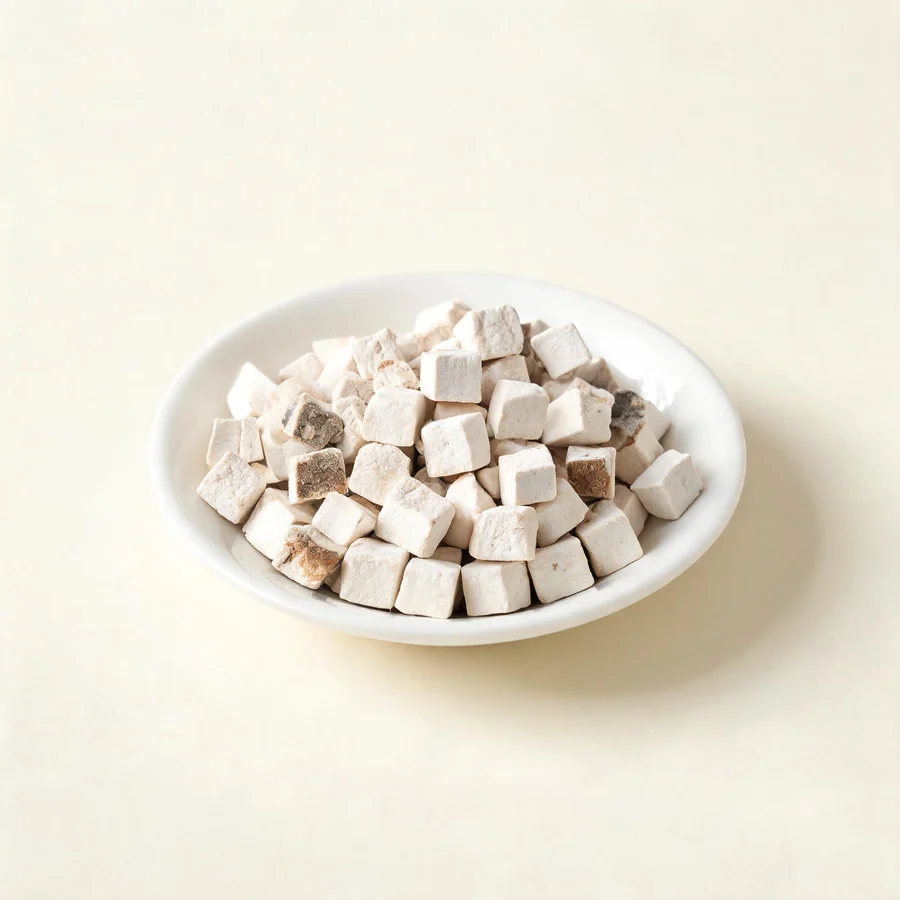
| Decoction | 9 to 15 g daily of the diced sclerotium, soaked for about half an hour and simmered with the rest of the prescription. The block is dense, so it is broken or sliced, and whole pieces extract poorly. |
| Higher dose for marked fluid | 15 to 30 g, and up to 30 to 60 g in severe oedema under supervision, where the ceiling is set by diuresis rather than by toxicity. Fluid and electrolytes are watched at those doses, especially in someone older or already depleted. |
| Fu Shen for sleep | 9 to 15 g of the portion from around the pine root, chosen when palpitations and broken sleep are the main complaint rather than the skin. |
| Course length | Months are acceptable because the material is neutral and food-like, but a long course is reviewed rather than simply continued, and it is stopped if the mouth dries or the urine becomes scanty and concentrated. |
Dose is set by what is being treated rather than by a single ceiling. Water and Dampness call for nine to fifteen grams; a weak Spleen for ten to fifteen; disturbed sleep for nine to fifteen of Fu Shen; and only marked fluid retention justifies the larger figures, under supervision. Because the material is neutral and food-like, what limits it is not toxicity but the slow drain of fluid from someone already dry, and the three forms should be chosen deliberately: Fu Ling for water and for the Spleen, Fu Shen when sleep is the issue, and Fu Ling Pi where oedema is the target.
Citations and further reading
Only real sources are listed: the classical materia medica passages quoted above, and the source works behind the botanical and safety statements.
- Shen Nong Ben Cao Jing (Divine Husbandman's Classic of Materia Medica), attributed compilation of the Han period - classical entry quoted above.
- Ben Cao Gang Mu (Compendium of Materia Medica), Li Shizhen, 1578 - classical entry quoted above.
- Yong Yao Xin Fa (The Art of Using Drugs), Li Dongyuan's school - classical entry quoted above.
- Fu Ling monograph: Pharmacopoeia of the People's Republic of China - source for the accepted species, the sclerotium as the drug, the 9 to 15 g dose and the quality requirements.
- Modern evidence statement: based on laboratory literature on Poria polysaccharides and on a pooled analysis of multi-herb formulas, summarised as a statement about the level of evidence rather than as a cited finding.
- Botanical description and identification: mycological literature on Wolfiporia cocos, family Polyporaceae, and on the distinction from Tu Fu Ling (Smilax glabra).
Educational reference for qualified practitioners. This page is not medical advice, and skin conditions should be diagnosed by a clinician before treatment.