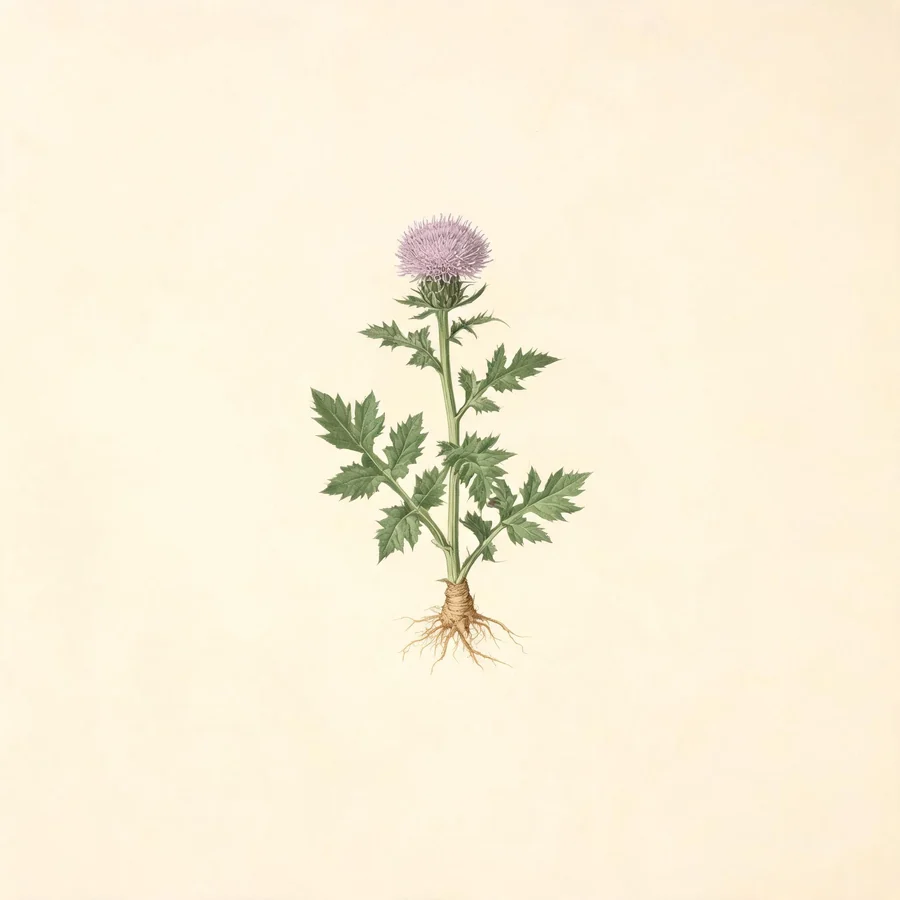
Skin profile
Where this herb sits in skin practice: the pattern it corrects, the skin signs it suits, and what it should not be used for.
Bai Zhu is chosen when the skin problem is wet, heavy and puffy and the digestion is weak, rather than when the skin is dry and hot. In a cooling skin formula it is often present for a second reason: to keep the middle warm enough for the treatment to be tolerated.
Skin signs that suggest it
- Pale, puffy skin that holds fluid, especially around the eyelids and ankles
- Weeping eczema with clear or pale fluid and a heavy, clammy feel
- Skin with a greasy sheen and a sensation of oiliness or dampness
- Slow-healing lesions in a tired person with a poor appetite
- Loose stools and a pale, swollen tongue with a greasy coat
- Flares that appear when digestion is unsettled or the diet is poor
When it is not the right herb
Not for dry, thin, hot skin with thirst, a red peeled tongue or night sweats, and not for acute red inflamed lesions with no dampness. Its warm, drying nature can make dryness and fluid loss worse. It is also not the herb for a genuinely congested, distended abdomen with a wiry pulse and no sign of deficiency.
What it does for skin
Skin-relevant actions only. Each one describes a mechanism in TCM terms and what it looks like on the skin.
Strengthens the Spleen so Dampness stops being produced
The tradition does not treat Dampness in the skin as a local accident. It asks where the fluid came from, and the usual answer is a Spleen that cannot sort clear from cloudy fluid. Bai Zhu restores that transforming function, so the ooze and puffiness have less to feed on. This is why it belongs to the subacute and chronic phases of eczema rather than to a sudden wet flare.
Dries Dampness and reduces ooze and puffiness
Its bitter taste is described as drying, and its sweet warmth supports the Spleen at the same time, so it removes moisture without the harshness of a pure draining herb. On the skin that means less weeping, less clamminess and less puffiness around the eyes. Fu Ling is its usual partner, one draining what has already gathered and the other limiting how much gathers next.
Holds the surface and settles clammy sweating
Daytime sweating without exertion, in a depleted person, reads as Qi that no longer holds the pores shut, and the skin stays damp and cool. Bai Zhu builds the Qi that holds the surface closed, and it is used with Huang Qi for that reason. The point matters in skin practice because constant moisture in skin folds and under dressings encourages irritation and infection.
Protects the digestion while cooling herbs are used
Many skin formulas are bitter and cold, and a person with a weak Spleen will develop loose stools, a poor appetite and a cold abdomen if the cooling is not balanced. Bai Zhu is added as the counterweight: it keeps the middle warm and dry so the treatment can continue. This is a practical role in prescribing rather than a direct action on the lesion.
Supports the healing of indolent, damp lesions
Skin that stays moist, pale and slow to close, with a boggy feel, is read as Qi deficiency with Dampness rather than heat. Bai Zhu strengthens the Qi that rebuilds and dries the surface that will not close. Wound care and treatment of infection remain the first measures, and the herb supports rather than replaces them.
Skin conditions it is used for
Mapped to the condition pages on this site. The pattern column shows what the skin is doing when this herb is the right choice.
| Condition | Pattern | Why it suits | Typical setting |
|---|---|---|---|
| Atopic dermatitis | Spleen deficiency with Dampness, in the subacute phase | When the flare is less angry but continues to ooze, and the person is tired, off their food, passing loose stools and showing a pale swollen tongue, the pattern is a weak Spleen producing Dampness. Bai Zhu addresses that source while the formula clears what is on the skin, and it is used bran-fried so the drying is gentler. It is not the herb for the acute red weeping stage on its own. | Modified Si Jun Zi Tang with Fu Ling and Bai Xian Pi |
| Eczema | Dampness from a weak Spleen, with chronic ooze and heaviness | Eczema that settles into pale, soggy skin with clear ooze, worse after rich or raw food, is read as Dampness from below rather than heat from above. Bai Zhu dries and strengthens at once, which suits the chronic phase, and it is combined with draining herbs so the effect is not too drying. Emollients and trigger avoidance remain essential. | Shen Ling Bai Zhu San with added skin herbs |
| Skin swelling | Fluid collecting under the skin because the Spleen is not moving it | Soft puffiness that pits on pressure, gathers around the eyes on waking and settles at the ankles by evening, in a tired person, is fluid the Spleen has failed to transport. Bai Zhu is used to strengthen the transport rather than to force diuresis, and it is given with Fu Ling and Gui Zhi. Swelling of one leg, breathlessness or sudden weight gain needs medical assessment. | Ling Gui Zhu Gan Tang |
| Oily or clammy skin sensation | Dampness sitting on the surface with Spleen deficiency | A persistent oily or clammy feel, with a heavy sensation and a greasy tongue coat, is read as Dampness that the Spleen is not clearing. Bai Zhu dries from the inside and is used with aromatic herbs that move Dampness outward. It is a supporting measure alongside washing and topical care, and a sudden change in skin oiliness should still be assessed. | Modified Si Jun Zi Tang with Cang Zhu and Fu Ling |
| Urticaria | Spleen deficiency failing to secure the surface, with wind-damp | Recurrent wheals in a person who is tired, clammy and prone to loose stools are read as a weak surface with lingering Dampness rather than simple wind-heat. Bai Zhu strengthens the Spleen and the surface so the wheals have less ground to recur on, and it is used with Huang Qi and wind-diffusing herbs. Acute urticaria with swelling of the lips or throat is an emergency. | Yu Ping Feng San with Fang Feng and Bai Xian Pi |
Combinations for skin
Herbs it is paired with when the skin, not an internal organ, is the target.
| Partner | Ratio | Why the pair is used |
|---|---|---|
| Fu Ling | 10 to 15 g each | Fu Ling drains Dampness that has already collected, and Bai Zhu strengthens the Spleen so less collects in future. The pair is the core of the dampness approach to skin: one herb treats the present ooze, the other the tendency behind it, and neither is strongly drying on its own. |
| Huang Qi | 10 to 15 g Huang Qi with 6 to 10 g Bai Zhu | Huang Qi pushes Qi to the surface and firms the exterior, and Bai Zhu provides the Qi that is being pushed outward. The pair is used for pale, clammy, slow-healing skin in a depleted person, and for spontaneous sweating that keeps the skin damp. |
| Zhi Gan Cao | 6 to 10 g Bai Zhu with 3 to 6 g Zhi Gan Cao | The sweet pair supports the middle and settles the digestion, which is the base that many skin formulas need when they are given for weeks. It is used where the tongue is pale and the pulse weak, and it is a supporting pairing rather than a treatment for the lesion. |
| Gui Zhi | 10 g each | Gui Zhi warms and moves Yang outward, and Bai Zhu strengthens the Spleen while drawing Dampness out from below. The pair is for fluid that has pooled because the Yang meant to move it has gone cold, with dizziness, a heavy chest and puffiness, and these two form the pair at the heart of Ling Gui Zhu Gan Tang. |
Formulas where it leads
- Si Jun Zi Tang (四君子汤) - The foundational Qi-tonifying formula, with Bai Zhu as the herb that dries while it strengthens. In skin practice it is the base for a Spleen-deficient eczema or atopic picture, to which cooling or itch-settling herbs are added.
- Yu Ping Feng San (玉屏风散) - The formula for a weak defensive surface, with Huang Qi and Fang Feng. Bai Zhu supplies the Qi that holds the pores closed, which is the logic for using it in clammy skin and in recurrent wheals on a deficient background.
- Ling Gui Zhu Gan Tang (苓桂术甘汤) - The classical formula for fluid that has collected because Yang is too cold to move it. Bai Zhu is one of its four herbs, and the formula is the context for puffiness and heaviness rather than for a hot skin lesion.
Safety for skin use
What to check before recommending or using it, including the cautions that matter most for skin patients.
Do not use, or use with caution
- Yin deficiency with internal heat: night sweats, thirst, constipation and a tongue that is red with almost no coating. The warm, drying rhizome can deplete fluids further and leave the skin drier.
- Genuine stagnation without deficiency: a distended, uncomfortable abdomen, belching, irritability and a wiry pulse. A tonic added here can increase the fullness rather than relieve it.
- A feverish illness with dryness, when the task is to clear heat and preserve fluids first. The drying warmth of the herb is the wrong direction at that stage.
- Dry, thin, hot skin with no dampness or ooze. The herb is chosen for damp patterns, and it can make a dry picture worse.
Pregnancy and breastfeeding
Used under supervision at a low dose for Spleen deficiency in pregnancy, and classical practice counts it among the herbs that settle a restless fetus on a deficient background. Six to twelve grams of the bran-fried rhizome is the usual range. Its drying warmth is reduced or balanced where she is thirsty or constipated, and any bleeding or pain in pregnancy needs clinical assessment rather than a herb. In breastfeeding it is generally treated as compatible at standard doses, and postpartum formulas for tiredness and loose stools often include it.
Interactions
- Medicines for diabetes: animal studies report a glucose-lowering effect, so people on insulin or metformin should check their readings when they begin it.
- Diuretics: at higher doses it also acts as a mild diuretic, which can add to a prescribed diuretic and upset potassium balance.
- Immunosuppressants: laboratory work reports immune-enhancing polysaccharides, a theoretical conflict with medicines given after transplantation or for autoimmune conditions.
- Laxatives: at high dose the raw rhizome loosens the stool, so it may add to a prescribed laxative.
Allergy and patch testing
Allergy to Bai Zhu is uncommon, but contact reactions to herb-containing creams and reactions to sulphur-fumigated material are the practical concerns. Slices that smell of a struck match should not be used, because they have been fumigated. Patch test any topical preparation and stop if irritation appears.
General safety references
General references for herbal hepatotoxicity and herb-drug interactions; they are not specific to this herb.
- Review article: Herbal hepatotoxicity - an update on traditional Chinese medicine preparations. Alimentary Pharmacology & Therapeutics, 2014. PMID: 24844799.
- Interactions between herbal medicines and prescribed drugs: an updated systematic review. Drugs, 2009. PMID: 19719333.
- Warfarin and food, herbal or dietary supplement interactions: a systematic review. British Journal of Clinical Pharmacology, 2021. PMID: 32478963.
Evidence
The classical record is quoted with its source. The modern note states the level of evidence plainly.
Classical record
It governs damp obstruction in the abdomen, wind-cold-damp painful obstruction, and dead muscles.
Shen Nong Ben Cao Jing (Divine Husbandman’s Classic of Materia Medica) - The link to Dampness and to the flesh is the earliest basis for using it on puffy, damp and slow-healing skin.
It removes Dampness and increases dryness, harmonises the Middle and supplements Qi. Its uses are nine: warming the Middle; removing Dampness from the Spleen and Stomach; clearing Heat from the Stomach; strengthening the Spleen and Stomach so that food is taken; harmonising the Stomach and generating fluids; stopping Heat at the level of the muscles; treating heaviness and fatigue of the limbs with drowsiness and no appetite; stopping thirst; and calming the fetus.
Zhang Yuansu, Jin-Yuan period: the nine uses - The list includes heat held at the level of the flesh, and heaviness of the limbs, both of which matter for the skin.
Used raw, Bai Zhu removes Dampness and increases dryness, resolves Phlegm and promotes urination, treats wind-cold-damp painful obstruction, dead flesh, spasms and jaundice, and disperses Blood between the waist and the navel. Prepared, it harmonises the Middle and supplements Qi, stops thirst and generates fluids, stops sweating and clears Heat, promotes appetite and calms the fetus.
Ben Jing Feng Yuan: raw and prepared - Here the two forms are given different jobs, which is the classical justification for choosing raw or fried rhizome in skin practice.
Modern evidence
Evidence status
- Laboratory studies of Atractylodes macrocephala polysaccharides and volatile oils report immune-modulating, anti-inflammatory and diuretic activity. These are mainly cell and animal studies, not trials in people with skin disease.
- Clinical trial evidence for Bai Zhu in eczema or atopic dermatitis is limited and comes almost entirely from multi-herb formula studies, so the contribution of this single herb cannot be separated out.
- The blood-sugar-lowering and diuretic effects reported in animal work are the findings behind the practical interaction notes, rather than evidence of benefit for the skin.
PubMed records
Selected real PubMed records for this herb's species or its constituents, chosen by species name and title relevance. They are references for the non-TCM discussion above, not proof that the herb treats any skin condition.
- Systematic review and meta-analysis of Chinese herbal formula Tongxie Yaofang for diarrhea-predominant irritable bowel syndrome: Evidence for clinical practice and future trials.. Frontiers in pharmacology, 2022. PMID: 36091782 (pharmacology or review record).
Dose and forms
Skin-practice dosing and the preparations that suit skin complaints.
| Form | Dose and notes |
|---|---|
| Decoction | 6 to 12 g of dried rhizome daily. The bran-fried form is the usual choice in skin formulas. The lower half of the range suits a dry person, and 10 to 15 g is for a very weak Spleen with loose stools. |
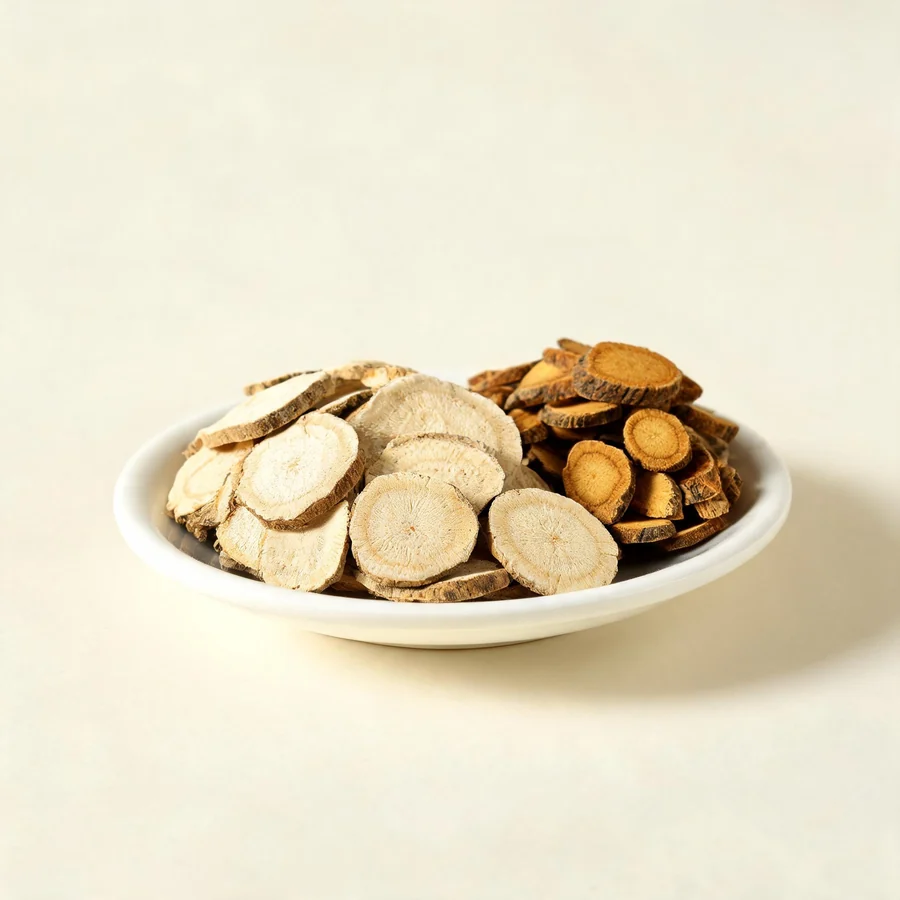
| Raw and fried | Raw rhizome moves fluid and is used for puffiness, bran-fried is the Spleen tonic and is gentler on dryness, earth-fried is kept for chronic looseness, and charred for a Spleen that cannot hold its contents. |
| Course length | Several weeks, with the tongue and the stools as the guide. If the mouth becomes dry or the stool hard, the dose is reduced rather than increased. |
| Prescribing note | High doses of the raw rhizome, thirty grams and above, are a practitioner's measure for the opposite effect and are not part of routine skin practice. |
The processing decides what the dose is for, so a prescription should name both. In skin practice the aim is a steady, drying support rather than a strong purge, and the guide to dose is the state of the tongue coat and of the stool. A course runs for weeks, so the grade of the slice matters, and sulphur-fumigated material is best avoided.
Citations and further reading
Only real sources are listed: the classical materia medica passages quoted above, and the source works behind the botanical and safety statements.
- Shen Nong Ben Cao Jing (Divine Husbandman's Classic of Materia Medica), attributed compilation of the Han period - classical entry quoted above.
- Zhang Yuansu, Jin-Yuan period, on the nine uses of Bai Zhu - classical entry quoted above.
- Ben Jing Feng Yuan, on the raw and prepared forms - classical entry quoted above.
- Bai Zhu monograph: Pharmacopoeia of the People's Republic of China - source for the accepted botanical source, part used and quality requirements.
- Modern evidence statement: based on laboratory and review literature on Atractylodes macrocephala, summarised as a statement about the level of evidence rather than as a cited finding.
- Botanical description and identification: botanical literature on Atractylodes macrocephala, Asteraceae.
Educational reference for qualified practitioners. This page is not medical advice, and skin conditions should be diagnosed by a clinician before treatment.