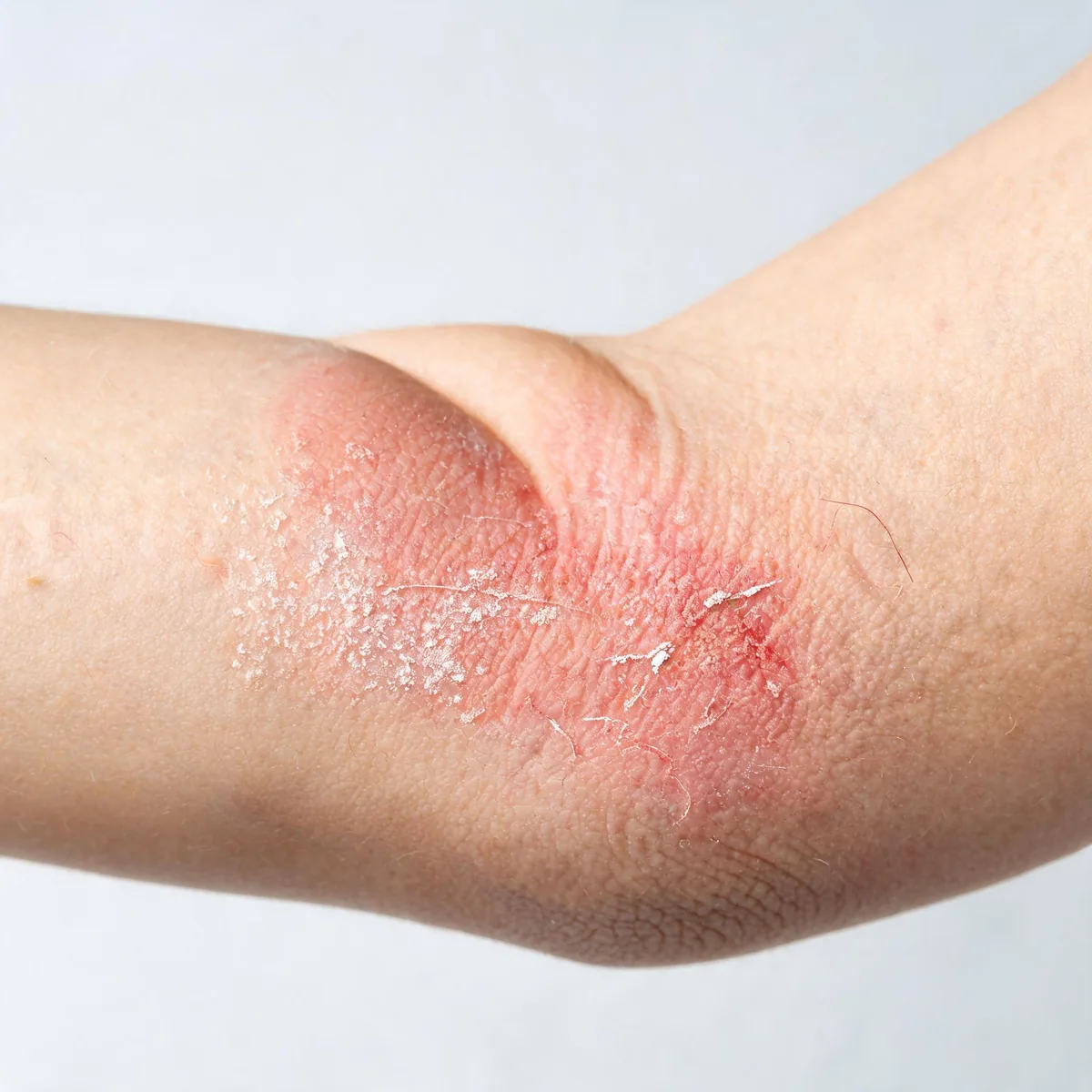
Understanding Atopic dermatitis
This condition is described through congenital constitution: the skin is vulnerable because the internal organs that nourish it are unsettled, and the flexural creases are where dampness tends to collect.
In the wet phase the picture is Damp-Heat or Spleen deficiency with dampness: red weeping lesions with yellow crusting, or pale oozing patches with bloating and loose stools. In the dry phase the picture is Blood deficiency with external wind, or Kidney and Liver Yin deficiency, with dry lichenified skin and itch that worsens at night.
A separate pattern, Heart Fire blazing, is described for bright red hot lesions with intense burning itch and disturbed sleep, often in children. The classical literature notes that these patterns alternate within the same person as the condition moves between wet and dry phases, which is why treatment is reviewed as the skin changes.
The practical implication is that a single fixed formula rarely stays right. The wet phase calls for clearing and draining, the dry phase for nourishing, and the classical literature treats the transition between them as part of the clinical work.
The Chinese name for the condition means wind of the four bends, and it names both the site and the mechanism. The creases inside the elbows and knees are where fluid tends to pool and where the surface is thinnest, so they are the first places to show trouble when the Spleen cannot transform fluids and the Lung cannot hold the exterior. The same diagnosis therefore produces weeping skin in one person and dry, cracked skin in another.
The constitution is where the trouble usually starts: a Spleen and Lung that were weak to begin with. The Spleen turns food into Qi and Blood and moves fluids; when it is sluggish, Dampness collects internally. The Lung holds the skin and the Wei Qi that patrols it, so when it is weak, Wind, Heat and Dampness reach the surface unopposed. Internal Dampness meeting an exposed exterior is what produces the itchy, oozing or dry lesions, and it is why treatment often works on digestion and immunity at the same time as on the skin.
Age changes the expression. Infants commonly show a bright red, heat-driven pattern with irritability and broken sleep, children often show a pale, moist, digestive pattern, and adults who have had the condition for years drift towards dryness, thickening and night itch as Blood and Yin are consumed. A single person may pass through several of these stages, or carry two at once with a damp flare on a dry background, which is why the assessment is repeated rather than made once.
Conventional view
Atopic dermatitis is a chronic relapsing inflammatory skin condition that usually begins in infancy or childhood, with intensely itchy dry red patches in the creases of the elbows and knees. It is associated with a defective skin barrier, immune dysregulation and a personal or family history of allergies, asthma or hay fever. Diagnosis is clinical, from the appearance and distribution of the rash and the presence of itch; the exact cause is not fully understood, but genetic and environmental factors are thought to trigger it, with flares linked to stress, irritants or allergens.
Standard management restores the skin barrier and controls inflammation: regular emollients, topical corticosteroids for flares, calcineurin inhibitors for sensitive areas, and for moderate to severe cases oral immunosuppressants, phototherapy or biologics such as dupilumab. Antihistamines are sometimes prescribed for itch, though benefit is often limited.
Topical steroids can thin the skin and lose effect over time, and stopping them abruptly may cause rebound flares; systemic immunosuppressants carry infection and organ toxicity risks, and biologics are expensive and not universally effective. Crucially, the conventional approach treats all atopic dermatitis as the same disease differing only in severity, so it does not explain why one person's rash is weeping and red in summer while another's is dry and cracked in winter, or why some flares follow digestive upset and others emotional stress, distinctions central to TCM.
Selected PubMed records
Real PubMed records for the conventional discussion above, selected by condition name and title relevance. They are references, not a claim that any treatment is proven for this condition.
- Allergen immunotherapy for atopic dermatitis: Systematic review and meta-analysis of benefits and harms.. The Journal of allergy and clinical immunology, 2023. PMID: 36191689.
- Dietary Elimination for the Treatment of Atopic Dermatitis: A Systematic Review and Meta-Analysis.. The journal of allergy and clinical immunology. In practice, 2022. PMID: 35987995.
- Atopic dermatitis and risk of autoimmune diseases: a systematic review and meta-analysis.. Frontiers in immunology, 2025. PMID: 40574848.
How it connects
Atopic dermatitis often appears alongside asthma and allergic rhinitis. In TCM all three share a root of Lung, Spleen and Kidney deficiency with weak defensive Qi: the Lungs govern the skin and the body's outer defence, so a constitutional weakness there leaves both skin and airways exposed to Wind, Dampness and Heat. A weak Spleen adds Dampness, which surfaces as weeping eczema while also congesting the sinuses and lungs. Treating the underlying deficiencies tends to bring relief to skin and breathing together. The overlap is practical as well as theoretical. Because skin and airways are both surfaces meeting the outside world, a formula that consolidates the Wei Qi may ease nasal congestion and wheeze at the same time as the skin, and patients often notice that their hay fever season is milder when the eczema is stable. The corollary is that treatments which only suppress the skin, without attention to the Spleen and Lung deficiency behind it, tend to leave the other atopic conditions untouched.
How it is assessed
Diagnosis looks at the phase of the skin, the location, and the constitution behind it.
What a practitioner looks for
- Phase: wet and weeping points to Damp-Heat or Spleen deficiency; dry and lichenified points to Blood or Yin deficiency.
- Location: flexural creases are the characteristic site named in the Chinese name for the condition.
- Constitutional signs: digestion, appetite, sleep, night sweats, low-back weakness, and how the person responded as a child.
- Tongue and pulse: a pale swollen tongue with teeth marks supports Spleen deficiency; a red tongue with a peeled coating supports Yin deficiency.
The examination begins at the skin. Colour, moisture, thickening, crusting and the exact distribution are recorded, along with the patient's account of what precedes a flare and what settles it. Because the rash alternates between wet and dry phases, the practitioner asks whether it weeps or cracks, whether heat or cold makes it worse, how sleep is affected and how the digestion behaves. These answers separate a damp picture from a dry one before the tongue is even seen.
Tongue and pulse then confirm the pattern. A red tongue under a thick, greasy yellow coat, together with a slippery, rapid pulse, belongs to Damp-Heat; a pale, swollen tongue bearing teeth marks beneath a white greasy coat, with a soft slow pulse, belongs to Spleen Deficiency with Dampness; a pale thin tongue under a thin dry coat, with a fine, slightly wiry pulse, belongs to Blood Deficiency with External Wind. In long-standing cases a red, thin, cracked tongue with little coat and a fine rapid pulse indicates Kidney and Liver Yin Deficiency, and in infants a distinctly red tip with a rapid forceful pulse indicates Heart Fire.
Age and history carry weight. Infantile eczema with irritability, broken sleep and bright red lesions is read differently from the dry, lichenified skin of an adult who has had the condition for twenty years, and a personal or family history of asthma or allergic rhinitis supports the constitutional view. The practitioner also looks for signs of secondary infection and asks about topical steroid use, so that withdrawal effects are not mistaken for a new pattern.
TCM patterns in Atopic dermatitis
Five patterns cover most atopic dermatitis, and they sit on a moving spectrum. At the wet end, Damp-Heat gives red, hot, weeping patches that crust yellow, while Spleen Deficiency with Dampness gives paler, cooler, oozing skin with bloating and loose stools; the first is driven by heat, the second by a Spleen that fails to move fluids. In the middle sits Heart Fire blazing, the infantile and stress-linked picture of bright red, burning, itchy skin with irritability. At the dry end, Blood Deficiency with External Wind gives flaky, lichenified patches with night itch, and Kidney and Liver Yin Deficiency gives deeper dryness with night sweats. The strategies pull in opposite directions: clearing and drying calms a wet flare but worsens a dry one, while nourishing and moistening rebuilds dry skin but can aggravate oozing. Most people need a sequence, with clearing first and building later.
| Pattern | Key signs | The itch | Tongue | Main formula |
|---|---|---|---|---|
| Blood Deficiency with External Wind | Dry flaky or lichenified skin in the creases | Itch worse at night | Body: Pale and thin, sometimes slightly dryCoat: Thin, white and a little dry | Dang Gui Yin Zi |
| Damp-Heat | Red hot weeping lesions; Yellow crusting | Not specified | Body: Red, often swollen with teeth marksCoat: Yellow, greasy and thick, usually in the middle and at the root | Long Dan Xie Gan Tang |
| Spleen Deficiency with Dampness | Moist weeping oozing patches; Pale or skin-coloured lesions | Not specified | Body: Pale and swollen, often with teeth marks along the edgesCoat: White, greasy and moist, thick in the middle | Shen Ling Bai Zhu San |
| Heart Fire blazing | Bright red hot lesions | Intense itching with burning | Body: Red with a distinctly redder tip and red points at the tipCoat: Yellow and dry | Dao Chi San |
| Kidney and Liver Yin Deficiency | Dry scaly lichenified patches; Dry eyes with blurred vision | Intense itch at night | Body: Red, thin and dry, often crackedCoat: Little or none; the tongue may look peeled | Liu Wei Di Huang Wan |
Blood Deficiency with External Wind
The dry, lichenified phase with itch that worsens at night.
Blood carries the moisture and substance that keep skin supple, so when it is low the surface becomes thin, dry and brittle and cracks open in the creases. That dryness is itself a kind of internal Wind, and it also leaves the exterior poorly defended, so external Wind lodges where the barrier is weakest. The result is itching that wanders, flares and settles, worse at night when Blood is at its most depleted, and skin that thickens and lichenifies as scratching continues.
The tongue is pale and thin with a thin white, slightly dry coat; the pulse is fine, sometimes wiry at the left middle and floating at the right front. The flexures of the elbows and knees are the usual site, and the person may look pale, with dull brittle nails, dizziness and a tendency to feel the cold. Dry, windy or cold weather, stress, spicy and fried food, hot showers and the premenstrual phase all make it worse, while regular moisturising, warm nourishing soups, sleep, gentle movement and avoiding drafts help. Dang Gui Yin Zi is the formula for this pattern; Dang Gui and Ji Li are numbered among its herbs, and the points are Sanyinjiao (SP-6), Xuehai (SP-10) and Quchi (LI-11).
Signs
- Dry flaky or lichenified skin in the creases
- Itch worse at night
- Pale complexion and brittle nails
- Aversion to wind and drafts
- Dizziness or light-headedness
Diet and lifestyle for this pattern: Build Blood with dark leafy greens, beetroot, black sesame and bone broth, and avoid food that is spicy, fried or very drying. Wear natural breathable fabrics, moisturise with a fragrance-free cream, skip long hot showers and keep a regular sleep routine so Blood can be replenished.
Damp-Heat
The wet, angry phase: red weeping lesions with yellow crusting.
Damp-Heat usually begins in a Spleen that is not transforming fluids well, so moisture accumulates internally. When humid weather, rich food or emotional heat is added, that moisture combines with heat and looks for a surface to escape through. It finds the warm, moist creases of the elbows and knees, where sweat and friction keep the area damp, and there it produces the acute flare of redness, swelling, oozing and yellow crusting with intense itch.
The tongue is red with a yellow greasy coat, sometimes swollen with teeth marks, and the pulse is soggy and rapid or slippery and rapid. The person often feels heavy, notices a greasy taste in the mouth and passes loose sticky stools. Hot humid weather, spicy and fried food, stress and sweating aggravate it; a cool room, light meals, keeping the skin clean and dry and avoiding overheating help. Si Miao San clears Heat, dries Dampness and strengthens the Spleen, with Huang Bo, Cang Zhu and Ku Shen as the named herbs and Quchi (LI-11), Yinlingquan (SP-9) and Sanyinjiao (SP-6) as the points.
Signs
- Red hot weeping lesions
- Yellow crusting
- Heavy body and greasy taste
- Worse in humid weather
- Loose sticky stools
Diet and lifestyle for this pattern: Keep meals light and easy to digest, with barley, mung beans and bitter greens. Avoid dairy, greasy, spicy and sugary food that creates Dampness and Heat, keep the skin clean and dry, use cool compresses during flares and stay out of humid, sweaty environments.
Spleen Deficiency with Dampness
The duller wet phase: pale oozing patches with a digestive picture.
Here the moisture is not the product of heat but of a Spleen too weak to process food and fluids properly. Fluids that should be transformed and transported instead accumulate, and they surface in the flexures as pale, cool, macerated patches that weep clear or slightly sticky fluid. Because there is no fire driving the lesion, it does not look angry: the skin is often the same colour as the surrounding area, or faintly pink, and it lingers because the underlying weakness has not changed.
The tongue is pale and swollen with teeth marks, a white greasy coat and a moist surface; the pulse is soggy and slow, sometimes slippery and without force. Bloating, loose stools, poor appetite, fatigue after eating and a heavy body accompany the skin. Cold, raw and greasy food, humid weather, large meals, inactivity and overthinking all worsen it, while warm dry weather, light digestible meals and moderate consistent exercise help. Ling Gui Zhu Gan Tang warms the Spleen and transforms fluids; Bai Zhu, Fu Ling and Yi Yi Ren are the named herbs, and the points are Yinlingquan (SP-9), Zusanli (ST-36) and Sanyinjiao (SP-6).
Signs
- Moist weeping oozing patches
- Pale or skin-coloured lesions
- Bloating and loose stools
- Poor appetite and fatigue after eating
- Heaviness in the body
Diet and lifestyle for this pattern: Favour warm cooked food such as congee, soups and steamed vegetables, and avoid cold, raw, dairy, fried and very sweet food that burdens the Spleen and adds Dampness. Gentle daily movement like walking or stretching supports the Spleen without using up your energy.
Heart Fire blazing
Bright red, hot, intensely itchy lesions with disturbed sleep.
This pattern centres on excess Heat in the Heart, and it is seen most often in infants and in adults whose sleep and emotions are badly frayed. Because the Heart rules the blood and its vessels, Fire there travels with the blood to the surface, producing bright red, hot lesions that burn as much as they itch. The same Fire disturbs the Shen, which is why the skin is accompanied by irritability, crying and broken sleep rather than by digestive upset.
The tongue is red with a distinctly redder tip, sometimes with raised red points and a yellow dry coat, and the pulse is rapid and forceful or overflowing at the left front position. Lesions are worst in the evening and at night, and there may be mouth or tongue ulcers. Heat, noise, stimulation, spicy and fried food, hot weather, lost sleep and overexertion aggravate it; a cool quiet room, cooling drinks and foods, calm surroundings, cool compresses and adequate sleep help. Dao Chi San clears Heart Fire and guides it downward, often with Lian Qiao or Zhi Zi added; Huang Lian, Zhi Zi and Dan Zhu Ye are the named herbs, and the points are Shenmen (HT-7), Shaofu (HT-8) and Quchi (LI-11).
Signs
- Bright red hot lesions
- Intense itching with burning
- Irritability and crying at night
- Disturbed sleep with frequent waking
- Mouth or tongue ulcers
Diet and lifestyle for this pattern: Avoid spicy, fried and greasy food that generates Heat, and keep the home cool and calm. With an infant, do not over-wrap and keep bedtime peaceful; mung bean soup or chrysanthemum tea can gently cool the picture.
Kidney and Liver Yin Deficiency
The chronic depleted phase: dry scaly patches with night itch and low-back weakness.
When the deeper reserves of Liver and Kidney Yin are spent, the body loses its store of cooling, moistening fluid and the driest form of eczema follows. Deficiency heat and internal Wind rise from that emptiness and settle in the flexures, producing patches that are scaly, lichenified and stubborn rather than red and weeping. The itch is at its worst at night, when Yin is naturally at its lowest and cannot restrain the heat, and the skin feels thin and papery rather than thick and moist.
The tongue is red and thin, cracked, with almost no coat and a dry surface; the pulse is fine and rapid, with a wiry quality, and weakest at the left Chi position. Dry eyes with blurred vision, soreness of the low back and knees, night sweats, heat in the palms and soles and restless sleep with vivid dreams accompany the skin. Late nights, overwork, hot dry weather, spicy food, alcohol and coffee worsen it, while sleep, cool humidified air, moistening foods such as pear and cucumber, gentle movement and stress reduction help. Liu Wei Di Huang Wan nourishes Kidney Yin and replenishes deep fluids; Shu Di Huang, Gou Qi Zi, Shan Zhu Yu and Nu Zhen Zi are the named herbs, and the points are Taixi (KI-3), Sanyinjiao (SP-6), Ganshu (BL-18), Shenshu (BL-23) and Quchi (LI-11).
Signs
- Dry scaly lichenified patches
- Intense itch at night
- Dry eyes with blurred vision
- Sore weak lower back and knees
- Night sweats and heat in palms and soles
Diet and lifestyle for this pattern: Choose moistening, cooling food such as pear, cucumber, black sesame, goji berries and bone broth, and cut out spicy, fried and drying food such as coffee and alcohol. Go to bed early to protect Kidney Yin, and keep exercise gentle so it supports Yin without overheating.
Treatment approach
How the tradition treats atopic dermatitis, with the herbs, formulas and points used for it.
Principles
- Treat the phase: clear and drain in the wet phase, nourish and moisten in the dry phase.
- Support the Spleen throughout, since constitution and digestion are described as the root of the tendency.
- Calm Heart Fire where the itch is burning and sleep is disturbed.
- Protect the barrier: the classical literature treats emollients as part of care, not as an alternative to it.
- Timing shapes the prescription as much as the pattern does: clearing herbs are used while the skin is wet and reduced as it dries, and nourishing herbs are introduced once oozing has stopped. A single formula is rarely continued unchanged for months, and the practitioner reviews the skin together with sleep, digestion and the pulse before each adjustment, so that clearing does not drift into dryness and tonifying does not entrench Dampness.
Herbs used
Formulas
Acupoints
- SP-6 (Sanyinjiao)
- SP-10 (Xuehai)
- LI-11 (Quchi)
- SP-9 (Yinlingquan)
- ST-36 (Zusanli)
- HT-7 (Shenmen)
- HT-8 (Shaofu)
- KI-3 (Taixi)
- BL-18 (Ganshu)
- BL-23 (Shenshu)
What to expect
- Itch is described as easing within the first one to two weeks of herbal treatment.
- Visible skin change follows more slowly, over weeks to months.
- The condition is expected to need ongoing management rather than a single course.
- Progress is judged by sleep and itch before appearance, because the need to scratch usually settles first and the skin follows. Flares around weather changes, stress or dietary slips are expected during treatment, and the plan is adjusted rather than abandoned. Between flares a lighter preventive formula is often continued for a season to consolidate the result, especially where the tendency has been lifelong.
Safety and when to get help
Seek medical help urgently for
- Signs of skin infection: increasing redness, warmth, swelling, pus or honey-coloured crusting, especially with fever.
- Widespread blistering or punched-out sores - this may be eczema herpeticum and needs urgent antiviral treatment.
- Swelling of the face or lips, or difficulty breathing.
For anything severe, sudden or spreading quickly, read when a skin problem needs urgent care.
Cautions
- Do not stop prescribed topical or systemic treatment abruptly.
- Children require practitioner review and weight-appropriate dosing.
- Long-term internal herbs should be supervised with liver function checked where indicated.
Using this alongside conventional care
- TCM is described as complementary to conventional care: emollients and prescribed topical treatment continue alongside herbs and acupuncture, and any change to systemic therapy belongs with the prescribing doctor.
- The practical points are to keep emollients going, to use topical steroids as prescribed rather than stopping abruptly when herbs begin to work, and to tell the dermatologist about every herb and supplement in use. Where immunosuppressants or biologics are prescribed, the herbal formula is kept simple and supportive so that any change in the disease or in blood results can be attributed clearly. Herbal washes and compresses are a useful local addition, but they should be stopped if the skin becomes irritated or shows signs of infection.
Diet and lifestyle
- The advice is to limit greasy, fried, spicy and sweet food, alcohol and dairy where the picture is Damp-Heat, and to keep a food and symptom diary so that individual triggers are found rather than assumed.
- Dietary advice follows the same split as the treatment. While the skin is wet and hot, the emphasis is on light, drying foods such as barley, mung beans, bitter greens and lightly cooked vegetables, with dairy, sugar, fried food and alcohol reduced. Once the skin is dry, the emphasis reverses towards moistening and nourishing foods: black sesame, goji berries, yam, pear, bone broth and cooked whole grains. Warm cooked meals suit most patterns better than raw salads and iced drinks, and a simple food diary is more useful than a long list of forbidden items, because the offending food is often particular to the person.
If you're pregnant
Atopic dermatitis can flare in pregnancy as Blood and Qi shift, and the Blood deficiency with External Wind pattern often becomes more pronounced as pregnancy advances and Blood is diverted to the fetus.
Dang Gui Yin Zi, the key formula for that pattern, contains Dang Gui, which in large doses may stimulate uterine activity, so it is used cautiously and at reduced dosage under professional guidance. Acupuncture is generally safe, but points such as Sanyinjiao (SP-6) and Hegu (LI-4), sometimes used for skin, must be avoided or used with great care because they can promote labour.
Milder food-based approaches such as congee with Yi Yi Ren and Bai Bian Dou are preferred for managing Dampness in pregnancy, and cooling compresses can soothe acute itching without systemic risk.
If you're breastfeeding
The main concern in breastfeeding is that bitter-cold herbs used to clear Damp-Heat, such as Huang Bo and Ku Shen, can pass into milk and cause diarrhoea or digestive upset in the infant. For Damp-Heat a practitioner may substitute milder aromatic herbs such as Cang Zhu and Fu Ling, or lean on acupuncture and external washes.
Blood-nourishing formulas such as Dang Gui Yin Zi are generally safer during lactation because they support postpartum Blood deficiency while moistening dry itchy skin. Diluted decoctions of Ku Shen or Di Fu Zi used as compresses give local relief with minimal systemic absorption and make a valuable first line while nursing.
If treating a child
Atopic dermatitis is extremely common in infants and young children, where Spleen deficiency with Dampness, Damp-Heat and Heart Fire are the most frequent patterns. The Heart Fire pattern is especially characteristic of infants, with bright red, burning, intensely itchy lesions and marked irritability.
Diagnosis relies on observation of skin, tongue and behaviour, since children cannot describe itching or burning. Doses are reduced to about a quarter to a half of the adult dose by age and weight, formulas favour gentle Spleen-fortifying herbs such as Bai Zhu and Fu Ling while bitter-cold herbs are used sparingly and briefly, acupuncture may be replaced by paediatric tuina or acupressure, and removing Dampness-producing foods is a cornerstone of long-term management.
If treating an elderly patient
In older adults the dry, lichenified phase of atopic dermatitis predominates, driven by Blood deficiency with External Wind or Kidney and Liver Yin deficiency. The skin becomes thin, papery and deeply dry and the itching is often worst at night, when Yin is most depleted.
Treatment nourishes Blood and Yin with formulas such as Dang Gui Yin Zi or Liu Wei Di Huang Wan at lower doses to spare a weaker digestion. Polypharmacy is a real concern, so herb-drug interactions must be screened, especially with anticoagulants if Dang Gui is prescribed; oily herbal salves and gentle acupuncture with fewer needles are better tolerated than strong internal herbs, and slower, modest gains in comfort and sleep are realistic goals.
Urgent-sign guidance is based on standard sources: NHS anaphylaxis, NHS cellulitis, NHS Stevens-Johnson syndrome, NHS melanoma.
Evidence
Evidence status
Compiled for this page from the classical and modern literature; not a systematic review, so treat it as a pointer to sources rather than clinical guidance.
Evidence is strongest for oral Chinese herbal medicine. Systematic reviews and randomised trials report that formulas which nourish Blood and clear Heat reduce severity and extent, improve sleep and reduce the need for topical steroids. A 2024 pilot trial of Dang Gui Yin Zi (VGH4) reported improvements in severity and quality of life over placebo. Acupuncture and acupressure also show promise for itch.
What the reviews show is a consistent direction with uneven quality. Oral herbal medicine, especially formulas that nourish Blood and clear Heat, has been associated with lower eczema severity and less reliance on topical steroids, and the 2024 VGH4 crossover pilot found improvements in SCORAD scores and quality of life against placebo with a good safety profile. Gu and colleagues reached a similar conclusion in their overview of the clinical evidence while noting that the quality of most trials was moderate. Acupuncture and acupressure have smaller, promising datasets, and because most research originates in China, replication elsewhere is limited. The most defensible reading is that TCM adds to, rather than replaces, emollients and intermittent topical treatment.
Studies often cited
Systematic reviews and randomised trials report reduced severity and extent of eczema, better sleep and less topical steroid use with oral formulas that nourish Blood and clear Heat. Systematic reviews and randomised trials (as recorded in the source)
A 2024 pilot trial reported significant improvements in disease severity and quality of life compared with placebo. 2024 pilot randomised trial (as recorded in the source)
Acupuncture and acupressure show promise in relieving itch in atopic dermatitis. Clinical trials (as recorded in the source)
PubMed records for the TCM evidence
Real PubMed records for the TCM clinical evidence discussed above, selected by condition name and title relevance. They are references, not proof of benefit.
- Acupuncture for atopic dermatitis: a systematic review and meta-analysis.. BMJ open, 2024. PMID: 39638592.
- Neutrophils in Atopic Dermatitis.. Clinical reviews in allergy & immunology, 2024. PMID: 39294505.
Classical record
「四弯风,生于两腿弯、两臂弯,瘙痒无度,搔破津水,形如湿癣。」
Four-crook wind arises in the creases of the legs and the creases of the arms, with itching that knows no limit; scratching breaks the skin and fluid seeps out, giving an appearance like damp tinea.
Yi Zong Jin Jian, Volume 76, Section on Surgical Diseases - Classical citation: translated here for this page.
Common questions
Can TCM cure atopic dermatitis?
The classical literature does not promise a cure. It aims to correct the internal imbalances that make the skin vulnerable, so that flares become less frequent and less severe.
How long until I see results?
Itch often eases within the first one to two weeks. Visible skin change is expected over weeks to months, and the dry phase takes longer than the wet phase.
Is acupuncture safe for children?
The classical literature treats children with caution and weight-appropriate care. Paediatric treatment should be supervised by a practitioner experienced with children.
Why does it flare in the same places?
The flexural creases are named in the Chinese name for the condition and are described as where internal dampness tends to settle, which is why the same sites recur.
Can I use TCM alongside steroid creams?
Yes. Herbal treatment and acupuncture can be used with topical steroids and emollients, and many people find they need less steroid as the skin settles. Reduce steroid use only under dermatological advice, keep the prescriber informed about the herbs, and never stop a prescribed cream abruptly, because rebound flares are common after sudden withdrawal.
What does the tongue tell you about my eczema?
The tongue is one of the main diagnostic clues. A red tongue with a greasy yellow coat points towards Damp-Heat, a tongue that is pale and puffy, with a white coat, towards Spleen deficiency, and a dry, red, cracked tongue with little coating towards Yin deficiency. The practitioner reads the tongue together with the pulse, the skin and the history rather than in isolation.