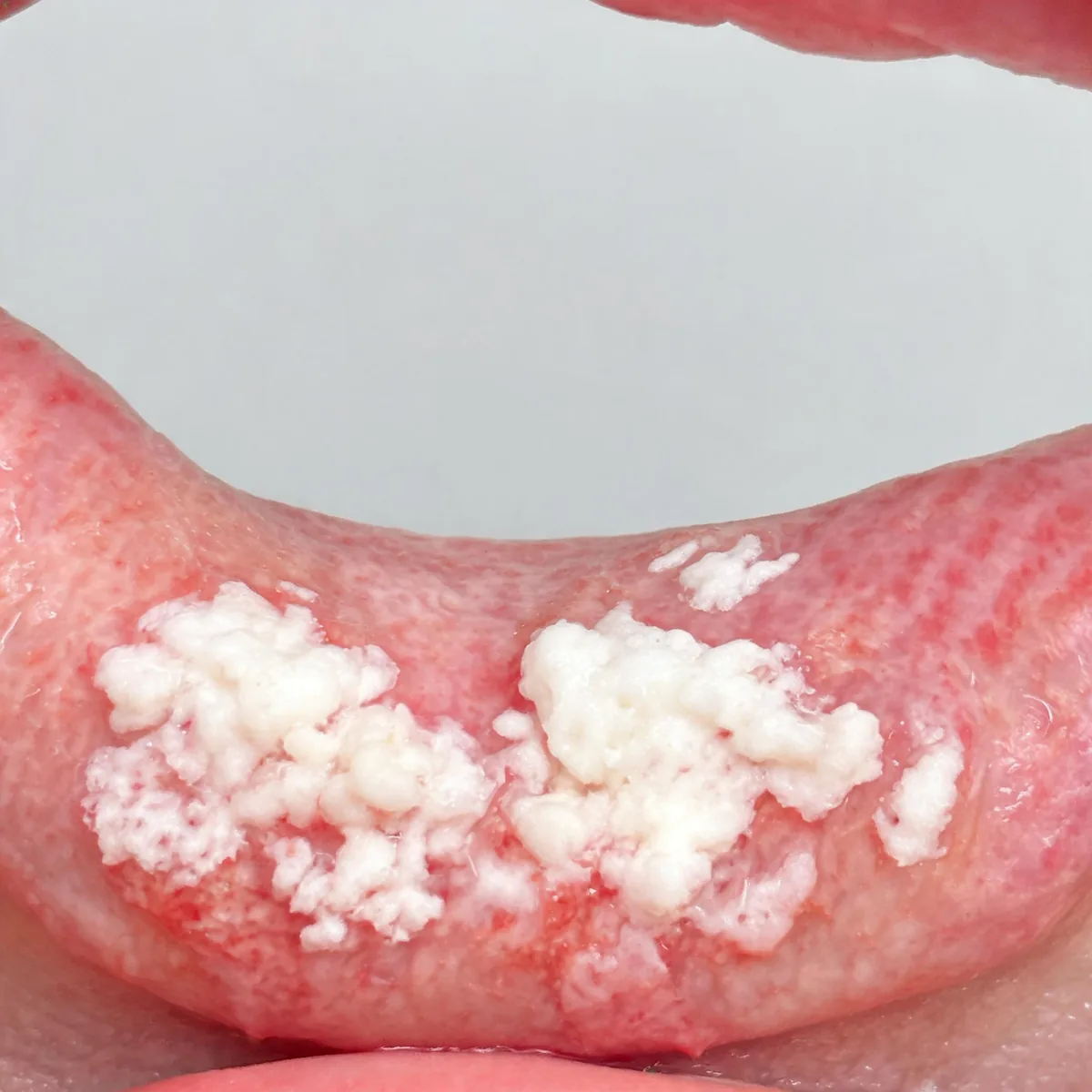
Understanding Candidiasis
The tradition describes yeast overgrowth as a sign that the internal environment has become too damp and warm, rather than as an infection arriving from outside.
The Spleen is described as transforming fluids. When it is weakened by diet, overwork or chronic illness, dampness accumulates, and heat from stress or greasy food combines with it. That damp heat is said to create the conditions in which yeast flourishes.
The patterns follow the site. Genital itching with thick yellow discharge and a bitter taste is read as Damp-Heat in the Liver channel; burning urination with a dragging lower abdomen as Damp-Heat in the Lower Burner; white curd-like oral patches as Damp-Heat in the Stomach and Spleen.
Where the discharge is thin rather than thick, or the picture is one of dryness with night sweats, the reading changes to Yin deficiency, and the treatment shifts from draining to nourishing. That distinction is the core of the page.
The image the tradition uses is one of climate rather than invasion. Candida is treated as an organism always present in small numbers, waiting for the internal weather to turn warm and damp enough for it to multiply, so the question is less how to kill it than why the body has become hospitable. That reframing explains why a course of antifungal treatment clears the symptoms and yet the same infection returns a few months later, and why two people with the same organism can have entirely different complaints.
The Spleen sits at the centre of the picture because it is the system that transforms fluids. When it is burdened by sugar, dairy, greasy food, overwork or long illness, fluids are only partly processed and the remainder becomes Dampness, a heavy sticky residue that tends to move downward. Add Heat from stress, alcohol or rich food and the mixture becomes the warm, moist environment in which yeast flourishes. Where it settles decides the presentation: the genitals when it pours down the Liver channel or into the lower burner, the mouth when turbid Heat rises from the Stomach and Spleen.
Not every case is excess. Some people present with a white sticky discharge and no burning at all, and with it exhaustion, a poor appetite and a pale puffy tongue; here the Spleen is simply too weak to manage moisture, and drying herbs would leave it weaker still. Others, especially after repeated courses of medication or a long chronic illness, have depleted Yin: the cooling and moistening fluids are low, empty Heat disturbs the lower burner, and the discharge is thin rather than thick, with night sweats and a dry mouth. Recognising which of these is present decides whether treatment drains, strengthens or nourishes.
Conventional view
Candidiasis, commonly called a yeast infection, is an overgrowth of Candida fungi, most often Candida albicans. It can affect the mouth as thrush, the vagina, skin folds and rarely the bloodstream, with itching, burning, redness and a thick white curd-like discharge in vaginal infection or white patches on the tongue and inner cheeks in oral thrush. Diagnosis is usually clinical, sometimes confirmed by swab culture, and triggers include antibiotic use, hormonal change, diabetes and weakened immunity.
Treatment relies on antifungal medication: topical creams, suppositories or oral drugs such as fluconazole. A single dose may clear a mild case, while recurrent infection may need longer courses or prophylactic antifungals, and symptoms usually settle quickly.
Antifungals target the fungus directly but do nothing about the internal conditions that let it thrive, so recurrence is common, especially with diabetes, antibiotics or hormonal change, and frequent use can contribute to resistance. Conventional medicine also treats all yeast infections as one problem, without distinguishing the different internal imbalances such as excess Heat versus deficiency that TCM sees as root causes.
Selected PubMed records
Real PubMed records for the conventional discussion above, selected by condition name and title relevance. They are references, not a claim that any treatment is proven for this condition.
- Risk Factors for Invasive Candida Infection in Critically Ill Patients: A Systematic Review and Meta-analysis.. Chest, 2022. PMID: 34673022.
- The Role of Probiotics in the Treatment of Vulvovaginal Candidiasis: A Systematic Review and Meta-Analysis.. Ethiopian journal of health sciences, 2023. PMID: 38784519.
- Vulvovaginal candidiasis: A global perspective through systematic review and meta-analysis.. Microbial pathogenesis, 2026. PMID: 41513184.
How it connects
Candidiasis usually signals a deeper pattern of Dampness and Heat that disturbs several systems. Where Damp-Heat in the Liver channel is the root, the same pathogenic energy that causes genital itching and discharge rises to produce a bitter taste in the mouth and a short temper, and obstructed Liver flow brings irritability and anxiety. If Spleen deficiency with Dampness underlies it, the first casualty is digestion: bloating, fatigue and heaviness, with the internal Dampness sinking to create the moist environment where yeast thrives. Oral thrush adds its own cluster: the Damp-Heat that coats tongue and mouth often starts in the Stomach and Spleen and rises as bad breath, a sticky taste and poor appetite. The clustering follows the pattern. Where the Liver channel supplies the root, the same constrained Qi that produces genital itching and discharge also produces a bitter taste, a short temper and low mood, and the whole group eases when Liver Qi is smoothed. Where the Spleen is the root of the trouble, digestion suffers first, with bloating, fatigue, heavy limbs and loose stools, and the internal Dampness that causes those symptoms is the same Dampness that sinks to create the environment yeast prefers. Oral thrush brings its own cluster, because turbid Heat rising from the Stomach and Spleen gives white plaques on the tongue together with bad breath, a sticky taste and a poor appetite, so clearing the Damp-Heat in the digestion usually settles the mouth and the breath together.
How it is assessed
The practitioner distinguishes damp heat from deficiency, and asks why the pattern keeps returning.
What a practitioner looks for
- Discharge quality: thick, yellow and foul points to Damp-Heat; thin and non-sticky points to Yin deficiency; sticky white without burning points to Spleen deficiency.
- Site: genital, oral, urinary and anal pictures are mapped to the Liver channel, the Lower Burner, and the Stomach and Spleen.
- Digestive signs: bloating, sticky taste, loose stools and fatigue support a damp pattern.
- Recurrence factors: diet, antibiotics, stress, sleep and blood sugar control are all part of the assessment.
The first distinction a practitioner makes is between excess and deficiency, and it is made largely from the discharge, the tissue and the accompanying signs. Thick, yellow, foul-smelling discharge with intense itching and burning, a red tongue with a yellow coat and a wiry rapid pulse describes Damp-Heat, an excess picture that needs clearing. Thin, non-sticky discharge with dryness, night sweats and a tongue bearing little coating describes Yin deficiency, a deficient picture that needs nourishing, and treating it with bitter cold drying herbs would make matters worse.
The next question is where the Damp-Heat is concentrated. A bitter taste, rib-side fullness, irritability and worsening with stress point to the Liver channel, which runs through the genitals; burning on urination, a dragging lower abdomen and a coating thickest at the root point to the lower burner; white curd-like plaques inside the mouth, with bloating, a sticky taste and bad breath, point to the Stomach and Spleen. The practitioner will also ask about antibiotics, blood sugar, contraception, sleep and diet, because these are what keep the terrain warm and damp.
Spleen deficiency is recognised by what is missing as much as by what is present. The discharge is white and sticky without burning, the person is tired, the limbs feel heavy, the appetite is poor and the stools are loose, the tongue is pale and puffy with teeth marks and the pulse is weak or soggy. Recurrence is the clue that ties the assessment together: an infection that returns after every course of treatment is usually being driven by a deficiency the antifungal never touched, and the tongue and pulse are what identify which one.
TCM patterns in Candidiasis
Five patterns are described, and the first division is between excess and deficiency. The excess patterns are all Damp-Heat and differ by location. Genital itching with thick yellow discharge, a bitter taste and rib-side discomfort that worsens with stress is Damp-Heat in the Liver Channel. Burning on urination with a heavy dragging lower abdomen and curd-like discharge is Damp-Heat in the Lower Burner, where the pathogens sit in the pelvis rather than along a channel. White plaques in the mouth with upper abdominal fullness, a sticky taste, bad breath and thirst without much drinking is Damp-Heat in Stomach and Spleen, where turbid heat rises. The deficient patterns explain recurrence: sticky white discharge without burning, with fatigue and loose stools, is Spleen Deficiency with Dampness, while thin discharge with dryness and night sweats, after long medication, is Yin Deficiency.
| Pattern | Key signs | The itch | Tongue | Main formula |
|---|---|---|---|---|
| Damp-Heat in the Liver Channel | Fullness or pain along the ribs | Intense genital itching and burning | Body: Red, with redder sides and edgesCoat: Yellow and greasy, thicker at the centre and root | Not specified |
| Damp-Heat in the Lower Burner | Burning or stinging on urination | Anal burning or itching | Body: Red, slightly swollen, with a coating thickest at the rootCoat: Yellow and greasy | Not specified |
| Spleen Deficiency with Dampness | Not specified | Not specified | Body: Pale and swollen, often with teeth marks along the edgesCoat: White, greasy and moist, thick in the middle | Not specified |
| Damp-Heat in Stomach and Spleen | Not specified | Not specified | Body: Red, possibly swollen with teeth marksCoat: Thick, yellow and greasy in the centre and root | Not specified |
| Yin Deficiency | Dry mouth and throat at night; Red tongue with little coating | Not specified | Body: Red, thin and dry, with cracksCoat: Little or none | Not specified |
Damp-Heat in the Liver Channel
Genital itching and burning with thick yellow discharge and a bitter taste.
Because the Liver channel passes through the genitals, this pattern shows itself there. Emotional stress, frustration and a diet of greasy or spicy food generate Damp-Heat, and the channel carries it downward to settle in the genital area. The tissue becomes hot, moist and irritated, which is exactly the environment yeast needs, so intense itching, burning and a thick yellow discharge follow. Rib-side fullness and a bitter taste are the signs that the channel itself, rather than the pelvis alone, is involved.
The tongue body is red with redder sides under a yellow greasy coat thicker at the centre and root, and the pulse is wiry, slippery and rapid. Anger and stress, rich or heavily spiced food, sugary food, alcohol, humid weather, tight synthetic underwear and long hours in wet clothes aggravate it, while stress management, cooling foods such as cucumber and mung beans, loose cotton underwear and a dry environment ease it. Long Dan Xie Gan Tang drains the channel with Long Dan Cao, Huang Qin and Zhi Zi, and the points are LR-3 Taichong, LR-2 Xingjian and SP-6 Sanyinjiao.
Signs
- Intense genital itching and burning
- Thick yellow foul-smelling discharge
- Bitter taste in the mouth
- Fullness or pain along the ribs
- Worse with stress, spicy and greasy food
Diet and lifestyle for this pattern: Eat cooling, Dampness-resolving food such as cucumber, bitter gourd, mung beans and barley, and avoid spicy, greasy and sugary food as well as alcohol, which fuel Damp-Heat. Wear loose cotton underwear, change out of wet clothes promptly, and keep stress moving with gentle exercise so Liver Qi flows.
Damp-Heat in the Lower Burner
Burning urination with curd-like discharge and lower abdominal heaviness.
When fluids are poorly transformed, Dampness accumulates, and if Heat is present too the mixture sinks into the lower burner, the region of the pelvis and urinary organs. Warmth and moisture collect exactly where Candida multiplies, so the discharge is thick, curd-like and offensive, urination stings or burns, and the lower abdomen feels heavy and dragging. Anal itching and thirst without a real desire to drink are further signs that the trouble is damp and hot rather than dry.
The tongue body is red and swollen under a yellow greasy coat thickest at the root, and the pulse feels slippery and quick, or soggy, most marked at the rear position. Sugary and processed food, alcohol, spicy dishes, humid weather and long periods of sitting aggravate it, while a cool dry environment, simply cooked food and a soup of barley or mung beans relieve it. Zhi Dai Fang clears Heat, drains Dampness and stops the discharge, Bi Xie Fen Qing Yin is used where discharge and urine are cloudy, and the points are SP-9 Yinlingquan, SP-6 Sanyinjiao, REN-3 Zhongji and LI-11 Quchi.
Signs
- Thick yellow curd-like discharge
- Burning or stinging on urination
- Heavy dragging lower abdomen or legs
- Anal burning or itching
- Thirst without desire to drink
Diet and lifestyle for this pattern: Cut out sugar, refined flour, dairy and greasy or spicy food that feed Dampness and Heat. Wear loose breathable cotton and change out of damp clothing quickly, and sip barley water or chrysanthemum tea to drain damp-heat gently.
Spleen Deficiency with Dampness
Sticky white discharge without burning, with a digestive deficiency picture.
The Spleen transforms and transports fluids, and when its Qi is weak, through poor diet, overwork or long illness, fluids are only half processed and remain in the body as Dampness. The result is a permanently moist interior in which yeast multiplies without any Heat being involved, so the discharge is white and sticky rather than yellow and offensive, and there is no burning. Fatigue, a poor appetite, heaviness in the limbs and loose stools belong to the same deficiency, which is why the infection returns whenever the person is run down.
The tongue is pale and swollen with teeth marks under a white greasy coat on a moist surface, and the pulse is soggy and slow, soft at the right guan position, sometimes slippery or deep and weak. Cold and raw food, iced drinks, dairy and sugar, heavy meals, humid weather, overexertion and long periods of sitting aggravate it, while warm cooked meals, light exercise, rest, a dry environment and small frequent meals help. Si Jun Zi Tang and Ping Wei San strengthen the Spleen through Bai Zhu, Fu Ling, Chen Pi and Yi Yi Ren, and the points are ST-36 Zusanli, SP-6 Sanyinjiao, SP-9 Yinlingquan and BL-20 Pishu.
Signs
- Sticky white vaginal or oral discharge
- Fatigue with heaviness in the limbs
- Poor appetite with bloating
- Loose stools
- Worse with cold and raw food
Diet and lifestyle for this pattern: Eat warm cooked food such as soups, stews and lightly steamed vegetables, and avoid raw, cold and Dampness-producing items such as dairy, sweets, greasy food and too much fruit. Gentle daily walking helps Qi move and stops Dampness collecting.
Damp-Heat in Stomach and Spleen
Oral thrush picture: white curd-like patches with digestive signs.
This is the oral picture. The Stomach and Spleen are where food and fluid are transformed, and when they are overloaded by rich or greasy food, late meals or chronic worry, moisture is left half processed and turns turbid. That turbid Damp-Heat rises, and as it reaches the mouth and throat it irritates them and produces white curd-like plaques on a red inflamed base. Upper abdominal fullness, a sticky taste, bad breath and thirst without much drinking all point to the same heated residue in the digestive tract.
The tongue body is red, sometimes swollen with teeth marks, under a thick yellow greasy coat heaviest at the centre and back, and the pulse is soggy and rapid, often slippery as well. Greasy, fried or rich food, alcohol and sugary drinks, overeating, late meals and chronic worry aggravate it, while light warm meals, less sugar and dairy, and regular unhurried eating relieve it. Lian Po Yin clears Heat and dries Dampness in the middle burner with Huang Lian and Hou Po, and the points are REN-12 Zhongwan, SP-9 Yinlingquan and ST-44 Neiting.
Signs
- White curd-like patches in the mouth
- Bloating and fullness
- Sticky or incomplete bowel movements
- Bitter or sticky taste
Diet and lifestyle for this pattern: Choose light, warm cooked food such as congee, steamed vegetables and a little lean protein, and avoid sugar, dairy, fried food and alcohol, which directly feed Damp-Heat. Chew slowly and eat at regular times to support the Spleen's rhythm.
Yin Deficiency
Thin discharge with dryness and night-time heat, explaining recurrence.
After repeated courses of medication, a long illness or years of late nights, the body's cooling and moistening fluids run low and a state of Empty Heat appears. That heat disturbs the lower burner, and the terrain it creates is one in which yeast can overgrow, but the discharge that follows is thin and non-sticky rather than thick, because there is no Dampness to give it body. Dry mouth and throat at night, night sweats and heat in the palms, soles and chest show that a deficiency, not an excess, is driving the problem.
The tongue body is red and thin, often cracked, with barely any coat, and the pulse is fine and rapid. Emotional stress, spicy, fried or greasy food, alcohol and coffee, overwork, late nights, heavy sweating and hot environments aggravate it, while rest, adequate sleep, cooling and moistening foods, water or herbal teas, stress reduction and gentle exercise relieve it. Zhi Bai Di Huang Wan nourishes Yin and clears deficiency Heat through Zhi Mu, Huang Bo and Mai Dong, and the points are KI-3 Taixi, SP-6 Sanyinjiao and BL-23 Shenshu.
Signs
- Thin non-sticky discharge
- Dry mouth and throat at night
- Night sweats
- Heat in palms, soles and chest
- Red tongue with little coating
Diet and lifestyle for this pattern: Choose moistening, Yin-nourishing food such as pear, honey, tofu and black sesame, and avoid alcohol, coffee, spicy and fried food that depletes Yin further. Rest and sleep come first, late nights consume Yin fastest, and keep the affected area clean and dry without harsh soap.
Treatment approach
How the tradition treats candidiasis, with the herbs, formulas and points used for it.
Principles
- Drain dampness and clear heat while the picture is active, then address why it recurs.
- Strengthen the Spleen so that dampness stops re-forming, which the classical literature treats as the prevention step.
- Nourish Yin where the picture is dry, since drying treatment would worsen that pattern.
- Review diet, blood sugar and antibiotic history, which are named as the practical drivers of recurrence.
- Clear the branch while it is active and treat the root once the acute picture settles: bitter cold herbs and diuretics to drain Damp-Heat, Spleen tonics to stop Dampness re-forming, and moistening herbs where Yin is low. Mixed pictures are the rule rather than the exception, so the formula is adjusted as the infection clears, and diet is treated as part of the prescription rather than as an optional extra.
Herbs used
Formulas
- Long Dan Xie Gan Tang
- Zhi Dai Fang
- Bi Xie Fen Qing Yin
- Si Jun Zi Tang
- Ping Wei San
- Lian Po Yin
- Zhi Bai Di Huang Wan
Acupoints
- LR-3 (Taichong)
- LR-2 (Xingjian)
- SP-6 (Sanyinjiao)
- SP-9 (Yinlingquan)
- zhongji-ren-3
- LI-11 (Quchi)
- ST-36 (Zusanli)
- BL-20 (Pishu)
- zhongwan-ren-12
- ST-44 (Neiting)
- KI-3 (Taixi)
- BL-23 (Shenshu)
What to expect
- Acute symptoms are described as settling within one to two weeks of treatment and dietary change.
- Recurrence is common unless the damp pattern and its triggers are addressed.
- Chronic or recurrent cases need medical review, not only herbal treatment.
- Acute symptoms usually settle within one to two weeks of herbs and dietary change, while the root takes longer: four to eight weeks for the Damp-Heat and Spleen deficiency patterns and two to four months for Yin deficiency, with acupuncture typically weekly for six to twelve weeks. Progress is measured in stages, with itching and discharge easing first, then energy and digestion improving, and only then a fall in the frequency of relapse.
Safety and when to get help
Seek medical help urgently for
- Fever or chills with yeast infection symptoms, which may indicate systemic infection.
- Severe pain or swelling spreading beyond the affected area.
- Oral thrush with difficulty swallowing or weight loss.
For anything severe, sudden or spreading quickly, read when a skin problem needs urgent care.
Cautions
- Recurrent candidiasis needs investigation for diabetes, immune suppression or antibiotic use.
- Do not stop prescribed antifungal treatment abruptly.
- Pregnancy requires practitioner review before internal herbs.
Using this alongside conventional care
- TCM is described as complementary to conventional care: prescribed antifungal treatment can continue alongside herbs and acupuncture, and any change to prescribed therapy belongs with the prescriber.
- Antifungal treatment and herbal treatment can run together, and most people begin that way. Continue fluconazole or the prescribed cream exactly as directed, tell both practitioners everything you are taking, and expect the herbal formula to be adjusted as the acute infection clears. Bitter cold herbs such as Huang Lian and Huang Qin are not known to interact with the common antifungals, but blood-moving herbs can add to the effect of anticoagulants and should be declared. Never stop a prescribed course on your own, even when the symptoms have gone.
Diet and lifestyle
- The consistent advice is to remove what is said to feed damp heat: sugar including honey and fruit juice, dairy, greasy and fried food, and alcohol.
- Across all five patterns the first step is the same: reduce what creates Dampness and Heat, which means sugar including honey and fruit juice, dairy, greasy and fried food, alcohol and refined carbohydrates, and build meals from cooked whole grains such as rice, millet and barley, vegetables that are lightly cooked, and modest servings of lean protein, while mung beans, Job's tears and cucumber are especially useful for clearing Damp-Heat, warm cooked food suits a weak Spleen better than cold or raw food, and warm water or unsweetened herbal tea is the usual drink. Pattern detail then shapes it, with cooling bitter foods for the Damp-Heat patterns, warm easy meals for Spleen deficiency, and pears, honey, tofu and black sesame for Yin deficiency.
If you're pregnant
Pregnancy creates a naturally damp and warm environment in the lower burner, so candidiasis is more common, especially in the second and third trimesters. The pattern often shifts towards Spleen deficiency with Dampness and Damp-Heat in the Lower Burner as the growing fetus taxes the Spleen's fluid handling, and hormonal change encourages yeast overgrowth.
Strong bitter-cold herbs such as Long Dan Cao and Huang Qin can be too harsh in pregnancy and may risk miscarriage in large doses, and formulas such as Long Dan Xie Gan Tang are generally avoided. Milder Spleen-supporting formulas such as Si Jun Zi Tang with Yi Yi Ren, or external washes with Ku Shen and Huang Bo that stay out of the systemic circulation, are preferred, and lower abdominal and lower back points are avoided, with Sanyinjiao (SP-6) used only under expert guidance.
If you're breastfeeding
During breastfeeding the mother's Yin and Blood are still recovering, so Yin deficiency is more likely if candidiasis recurs. The priority is to avoid herbs that pass into milk and might cause diarrhoea or cold damage in the infant, so bitter-cold herbs such as Huang Lian and Da Huang are typically avoided.
Safer options include gently clearing Damp-Heat with Fu Ling and Yi Yi Ren, or external sitz baths and washes that do not affect the milk. Acupuncture carries no risk of herb transfer and points such as Yinlingquan (SP-9) and Zusanli (ST-36) can be used freely, while a milder modified Zhi Bai Di Huang Wan may be used for Yin deficiency under close supervision.
If treating a child
In infants and young children oral thrush is the most common presentation. The immature Spleen and Stomach are easily overwhelmed by milk or formula, generating Damp-Heat that rises to the mouth, and the child may be fussy, refuse feeds and show white patches on the tongue and cheeks; since infants cannot describe symptoms, diagnosis rests on observing the mouth and behaviour.
Treatment is very gentle, at about a quarter to a half of the adult dose by age and weight, and strong purgatives such as Da Huang are avoided. A mild formula clearing Damp-Heat from Stomach and Spleen such as a modified Lian Po Yin, or a weak Huang Lian decoction applied externally to the mouth, may be used, and acupressure or very shallow needling at points such as Neiting (ST-44) can clear Stomach Heat without distress.
If treating an elderly patient
Older patients often present with chronic recurrent candidiasis, especially oral thrush and denture stomatitis, and the pattern shifts towards Yin deficiency or Spleen deficiency as ageing depletes Yin fluids and digestive Qi. Dry mouth, a thin tongue body with little coat and a fine rapid pulse are common, and Damp-Heat may still be present but on a deficient background.
Doses are reduced to about two-thirds of the adult dose and strong bitter-cold herbs are used sparingly to avoid further injuring Spleen and Stomach. Zhi Bai Di Huang Wan is a cornerstone for Yin deficiency with empty heat, polypharmacy means interactions must be checked, and acupuncture with points such as Taixi (KI-3) and Shenshu (BL-23) to nourish Yin and Sanyinjiao (SP-6) to drain Dampness is often better tolerated.
Urgent-sign guidance is based on standard sources: NHS anaphylaxis, NHS cellulitis, NHS Stevens-Johnson syndrome, NHS melanoma.
Evidence
Evidence status
Compiled for this page from the classical and modern literature; not a systematic review, so treat it as a pointer to sources rather than clinical guidance.
Evidence is growing but modest. Laboratory studies show several Chinese herbs and formulas have direct antifungal activity against Candida albicans, including fluconazole-resistant strains; a 2022 Frontiers in Pharmacology study found the formula Cao Huang Gui Xiang disrupts Candida biofilms and cell membranes. Clinical trials remain small and mostly Chinese, and a 2025 review of vulvovaginal candidiasis noted the need for better-designed studies.
The evidence is growing but remains modest. Laboratory work has shown that several Chinese herbs and formulas have direct antifungal activity against Candida albicans, including strains resistant to fluconazole, and a 2022 study of Cao Huang Gui Xiang in Frontiers in Pharmacology found that it disrupted biofilms and cell membranes and downregulated virulence genes. Clinical trials remain few and small, and most come out of China, though a 2025 review of vulvovaginal candidiasis reported that integrated Chinese and Western treatment gives better cure rates and fewer relapses than antifungals used alone, and acupuncture has been studied as an adjunct for recurrent infection with promising results. Larger randomised trials with standardised outcomes are still needed.
Studies often cited
The in vitro study tested the formula Cao Huang Gui Xiang, made of rhubarb, licorice, cinnamon bark and Pogostemon cablin, against Candida albicans and non-albicans species including fluconazole-resistant strains. It inhibited biofilm formation, damaged cell membranes and downregulated virulence genes, giving a mechanistic rationale for its traditional use in cutaneous, oral and systemic candidiasis. Wang Y, et al. Antifungal mechanisms of a Chinese herbal medicine, Cao Huang Gui Xiang, against Candida species. Frontiers in Pharmacology. 2022;13:813818.
Laboratory studies of single herbs and formulas used in candidiasis report activity against Candida albicans and against fluconazole-resistant strains, supporting the traditional use of bitter, drying and toxin-resolving herbs for damp-heat presentations, though clinical trials are still limited in number and size. As recorded in the classical record.
PubMed records for the TCM evidence
Real PubMed records for the TCM clinical evidence discussed above, selected by condition name and title relevance. They are references, not proof of benefit.
- Efficacy and safety of oral ibrexafungerp in Chinese patients with vulvovaginal candidiasis: a phase III, randomized, double-blind study.. Infection, 2024. PMID: 38568411.
- Mechanisms and regulation of iron uptake and the role of iron in pathogenesis of Candida albicans.. Critical reviews in microbiology, 2025. PMID: 40411301.
Classical record
All leukorrhea disorders are dampness syndromes. They are named after the Dai vessel because it fails to restrain, leading to this illness. Yellow leukorrhea is due to Damp-Heat in the Ren vessel.
- Fu Qing Zhu Nu Ke (Fu Qing-Zhu's Gynecology), chapter on leukorrhea. The Chinese original is not reproduced here: it could not be recovered reliably from the source record, and is not guessed.
小儿初生,口里白屑起,乃至舌上生疮,如鹅口里,世谓之鹅口。此由在胎时,受谷气盛,心脾热气熏发于口故也。
In newborn babies, white flakes appear in the mouth and may go on to form sores on the tongue, like the inside of a goose's beak, which people call goose mouth. It comes from receiving too much grain Qi while in the womb, so that Heat from the Heart and Spleen steams upward and manifests in the mouth.
Zhubing Yuanhou Lun on oral thrush in infants - Zhubing Yuanhou Lun (Treatise on the Origins and Symptoms of Diseases), volume 50, on oral thrush in infants, translated from the Chinese original as recorded in the classical literature.
Common questions
Can TCM treat recurrent yeast infections?
The classical literature treats the damp heat and the Spleen weakness behind it, with the aim of reducing recurrence. Recurrent infections should also be medically investigated for underlying causes.
Do I have to cut out sugar completely?
The classical literature advises removing sugar, fruit juice, dairy and alcohol while treating an active infection, since these are described as feeding damp heat.
Why does it keep coming back?
In this framework recurrence means the damp environment was not changed, only the acute episode treated. That is why Spleen support and diet are part of the plan.
Can I use it alongside antifungal treatment?
Yes. The tradition describes them as compatible, with prescribed treatment continuing.
Can TCM cure a yeast infection permanently?
No treatment can promise that, and TCM does not claim to. What it aims at is the terrain that allows Candida to overgrow, so that recurrence becomes rare rather than routine. In practice that means a course of herbs, acupuncture and dietary change, followed by the habits learned along the way. Many people find their infections become much less frequent, and some stop having them.
How long does it take to see results with TCM?
Itching and discharge usually settle within the first week or two of treatment. The deeper work takes longer: four to eight weeks is typical for the Damp-Heat and Spleen deficiency patterns, and two to four months for Yin deficiency with its background of depletion. Expect the formula to be adjusted as the acute picture clears and the underlying pattern becomes easier to read.
Can I use TCM alongside my antifungal medication?
Yes, and in practice most people do, at least at the beginning. Continue the prescribed cream or oral antifungal exactly as directed and tell both your practitioner and your doctor what you are taking. Bitter cold herbs such as Huang Lian and Huang Qin are not known to interact with the common antifungals, but the full list should always be checked. Never stop a prescribed course without medical advice.
Is TCM safe for yeast infections during pregnancy?
Many herbs are safe in pregnancy when a qualified practitioner prescribes them, but some that clear Heat strongly or move Blood are not, and doses need adjusting. Tell your practitioner as soon as you know you are pregnant or are trying to conceive, and do not use over-the-counter herbal preparations in the meantime. Acupuncture is generally safe with careful point selection, and for mild infections dietary change alone can be enough.