
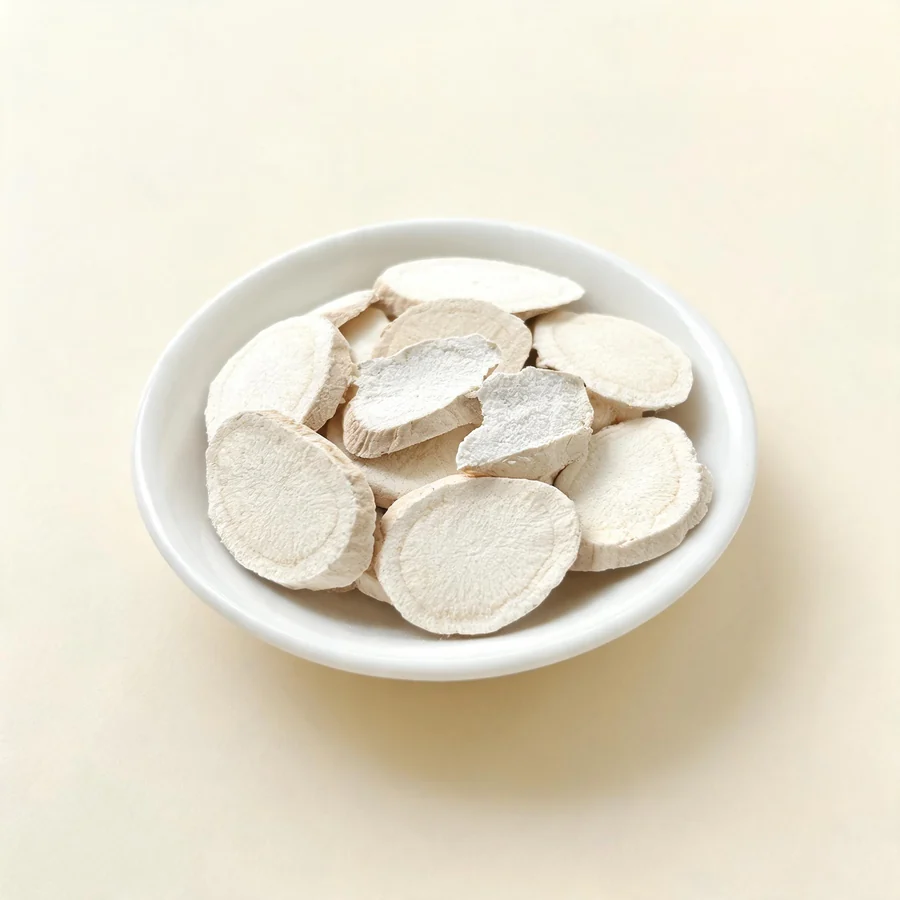
Skin profile
Where this herb sits in skin practice: the pattern it corrects, the skin signs it suits, and what it should not be used for.
Shan Yao is included on a skin page for one clause and for what it enables. The clause is that it moistens skin and body hair; what it enables is a digestion strong enough to make the Blood and fluid that reach the surface. That makes it a formula herb for dry deficiency and a poor fit for anything wet, hot or infected, and the classical commentators said as much themselves.
Skin signs that suggest it
- Dry, thin, dull skin with fine scaling and a papery feel
- Cracks at the heels, knuckles or lips that return every winter
- Loose, wrinkled or shrunken skin in a tired, underweight person
- Itch in later life with dryness, scanty sweating and a dry mouth
- A pale tongue with a thin coating and a weak, fine pulse
When it is not the right herb
Not for a wet, red, weeping or infected lesion, where the task is to clear heat and dry the surface rather than to add a sweet tonic. It is also wrong when food is sitting undigested: fullness, a coated tongue and an unpleasant taste in the mouth mean the digestion must be cleared first, because a sweet, starchy herb adds to the stagnation. A person with dry stools and no deficiency can find it binding. It does not replace the assessment of a persistent dermatosis, and anyone whose skin has reacted to the raw tuber should wear gloves or leave it alone.
What it does for skin
Skin-relevant actions only. Each one describes a mechanism in TCM terms and what it looks like on the skin.
Builds the Qi that supplies the surface
The Spleen converts food into Qi and Blood, and the skin is the furthest point they reach. When the Spleen is weak the surface shows it as thin, pale, cool skin that bruises or heals slowly, and the yam is used to strengthen that transformation in a person who is tired, has a poor appetite and passes loose stools. It works over weeks and months, which is why it is given as food as often as in a decoction.
Nourishes Yin and moistens the skin
The classical clause about moistening skin and body hair is the direct statement, and it is a moistening rather than a clearing action. It suits dryness that comes from depletion: skin that is thin, finely scaled and slow to recover, with a dry mouth, scanty sweating and a tongue without much coating. Because the herb is neutral rather than cold it can be taken for months together without chilling the digestion, which is not true of the bitter herbs used for dry heat.
Firms the bowel while it moistens the surface
The yam is mildly astringent, so it holds in what is leaking while it adds moisture where the surface is dry. That combination is unusual and useful: a person with chronic loose stools and dry skin, or with a tendency to sweat at night and to crack at the heels, can be given one herb for both. The astringency is mild, and it is not a treatment for active diarrhoea with fever or blood.
Supports repair in convalescence and old age
After a long illness, in frailty, or in the papery skin of advanced age, the work is repair and not attack. The yam serves as a base: a tonifying prescription sits more easily with it, and a draining one does less harm to a depleted body. Nothing dramatic follows. The skin slowly regains tone and stops splitting, and no rash is suddenly cleared. The old commentators were explicit that it cannot carry a prescription by itself.
Skin conditions it is used for
Mapped to the condition pages on this site. The pattern column shows what the skin is doing when this herb is the right choice.
| Condition | Pattern | Why it suits | Typical setting |
|---|---|---|---|
| Skin dryness | Spleen and Lung Qi deficiency with Yin not reaching the surface | Dry skin that is thin, dull and finely scaled, in a person who is tired and has a poor appetite, is read as a supply problem rather than a surface one. The yam strengthens the Spleen that makes the fluid and the Lung that spreads it, and its neutral, moistening quality lets it be taken for months. It is a supporting herb in that formula, and a dry skin with redness, heat or scaling plaques needs a different approach. | Modified Si Jun Zi Tang with Shan Yao and Mai Men Dong |
| Cracked skin | Blood and Yin deficiency with dryness at the extremities | Cracks that return each winter at the heels, knuckles or lips are read as a loss of moisture and flexibility in the surface, and the yam is used to nourish the Yin and support the Blood that carries moisture out. The effect is slow, and it is paired with blood-nourishing herbs rather than relied on alone. A fissure that bleeds, becomes infected or does not heal needs assessment. | Dang Gui Yin Zi with Shan Yao added |
| Wrinkled and shrunken skin | Deficiency of Qi, Blood and Essence failing to support the skin | Loose, wrinkled skin in a thin older person is read as losing its support, and the yam is one of the gentlest herbs used to build that support, particularly where the Kidneys and Spleen are both depleted. It is a supporting ingredient in formulas such as Liu Wei Di Huang Wan rather than a stand-alone rejuvenating herb, and no herb reverses photoageing. Sudden shrivelling with sunken eyes is dehydration or shock and needs urgent care. | Liu Wei Di Huang Wan, in which Shan Yao is a principal herb |
| Senile pruritus | Blood and Yin deficiency with Wind-dryness in later life | Itch in later life that comes with dry, thin skin is read as dryness from declining Blood and Yin, with Wind moving in the spaces that moisture has left. The yam nourishes Yin and supports the Spleen that makes Blood, and it is combined with blood-nourishing and Wind-settling herbs. Itch with weight loss, jaundice or a new rash needs investigation rather than a tonic. | Modified Si Wu Tang with Shan Yao and Bai Ji Li |
| Eczema | Chronic dry, lichenified eczema on a background of deficiency | The dry, thickened, itching eczema of long standing is treated differently from the weeping acute flare, and where the person is depleted the yam is used to support the Spleen and nourish the Yin that the dryness has consumed. It is a base herb in a formula that also moves blood and settles itch, and it has no place in a wet, red, oozing flare. Eczema that is widespread, infected or resistant needs dermatological care. | Modified Si Jun Zi Tang with Shan Yao, Dang Gui and Bai Xian Pi |
Combinations for skin
Herbs it is paired with when the skin, not an internal organ, is the target.
| Partner | Ratio | Why the pair is used |
|---|---|---|
| Bai Zhu | 10 to 15 g each | Bai Zhu is the standard partner for a weak Spleen, and the yam makes the pairing kinder: Bai Zhu's drying is offset by the yam's moisture, and the yam's slight cloying quality is offset by Bai Zhu's movement. The pair suits someone with loose stools, a poor appetite and dry, thin skin, which is a common combination in convalescence and in old age. Both herbs are neutral or slightly warm and can be taken for months. |
| Huang Qi | 15 to 30 g Huang Qi with 15 to 30 g Shan Yao | Huang Qi lifts and warms, the yam moistens and settles, and the two belong together once a Qi deficiency has lasted long enough to leave the body dry. The one provides the pushing force that carries fluid outward and keeps the surface closed, the other provides the substance that such pushing would otherwise use up. Tired skin that heals slowly, a dry mouth and a poor appetite are the setting. |
| Dang Gui | 10 to 15 g Dang Gui with 15 to 30 g Shan Yao | Dang Gui nourishes Blood and the yam nourishes Yin, and the two are paired for dry, cracked skin in a pale person, where the surface lacks both substance and moisture. Dang Gui supplies the material and the yam helps the Spleen to make more of it, so the formula is gentle enough to continue through the winter. It is not a treatment for a hot, red dermatosis. |
| Fu Ling | 10 to 15 g each | Fu Ling leaches dampness and supports the Spleen while adding nothing moist, whereas the yam supports the Spleen and does add moisture. They meet in skin that is puffy, dull and heavy rather than dry, where a sweet tonic on its own would lie in the stomach and cloy. The choice is made at formula level: Fu Ling for the wet and swollen picture, the yam for the thin and dry one. |
Formulas where it leads
- Liu Wei Di Huang Wan (六味地黄丸) - The classical Yin-nourishing formula, in which the yam is one of the three herbs that supplement rather than drain. For the skin it is the formula used where dryness, a sore lower back, night sweats and a red tongue without coating point to Kidney Yin deficiency, and the yam's part is to support the Spleen so that the richer herbs can be absorbed.
- Shen Ling Bai Zhu San (参苓白术散) - A Spleen formula for loose stools, fatigue and a poor appetite, with the yam among its ingredients. Its skin relevance is indirect and real: a person whose digestion is weak has thin, dull skin and heals slowly, and strengthening the Spleen is the way the surface is supplied.
Safety for skin use
What to check before recommending or using it, including the cautions that matter most for skin patients.
Do not use, or use with caution
- Damp-heat or an active excess with a distended abdomen, a furred tongue, a foul taste in the mouth and belching. A sweet, starchy tonic adds to stagnation, and the digestion must be cleared before it is given.
- Dry stools or constipation as the main complaint. The yam's mild astringency firms a loose bowel and can make a dry one drier, so it is balanced with moistening herbs rather than given alone at a high daily weight.
- Handling the fresh raw tuber. Its mucilage carries calcium oxalate raphides, which inflame the skin of the hands and leave them itching, and heat or drying destroys them. Gloves, or a brief blanch, prevent it, and a person whose skin has reacted before should keep their hands off the raw tuber.
- A wet, weeping or infected skin lesion as the primary problem. This is a supporting herb for dry deficiency, not a treatment for an acute flare.
Pregnancy and breastfeeding
Food-level and standard medicinal amounts are considered safe. The rhizome sits on the national food-medicine list, no classical text forbids it, and nothing suggests it stimulates the womb; women eat it through pregnancy in soup and congee to keep appetite and digestion steady. What matters is the pattern: it fits a tired, pale woman whose stools are loose, not one who is damp-heat or constipated. Trouble with digestion that persists in pregnancy deserves assessment rather than self-treatment, and any course at medicinal strength should be reviewed by a practitioner.
Interactions
- Medicines that lower glucose. Polysaccharides from the yam and allantoin have produced a mild fall in blood sugar in laboratory work, so a large daily amount taken alongside metformin, a sulfonylurea, insulin or a glitazone may drive glucose below what is expected. Extra testing when the herb is started or increased is wise, and the prescriber should be told.
- Medicines whose uptake depends on how fast the gut moves. A mild astringency may slow the passage of food and therefore shift when a tablet taken at the same moment is absorbed; leaving an hour or two between them is a sensible precaution, not a rule.
- Nothing of clinical importance has been found for liver enzymes, and a food-grade tuber is unlikely to produce the sort of interaction that stronger tonics do. That gap in the literature is noted rather than filled with a warning, and it does not excuse a patient from telling the prescriber.
Allergy and patch testing
True allergy is rare for a food yam, and the reaction most often mistaken for one is the irritant dermatitis from the raw tuber's oxalate needles, which is confined to the hands and settles once the exposure stops. A rash that spreads, itches elsewhere or comes with swelling is different and should be assessed. Anyone with a known sensitivity to yams should avoid both handling and eating the raw material.
General safety references
General references for herbal hepatotoxicity and herb-drug interactions; they are not specific to this herb.
- Review article: Herbal hepatotoxicity - an update on traditional Chinese medicine preparations. Alimentary Pharmacology & Therapeutics, 2014. PMID: 24844799.
- Interactions between herbal medicines and prescribed drugs: an updated systematic review. Drugs, 2009. PMID: 19719333.
- Warfarin and food, herbal or dietary supplement interactions: a systematic review. British Journal of Clinical Pharmacology, 2021. PMID: 32478963.
Evidence
The classical record is quoted with its source. The modern note states the level of evidence plainly.
Classical record
益肾气,健脾胃,止泄痢,化痰涎,润皮毛。
It supplements the Qi of the Kidneys, strengthens the Spleen and Stomach, checks diarrhoea and dysentery, transforms phlegm and drool, and brings moisture to the skin and to the body hair.
Ben Cao Gang Mu (Compendium of Materia Medica), Li Shizhen, 1578 - The last clause is the only direct statement of a skin action in the classical record, and it is a moistening action, which is why the herb belongs to dry deficiency rather than to heat.
主头面游风,风头眼眩,下气,止腰痛,治虚劳羸瘦,充五脏,除烦热,强钥。
It rules the Wind that drifts across the head and face, and giddiness from Wind in the head, and it settles Qi downward. Lower back pain is eased, the wasted from consumptive illness are restored, the five viscera are filled, vexing heat is cleared, and the gate of urine is made firm.
Ming Yi Bie Lu (Supplement to the Classic of Materia Medica), Tao Hongjing - Wandering Wind over the head and face is the earliest surface indication, and it describes a migrating itch or rash of the face rather than a fixed lesion.
山药,能健脾补虚,滋精固肾,治诸虚百损,疗五劳七伤。第其气轻性缓,非堪专任。
The yam strengthens the Spleen and supplies what is deficient, enriches the Essence and steadies the Kidneys, and it treats depletion in its hundred forms and damage in its seven. Because its Qi is light and its action unhurried, it cannot carry a treatment alone, so it has to be given alongside stronger medicines.
Ben Cao Zheng (Orthodox Materia Medica), Zhang Jiebin, 1624 - Zhang Jiebin's reservation is the reason this page calls it a supporting herb, and it is a rare case of a classical commentator setting the limit on his own subject.
Modern evidence
Evidence status
- Yam polysaccharides, allantoin and the mucilage have been studied in laboratory and animal work on mucosal repair, blood glucose and inflammation. That work does not measure skin outcomes, and it does not show that eating or decocting the rhizome repairs dry skin in a person.
- No controlled clinical trial of Shan Yao in eczema, pruritus or any other dermatosis is available to cite. Its skin use is inferred from one classical clause and from a long food record, which is a record of safety and of use rather than a demonstration of effect.
- What is best evidenced is safety rather than benefit: the rhizome appears on the national food-medicine list, is graded non-toxic, and the only physical hazard on record is the oxalate-rich mucilage of the tuber when fresh, which heat or drying destroys.
PubMed records
Selected real PubMed records for this herb's species or its constituents, chosen by species name and title relevance. They are references for the non-TCM discussion above, not proof that the herb treats any skin condition.
- The genus Dioscorea L. (Dioscoreaceae), a review of traditional uses, phytochemistry, pharmacology, and toxicity.. Journal of ethnopharmacology, 2024. PMID: 38552992 (safety record).
- Ethnobotany, Phytochemistry, and Pharmacological Activity of Dioscorea bulbifera: A Comprehensive Review.. Chemistry & biodiversity, 2025. PMID: 39283965 (pharmacology or review record).
Dose and forms
Skin-practice dosing and the preparations that suit skin complaints.
| Form | Dose and notes |
|---|---|
| Decoction | Fifteen to thirty grams of dried slices daily. A small amount is enough when the yam supports other herbs in a compound, while the full thirty grams is reserved for cases where it leads, such as a depleted patient with thirst or a long-standing loose stool. |
| Raw or bran-fried slices | Raw slices serve Yin and the fluids, dry skin among them; slices fried with bran serve the Spleen and the bowel. What separates them is processing, not the weight given. |
| As food | Steamed, boiled in soup or cooked as porridge, in whatever quantity appetite allows, since this is a food rather than a drug. A bowl of yam porridge counts towards the day's intake. |
| High-dose tradition | Zhang Xichun recorded decoctions of a single herb at sixty grams and above for profound depletion, which is specialist work under supervision. At that weight the starch alone is enough to cause bloating. |
Amount follows both purpose and preparation. By decoction, fifteen to thirty grams is usual: a small share when the yam supports other herbs, the full weight when it leads. Raw slices serve Yin and fluid, bran-fried slices the Spleen and a loose stool. The very large single-herb figures from the twentieth century are specialist work, and at that weight starch alone can bloat. Eaten as food, the limit is appetite rather than pharmacology.
Citations and further reading
Only real sources are listed: the classical materia medica passages quoted above, and the source works behind the botanical and safety statements.
- Ben Cao Gang Mu (Compendium of Materia Medica), Li Shizhen, 1578 - classical entry quoted above.
- Ming Yi Bie Lu (Supplement to the Classic of Materia Medica), Tao Hongjing, Southern and Northern Dynasties - classical entry quoted above.
- Ben Cao Zheng (Orthodox Materia Medica), Zhang Jiebin, 1624 - classical entry quoted above.
- Rhizoma Dioscoreae monograph: Pharmacopoeia of the People's Republic of China - accepted botanical source, part used and quality requirements.
- Chinese food-medicine dual-use list, national catalogue - the basis for the statement that the rhizome is treated as a food as well as a medicine.
- Modern evidence statement: based on laboratory literature on yam polysaccharides and allantoin, summarised as a statement about the level of evidence rather than as one cited finding.
- Botanical description and identification: botanical literature on Dioscorea opposita, Dioscoreaceae.
Educational reference for qualified practitioners. This page is not medical advice, and skin conditions should be diagnosed by a clinician before treatment.