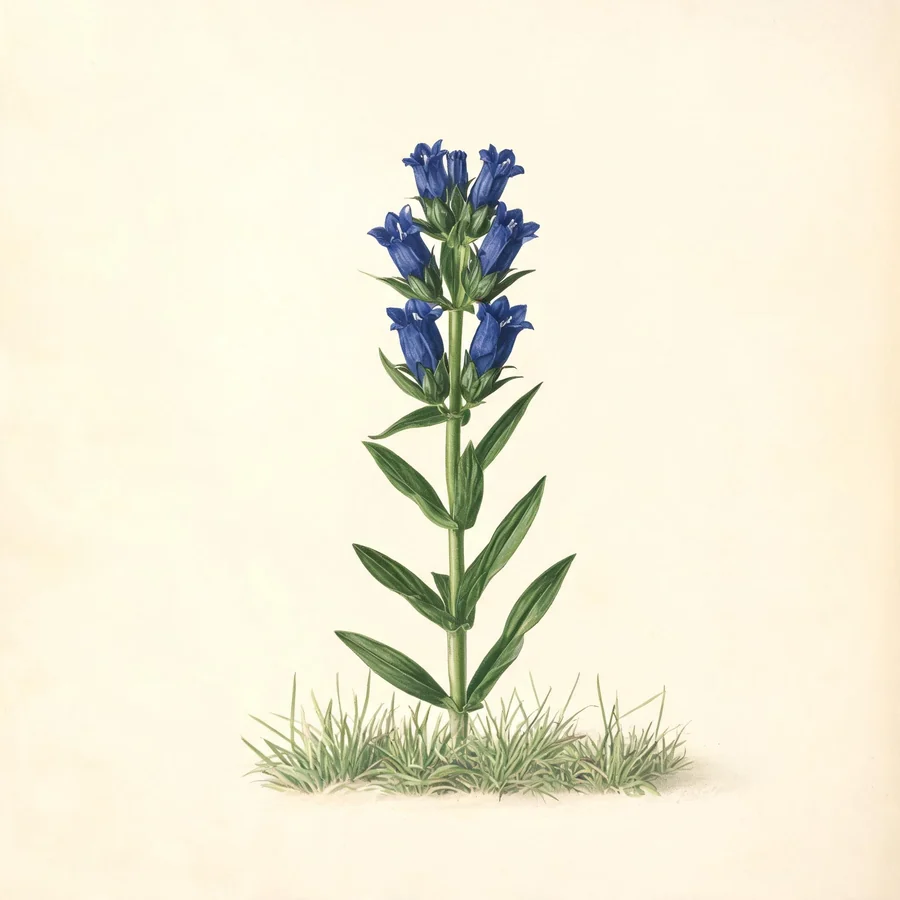
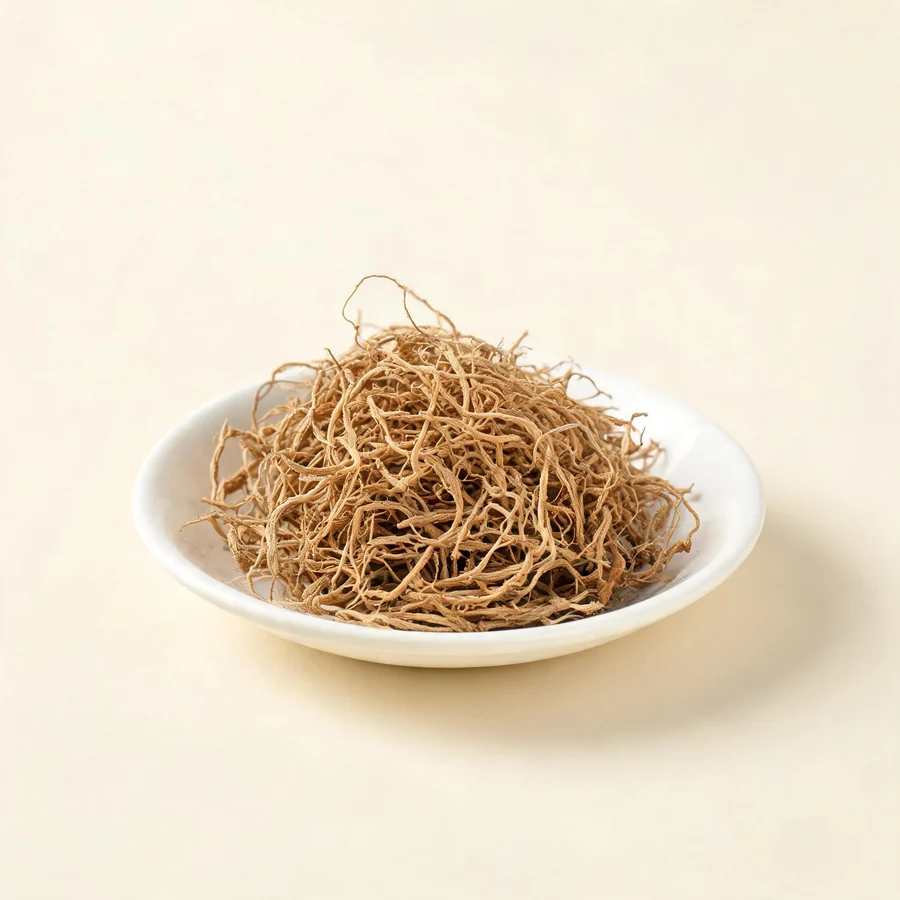
Skin profile
Where this herb sits in skin practice: the pattern it corrects, the skin signs it suits, and what it should not be used for.
Long Dan Cao is chosen for skin that is hot and wet below the waist, or for a burning eruption along the Gallbladder channel. It drains hard and briefly, never for the dry, cold or deficient skin, and the small dose is deliberate.
Skin signs that suggest it
- Intense genital or scrotal itch with redness, swelling and a sticky yellow discharge (damp-heat in the Liver channel)
- Weeping, inflamed skin in the groin, inner thighs or perianal area with a greasy yellow tongue coat
- A band of blisters on a red base with burning, shooting pain on one side of the trunk (Gallbladder channel fire)
- Red, painful eyes, a bitter taste and irritability alongside the skin flare (Liver fire rising)
- A red tongue edge with a yellow greasy coating and a wiry, rapid pulse
When it is not the right herb
Not for dry, pale, cold skin, and not for the lichenified eczema or the scaly plaque of psoriasis, where there is no fire to drain. Not for Yin deficiency with empty heat: a tongue that is red and bare, night sweats and a dry throat call for nourishing and settling rather than for the most bitter draining root in the materia medica. Not for a weak digestion, and not for months at a time. Genital itch with discharge needs a diagnosis, and shingles needs antiviral treatment started early.
What it does for skin
Skin-relevant actions only. Each one describes a mechanism in TCM terms and what it looks like on the skin.
Drains Liver and Gallbladder Fire
Fire in these channels shows in the skin as a burning eruption along the channel's path, with a red base and a sharp, shooting pain, most typically the band of shingles on one flank. The root is intensely bitter, intensely cold, and enters both channels directly; bitterness is the taste that drains, pulling downward. It therefore opposes the upward direction of the fire rather than following it about the surface, which is why it is given inside a formula with other channel-clearing herbs.
Dries Dampness and clears it from the lower burner
When damp-heat settles in the pelvis it produces burning, itching, swelling and a sticky discharge in the genital skin, and sometimes a weeping rash in the groin fold. The genitals lie on the Liver channel, so an herb entering that channel and travelling downward reaches the site directly. Bitterness dries dampness; coldness lowers heat; and the herb's own downward movement follows the route the pathogen has already taken.
Quiets itch by removing its cause
The root is not a sedating antipruritic and it does nothing for the dry, neuropathic itch of cold skin. It reduces itch by clearing the heat and dampness that drive it, which is why it works in a hot, wet, angry itch with redness and discharge and fails in a dry one. That distinction is the practical test: if the skin is not hot and moist, this is the wrong herb, however severe the itch.
Drains downward so the heat leaves by the urine
The root's bitterness and coldness both bear downward, and it is given with diuretic herbs so the damp-heat leaves by the shortest path rather than merely being dried in place. That is the reasoning behind its place in the lower-burner formulas, and also the reason for care in anyone whose urine is already frequent or whose middle is weak, since the downward pull is real.
Skin conditions it is used for
Mapped to the condition pages on this site. The pattern column shows what the skin is doing when this herb is the right choice.
| Condition | Pattern | Why it suits | Typical setting |
|---|---|---|---|
| Genital itch | Damp-heat pouring down into the genital skin | Itch of the vulva, scrotum or perianal skin with redness, swelling and a sticky discharge is the lower-burner damp-heat picture this root is chosen for. The Liver channel passes through the genitals, so the herb reaches the site directly, and its bitterness dries the dampness while the cold lowers the heat. It is given for a short course beside treatment of whatever infection is found on swab, and it is not used for itch on dry skin. | Long Dan Xie Gan Tang, with Che Qian Zi added to move the dampness out through the urine |
| Scrotal eczema | Damp-heat with redness, ooze and itch on the scrotum | Scrotal skin that is red, wet, itchy and heavy is the textbook expression of damp-heat along the Liver channel. The root drains the channel heat and dries the ooze at once, which is why it leads the formula rather than supporting it. The skin there is thin and the area is occluded by clothing, so the course stays short and the formula is balanced against the coldness. | Long Dan Xie Gan Tang, with Ku Shen and Bai Xian Pi for the itch |
| Vulval eczema | Damp-heat in the vulval skin with itch and discharge | Vulval itch with redness, a weeping surface and a discharge is read as damp-heat in the Liver channel, and the root is a leading herb for it. It clears the heat that makes the skin angry and dries the dampness that keeps it wet, and it is combined with antipruritic herbs for the sensation itself. A persistent vulval lesion needs examination and a diagnosis, not only a formula. | Long Dan Xie Gan Tang, modified with Tu Fu Ling and Bai Xian Pi |
| Jock itch | Damp-heat in the groin folds with a raised, itchy edge | A red, itchy patch in the groin fold with a raised, scaling edge and a moist surface is damp-heat trapped where the skin folds and clothing hold warmth. The root drains the dampness and clears the heat, and it is used in a formula with drying and antifungal herbs rather than alone. It does not replace a topical antifungal, and the area should be kept dry and the clothing loose. | With Huang Bai, Ku Shen and Cang Zhu in a lower-burner damp-heat formula |
| Shingles | Liver and Gallbladder fire with dampness along one flank | The band of blisters with a red base and burning, shooting pain on one side of the trunk follows the Gallbladder channel, and it is read as fire with dampness in that channel. Draining the fire eases the burning, and drying the dampness lets the blisters settle, which is why the root is standard in formulas for the acute stage. Antivirals do most good in the first days, so the herb supports them and never delays them. | Long Dan Xie Gan Tang, with Yan Hu Suo and Chai Hu for the pain |
| Eczema | Weeping damp-heat eczema on the lower legs or trunk | The root is used for the wet, angry end of eczema, where lesions are red, oozing and intensely itchy and the person has a bitter taste with a greasy coating. It is not used for the dry, lichenified, cold type, which it would worsen. It leads or supports depending on how much of the picture is channel heat, and it is combined with dampness-draining and itch-quieting herbs. | Long Dan Xie Gan Tang, with Ku Shen and Bai Xian Pi for a weepy lower-leg eczema |
Combinations for skin
Herbs it is paired with when the skin, not an internal organ, is the target.
| Partner | Ratio | Why the pair is used |
|---|---|---|
| Huang Qin | 3 to 6 g Long Dan Cao with 6 to 10 g Huang Qin | This is the core pairing where damp-heat has settled in the Liver and Gallbladder. Huang Qin is broader, clearing heat in the Lung, Stomach and Large Intestine as well, while the gentian is narrower and fiercer and aims at the channel itself. Between them they cover a mixed picture in which genital itch or a weeping groin rash sits beside a bitter taste and a greasy coat. |
| Zhi Zi | 3 to 6 g Long Dan Cao with 6 to 10 g Zhi Zi | Gardenia clears Heart heat and moves fire from all three burners down through the urine, while the gentian drains the Liver and Gallbladder specifically. Between them the fire is given two exits, one through the water route and one along the channel carrying it, which suits a picture where irritability and dark scanty urine sit beside the skin signs. Both herbs are cold and bitter, so the course stays short. |
| Che Qian Zi | 3 to 6 g Long Dan Cao with 10 to 15 g Che Qian Zi | Plantago seed moves damp-heat out through the bladder and so opens the drain that the gentian's drying needs. Where burning urination outranks the itch, the pair pushes the damp-heat out by the water route instead of merely drying it in place. Plantago is mild and neutral and tempers the extreme coldness of the root, which makes the combination easier on the stomach. |
| Gan Cao | 3 to 6 g Long Dan Cao with 3 to 6 g Gan Cao | Licorice is here for the gentian's faults rather than for its own action. The root is so bitter that it can turn the stomach and bring on nausea, and licorice sweetens the cup and protects the middle. The classical liver-draining formula also uses it to reconcile its cold bitter herbs with everything else in the prescription, a reminder, if one were needed, that a decoction has to be drinkable before it can be therapeutic. |
Formulas where it leads
- Long Dan Xie Gan Tang (龙胆泻肝汤) - The gentian liver-draining decoction is the formula that carries this root's name and its main skin use. It treats Liver and Gallbladder fire with damp-heat: genital itch and swelling, a weeping groin rash, burning urination, red eyes and a bitter taste. The root leads the draining, Zhi Zi and Huang Qin clear the channel heat, and Che Qian Zi and Ze Xie give the dampness a route out through the urine.
Safety for skin use
What to check before recommending or using it, including the cautions that matter most for skin patients.
Do not use, or use with caution
- Spleen and Stomach deficiency-cold: loose stools, a poor appetite, cold abdominal pain and a pale tongue. The root is extremely bitter and cold, and in a weak digestion it damages Spleen Yang and worsens every one of those symptoms rather than settling them.
- Absence of excess heat. The root drains and does not tonify, so given to a cold and tired person it takes away what little Qi and Blood remain. A red, bare tongue, night sweats and a dry throat are Yin deficiency with empty heat, which needs nourishing and settling instead.
- Long courses, and repeated doses on an empty stomach. Older commentary held that use over weeks saps the Stomach's generative Qi and may paradoxically stir fire, and that a dose taken fasting can loosen the holding of urine through its downward pull.
- Known sensitivity to gentian or to the Gentianaceae, and any previous rash, wheeze or swelling after a decoction. The root is intensely bitter and a first dose that produces nausea, dizziness or a rash is a reason to stop rather than to reduce.
Pregnancy and breastfeeding
Internal use is avoided unless a practitioner is supervising. The concern is the root's extreme bitterness and its strong downward force rather than any recorded harm to the fetus, since no teratogenicity has been reported. The tradition handles strong draining in pregnancy warily, since such herbs can weaken the Qi that sustains it, so a clear indication, the lowest dose and the shortest time apply. If it is used while nursing, there is no data on transfer, and a brief course at the smallest workable dose is the safer choice.
Interactions
- Sedatives are a theoretical concern. Gentianine, a constituent of the root, has shown sedative activity in animals; a formula taken alongside benzodiazepines, barbiturates or sedating antihistamines may therefore add to drowsiness. Marked effects are unlikely from a decoction, though anyone driving or operating machinery ought to know about it.
- Liver-metabolised drugs are the interaction to disclose. Because gentiopicroside is credited with liver-protective and bile-stimulating effects, the rate at which the liver clears other medicines could shift, which matters for narrow-margin drugs such as warfarin, ciclosporin or an anti-epileptic.
- Blood glucose and blood pressure medicines are another theoretical interaction, because animal work reports both being lowered. People taking insulin, sulphonylureas or blood pressure drugs should have those effects watched, and the herb should not be treated as inert. None of this has been confirmed in trials, so caution is the better reading than reassurance.
Allergy and patch testing
Handling the root can provoke a contact reaction, and a bitter decoction that causes a rash, wheeze or swelling should be stopped immediately. There is no well-described cross-reaction pattern within the Gentianaceae, but a person who has reacted to one bitter herb is watched more closely with another. The root should not be applied to the skin as a paste, since its bitterness and coldness irritate rather than soothe.
General safety references
General references for herbal hepatotoxicity and herb-drug interactions; they are not specific to this herb.
- Review article: Herbal hepatotoxicity - an update on traditional Chinese medicine preparations. Alimentary Pharmacology & Therapeutics, 2014. PMID: 24844799.
- Interactions between herbal medicines and prescribed drugs: an updated systematic review. Drugs, 2009. PMID: 19719333.
- Warfarin and food, herbal or dietary supplement interactions: a systematic review. British Journal of Clinical Pharmacology, 2021. PMID: 32478963.
Evidence
The classical record is quoted with its source. The modern note states the level of evidence plainly.
Classical record
It governs heat in the Liver, jaundice, and pain in the bones and joints.
Shen Nong Ben Cao Jing (Divine Husbandman's Classic of Materia Medica) - The Liver-heat indication is unchanged after two thousand years and remains the basis of the gentian liver-draining decoction.
Taken on an empty stomach it can loosen the holding of urine, because its bitterness descends and its coldness bears down. Where the middle is deficient it should not be used at all, and where the Liver fire is not in excess it has nothing to drain.
Ben Cao Jing Shu (Commentary on the Classic of Materia Medica) - The origin of the practical rules about taking it with food and about never using a draining herb on a deficient pattern.
Its nature is to drain, and it enters the Liver and Gallbladder, where it clears the fire of excess and dries the dampness that clings to the lower body. It is not a herb for a weak Stomach, and it is withheld where the digestion is cold and the stools are loose.
Ben Cao Tong Xuan (Thorough Understanding of Materia Medica) - A Ming formulary comment that places the draining action and its digestive limit in a single sentence.
Modern evidence
Evidence status
- Laboratory and animal work on gentiopicroside and gentianine reports liver-protective, bile-stimulating and sedative activity. These are pharmacological observations, not trials in people, and they do not establish a benefit in genital itch, shingles or eczema.
- Clinical evidence for this root in skin disease is very limited and comes mainly from Chinese-language formula studies in which it is one ingredient in a decoction. No controlled trial of the single herb in a skin condition was identified.
- The root is an accepted herbal substance in the Chinese Pharmacopoeia. Shingles needs antiviral treatment started early and genital itch needs a diagnosis, so the herb is a support to proper care rather than a substitute for it.
PubMed records
Selected real PubMed records for this herb's species or its constituents, chosen by species name and title relevance. They are references for the non-TCM discussion above, not proof that the herb treats any skin condition.
- Gentiana scabra Bunge. Formula for Herpes Zoster: Biological Actions of Key Herbs and Systematic Review of Efficacy and Safety.. Phytotherapy research : PTR, 2017. PMID: 28078812 (safety record).
Dose and forms
Skin-practice dosing and the preparations that suit skin complaints.
| Form | Dose and notes |
|---|---|
| Decoction (internal) | 3 to 6 g of dried root daily, inside a formula rather than alone. The small figure is the point: raising it does not drain fire any better, it only turns the stomach and brings on nausea. |
| Severe patterns | 6 to 9 g briefly where lower-burner damp-heat is intense, supervised and not continued past a few days. The higher figure belongs to an acute presentation under review, not to a course. |
| Course length | Days rather than weeks. Treatment stops when the itching settles, the discharge clears and the tongue coat thins, and it is not continued as maintenance because the coldness accumulates in the digestion. |
Small doses, short courses; the limit is digestive tolerance rather than toxicity. The root is so bitter that the decoction is usually sweetened with licorice and taken with food, and a slow response is met by adding another herb rather than by increasing this one. For the head and eyes the root is wine-fried, which turns its movement upward rather than purely down.
Citations and further reading
Only real sources are listed: the classical materia medica passages quoted above, and the source works behind the botanical and safety statements.
- Shen Nong Ben Cao Jing (Divine Husbandman's Classic of Materia Medica), attributed compilation of the Han period - classical entry given above.
- Ben Cao Jing Shu (Commentary on the Classic of Materia Medica) - classical entry given above.
- Ben Cao Tong Xuan (Thorough Understanding of Materia Medica) - classical entry given above.
- Radix Gentianae monograph: Pharmacopoeia of the People's Republic of China - accepted botanical source, part used and quality requirements.
- Modern evidence statement: based on laboratory literature on gentiopicroside and gentianine, summarised as a statement about the level of evidence rather than as a cited finding.
- Botanical description and identification: botanical literature on Gentiana scabra, Gentianaceae, including the regional species sold as Guan Long Dan and Jian Long Dan.
Educational reference for qualified practitioners. This page is not medical advice, and skin conditions should be diagnosed by a clinician before treatment.