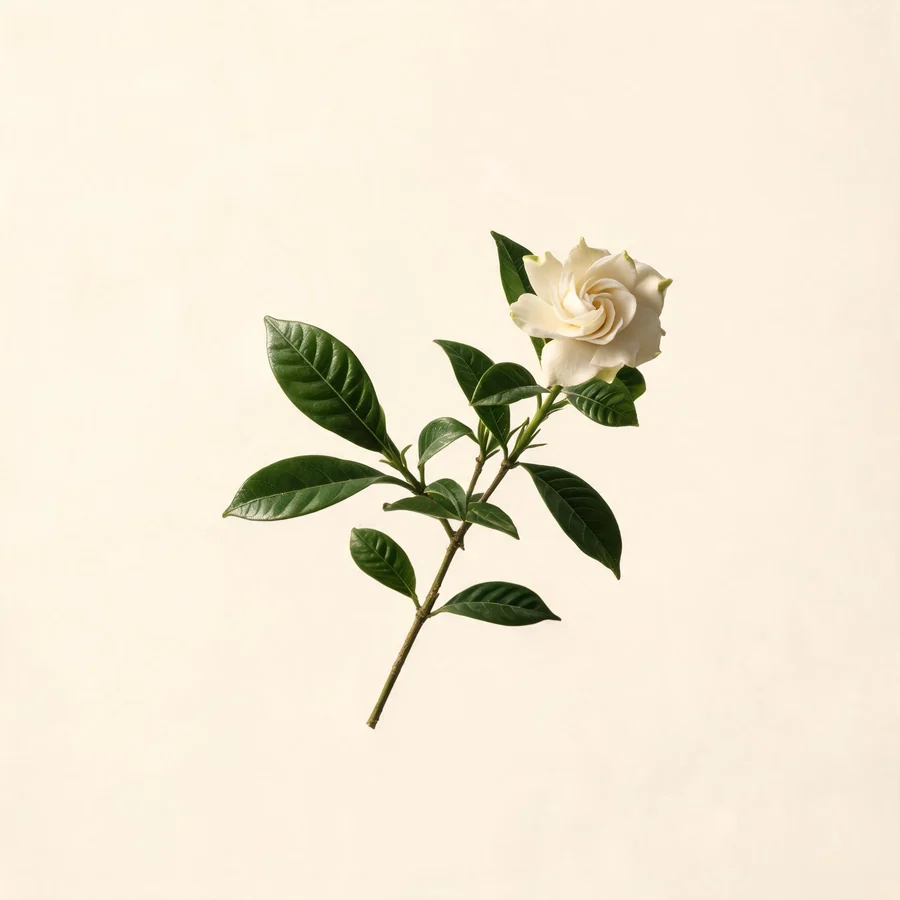
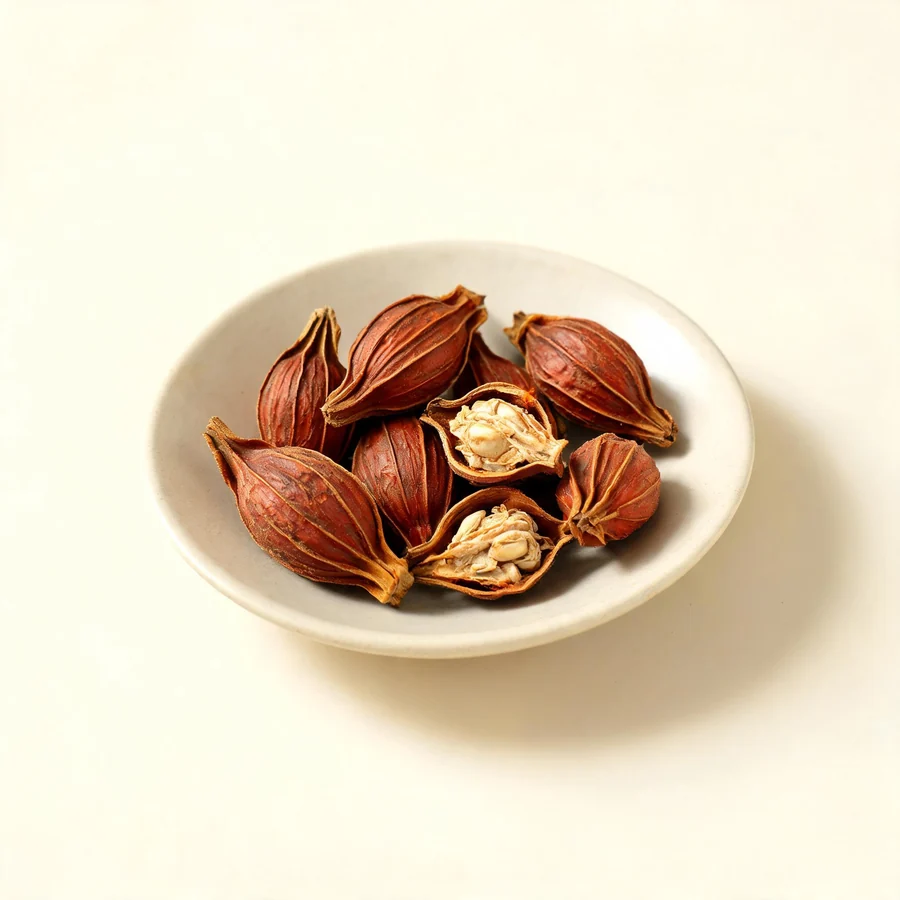
Skin profile
Where this herb sits in skin practice: the pattern it corrects, the skin signs it suits, and what it should not be used for.
Zhi Zi is the fruit for heat that has risen into the face and the blood, and for the restlessness that comes with it. It cools widely and dries only modestly, so it is a supporting herb in most skin formulas, and the dose stays inside the ordinary range.
Skin signs that suggest it
- A flushed, hot face with red papules or a burning sensation
- A rash that is bright red and spreads quickly, with restlessness and irritability
- Itch or burning that is worse at night or in heat, with scanty dark urine
- Yellow greasy scaling on a red base around the hairline, eyebrows or nasolabial folds
- A red tongue tip, a bitter taste in the mouth and a rapid pulse
When it is not the right herb
Not for pale, cold skin without heat, and not for the dry, thin skin of blood or Yin deficiency where the warmth comes with night sweats and a weak pulse. It is not for cold-deficient digestion, with loose stools, a poor appetite and a pale tongue, because the bitter cold lowers the digestive fire further. Pale, sunken lesions that discharge thin fluid are a deficiency picture and do not belong to this herb. Prolonged high-dose use is avoided because of the liver signal from its main constituent.
What it does for skin
Skin-relevant actions only. Each one describes a mechanism in TCM terms and what it looks like on the skin.
Clears Heat from the Heart and settles restlessness
Heat in the Heart does not only disturb sleep: it shows in the face as flushing and red papules, and it drives the kind of itch that is worse when the person is agitated or overheated. Zhi Zi enters the Heart directly and is bitter and cold enough to lower that heat, while its descending quality gives the heat a route out. This is why it appears in formulas for hot, angry skin in a restless, thirsty person.
Cools the Blood and resolves Toxin
When heat enters the blood, a rash becomes a deeper, brighter red, spreads quickly and may be accompanied by fever, thirst or a burning sensation. Zhi Zi cools that level of heat and resolves the toxin that drives the eruption, and it is used as a supporting herb in formulas for acute eruptive rashes. The charred form is chosen when heat is forcing blood out of the vessels as well as inflaming the skin.
Drains Damp-heat that shows as greasy scale
The combination of redness with a thick yellow, greasy scale is read as damp-heat, and it is common on the scalp, the eyebrows and the folds beside the nose. Zhi Zi is bitter enough to dry that dampness and cold enough to lower the heat, and it is often paired with Huang Qin and Fang Feng for this picture. It is a supporting herb rather than the leading one, because it does not dry as strongly as the root bitters.
Lowers heat in the face and head
Because the fruit is light and its action moves upward and outward before descending, it reaches the face and the upper body, where heat produces flushing, burning and red papules. This is the basis for its use in rosacea and in acne with a flushed complexion. It is combined with blood-cooling and surface herbs so that the facial heat is both cleared and redirected downward rather than simply suppressed.
Gives heat an exit through the urine
A recurrent theme in the classical descriptions is that the fruit does not merely cool the heat where it sits, it moves it out through the bladder. On the skin this matters in hot, dry eruptions where the person passes little dark urine and feels hot and irritable. The action is not a diuretic in the modern sense, and it should not be read as a reason to push fluids or to treat urinary symptoms without assessment.
Skin conditions it is used for
Mapped to the condition pages on this site. The pattern column shows what the skin is doing when this herb is the right choice.
| Condition | Pattern | Why it suits | Typical setting |
|---|---|---|---|
| Acne | Heat in the Heart and Stomach with blood heat | Red, inflamed papules on a flushed and oily face, with irritability and a red tongue tip, suggest heat in the Heart and Stomach with heat in the blood. Zhi Zi cools the blood and drains the upper-body heat, and it works well beside Huang Lian and Huang Qin when the lesions are angry and the person is hot and restless. It is less suited to deep, cold, cystic lesions that are slow to resolve. | Huang Lian Jie Du Tang, or Qing Shang Fang with Mu Dan Pi and Huang Qin |
| Rosacea | Fire in the face with heat in the blood | Persistent flushing, burning and red papules across the cheeks and nose are read as heat held in the face, often with blood heat underneath. Zhi Zi clears the heat and its upward-then-downward movement addresses the facial flush, while Mu Dan Pi cools the blood. It is used where the skin is hot and reactive rather than in the dry, photosensitive form with prominent scaling. | Huang Qin with Zhi Zi, Mu Dan Pi and Lian Qiao |
| Seborrhoeic dermatitis | Damp-heat with greasy yellow scale | A red base with a thick yellow, greasy scale along the hairline, the eyebrows or the nasolabial folds is a damp-heat picture, and Zhi Zi dries and cools at the same time. Its lightness suits the upper body and the face, which is where this eruption sits. It is combined with Huang Qin for the heat and Fang Feng for the surface, and it is a supporting herb rather than the main drying agent. | Huang Qin with Zhi Zi and Fang Feng, within a damp-heat formula |
| Erythema multiforme | Heat in the Blood with toxin in the skin | A rash of expanding red rings with a darker or dusky centre, spreading quickly and sometimes with fever, is read as heat in the blood with toxin in the skin. Zhi Zi cools the blood and resolves toxin, and it appears in the cooling formulas used for acute eruptive rashes. Any rash with blistering, mucosal involvement or fever belongs in urgent medical care, and herbs are used only within a supervised formula. | Modified Wen Qing Yin or Qing Ying Tang, with Sheng Di Huang and Mu Dan Pi |
| Urticaria | Wind-heat with heat in the blood | Red wheals that rise with heat, stress or overheating, in a person who is flushed and irritable, are read as wind-heat with heat underneath. Zhi Zi is a supporting herb here: it cools the blood and settles the heat that makes the wheals red, while the wind-releasing herbs address the surface. It is not the herb for cold-provoked or pale wheals, which need warming treatment. | Xiao Feng San, modified with Zhi Zi for red wheals that flare with heat |
Combinations for skin
Herbs it is paired with when the skin, not an internal organ, is the target.
| Partner | Ratio | Why the pair is used |
|---|---|---|
| Huang Lian | 2 to 5 g Huang Lian with 6 to 10 g Zhi Zi | Heat is cleared from the Heart and the middle at once. Huang Lian drains the Heart and Stomach with force, while Zhi Zi covers the whole triple burner and gives the heat a route down and out. The pair is a standard element of the strong clearing formulas used for high fever and hot sores, and it is strong enough that it is not continued for long. |
| Huang Qin | 6 to 10 g each | Huang Qin works on the Lung and Gallbladder and dries dampness, while Zhi Zi works on the Heart and the triple burner and cools the blood. Between them the upper and middle burners are covered more fully than by either alone, and the pair suits a flushed face, red papules, a bitter taste and a hot, restless feeling. Both are bitter and cold, so the mixture dries. |
| Mu Dan Pi | 6 to 10 g each | Mu Dan Pi cools the blood and moves stasis, and Zhi Zi cools the blood and clears heat from above. The pair is used for dusky, deep-red eruptions that are slow to settle and for facial redness with a purplish tone. Mu Dan Pi adds movement so that the cold herbs do not leave the lesions stagnant, and the two are a standard element of blood-cooling formulas. |
| Fang Feng | 6 to 10 g Fang Feng with 6 to 10 g Zhi Zi | Fang Feng releases wind from the surface while Zhi Zi clears the heat underneath it. This is the wind-heat pairing for rashes that move around, for red urticaria provoked by heat, and for a seborrhoeic flare on the face and scalp. The releasing herb keeps the cold fruit from trapping the surface reaction, and the cooling herb stops the wind from stirring up more heat. |
| Dan Dou Chi | 6 to 10 g Zhi Zi with about 10 g Dan Dou Chi | This is the classical pair for restless heat left behind after a fever, where the chest feels hot, sleep is broken and the person is irritated and unsettled. Zhi Zi clears the interior heat while the fermented soybean disperses what remains at the surface. On the skin it is used when a hot rash has mostly settled but flushing and restlessness persist. |
Formulas where it leads
- Huang Lian Jie Du Tang (黄连解毒汤) - The fire-purging formula of Huang Lian, Huang Qin, Huang Bo and Zhi Zi, used for severe heat toxin with hot, swollen, pustular skin and a red tongue. Zhi Zi contributes the triple-burner clearing and the downward exit for the heat. It is a short-course formula, not a maintenance one.
- Xiao Feng San (消风散) - The standard formula for wind-heat urticaria and acute itchy rashes, where Zhi Zi can be added to cool the blood beneath the surface reaction. It suits red, migrating wheals with heat and thirst, and it is used while the eruption is acute.
- Wen Qing Yin (温清饮) - A blood-cooling formula for chronic relapsing eruptions with heat, such as psoriasis and eczema flares, built on Sheng Di Huang, Mu Dan Pi, Dang Gui and the bitter cooling herbs. Zhi Zi strengthens the heat-clearing side and is included when the lesions are actively red and hot.
Topical use
The raw fruit is used externally as a paste for hot, swollen and painful areas, a tradition better known for bruises and sprains than for skin disease. In skin practice the same preparation is applied to a hot, red, painful plaque or an inflamed boil, where cooling and toxin-clearing are wanted at the surface. The fruit stains skin and cloth strongly yellow, and the paste is kept away from broken skin.
| Preparation | How and when it is used |
|---|---|
| Paste with water or vinegar | Ground fruit is mixed to a thick paste with water, or with a little vinegar for a well-defined hot swelling on intact skin. Apply a thin layer, cover with a clean cloth, and remove after 20 to 30 minutes; vinegar stings on excoriated skin and is avoided there. |
| Cooled decoction compress | 10 to 15 g of crushed fruit is simmered for 15 minutes, strained and cooled, then used on gauze as a compress for a hot, red patch. Make it fresh and discard leftovers, because the liquid spoils quickly. |
| Blend with other cooling powders | The powder is combined with Huang Bo or Huang Qin powder in traditional external preparations for inflamed skin. Keep to a small area, and stop if the paste dries hard and cracks the skin. |
Patch test and cautions
Patch test first and keep the paste off broken or ulcerated skin, the eyelids and the genitals. Remove it if burning increases. The strong yellow colour stains skin and fabric and may take days to fade, so protect clothing. External use does not replace medical care for a spreading or febrile skin infection.
Safety for skin use
What to check before recommending or using it, including the cautions that matter most for skin patients.
Do not use, or use with caution
- Spleen and Stomach deficiency-cold: the digestion is already cold, with loose stools, little appetite, cold hands and feet, and a pale tongue. A bitter cold fruit lowers that digestive fire further and can bring on diarrhoea.
- Blood or Yin deficiency with low-grade heat: the person is dry and thin, sweats at night and feels hot in the palms. The drying cold can harm the blood and the Stomach without clearing the heat.
- Sores that are pale, sunken and slow, with no heat in them. These need warming and building rather than clearing, and a cold fruit delays them further.
- Prolonged high-dose use, given the dose-dependent liver findings in animal work. Anything longer than a few weeks should be reviewed rather than repeated by default.
Pregnancy and breastfeeding
Use with caution and only under guidance. The fruit is not among the herbs that the classics prohibited in pregnancy, but a bitter, cold, blood-cooling medicine is not ideal at that time, and the commentaries warn against it in Spleen or blood weakness, which is common in pregnancy. A short supervised course for clear acute heat differs from a daily self-prescribed dose, and it is best left out where there are loose stools or a pale complexion.
Interactions
- Anticoagulants and antiplatelet drugs: in laboratory models the fruit prolonged bleeding time and reduced platelet clumping, so with warfarin, heparin, aspirin or clopidogrel there may be an additive effect, and unusual bruising or bleeding should be reported.
- Sedatives: an additive calming effect is possible at high doses, which matters for anyone driving or operating machinery, and for people already on sleeping tablets.
- Medicines that burden the liver, including high-dose paracetamol, some statins and antifungals: given the geniposide signal, this combination is best avoided, or monitored with liver tests, and anyone with existing liver disease should use the fruit only under supervision.
- At ordinary concentrations the main liver enzymes are not strongly inhibited in laboratory work, which makes a major metabolic interaction unlikely at usual doses. In animals, high doses reduce liver enzyme content overall, a reminder to tell a prescriber when several medicines are being taken.
Allergy and patch testing
Allergic reaction to the fruit is uncommon, but contact dermatitis to the paste and to herb-containing washes does occur, so a patch test is sensible before external use. The yellow pigment can also irritate skin that is already excoriated. Stop the preparation if the skin becomes more irritated or if a spreading redness develops.
General safety references
General references for herbal hepatotoxicity and herb-drug interactions; they are not specific to this herb.
- Review article: Herbal hepatotoxicity - an update on traditional Chinese medicine preparations. Alimentary Pharmacology & Therapeutics, 2014. PMID: 24844799.
- Interactions between herbal medicines and prescribed drugs: an updated systematic review. Drugs, 2009. PMID: 19719333.
- Warfarin and food, herbal or dietary supplement interactions: a systematic review. British Journal of Clinical Pharmacology, 2021. PMID: 32478963.
Evidence
The classical record is quoted with its source. The modern note states the level of evidence plainly.
Classical record
疗目热赤痛,胸心大小肠大热,心中烦闷,胃中热气。
For eyes that are red, hot and painful; for strong heat in the chest, Heart and intestines; for a stifled, irritable feeling in the Heart; and for heat in the Stomach.
Ming Yi Bie Lu (Supplement to the Classic of Materia Medica) - The eye and the Heart are named side by side here, which is how rising fire behaves: the same heat is visible in the face and felt as agitation, and that is the pattern behind a flushed, angry flare.
其用有四:去心经客热一也;除烦躁二也;去上焦虚热三也;治风热四也。
Four uses are recorded: it clears heat that has lodged in the Heart channel, it settles agitation and irritability, it removes empty heat from the upper burner, and it treats wind-heat.
Yi Xue Qi Yuan (Medicine and Its Origins) - A four-part summary from the Jin and Yuan period, which shows the fruit already understood as a broad clearer of upper-body heat rather than a heart-specific herb.
Modern evidence
Evidence status
- Geniposide, the main constituent, is hydrolysed by gut bacteria to genipin, and animal work shows dose-dependent liver injury at high oral exposure. In rats, liver injury appeared at 574 mg per kg and above, while 24.3 mg per kg for 90 days produced none, and no human toxicity reports exist at standard doses. The threshold is far above the therapeutic range.
- Laboratory work on geniposide and related constituents reports anti-inflammatory and antioxidant activity in cell and animal models, and the fruit has a long record as a cooling anti-inflammatory herb. These findings do not establish benefit in any skin disease.
- Clinical trial evidence for Zhi Zi in skin conditions is very limited and mostly embedded in studies of multi-herb formulas published in Chinese. The fruit is an accepted substance in the Chinese Pharmacopoeia; the page describes traditional practice and the state of the evidence.
PubMed records
Selected real PubMed records for this herb's species or its constituents, chosen by species name and title relevance. They are references for the non-TCM discussion above, not proof that the herb treats any skin condition.
- Fructus Gardenia (Gardenia jasminoides J. Ellis) phytochemistry, pharmacology of cardiovascular, and safety with the perspective of new drugs development.. Journal of Asian natural products research, 2013. PMID: 23211013 (safety record).
- A comprehensive review of ethnopharmacology, chemical constituents, pharmacological effects, pharmacokinetics, toxicology, and quality control of gardeniae fructus.. Journal of ethnopharmacology, 2024. PMID: 37956915 (safety record).
Dose and forms
Skin-practice dosing and the preparations that suit skin complaints.
| Form | Dose and notes |
|---|---|
| Decoction | 6 to 10 g of dried fruit daily, crushed first so that the inside of the fruit is extracted. Three to six grams suffices when it supports a larger formula; ten grams is for marked heat. |
| Ceiling and duration | Fifteen grams is the ceiling and belongs to acute heat under supervision. At any dose, a long course should be reviewed instead of simply repeated, and the smallest amount that works is the sensible default. |
| Processed forms | The raw fruit drains fire hardest; stir-frying softens the cold for a sensitive stomach; charring moves the emphasis toward the blood and toward bleeding. Processed forms are chosen to suit the stomach, not because they are stronger. |
| External paste | A small amount of powder mixed to a paste and applied to a limited area for 20 to 30 minutes. It is not left on overnight and not used on broken skin. |
The range is kept modest: the fruit is bitter and cold, and its main constituent has shown a liver signal when exposure is high. The animal threshold sits far above the therapeutic dose, and stir-frying or charring lowers the geniposide content, which is one reason a processed form is preferred for a sensitive digestion. The fruit is crushed before decoction, and a course lasting weeks deserves review, not the assumption that it is safe.
Citations and further reading
Only real sources are listed: the classical materia medica passages quoted above, and the source works behind the botanical and safety statements.
- Ming Yi Bie Lu (Supplement to the Classic of Materia Medica), Tao Hongjing, Southern and Northern Dynasties - classical entry quoted above.
- Yi Xue Qi Yuan (Medicine and Its Origins), Jin and Yuan period - classical entry quoted above.
- Gardenia jasminoides monograph: Pharmacopoeia of the People's Republic of China - source for the accepted botanical source, part used and quality requirements.
- Modern evidence statement: based on animal toxicology and laboratory literature on geniposide, summarised as a statement about the level of evidence rather than as a cited finding.
- Botanical description and identification: botanical literature on Gardenia jasminoides, Rubiaceae.
Educational reference for qualified practitioners. This page is not medical advice, and skin conditions should be diagnosed by a clinician before treatment.