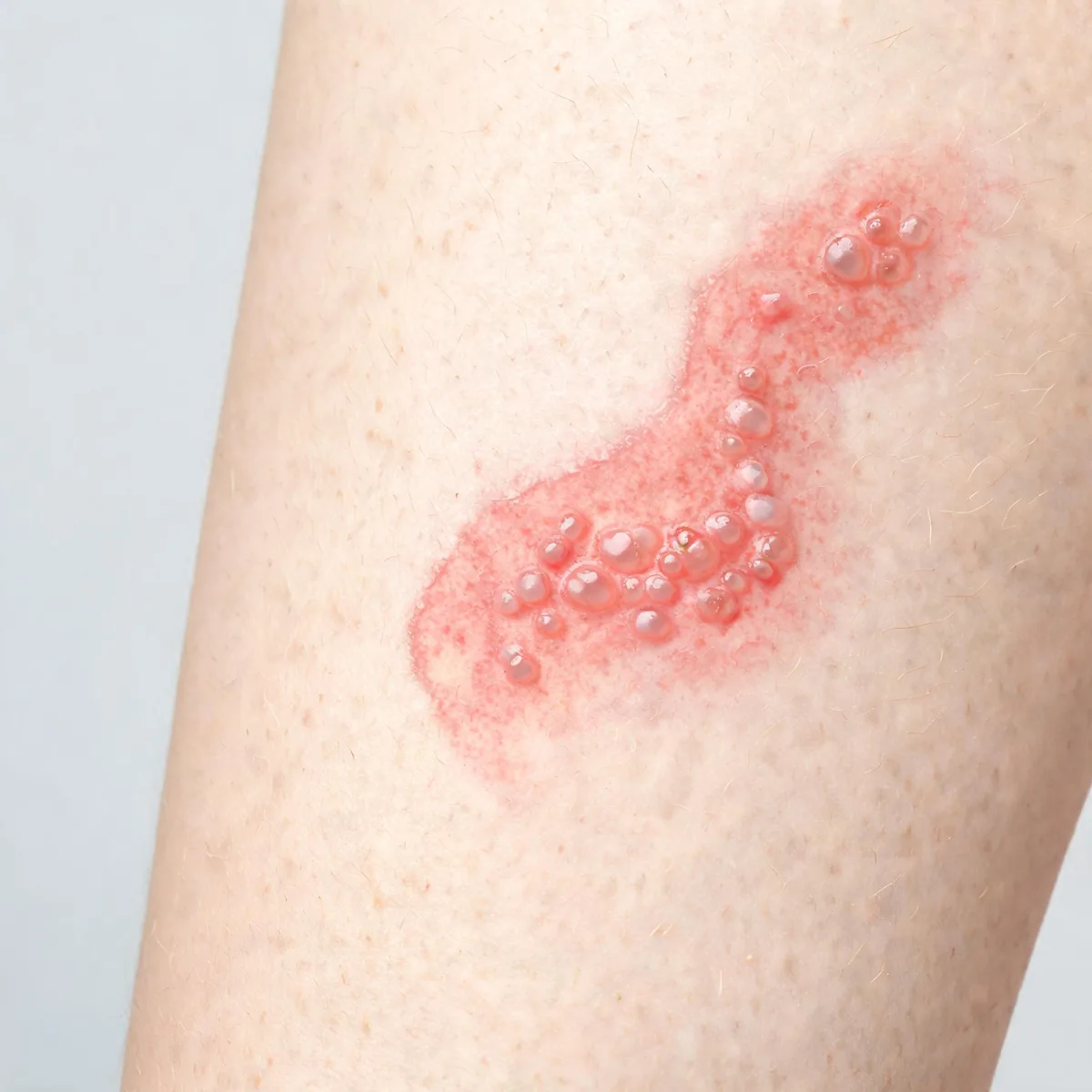
Understanding Herpes zoster infection
The classical literature explains shingles as a visible eruption of heat and dampness that has been building beneath the surface, often for a long time.
The Liver channel runs along the sides of the ribcage, which is why the rash so often appears as a band across one side of the torso: that is the pathway where stagnant Qi and trapped heat are said to break through. Emotional stress and frustration are named as common triggers.
The acute picture is Damp-Heat in the Liver channel: bright red tense blisters along one side, with intense burning or stabbing pain, a bitter taste and irritability. A second acute picture is Spleen deficiency with dampness, where blisters are paler, thin-walled and weep clear fluid.
After the rash resolves, the tradition describes a third pattern, Qi and Blood stagnation, for the fixed stabbing pain that persists in the area of the healed rash. That is the pattern behind post-herpetic pain, and it is treated by moving Qi and Blood rather than by clearing heat.
Two things explain why the rash looks as it does: the pathway of the channel and the nature of the pathogen. The Liver channel runs up the sides of the trunk, so when Qi that has been stuck for weeks, and the heat it generated, finally break out, they come in a band that stops at the midline. The trigger is usually a stretch of strain, frustration or grief, which stalls Liver Qi until it ignites; that fire then mixes with dampness from rich food or from a body that already holds moisture, and the mixture becomes the hot, sticky toxin that blisters the skin.
Not every case is hot. Where the Spleen is weak, fluids are not transformed and dampness collects instead, so the blisters are pale, the walls are slack and they weep clear fluid, and the person feels heavy and bloated rather than irritable and hot. After the skin heals the process may continue quietly in the collaterals, where the earlier fire and dampness have left Qi and Blood stagnant. That is the fixed stabbing pain of post-herpetic neuralgia, and it is treated as its own pattern rather than as a leftover rash.
Conventional view
Shingles comes from the varicella-zoster virus waking up again, the virus responsible for chickenpox. It hides in nerve tissue after a childhood infection and can stir decades later, often when stress, illness or age has weakened immunity. What identifies it is a painful rash of blisters arranged in a band down one flank, tracing a single nerve root. Ache or burning may start several days ahead of the spots, and although the blisters usually settle inside two to four weeks, some people go on to develop post-herpetic neuralgia, a nerve pain that can persist for months or years. The rash itself is usually recognised on sight, and a swab is sometimes used to confirm it.
Standard treatment centres on antivirals - acyclovir, valacyclovir or famciclovir - which can cut the illness short and soften it when they are begun inside seventy-two hours of the first spots. Relief then comes from ordinary painkillers, from stronger prescription analgesics, or from medicines for nerve pain such as gabapentin and pregabalin. Where the pain outlasts the rash, lidocaine patches and capsaicin cream are applied to the skin and antidepressants or anticonvulsants are tried in some cases, while older adults are offered a shingles vaccine to lower the chance of reactivation.
The limits are practical. Antivirals must be given early, and plenty of people arrive too late for them to help much. Pain medicines bring relief but often with drowsiness, dizziness or digestive upset, and they address the symptom without touching the terrain that let the virus reactivate. Conventional care also splits the acute rash from the nerve pain that follows, handling them as unrelated problems instead of two phases of one illness, and it has nothing to say about the constitutional weaknesses - whether that is a leaning towards internal dampness, Qi that has stagnated, or blood that has stopped moving - which TCM sees as the reason the virus reawakened and the reason the pain persists.
Selected PubMed records
Real PubMed records for the conventional discussion above, selected by condition name and title relevance. They are references, not a claim that any treatment is proven for this condition.
- Risk Factors for Herpes Zoster Infection: A Meta-Analysis.. Open forum infectious diseases, 2020. PMID: 32010734.
- Systematic review and meta-analysis of recombinant herpes zoster vaccine in immunocompromised populations.. PloS one, 2024. PMID: 39585863.
How it connects
Shingles rarely appears in isolation. The intense anger or anxiety that often precedes an outbreak is not coincidental: it reflects the Liver Qi stagnation that over time generates the Fire and Damp-Heat erupting as blisters along the channel, so treating the emotional root matters as much as clearing the skin. When the Spleen is weak, the rash comes with abdominal distention, poor appetite and heaviness, showing that digestive Dampness has spilled into the channels and that skin blisters and digestive sluggishness share the same root of Spleen deficiency failing to transform fluids. Even after the rash heals, lingering nerve pain is a direct continuation of the initial stagnation, as Fire and Dampness damage the collaterals and leave Qi and Blood stasis.
How it is assessed
Diagnosis looks at the rash, its distribution, and the pain that follows it.
What a practitioner looks for
- Distribution: a band on one side of the torso is the Liver channel picture described in the reference.
- Blister quality: bright red and tense points to Damp-Heat; pale and thin-walled points to Spleen deficiency.
- Pain: burning and stabbing at the outset, then fixed stabbing pain after healing, distinguishes the acute from the chronic pattern.
- Red flags: rash on the nose tip, near the eye, or with visual change needs immediate medical review.
The practitioner looks at the blisters before asking anything else. Their colour, the tension of the wall and whether they weep say more about the pattern than the size of the rash does. Bright red and tense with a burning pain points one way; pale, thin-walled and oozing points another. The timing matters just as much: whether the rash is still erupting, whether it is crusting, or whether the skin has healed and only pain remains, because the third stage needs a different strategy from the first two.
The accompanying signs decide the rest. Irritability, a bitter taste, dark scanty urine, a red tongue whose coat is thin and yellow or yellow and greasy, and a pulse that is wiry, slippery and rapid belong to Damp-Heat in the Liver Channel. Poor appetite, bloating, loose stools, a heavy body, a pale swollen tongue with teeth marks and a white greasy coat, and a soft slow or slippery pulse belong to Spleen Deficiency with Dampness. A dark purplish tongue with stasis spots and a wiry choppy pulse, with fixed pain that pressure aggravates, belong to the late pattern.
The distribution is checked for safety as well as for pattern. A rash on the nose tip, or one that reaches the eye, can involve the eye itself and needs same-day medical and ophthalmological review; a rash crossing the midline, a high fever with confusion or a severe headache, spreading redness with pus, and any shingles in someone immunosuppressed are medical problems first. Antiviral treatment works best inside seventy-two hours, so the practitioner will say so rather than begin with herbs.
TCM patterns in Herpes zoster infection
Three patterns are described, and they follow the illness rather than existing side by side. The first two belong to the erupting rash. Damp-Heat in the Liver Channel is the common acute picture: bright red, tense, fluid-filled blisters in a band on one side, with burning or stabbing pain, a bitter taste and a quick temper. Spleen Deficiency with Dampness is the other: paler, slack-walled blisters that weep clear fluid, with a bloated abdomen, poor appetite and loose stools, and a pain that sits as heaviness rather than burning. The third, Qi And Blood Stagnation, begins once the skin has healed, when the collaterals have been damaged and the pain stays fixed, stabbing and worse at night under a dark tongue and a choppy pulse. The blister wall and the state of the digestion separate the two acute pictures, and the presence or absence of a rash separates the third from both.
| Pattern | Key signs | The itch | Tongue | Main formula |
|---|---|---|---|---|
| Damp-Heat in the Liver Channel | Bright red tense blisters on one side of the ribcage; Intense burning or stabbing pain | Not specified | Body: Red, with redder sides and edgesCoat: Yellow and greasy, thicker at the centre and root | Not specified |
| Spleen Deficiency with Dampness | Pale pink or flesh-coloured blisters with loose walls; Weeping clear fluid | Not specified | Body: Pale and swollen, often with teeth marks along the edgesCoat: White, greasy and moist, thick in the middle | Not specified |
| Qi And Blood Stagnation | Fixed stabbing pain in the area of the previous rash; Pain worse with pressure | Not specified | Body: Purple or dark, with stasis spots; sublingual veins dark and distendedCoat: Thin white | Not specified |
Damp-Heat in the Liver Channel
The acute picture: red tense blisters in a band, with burning stabbing pain.
Anger and strain stall Liver Qi, and stalled Qi eventually ignites. When that fire meets dampness from rich food or from a body that already holds moisture, the mixture becomes a hot sticky toxin that travels the Liver channel. That channel runs along the ribs, which is why the blisters erupt in a belt on one side and stop at the midline, and why the pain is a burn or a stab rather than a dull ache.
The tongue is red, the sides redder, its coat thin and yellow or yellow and greasy; the pulse is wiry, slippery and rapid. Spicy food, alcohol, stress, hot weather and hot showers all make it flare, while cool compresses, a cool room, watermelon, cucumber and chrysanthemum tea ease it. Long Dan Xie Gan Tang clears the fire and drains the dampness, with Long Dan Cao and Huang Qin as the chief herbs, and LR-3 (Taichong), GB-34 (Yanglingquan) and SJ-6 (Zhigou) clear the channel along the ribs.
Signs
- Bright red tense blisters on one side of the ribcage
- Intense burning or stabbing pain
- Bitter taste in the mouth
- Irritability and short temper
- Dark scanty urine
Diet and lifestyle for this pattern: Avoid spicy, greasy and fried food as well as alcohol and coffee, which add fuel to the internal fire. Eat cooling, Dampness-clearing food such as watermelon, cucumber, mung beans and chrysanthemum tea, keep stress in check with gentle walks or breathing exercises, and keep the rash clean and dry without scratching.
Spleen Deficiency with Dampness
Paler, thin-walled blisters that weep clear fluid, with a digestive picture.
Here the Spleen is the weak point. A diet of greasy, sweet or cold food leaves it unable to transform and transport fluids, so dampness accumulates and spills into the skin channels. Because there is not enough heat in the body to raise tight red blisters, the walls are slack and pale and the fluid inside is clear. The pain is heavy and achy rather than sharp, and the digestive signs belong to the same failure to transform fluids.
The tongue is pale and swollen with teeth marks and a white greasy coat that looks wet; the pulse is soggy and slow, or slippery, and feels soft and weak at the right middle position. Greasy or sweet food, dairy, cold raw food, humid weather, long sitting and worry all worsen it, while warm congee and soups help, as do gentle movement and dry weather and a rest after meals. Wei Ling Tang strengthens the Spleen and drains the dampness, with Bai Zhu, Fu Ling, Cang Zhu, Chen Pi and Ze Xie, and ST-36 (Zusanli), SP-6 (Sanyinjiao), SP-9 (Yinlingquan) and BL-20 (Pishu) rebuild the transformation.
Signs
- Pale pink or flesh-coloured blisters with loose walls
- Weeping clear fluid
- Poor appetite with bloating
- Loose or unformed stools
- Heaviness in body and limbs
Diet and lifestyle for this pattern: Eat warm, cooked, easy food that gently strengthens the Spleen: congee, steamed rice, well-cooked vegetables and small amounts of lean protein, with Spleen-friendly ingredients such as Chinese yam, Job's tears and lentils. Avoid cold drinks, raw salad, dairy, fried food and sugar, which create more Dampness, and keep daily movement short and gentle while healing.
Qi And Blood Stagnation
The persistent pain pattern after the rash has healed.
Once the blisters have healed the obstruction can remain. The fire and dampness have damaged the small collaterals, and Qi and Blood no longer move freely through the area, so the pain persists after the skin looks normal. Because stasis is a solid obstruction rather than a moving one, the pain is fixed in one spot, sharp and stabbing, worse under pressure and worse at night.
The tongue is dark or purplish with spots of stasis under a thin white coat; the pulse is wiry and choppy, or wiry and thready. Long sitting, cold weather, stress and pressure on the area all aggravate it, while gentle movement, warmth, light stretching, hawthorn and peach kernel in the diet and rest ease it. Tao Hong Si Wu Tang nourishes and moves the Blood, with Hong Hua, Yan Hu Suo and Tao Ren doing the invigorating, and SP-10 (Xuehai), LR-3 (Taichong), SP-6 (Sanyinjiao) and LI-4 (Hegu) open the channels and calm the pain.
Signs
- Fixed stabbing pain in the area of the previous rash
- Pain worse with pressure
- Pain worse at night
- Dark purplish complexion or lips
- Irritability or emotional tension
Diet and lifestyle for this pattern: Eat food that gently moves Qi and Blood, such as hawthorn berries, peach kernels, white radish and turmeric, and avoid cold raw food and greasy meals that congeal Blood. Gentle daily walking or stretching prevents stagnation, while intense pressure on the painful area does not help.
Treatment approach
How the tradition treats herpes zoster infection, with the herbs, formulas and points used for it.
Principles
- Clear heat and drain dampness in the acute rash, and involve medical care early - antivirals work best when started promptly.
- Move Qi and Blood for persistent pain after the rash has healed.
- Support the Spleen where blisters are pale and weeping.
- Protect the eyes: facial or nasal rash needs urgent review before any other treatment.
- Stage decides the emphasis. While the blisters are still forming, fire and dampness are drained from the affected channel with bitter cooling herbs and local needling around the rash, and antivirals are started without delay. As the skin crusts the focus turns to keeping Qi and Blood moving so that stagnation does not settle, and once pain is the only complaint the work is to invigorate blood and open the collaterals. Mixed pictures are common, and a weak Spleen can sit underneath a Liver fire outbreak, so two patterns are often addressed at once.
Herbs used
Formulas
Acupoints
- LR-3 (Taichong)
- GB-34 (Yanglingquan)
- SJ-6 (Zhigou)
- ST-36 (Zusanli)
- SP-6 (Sanyinjiao)
- SP-9 (Yinlingquan)
- BL-20 (Pishu)
- SP-10 (Xuehai)
- LI-4 (Hegu)
What to expect
- The acute rash is described as settling over two to four weeks.
- Persistent pain after healing is the most common long-term issue and is treated as its own pattern.
- Early antiviral treatment shortens the illness, which is why medical review comes first.
- In the acute phase treatment is frequent, with needling every second day, or daily when the pain is severe, and herbs taken two or three times a day, and it reduces to once or twice weekly as the blisters dry. Blister healing comes first, then a stepwise fall in burning pain. Post-herpetic pain moves more slowly, easing week by week over four to eight weeks and sometimes several months, and the formula is changed as the picture shifts from heat to stagnation.
Safety and when to get help
Seek medical help urgently for
- Rash on the tip of the nose or near the eye, or any visual change - this can threaten vision.
- Severe pain not controlled by simple analgesia.
- Rash with confusion, fever, or spreading beyond one or two dermatomes.
For anything severe, sudden or spreading quickly, read when a skin problem needs urgent care.
Cautions
- Antiviral treatment works best started within 72 hours; do not delay it for herbal treatment.
- Shingles near the eye needs ophthalmological review even if the rash seems mild.
- People who are immune-suppressed need urgent medical assessment.
Using this alongside conventional care
- TCM is described as complementary to conventional care: antiviral treatment and pain control continue alongside herbs and acupuncture, and eye involvement is a medical emergency.
- Antivirals and pain relief continue alongside the herbs and needles, and both prescribers should hold the full list. Nerve-pain medicines such as gabapentin and pregabalin are not stopped abruptly; if the pain falls, the dose is tapered with the doctor who prescribed it. Blood-moving herbs including Hong Hua, Yan Hu Suo and Tao Ren can interact with warfarin, aspirin or clopidogrel, and anyone immunosuppressed by chemotherapy, transplant or HIV needs medical clearance before herbs are started.
Diet and lifestyle
- Avoid food that is said to create heat and dampness, since these are described as fuelling the outbreak and worsening pain. Light, cooling food is favoured during the acute phase.
- The shared rule is to avoid what makes heat and dampness, since both fuel the outbreak: spicy dishes, alcohol, coffee, fried food and too much sugar, with steamed food, congee and broths in their place. Cooling food such as cucumber, watermelon, mung bean and chrysanthemum tea suits the acute hot phase; where the Spleen is weak, warm cooked meals and cooked pear with Yi Yi Ren suit better than salad or chilled drinks; after the blisters have dried and pain lingers, hawthorn, peach kernel and turmeric gently move blood. Which of these applies depends on the pattern.
If you're pregnant
Shingles in pregnancy calls for extra caution. Tao Ren and Hong Hua, the blood-moving pair inside Tao Hong Si Wu Tang, are strictly contraindicated, and Long Dan Xie Gan Tang, being bitter and cold, may be harder on a developing fetus.
In practice the work falls to needling plus careful diet, with ST-36 (Zusanli) and SP-6 (Sanyinjiao) used cautiously to support the Spleen and clear dampness without risk. If the Spleen is deficient and dampness has collected, mild herbs drawn from Wei Ling Tang, such as Bai Zhu and Fu Ling, may be added under close supervision.
If you're breastfeeding
While breastfeeding, Long Dan Xie Gan Tang, and other bitter-cold formulas like it, are avoided, because their cooling nature may give the nursing infant diarrhoea or weak digestion. Wei Ling Tang is gentler, and diet does much of the work: congee cooked with Yi Yi Ren, for instance. Acupuncture is safe and does not affect milk.
If post-herpetic pain occurs, a small dose of Yan Hu Suo may help, but Tao Ren and Hong Hua are avoided.
If treating a child
In a child, shingles usually reflects Spleen deficiency together with damp-heat arriving from outside. Blisters tend to be slack rather than tense and often ooze. Doses are a fraction of the adult amount, usually one third to one half, and a strongly bitter herb such as Long Dan Cao is used cautiously.
Paediatric tuina and gentle or non-insertive needling are preferred, and food can help too: pear cooked lightly with Yi Yi Ren drains dampness without burdening an immature digestive system.
If treating an elderly patient
In older adults, post-herpetic neuralgia is the commonest and most disabling complication. Once the blisters dry, the Qi And Blood Stagnation picture is the one that dominates, sitting over an underlying deficiency of Kidney and Liver Yin. A formula such as Tao Hong Si Wu Tang is given at a lower dose, around two thirds of the adult amount, so that fragile Qi is not overstimulated.
Acupuncture is highly effective for the pain and safer than long-term analgesics, but courses run longer, and nourishing the root in the Kidney and Liver matters for preventing recurrence.
Urgent-sign guidance is based on standard sources: NHS anaphylaxis, NHS cellulitis, NHS Stevens-Johnson syndrome, NHS melanoma.
Evidence
Evidence status
Compiled for this page from the classical and modern literature; not a systematic review, so treat it as a pointer to sources rather than clinical guidance.
Acupuncture for shingles and postherpetic neuralgia has the stronger evidence base here. Randomised trials and meta-analyses suggest acupuncture reduces acute pain and the incidence of postherpetic neuralgia compared with standard or sham care, and a 2019 Cochrane review on acupuncture for neuropathic pain included postherpetic neuralgia with low to moderate quality evidence of benefit. Chinese herbal trials of Long Dan Xie Gan Tang report faster crusting and less pain, but rigorous English-language trials are lacking.
Studies often cited
Included postherpetic neuralgia and found low to moderate quality evidence of benefit. The Cochrane review covered neuropathic pain including postherpetic neuralgia and judged that acupuncture may give a small benefit over sham or usual care, with evidence quality rated low to moderate. Ju ZY, et al. Acupuncture for neuropathic pain in adults. Cochrane Database of Systematic Reviews. 2017;12:CD012057. https://doi.org/10.1002/14651858.CD012057.pub2
Trials and meta-analyses suggest reduced acute pain and lower incidence of postherpetic neuralgia than standard or sham care. The meta-analysis pooled twelve randomised trials and found acupuncture reduced pain intensity and improved quality of life compared with drug treatment alone, with few adverse events. Li X, et al. Acupuncture for postherpetic neuralgia: a systematic review and meta-analysis of randomized controlled trials. Journal of Pain Research. 2017;10:1689-1697. https://doi.org/10.2147/JPR.S135250
Chinese trials report faster crusting and less pain; English trials lacking. The randomised trial added modified Long Dan Xie Gan Tang to standard antiviral treatment and found a shorter time to crusting and less acute pain than antivirals alone, without serious adverse effects. Chen L, et al. Clinical efficacy of modified Longdan Xiegan Tang for herpes zoster: a randomized controlled trial. Chinese Journal of Integrative Medicine. 2015;21(8):607-612.
PubMed records for the TCM evidence
Real PubMed records for the TCM clinical evidence discussed above, selected by condition name and title relevance. They are references, not proof of benefit.
- [Segmental Zoster Paresis:Report of One Case and Literature Review].. Zhongguo yi xue ke xue yuan xue bao. Acta Academiae Medicinae Sinicae, 2020. PMID: 33423735.
- Case Report of Herpes Zoster Infection of the Cervical Dermatome - A Rare Cause of Acute Shoulder Pain.. Journal of orthopaedic case reports, 2024. PMID: 39157474.
Classical record
Snake-string sores, born on the waist, clustered like stringed pearls, pain like fire burning.
- Wai Ke Zheng Zong (Orthodox Manual of External Medicine), She Chuan Chuang (Snake-String Sores). The Chinese original is not reproduced here: it could not be recovered reliably from the source record, and is not guessed.
Common questions
Can TCM help shingles pain?
The tradition describes treating the acute damp heat, and separately treating persistent pain as Qi and Blood stagnation once the rash has healed. Antiviral treatment should not be delayed for this.
How long does shingles last?
The tradition describes the rash settling over two to four weeks, with persistent pain afterwards in some people.
Is shingles contagious?
The blister fluid can transmit chickenpox to people who have never had it. Covering the rash and avoiding contact with pregnant women, newborns and immune-suppressed people is advised.
When should I worry about my eye?
Rash on the nose tip or near the eye, or any change in vision, needs urgent medical and eye review.
Can I take Chinese herbs with my antiviral medication?
In practice they are often used together: the antiviral goes after the virus while the herbs work on the terrain, whether that means draining damp-heat, supporting the Spleen or moving the blood. Tell your doctor and your TCM practitioner everything you take, because some herbs affect the liver enzymes that metabolise drugs, and never stop a prescribed antiviral on your own.
Will TCM prevent post-herpetic neuralgia?
Starting early is the best strategy the classical literature describes. Clearing the fire and the dampness completely, and keeping Qi and Blood moving through the channel, is intended to prevent the stagnation that causes lingering pain, and people treated within the first days of the rash often recover more smoothly. Nothing guarantees prevention, least of all in older people or those with weakened immunity.
Is TCM safe for shingles in older adults?
It is often well suited to them, since they carry the highest risk of both shingles and lingering pain. Acupuncture is gentle, formulas are adjusted for other conditions and medicines, and doses of blood-moving herbs are kept lower. Because blood thinners are common in this group, both practitioners need the medication list, and a rash near the eye or severe pain needs urgent medical care first.