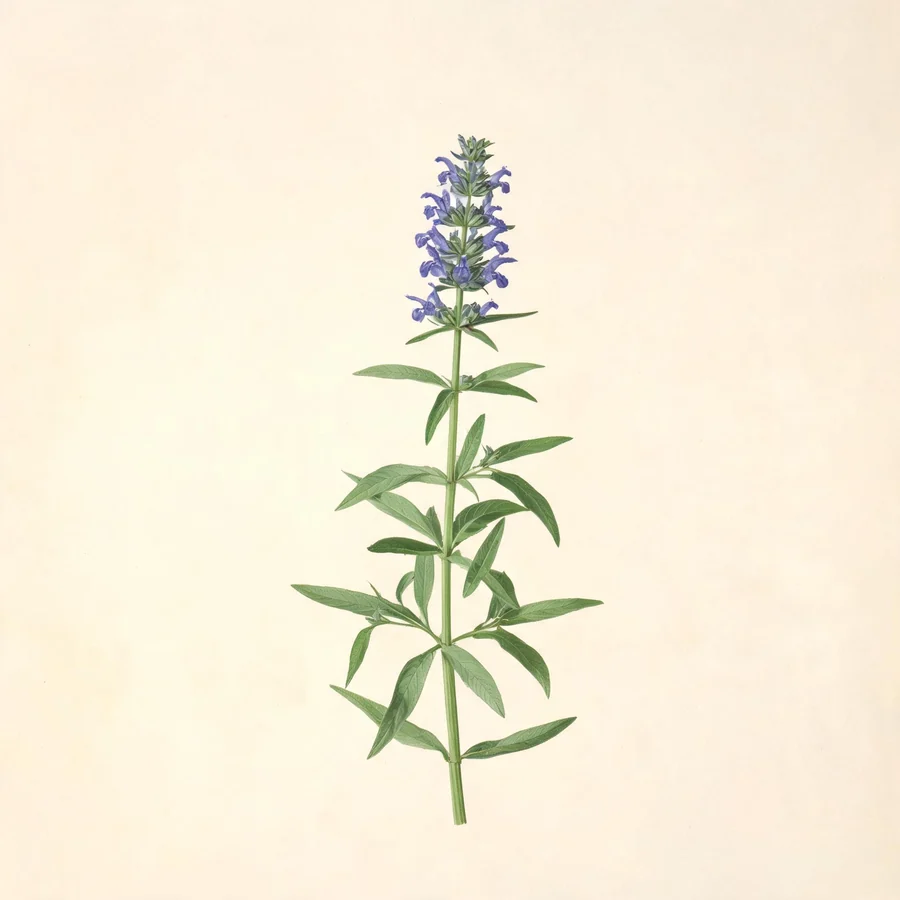
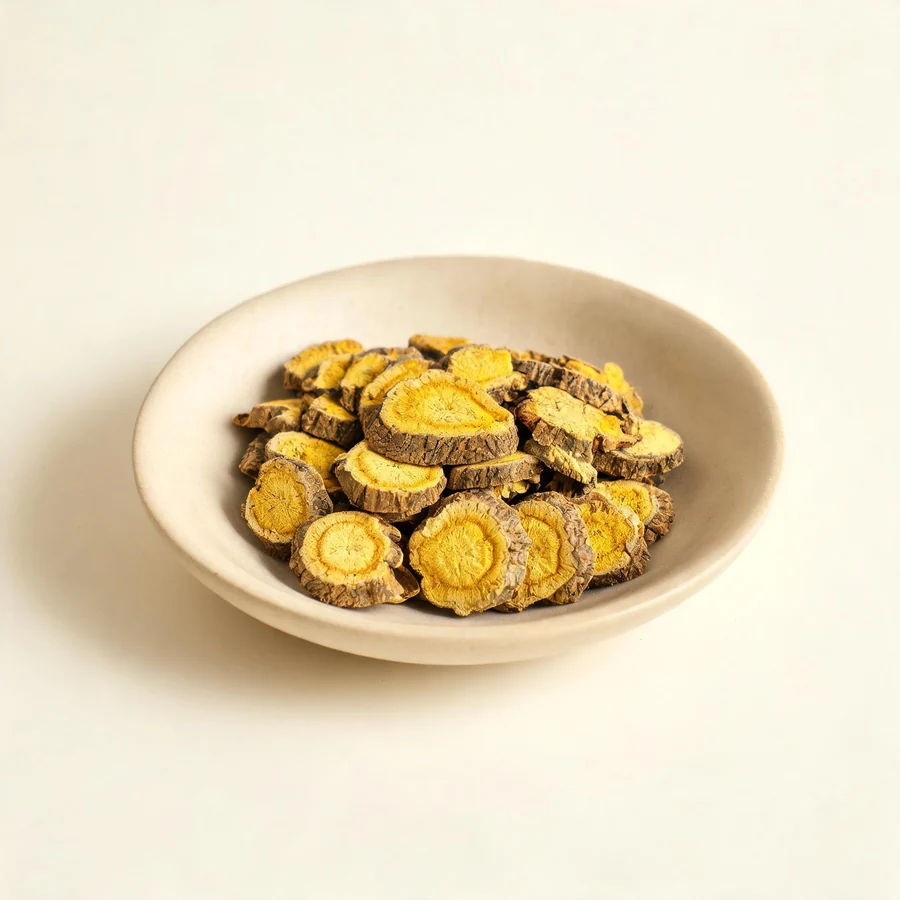
Skin profile
Where this herb sits in skin practice: the pattern it corrects, the skin signs it suits, and what it should not be used for.
Huang Qin is used where Heat and Dampness are both present: redness with moisture, inflammation with infection, and itch that is driven by heat. It also cools the Blood when a rash is deep red or purplish and spreading quickly.
Skin signs that suggest it
- Red, hot, swollen patches with oozing, weeping or yellow crusting (damp-heat)
- Pustules, boils, folliculitis or impetigo with surrounding redness (heat toxin)
- Itch that is worse with heat, warmth of the bed or humid weather
- Flushing, rosacea-like redness or a red rash that spreads quickly (fire or blood heat)
- A red tongue with a yellow, greasy or sticky coating; a rapid or slippery pulse
When it is not the right herb
Not for dry, pale, thin skin with no redness, and not for chronic eczema of the cold-deficiency type where the skin is dry, lichenified and cold to touch. In those pictures, bitter-cold draining will dry the skin further and disturb digestion. Because the herb is bitter and cold it can weaken digestion, so skin practice keeps courses short, doses moderate and pairs it with herbs that protect the Stomach when needed.
What it does for skin
Skin-relevant actions only. Each one describes a mechanism in TCM terms and what it looks like on the skin.
Clears Heat and drains Dampness
The core skin action. Damp-heat shows as a lesion that is both inflamed and moist: weepy eczema, a seborrhoeic scalp with yellow greasy scale, intertrigo in skin folds, or a rash that oozes clear or yellow fluid. Huang Qin dries the Dampness while cooling the Heat, so the ooze reduces and the redness settles together rather than one at the expense of the other.
Purges Fire and resolves Toxin
For skin that has moved beyond inflammation into infection or suppuration: pustular acne, folliculitis, boils, impetigo and cellulitis with a red, hot, tender edge. The bitter cold clears the Fire driving the lesion, and the toxin-resolving action addresses the pus and local poisoning that make it spread. It is the herb most often added when a dermatitis becomes secondarily infected or when a pustule is surrounded by spreading redness.
Cools the Blood and settles a hot rash
When Heat enters the Blood level the rash becomes deep red or purplish, spreads quickly, and may be accompanied by fever, thirst or fine bleeding into the skin. Huang Qin cools the Blood, which makes it a standard component of formulas for drug eruptions, erythema multiforme, vasculitic purpura and the confluent red rash of an acute febrile illness.
Relieves itch by removing the cause
Huang Qin is not a sedating antipruritic. It reduces itch by clearing the Heat and Dampness that drive it, which is why it works best in itchy conditions with redness, warmth and moisture rather than in dry neuropathic itch. In urticaria it is used where wheals are red and provoked by heat, and in eczema where scratching produces oozing rather than dryness.
Dries and protects against secondary infection
Its drying quality reduces the moist surface that bacteria and Candida favour, and its long traditional use in washes and powders for weeping skin reflects that. In modern terms, its flavonoids are the subject of laboratory work on inflammation and microbial growth, which is why the herb recurs in both internal formulas and topical washes for infected or weeping lesions.
Skin conditions it is used for
Mapped to the condition pages on this site. The pattern column shows what the skin is doing when this herb is the right choice.
| Condition | Pattern | Why it suits | Typical setting |
|---|---|---|---|
| Eczema | Damp-heat in the skin (acute, weeping or crusted flare) | The combination of redness, ooze and itch is the textbook expression of damp-heat. Huang Qin is used when a flare is wet rather than dry, and is commonly paired with Ku Shen and Bai Xian Pi to clear the heat, dry the ooze and quiet the itch. | Long Dan Xie Gan Tang, or a modified damp-heat formula with Ku Shen and Bai Xian Pi |
| Atopic dermatitis | Damp-heat on a background of Spleen deficiency | The acute, weeping, red flare responds to the bitter-cold draining action, while the underlying tendency needs Spleen support. Huang Qin is therefore combined with Bai Zhu or Fu Ling so the flare is cleared without further weakening digestion. | Modified Si Jun Zi Tang with Huang Qin and Bai Xian Pi for flaring atopic dermatitis |
| Seborrhoeic dermatitis | Damp-heat with greasy yellow scale | The greasy yellow scale and red base of seborrhoeic dermatitis fit the damp-heat pattern well, and the scalp, eyebrows and nasolabial folds are within the upper-body territory Huang Qin favours. | Huang Qin with Zhi Zi and Fang Feng, or as a diluted wash for the scalp |
| Acne | Lung and Stomach Heat with heat toxin | Inflammatory papules and pustules with redness and oiliness are read as Heat and toxin in the Lung and Stomach. Huang Qin drains the Heat while resolving the pustular component, and it is a standard ingredient of the classic acne formulas. | Pi Pa Qing Fei Yin or Qing Shang Fang, with Mu Dan Pi and Zhi Zi |
| Rosacea | Heat in the face, often with Stomach Fire or vacuity heat | Persistent facial flushing, papules and a burning sensation are treated by clearing the Heat that is held in the upper body. Huang Qin is used where there is active redness and pustulation rather than the distinctly dry, photosensitive type. | Huang Qin with Zhi Mu, Mu Dan Pi and Lian Qiao |
| Folliculitis | Heat toxin lodged in the hair follicles | Folliculitis and boils are the clearest heat-toxin skin pattern, and Huang Qin is among the first herbs chosen to resolve the toxin and prevent spread. It is often combined with Lian Qiao and Pu Gong Ying. | Huang Lian Jie Du Tang, or with Pu Gong Ying and Lian Qiao |
| Boils and abscesses | Toxic Heat with pus | A hot, red, tender swelling with pus calls for fire-purging and toxin-resolving treatment. Huang Qin is a standard herb for the early spreading phase and is given orally as well as used in a wash where the skin allows. | Huang Lian Jie Du Tang with Jin Yin Hua and Lian Qiao |
| Urticaria | Wind-heat in the skin | Red wheals that flare with heat, stress or overheating benefit from clearing Wind and Heat. Huang Qin is combined with Fang Feng, Jing Jie and Chan Tui, particularly when the wheals are red and the attack is recent. | Xiao Feng San, modified with increased Huang Qin for red heat-provoked wheals |
| Erythema multiforme | Heat in the Blood and toxin in the skin | The targetoid spreading rash with a red or purplish centre is a blood-heat and toxin picture, and Huang Qin is included in the formulas used for acute eruptive heat rashes with danger of deeper involvement. | Modified Qing Ying Tang or Wen Qing Yin, with Sheng Di Huang and Mu Dan Pi |
| Psoriasis | Blood heat with Dampness in a flare | Psoriasis is primarily a Blood-heat and stasis condition, treated with cooling and blood-moving herbs. Huang Qin is added when plaques are actively red, weeping or secondarily infected rather than dry and scaly. | Xiao Yin Ke Li style formulas with heat-clearing herbs added during an inflammatory flare |
| Itchy skin with redness | Heat and Dampness provoking the itch | When itch comes with warm, red and slightly moist skin, Huang Qin reduces the underlying heat rather than suppressing the sensation. It is combined with antipruritic herbs such as Bai Xian Pi and She Chuang Zi. | Huang Qin with Bai Xian Pi, Ku Shen and Fang Feng |
Combinations for skin
Herbs it is paired with when the skin, not an internal organ, is the target.
| Partner | Ratio | Why the pair is used |
|---|---|---|
| Ku Shen | 6 to 10 g each in decoction | Both are bitter and cold and both drain damp-heat, but Ku Shen is stronger against itch and lower-body damp-heat while Huang Qin is stronger for the upper body and heat toxin. Together they cover wet, itchy, infected eczema and are a standard pairing for weeping lesions. |
| Huang Lian | 3 to 6 g Huang Lian with 6 to 10 g Huang Qin | Two of the three bitter-cold herbs, combined for severe heat toxin with suppuration or spreading redness. Huang Lian adds stronger toxin-resolving power for the pus and infection component while Huang Qin targets the upper-body heat. |
| Zhi Zi | 6 to 10 g each | Zhi Zi drains heat from all three burners and has its own skin and topical tradition. Together they clear heat that is both in the face and in the blood, which suits rosacea, seborrhoeic dermatitis and inflamed acne. |
| Bai Xian Pi | 6 to 10 g each | Bai Xian Pi is a skin-specific heat and wind herb with a strong antipruritic and antifungal profile. Pairing it with Huang Qin gives a combined anti-inflammatory and itch-quieting effect for eczema, neurodermatitis and fungal itch. |
| Fang Feng | 6 to 10 g each | Fang Feng releases Wind from the surface while Huang Qin clears the Heat underneath it. This is the wind-heat pairing used for red, migrating urticaria and for rashes that move around the body. |
| Sheng Di Huang | 10 to 15 g Sheng Di Huang with 6 to 10 g Huang Qin | Huang Qin cools the Blood without nourishing it, while Sheng Di Huang nourishes Yin and cools the Blood. Together they treat a hot, spreading rash with dryness and thirst, where clearing alone would leave the skin dry. |
| Bai Zhu | 10 g each | Bai Zhu tonifies and dries the Spleen, and offsets the digestive coldness of Huang Qin. The pair is used in damp-heat skin conditions on a Spleen-deficient background, such as flaring atopic dermatitis in a person with poor digestion. |
Formulas where it leads
- Long Dan Xie Gan Tang (龙胆泻肝汤) - For damp-heat in the Liver and Gallbladder channels: weepy eczema, genital and perianal itch, and red inflamed skin with a bitter taste and red eyes. Huang Qin drains the damp-heat while Long Dan Cao and Zhi Zi clear the channel heat.
- Huang Lian Jie Du Tang (黄连解毒汤) - The classic fire-purging and toxin-resolving formula for severe heat toxin with pustules, boils or spreading erythema. Huang Qin clears upper-body heat while Huang Lian handles the toxin and Huang Bo drains the lower body.
- Xiao Feng San (消风散) - For wind-heat urticaria and acute itchy rashes with redness. Huang Qin clears the heat component while the wind-releasing and itch-quieting herbs address the surface reaction.
- Wen Qing Yin (温清饮) - For blood heat with dampness in chronic relapsing eruptions such as psoriasis and eczema flares, where Huang Qin cools the Blood together with Sheng Di Huang, Mu Dan Pi and Dang Gui.
Topical use
Huang Qin is used topically as a decoction or a dilute wash for red, weeping and infected skin. The root is boiled, strained and cooled, and applied as a compress or a bath for affected areas; it is also an ingredient in the medicated ointments used for eczema and burns. Topical use targets the surface heat and ooze directly and is generally reserved for limited areas of skin.
| Preparation | How and when it is used |
|---|---|
| Decoction compress | 10 to 30 g of dried root simmered in 500 ml of water for 20 minutes, strained and cooled to skin temperature. Apply with clean gauze for 10 to 15 minutes once or twice daily to weeping, red or infected patches. |
| Dilute wash or soak | A weaker decoction used for larger areas such as the scalp in seborrhoeic dermatitis, or as a hand or foot soak. Discard after use and avoid sharing containers. |
| Ointment and cream bases | Huang Qin extract appears in medicated skin ointments in Chinese clinical practice, often combined with other cooling herbs. Use only products from a reputable maker and check the full ingredient list for known sensitivities. |
| Powder blend | Finely ground root is blended with other cooling powders and applied sparingly to weeping lesions or the surrounding skin in traditional practice. Because the powder can dry and crack the skin, it is used on small areas only. |
Patch test and cautions
Do a patch test on a small area of normal skin for 24 hours before first use, and do not apply to broken, ulcerated or deep infected skin without clinical supervision. Stop immediately if burning, stinging or spreading redness develops. Do not apply near the eyes, and do not cover treated areas with an occlusive dressing.
Safety for skin use
What to check before recommending or using it, including the cautions that matter most for skin patients.
Do not use, or use with caution
- Spleen and Stomach deficiency-cold: loose stools, poor appetite, a pale tongue and a cold abdomen. The bitter cold can worsen digestive weakness, and prolonged use can cause diarrhoea.
- Dry, cold or deficient skin without active heat: chronic dry eczema, ichthyosis and lichenified cold eczema will typically worsen.
- Known allergy to the Lamiaceae family, and previous contact reaction to a herb-containing cream or wash.
- Long courses without review: bitter-cold herbs are given for acute and subacute heat patterns, not as indefinite maintenance.
Pregnancy and breastfeeding
Use only under practitioner supervision. Huang Qin is not a routine pregnancy herb: the classical record includes it among herbs used to calm the fetus, but modern practice is cautious because of its strong cold and draining nature. Topical use on small areas is generally considered lower risk, but should still be checked. During breastfeeding the same caution applies, and topical use should be kept away from the nipple area unless specifically advised.
Interactions
- Huang Qin may add to the effects of anticoagulant and antiplatelet medicines in theory, and people on warfarin or similar drugs should not start regular courses without informing their prescriber.
- Its flavonoids affect several liver enzyme pathways in laboratory work, so levels of medicines metabolised by the liver can in theory change; this matters mostly for high-dose concentrated extracts.
- Because it can loosen the stool and cool the digestion, it may add to the effects of laxatives and to the gut effects of some antibiotics.
- Topical use alongside prescription steroid creams is common in clinic practice, but the two should be applied at different times of day to avoid diluting or irritating the skin.
Allergy and patch testing
Contact dermatitis to herbs in creams and washes is well recognised. Patch test first, keep compresses to limited areas, and stop at once if the skin becomes more irritated rather than calmer. A reaction to Huang Qin can occur in people who have reacted to other Lamiaceae herbs, including mint and basil.
General safety references
General references for herbal hepatotoxicity and herb-drug interactions; they are not specific to this herb.
- Review article: Herbal hepatotoxicity - an update on traditional Chinese medicine preparations. Alimentary Pharmacology & Therapeutics, 2014. PMID: 24844799.
- Interactions between herbal medicines and prescribed drugs: an updated systematic review. Drugs, 2009. PMID: 19719333.
- Warfarin and food, herbal or dietary supplement interactions: a systematic review. British Journal of Clinical Pharmacology, 2021. PMID: 32478963.
Evidence
The classical record is quoted with its source. The modern note states the level of evidence plainly.
Classical record
黄芩,味苦平,主诸热黄疸,肠澼泄痢,逐水,下血闭,恶疮,疽蚀,火疡。
Huang Qin is bitter and neutral. It governs all heat and jaundice, dysentery and diarrhoea, drives out water, opens blocked menses and treats malignant sores, flat abscesses, ulceration and fire lesions.
Shen Nong Ben Cao Jing (Divine Husbandman's Classic of Materia Medica) - Even the oldest record already names sores and fire lesions, the skin applications that later become central to its use.
疗痰热胃中热,小腹绞痛,消谷,利小肠,女子血闭,淋露下血,小儿腹痛。
It treats phlegm-heat and heat in the Stomach, griping pain in the lower abdomen, helps food transform, benefits the small intestine, opens blocked menstruation in women, checks irregular bleeding and eases abdominal pain in children.
Ming Yi Bie Lu (Supplement to the Classic of Materia Medica) - The broader internal applications recorded here are the reason the herb remains classified as an internal heat-clearing herb even when it is prescribed for skin.
治风热湿热头疼,奔豚热痛,火咳肺痿喉腥,诸失血。
It treats headache from wind-heat and damp-heat, the running piglet condition with heat and pain, fire cough with lung atrophy and a foul throat, and all kinds of blood loss.
Ben Cao Gang Mu (Compendium of Materia Medica), Li Shizhen - Li Shizhen's entry is the basis for using the herb to cool the Blood in hot, spreading rashes.
上行泻肺火,下行泻膀胱火,男子五淋,女子暴崩,调经清热。
Going upward it drains Lung fire; going downward it drains Bladder fire. It is used for the five types of urinary strangury in men, for sudden uterine flooding in women, to regulate menstruation and to clear heat.
Dian Nan Ben Cao (Materia Medica of Yunnan) - A clear statement of the upper-body and lower-body draining actions; the Lung-fire portion supports its use in facial and scalp skin heat.
Modern evidence
Evidence status
- Laboratory studies of baicalin, baicalein and the whole-root extract report anti-inflammatory, antibacterial, antifungal and antioxidant activity, including effects on pathways relevant to skin inflammation. These are principally cell and animal studies.
- Clinical trial evidence for Huang Qin in skin disease is limited, mostly small, and often published in Chinese-language journals or embedded within multi-herb formula studies rather than as trials of the single herb. No robust conclusion about efficacy in eczema, acne or psoriasis can be drawn from the current literature.
- Regulatory status: Huang Qin root is an accepted herbal substance under the Chinese Pharmacopoeia. The information on this page describes traditional practice and the state of the evidence; it is not a claim of proven benefit.
PubMed records
Selected real PubMed records for this herb's species or its constituents, chosen by species name and title relevance. They are references for the non-TCM discussion above, not proof that the herb treats any skin condition.
- Scutellaria radix Extract as a Natural UV Protectant for Human Skin.. Phytotherapy research : PTR, 2016. PMID: 26620130 (skin-related record).
Dose and forms
Skin-practice dosing and the preparations that suit skin complaints.
| Form | Dose and notes |
|---|---|
| Decoction (internal) | 3 to 10 g of dried root daily for skin complaints, in a formula rather than alone. Higher doses are used in acute heat toxin under supervision, and lower doses when the digestion is delicate. |
| Extract and granules | Standardised extracts are available; follow the manufacturer's label and a practitioner's direction, because concentrations vary widely between products. |
| Topical decoction | 10 to 30 g simmered in 500 ml water and used as a cooled compress or wash once or twice daily for limited areas. |
| Course length | Short courses, typically two to four weeks, with review. Stop or reduce if loose stools, poor appetite or coldness of the abdomen develop. |
For skin practice the raw untreated root is standard. The stir-baked form is used mainly when the cold nature needs softening in a sensitive Stomach, and the charred form is a bleeding-specific preparation that is not relevant to most skin cases. Because the herb is bitter and cold, it is nearly always given in a formula with either a Spleen-protecting herb or warming herbs that keep digestion steady.
Citations and further reading
Only real sources are listed: the classical materia medica passages quoted above, and the source works behind the botanical and safety statements.
- Shen Nong Ben Cao Jing (Divine Husbandman's Classic of Materia Medica), attributed compilation of the Han period - classical entry quoted above.
- Ming Yi Bie Lu (Supplement to the Classic of Materia Medica), Tao Hongjing, Southern and Northern Dynasties - classical entry quoted above.
- Ben Cao Gang Mu (Compendium of Materia Medica), Li Shizhen, 1578 - classical entry quoted above.
- Dian Nan Ben Cao (Materia Medica of Yunnan), Lan Mao, 1436 - classical entry quoted above.
- Huang Qin monograph: Pharmacopoeia of the People's Republic of China - source for the accepted botanical source, part used and quality requirements.
- Modern evidence statement: based on laboratory and trial literature on baicalin and baicalein, summarised as a statement about the level of evidence rather than as a cited finding. No single clinical trial is presented as proof of effect.
- Botanical description and identification: botanical literature on Scutellaria baicalensis, Lamiaceae.
Educational reference for qualified practitioners. This page is not medical advice, and skin conditions should be diagnosed by a clinician before treatment.