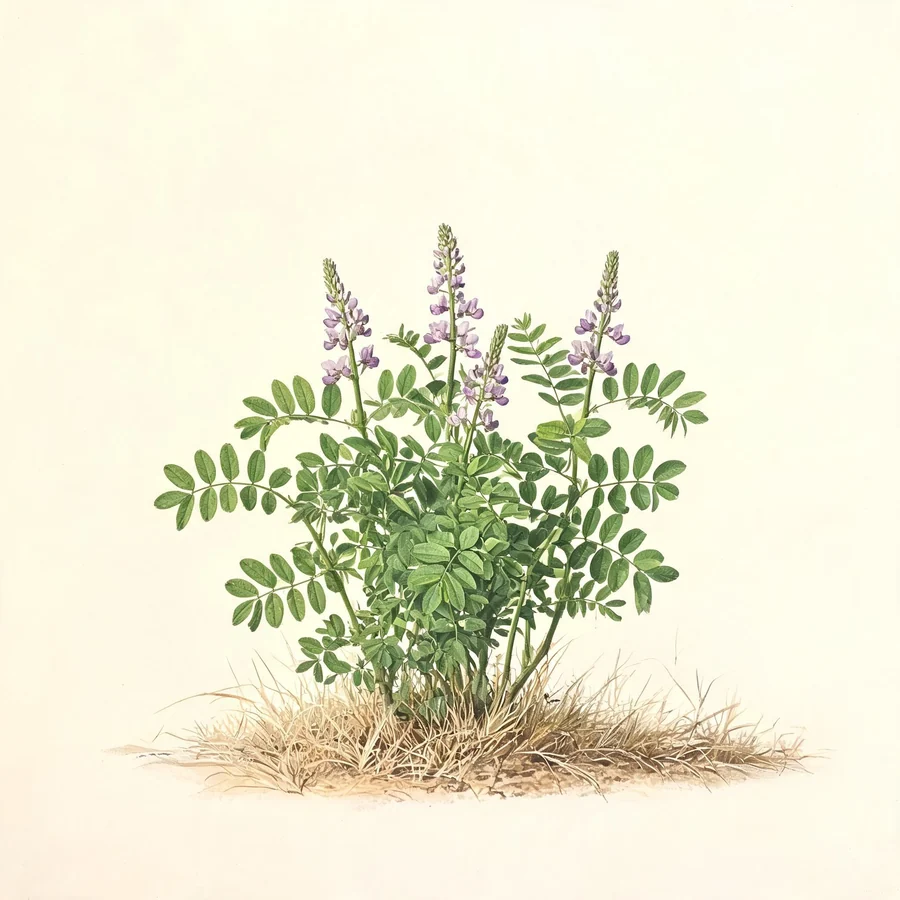
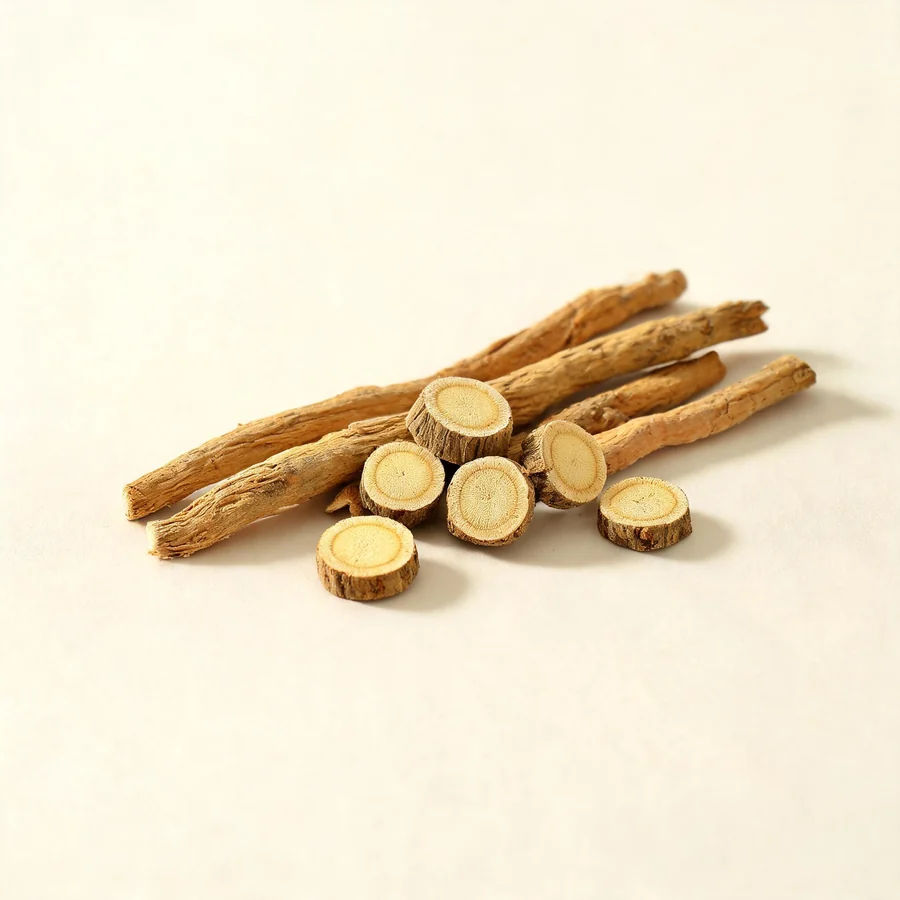
Skin profile
Where this herb sits in skin practice: the pattern it corrects, the skin signs it suits, and what it should not be used for.
Gan Cao is rarely the herb that turns a skin case around; it is the herb that makes the rest of the prescription work and keeps the digestion steady. Its own contribution is a gentle cooling and soothing of hot, raw or eroded skin, and its main risk is cumulative rather than immediate.
Skin signs that suggest it
- Hot, red, swollen and painful lesions with a burning quality
- An acute itchy red rash with small blisters or weeping, as in a contact reaction
- Boils, folliculitis or impetigo with redness around the lesion
- Raw, eroded or stinging skin, including at the corners of the mouth
- A red tongue, often redder at the tip, with a rapid pulse
- A formula that needs softening so the cooling herbs can be tolerated
When it is not the right herb
Not for oedema, fluid retention or a tendency to swollen ankles, and not for uncontrolled high blood pressure: the root encourages sodium and water retention. It is also not for a damp pattern with bloating, a greasy coating and heaviness, where its sweetness can add to the congestion. A short course inside a formula is a different proposition from a daily liquorice habit.
What it does for skin
Skin-relevant actions only. Each one describes a mechanism in TCM terms and what it looks like on the skin.
Clears Heat and resolves Toxin on the skin
The raw root is the cooling form, and it is used where heat toxin shows as red, hot, painful swelling, pustules or eroded skin. It is not a strong drainer like Huang Lian, but it cools and detoxifies while soothing, which suits lesions that are inflamed and raw rather than deep and suppurating. It is nearly always given with stronger heat-clearing herbs.
Soothes raw and eroded surfaces
Eroded skin, cracked corners of the mouth and raw patches sting and weep, and the sweet, mucilaginous quality of the root is described as soothing and protective. This is the traditional basis for including it in washes and in formulas for ulcerated or excoriated skin. It supports comfort rather than driving repair, and infection still needs proper treatment.
Harmonises a formula so harsh herbs can be used
Many skin formulas depend on bitter, cold or drying herbs that upset the digestion or taste too harsh to continue. Gan Cao moderates that: it softens the harshness, protects the middle and keeps the ingredients working together. This is a real clinical function in skin practice, because a course that cannot be tolerated treats nothing.
Relaxes tension in dry, tight, itchy skin
The sweet flavour is described as relaxing, and with a sour herb such as Bai Shao it is used for the tight, cramped quality of dry skin, where the surface feels drawn and the itch comes in waves. The classical pairing was written for cramps, and the same softening logic is applied to skin that feels constricted. It is a supporting action, not a treatment for the dryness itself.
Skin conditions it is used for
Mapped to the condition pages on this site. The pattern column shows what the skin is doing when this herb is the right choice.
| Condition | Pattern | Why it suits | Typical setting |
|---|---|---|---|
| Contact dermatitis | Heat toxin with acute redness, swelling and weeping | An acute contact reaction with bright redness, small blisters and weeping is read as heat toxin at the surface. Raw Gan Cao cools and resolves the toxin while soothing the raw skin, and it is included in a cooling formula rather than used alone. Removing the trigger and cooling the area are the first measures, and a severe reaction needs medical care. | Xiao Feng San modified with Jin Yin Hua and Lian Qiao |
| Urticaria | Wind-heat with disharmony in the formula | Red, itchy wheals that move around and flare with heat are treated with wind-releasing and heat-clearing herbs, and Gan Cao is the harmoniser that holds that combination together. Its own contribution is modest, but it softens the harsher herbs and supports the digestion during a course. Wheals with swelling of the lips or throat are an emergency. | Xiao Feng San |
| Boils | Heat toxin with swelling and pain | A hot, red, tender boil is the clearest heat-toxin lesion, and the raw root is included in the toxin-resolving formulas for it. It supports the stronger herbs and soothes the inflamed tissue, and it is not a stand-alone treatment. Spreading redness, fever or a deep abscess needs urgent assessment. | Xian Fang Huo Ming Yin |
| Erysipelas | Heat toxin in the upper body and face | A sharply bordered, hot, red, raised plaque with fever is read as heat toxin lodged in the channels of the head and face. Gan Cao is part of the classical formula for that picture, where it harmonises a group of strong cooling and dispersing herbs. Erysipelas is a bacterial infection and needs antibiotics; the formula is a supporting context, not a substitute. | Pu Ji Xiao Du Yin |
| Impetigo | Heat toxin on the face with crusting | Golden or honey-coloured crusts around the nose and mouth, on red skin, are read as heat toxin in a child or a depleted person. Gan Cao is included for its cooling and soothing role alongside the main toxin-clearing herbs. Impetigo is contagious and usually needs topical or oral antibiotics, so the herb supports rather than replaces treatment. | Modified Huang Lian Jie Du Tang with Gan Cao and Lian Qiao |
Combinations for skin
Herbs it is paired with when the skin, not an internal organ, is the target.
| Partner | Ratio | Why the pair is used |
|---|---|---|
| Jin Yin Hua | 6 to 10 g each | Jin Yin Hua clears heat and resolves toxin strongly, while Gan Cao cools more gently and harmonises the pair. Together they are used for hot, red, painful lesions and early boils, and the combination is mild enough to continue for a short course. |
| Bai Shao | 10 g each | The sour-sweet pair is the classical combination for cramping and tension, and in skin practice it is used where the skin feels tight and drawn and the itch comes in waves. Bai Shao nourishes and gathers, Gan Cao softens and relaxes, and the pair is a support rather than a cure for dryness. |
| Jie Geng | 6 to 10 g each | Jie Geng opens the Lung and directs the action upward, while Gan Cao soothes and moderates. The pair is used for lesions of the upper body and face, and for the raw, sore quality that comes with a hot rash around the mouth and throat. It is a small, targeted combination rather than a whole treatment. |
| Huang Qin | 6 to 10 g each | Huang Qin drains damp-heat and clears heat toxin, and Gan Cao moderates its bitter cold while soothing the tissue it is acting on. The pair appears in formulas for hot, weeping and infected skin, where the cooling needs to be strong but the digestion needs protection. |
Formulas where it leads
- Xiao Feng San (消风散) - The standard formula for wind-heat urticaria and acute itchy rashes, with Gan Cao as the harmoniser. It is the clearest example of the root's role in skin prescribing: present throughout, leading nothing.
- Pu Ji Xiao Du Yin (普济消毒饮) - A formula for heat toxin of the head and face, including erysipelas. Gan Cao is included to harmonise the strong cooling and dispersing herbs, and the formula is a context rather than a prescription.
- Xian Fang Huo Ming Yin (仙方活命饮) - A toxin-resolving formula for boils and abscesses, with Gan Cao supporting the cooling and dispersing herbs. It belongs to the early, spreading phase and is not a substitute for treating a deep or spreading infection.
Topical use
Gan Cao is used topically as a cooled decoction for hot, itchy and mildly weeping skin, usually alongside other cooling herbs rather than on its own. The root yields a sweet, slightly mucilaginous liquid that is described as soothing raw surfaces. Licorice-derived ingredients also appear in modern medicated creams, where they are used for their anti-inflammatory properties. Topical use is kept to small areas and short periods.
| Preparation | How and when it is used |
|---|---|
| Cooled decoction compress | 10 to 20 g of dried root simmered in 500 ml of water for 20 minutes, strained and cooled to skin temperature. Apply with clean gauze for 10 minutes once or twice daily to hot, itchy or mildly weeping patches, and discard the liquid after use. |
| Dilute wash | A weaker decoction used to rinse irritated skin after washing, or as a hand and foot soak. Keep it away from the eyes and from broken or ulcerated skin, and stop if the skin stings more than before. |
| Licorice-based creams | Some medicated creams contain licorice extracts or glycyrrhetinic acid. Use only products from a reputable maker, check the full ingredient list, and remember that a medicated cream applied over a large area carries more exposure than a short wash. |
Patch test and cautions
Patch test on a small area of normal skin for 24 hours before first use. Do not apply to deep, ulcerated or infected skin without clinical supervision, and do not use large-area or occlusive compresses for long periods, because glycyrrhizin can be absorbed through damaged skin. Keep the preparation away from the eyes, stop at once if burning or spreading redness develops, and do not continue a topical course for more than a couple of weeks without review.
Safety for skin use
What to check before recommending or using it, including the cautions that matter most for skin patients.
Do not use, or use with caution
- Oedema, fluid retention or a tendency to swollen ankles and a puffy face. Glycyrrhizin causes sodium and water retention and can make the swelling worse.
- High blood pressure that is not controlled, heart failure or significant kidney impairment. The root raises blood pressure and adds fluid to a system that is already overloaded.
- Low potassium, or medicines that waste potassium, because the root can lower potassium further.
- Dampness with bloating, a greasy coating and heaviness. A sweet root of this kind is held to feed Dampness and block Qi, so the fullness can grow.
Pregnancy and breastfeeding
Safe in culinary amounts, and avoided at medicinal doses and as a daily sweet or tea. The worry is endocrine rather than teratogenic: glycyrrhizin acts on the cortisol pathway that holds sodium and loses potassium, and observational studies have associated heavy liquorice consumption during pregnancy with earlier birth. A short, low-dose course inside a balanced formula is the sensible limit, and any longer course belongs with a practitioner. In breastfeeding, small amounts in a formula are generally treated as acceptable, while concentrated liquorice sweets and supplements are avoided.
Interactions
- Digoxin: licorice drives potassium down, a heart short of potassium reacts more strongly to cardiac glycosides, and rhythm disturbance can appear at a digoxin dose that had been steady for months.
- Potassium-wasting diuretics such as thiazides and loop diuretics: serum potassium can fall sharply when the two are used together, so electrolytes need checking.
- Blood pressure medicines: sodium and water retention works directly against antihypertensives and can make treatment appear resistant.
- Corticosteroids: glycyrrhizin delays the removal of prednisolone and related drugs, so steroid effects can be amplified.
- Diabetes medicines: licorice can raise glucose, and its constituents inhibit CYP3A4 in laboratory work, which matters where a drug has a narrow therapeutic window.
Allergy and patch testing
Allergy to Gan Cao is uncommon, but contact reactions to herb-containing creams and washes do occur. People with a known sensitivity to liquorice in foods should be cautious with medicinal doses. Patch test topical preparations, and stop if the skin becomes more irritated rather than calmer.
General safety references
General references for herbal hepatotoxicity and herb-drug interactions; they are not specific to this herb.
- Review article: Herbal hepatotoxicity - an update on traditional Chinese medicine preparations. Alimentary Pharmacology & Therapeutics, 2014. PMID: 24844799.
- Interactions between herbal medicines and prescribed drugs: an updated systematic review. Drugs, 2009. PMID: 19719333.
- Warfarin and food, herbal or dietary supplement interactions: a systematic review. British Journal of Clinical Pharmacology, 2021. PMID: 32478963.
Evidence
The classical record is quoted with its source. The modern note states the level of evidence plainly.
Classical record
It governs the five viscera and six fu, harmonising and calming the middle.
Shen Nong Ben Cao Jing - The harmonising role is the oldest recorded use, and it is the one that matters most inside skin formulas.
诸药中甘草为君,治七十二种乳石毒,解一千二百般草木毒,调和众药有功,故有国老之号。
Among all drugs licorice is the sovereign: it treats seventy-two kinds of mineral poison, resolves twelve hundred kinds of plant and wood poison, and is honoured for reconciling drugs with one another, which is why it bears the name National Elder.
Yao Xing Ben Cao (Materia Medica of Medicinal Properties) - The figures are rhetoric; what survives is the antidotal role and the reconciling one, which is why the root turns up in so many skin prescriptions without ever leading them.
甘草资全土德,协和群品,有元老之功,善治百邪,得王道之化。
Licorice completes the virtue of Earth and brings all substances into accord; it has the merit of a senior minister, and though it sustains the ruler work nobody notices, it achieves its results without claiming credit.
Ben Cao Gang Mu (Compendium of Materia Medica), Li Shizhen - Here a pharmacological role becomes a courtly one: Earth, the centre, the mediator on whom the rest depend.
Modern evidence
Evidence status
- Glycyrrhizin and its metabolite glycyrrhetinic acid inhibit the enzyme that protects mineralocorticoid receptors, producing sodium and water retention, potassium loss and raised blood pressure. This is well established and is the basis of the safety section.
- Glycyrrhetinic acid and licorice extracts show anti-inflammatory activity in laboratory work, and they are used as ingredients in some medicated skin creams. Clinical trial evidence for whole licorice root as a treatment for eczema or other skin disease is limited.
- Evidence for the herb's traditional toxin-resolving skin uses is traditional rather than clinical, and no trial is presented here as proof of benefit.
PubMed records
Selected real PubMed records for this herb's species or its constituents, chosen by species name and title relevance. They are references for the non-TCM discussion above, not proof that the herb treats any skin condition.
- Chijabyukpi-Tang Inhibits Pro-Inflammatory Cytokines and Chemokines via the Nrf2/HO-1 Signaling Pathway in TNF-α/IFN-γ-Stimulated HaCaT Cells and Ameliorates 2,4-Dinitrochlorobenzene-Induced Atopic Dermatitis-Like Skin Lesions in Mice.. Frontiers in pharmacology, 2020. PMID: 32733250 (skin-related record).
Dose and forms
Skin-practice dosing and the preparations that suit skin complaints.
| Form | Dose and notes |
|---|---|
| Harmonising dose | 2 to 6 g daily, the amount used when the root is there only to reconcile a formula. This is its usual role in skin prescriptions. |
| Active dose | 6 to 10 g where the aim is to clear heat, resolve toxin or soothe, and up to 30 g for short supervised courses in acute heat toxin. |
| Monitoring | If the daily amount passes 10 g, or a course runs beyond a month, check blood pressure and serum potassium, and step the dose down in older people and in anyone with heart or kidney disease. |
| Course length | Short courses of two to four weeks in skin practice, with review. Stop if the person becomes unsteady, weak in the muscles, swollen at the ankles or short of breath. |
The limit is about duration rather than any single dose. Published estimates set the threshold at some 0.7 to 1.4 grams of glycyrrhizin each day, the amount supplied by roughly 10 to 14 grams of crude root taken over weeks; there ordinary people begin to hold sodium and lose potassium. So a brief high-dose course for an acute hot lesion is not the same thing as a low dose continued indefinitely, and the prescription should state whether raw or honey-fried root is meant.
Citations and further reading
Only real sources are listed: the classical materia medica passages quoted above, and the source works behind the botanical and safety statements.
- Shen Nong Ben Cao Jing (Divine Husbandman's Classic of Materia Medica), attributed compilation of the Han period - classical entry quoted above.
- Yao Xing Ben Cao (Materia Medica of Medicinal Properties), attributed to Zhen Quan, Tang dynasty - classical entry quoted above.
- Ben Cao Gang Mu (Compendium of Materia Medica), Li Shizhen, 1578 - classical entry quoted above.
- Gan Cao monograph: Pharmacopoeia of the People's Republic of China - source for the accepted botanical source, part used and quality requirements.
- Modern evidence statement: based on pharmacological and review literature on glycyrrhizin and glycyrrhetinic acid, summarised as a statement about the level of evidence rather than as a cited finding.
- Botanical description and identification: botanical literature on Glycyrrhiza uralensis, Fabaceae.
Educational reference for qualified practitioners. This page is not medical advice, and skin conditions should be diagnosed by a clinician before treatment.