Skin profile
Where this herb sits in skin practice: the pattern it corrects, the skin signs it suits, and what it should not be used for.
Long Gu is a drying, settling material for a moist surface that has stopped spreading, and a quietener for itch that will not let a person rest. It is a short-term topical measure with a genuine adulteration problem, not a general skin tonic.
Skin signs that suggest it
- Moist, oozing patches with a pale or dull base that will not dry and crust over
- Shallow ulcers or slow-healing wounds with a wet surface and no spreading redness
- Itch that is worse at night, with broken sleep and scratching that continues into drowsiness
- A raw, excoriated area where the surface has been rubbed away and stays damp
- A pale tongue with a thin coating and a pulse that is deep and weak rather than rapid
When it is not the right herb
Not for skin that is hot, red and spreading, and not for an ulcer with pus, swelling or fever, which needs medical assessment rather than a drying powder. Because it is astringent it can hold moisture and heat in place while a lesion is still active, so it is withheld until the surface has stopped extending. It is also wrong for dry, scaly, tight skin, where an absorbent mineral adds to cracking, and for the ordinary dry phase of atopic eczema. Internal use is heavy on the digestion and is not a maintenance measure.
What it does for skin
Skin-relevant actions only. Each one describes a mechanism in TCM terms and what it looks like on the skin.
Dries a weeping surface
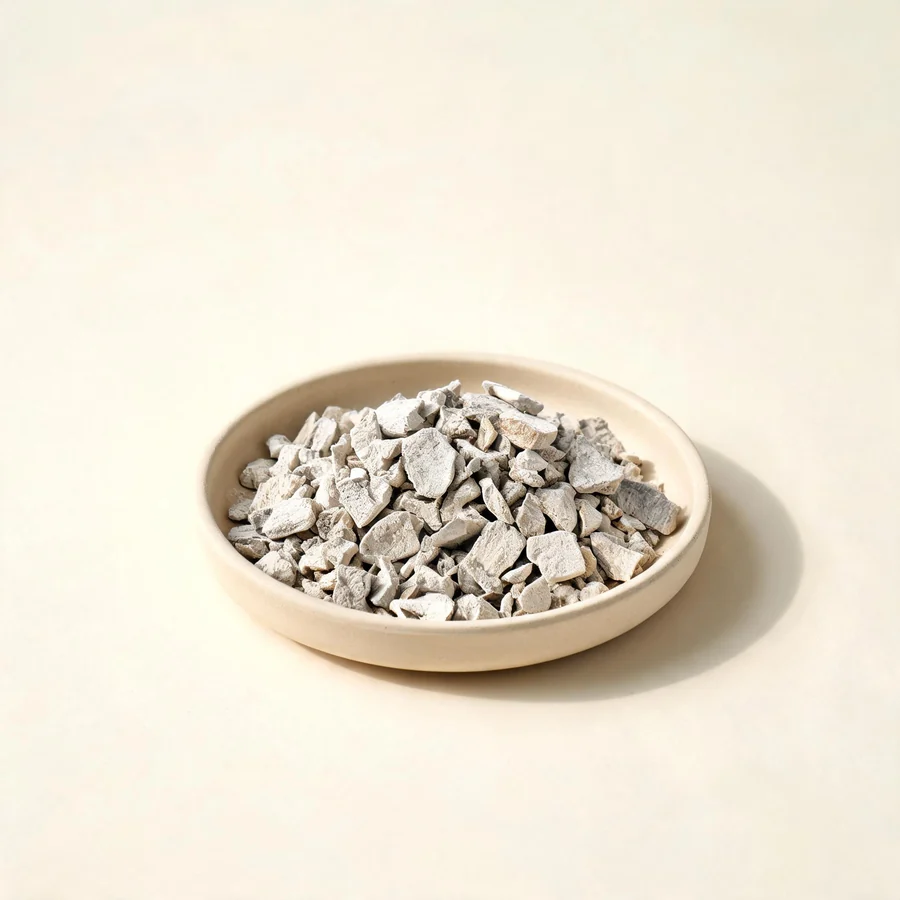
Calcined fossil bone is a calcium phosphate material with a fine, faintly absorbent grain. Dusted thinly on a wet, shallow lesion it takes up surface fluid and leaves a dry film, which reduces maceration at the edges and helps a dressing stay in place. The effect is physical and lasts only while the powder stays dry, so it is applied after cleaning and patted on rather than layered over an old application. It does not treat an infection and it is not a dressing.
Settles itch that restlessness keeps alive
A heavy mineral is read as anchoring, and this is the traditional reason a fossil appears in an itchy skin formula at all. The picture is a person who cannot leave a patch alone, who sleeps badly, who is agitated by the itch rather than merely inconvenienced by it, and whose pulse is deep and weak. The mineral is added to quiet that state, usually with Mu Li, and it is not a sedative: nothing on the skin changes, and the person is not made drowsy. Sedating antihistamines are not replaced by it.
Astringes an eroded, damp surface
The astringent taste is used where the surface itself has lost tone: excoriated eczema after scratching, a shallow crack that keeps weeping at its base, the raw area left when a blister roof comes away. The calcined form is the stronger astringent and the raw fossil is kept for the calming work, an important practical distinction because the two are not interchangeable. It belongs to the settling phase of a lesion, after the acute spread has stopped, and it is stopped as soon as the skin is dry.
Secures fluids that are leaking through the skin
Weeping skin, night sweats and a chronic wound that discharges thin fluid all read as fluid escaping rather than being held, and the astringent quality is directed at that loss. On the skin this means less ooze and a less sodden edge; taken internally in a formula it is the same action applied to sweat and to the stool. The traditional caution travels with it: an astringent is the wrong tool while there is still something to discharge, whether that is pus, heat or an unresolved surface pathogen.
Skin conditions it is used for
Mapped to the condition pages on this site. The pattern column shows what the skin is doing when this herb is the right choice.
| Condition | Pattern | Why it suits | Typical setting |
|---|---|---|---|
| Eczema | Subacute weeping eczema on limited areas | Once an acute flare has stopped extending, a moist dull-red patch that keeps oozing can be dusted with the calcined powder, and the traditional reading is that the astringency closes a surface that has lost its tone. It suits limited areas of intact skin around a shallow lesion rather than a whole limb, and it is stopped when the surface dries. A patch that is hot, spreading or foul needs a clinician first, because drying a discharging infection is the wrong move. | Calcined Long Gu powder used alone, with Huang Qin and Ku Shen in a damp-heat formula internally |
| Skin erosion | Eroded, damp skin after scratching | Where scratching has taken the surface off and the exposed area stays wet, the powder acts as a drying cover while the skin beneath settles. The itch that produced the erosion is the real target, so the mineral is used in a formula that treats the pattern rather than as a stand-alone remedy. An erosion that is enlarging, painful or warm should be reviewed, since a powder can seal over a surface that needs cleaning and dressing. | A dusting of the calcined powder, with a damp-heat formula such as Long Dan Xie Gan Tang internally |
| Pus and discharge | A shallow sore discharging thin fluid | The astringent action is used on a shallow sore that discharges a thin, watery fluid and will not close, where the surrounding skin is not red and spreading and the person is systemically well. This is a narrow window, and it is the reason the herb is used under supervision rather than by the patient. Frank pus, an offensive smell, swelling or fever means infection that requires proper assessment, and an astringent powder at that point risks trapping what needs to drain. | Calcined Long Gu in a dusting powder, with Huang Qi and Dang Gui in a tonic formula where the person is depleted |
| Burns | Superficial burns in the healing phase | The traditional external use extends to burns and slow-healing wounds, and a fine mineral powder was a household dressing for a superficial scald. Modern practice is far more cautious: only the healing phase, only on a small superficial area, and never in place of proper burn care. A burn that blisters over a wide area, involves the face, hands or joints, or looks white and leathery is a medical matter and no herb belongs on it. | A thin dusting of the calcined powder on a closed, superficial area, with conventional wound care |
| Itchy skin with redness | Night itch with agitation and exhaustion | When itch is worst at night and the person is worn out by it, with a deep weak pulse and a pale tongue, the emphasis shifts from clearing the skin to settling the person. The mineral is added to an antipruritic formula for that restlessness, usually with Mu Li and a blood-nourishing herb. It is not used alone for itch, and it is not a treatment for itch that comes with dry, thin, cold skin. | A calming and antipruritic formula with Mu Li and Bai Shao, with the calcined powder applied to excoriated patches |
Combinations for skin
Herbs it is paired with when the skin, not an internal organ, is the target.
| Partner | Ratio | Why the pair is used |
|---|---|---|
| Mu Li | 15 to 30 g of each, crushed and decocted first | Oyster shell is salty, cool and heavy, and the tradition treats it as nourishing Yin while it anchors; the fossil is the astringent one, chosen where fluid and tissue are leaking rather than where Yin is dry. On the skin the pair is used when a weeping patch comes with broken sleep and night sweating, and the itch is clearly worse for agitation. Neither acts as a sedative, and the combination does nothing for an active skin infection. |
| Duan Shi Gao | 10 g calcined Long Gu with 10 g calcined Shi Gao as a dusting powder | Calcined gypsum is the other traditional drying mineral, cooler and more markedly drying than the fossil. Blended, the two make a dusting powder for moist, irritated skin on intact surfaces, and the gypsum adds a stronger cooling quality while the fossil gives the mixture body. Both are minerals with no nutritional role, and neither belongs on broken, ulcerated or infected skin without supervision. |
| Ku Shen | 15 g Long Gu with 10 g Ku Shen in a cooled wash | Ku Shen is the skin-specific bitter for damp-heat and itch, and the mineral adds absorbency and a drying film to a wash or a compress. The pairing is used on moist, itchy patches where the surface is intact, and contact is kept short because both are drying. Ku Shen is not applied to large areas of broken skin, the wash is discarded after use, and the mineral settles out so the liquid is stirred before each application. |
| Huang Bo | 10 g of each in a cooled wash for the legs and feet | Huang Bo clears damp-heat from the lower half of the body and is the usual partner when weeping eczema settles on the shins, ankles and feet. The bitter cold herb addresses the heat and the discharge while the mineral dries the surface, and the two are used as a short course of compresses. The wash is not used on ulcerated skin, and a leg that is swollen, hot and red is a reason to seek medical advice rather than to apply more herb. |
Topical use
The external use is the main skin use, and it is a powder rather than an ointment. Calcined fossil bone is ground fine and applied alone or blended with another mineral, always to clean, dry, intact skin around a lesion rather than into an open cavity. It is a short-term measure for a moist surface that is settling, and it is stopped as soon as the skin dries.
| Preparation | How and when it is used |
|---|---|
| Dusting powder | Grind the calcined material to a fine, grit-free powder and dust a thin layer on clean, dry skin around a shallow weep, using a soft pad. Remove the old powder before reapplying, keep the area uncovered or lightly dressed, and stop when the surface stops oozing. Do not use it on a lesion with pus, an offensive smell or a spreading red edge. |
| Powder and oil paste | Blend the powder with a little sesame oil or a plain ointment base to a soft paste and apply thinly to a dry, cracked or healing area once or twice daily. The paste holds the mineral in longer contact than a dusting does, and it is used once the surface has stopped weeping, not while it is still wet. Patch test first, since a paste keeps the material on the skin for hours. |
| Cooled wash | Simmer 15 to 30 g of the crushed mineral in 500 ml of water for 20 minutes, strain through cloth and cool to skin temperature. Use as a rinse or a short compress on a moist, itchy patch no more than twice daily, and make it fresh each time because the mineral settles out of suspension. Discard what is left and do not keep it overnight. |
Patch test and cautions
Patch test on normal skin for 24 hours before first use. Buy only from a supplier who can name the source material, because the market carries dinosaur fossil with a high fluoride content and processed modern bone sold under the same name. Do not apply to broken, ulcerated or infected skin without supervision, do not cover a treated area with an occlusive dressing, and stop if burning, itching or redness increases rather than settles.
Safety for skin use
What to check before recommending or using it, including the cautions that matter most for skin patients.
Do not use, or use with caution
- Skin that is hot, red, swollen or spreading, and any ulcer with pus, an offensive smell or fever. An astringent powder can trap discharge and mask advancing infection, and these pictures need clinical assessment first.
- Dry, scaly, tight or lichenified skin. The mineral takes up the little moisture present and adds to cracking, so it is not for the chronic dry phase of eczema or for ichthyosis.
- Unverified source material. Fossil bone is scarce and expensive, and fluoride-rich dinosaur fossil or treated modern bone is sold in its place; buy only from a supplier who states the material and can document it.
- A weak digestion for internal use. A dense mineral sits heavily, and poorly levigated powder can irritate the gut and is said to generate Heat over a long course.
Pregnancy and breastfeeding
The classical texts do not place the fossil among pregnancy-prohibited substances, and a calcium salt is barely absorbed through intact skin, so a small dusted area is a low-exposure use. An internal course is still a practitioner's decision, and the ordinary restraint on internal herbs in pregnancy applies. During breastfeeding, keep any powder away from the nipple area so that the infant does not swallow it, and check with a practitioner before using it on a large area or on broken skin.
Interactions
- Cardiac glycosides such as digoxin. The calcium content can add to the drug's effect and to its toxicity, so blood levels need monitoring if an internal course overlaps.
- Medicines that bind calcium: tetracycline and quinolone antibiotics, isoniazid and iron salts are chelated by calcium ions, so doses are separated by at least two hours.
- Prescribed topical treatment. Powder applied over a steroid cream or a calcineurin inhibitor reduces how much of the medicine is absorbed, so the prescribed cream goes on first and the powder at a different time of day.
Allergy and patch testing
A mineral is an unusual allergen, but a reaction to another ingredient of a dusting powder or paste is common. Patch test first, keep the area small, and stop at once if the skin stings, itches more or reddens, since a contact reaction to a mineral powder is easy to mistake for a worsening of the original rash.
General safety references
General references for herbal hepatotoxicity and herb-drug interactions; they are not specific to this herb.
- Review article: Herbal hepatotoxicity - an update on traditional Chinese medicine preparations. Alimentary Pharmacology & Therapeutics, 2014. PMID: 24844799.
- Interactions between herbal medicines and prescribed drugs: an updated systematic review. Drugs, 2009. PMID: 19719333.
- Warfarin and food, herbal or dietary supplement interactions: a systematic review. British Journal of Clinical Pharmacology, 2021. PMID: 32478963.
Evidence
The classical record is quoted with its source. The modern note states the level of evidence plainly.
Classical record
龙骨最粘涩,能收敛正气,凡心神耗散,肠胃滑脱之疾,皆能已之。且敛正气而不敛邪气。
Dragon Bone is the most sticky and astringent of materials and can gather the upright Qi. Every condition in which the Heart spirit scatters, or in which the intestines and stomach slip and leak, can be resolved with it, and it gathers upright Qi without gathering pathogenic Qi.
Ben Cao Jing Bai Zhong Lu (Hundred Kinds of Materia Medica Explained) - The line explains the strength of the astringency, and the claim that it does not gather pathogenic Qi is the classical licence for using it on a lesion that still discharges.
龙骨,质最粘涩,具有翕收之力,故能收敛元气,镇安精神,固涩滑脱。
Dragon Bone is extremely sticky and astringent by nature and possesses a gathering, closing power, so it can collect the original Qi, steady and calm the spirit, and secure what is slipping away.
Yi Xue Zhong Zhong Can Xi Lu (Records of Tradition and Modern Medicine), Zhang Xichun - The clearest single sentence on why a fossil is used where tissue and fluid will not hold: the quality that secures sweat and stool is applied to a surface that will not close.
It settles the spirit, secures the ethereal soul and stops sweating.
Shen Nong Ben Cao Jing (Divine Husbandman's Classic of Materia Medica) - The oldest stratum of the record is about calming and about stopping loss, not about skin; the external use grew out of that second half.
Modern evidence
Evidence status
- No clinical trial of Long Gu in any skin condition was identified. The external use rests on traditional practice and on the physical behaviour of a fine calcium phosphate powder, which absorbs surface fluid; that behaviour is plausible but has not been compared with a dressing or a topical steroid.
- Chemically the material is carbonated hydroxyapatite with calcium carbonate and trace iron, potassium, zinc, strontium and manganese, and it contains no toxic organic constituents. That composition is why the toxicity record is reassuring, and why the practical hazards are adulteration and weight on the digestion.
- Supply is the modern problem. The pharmacopoeia dropped the material after 1985, fossil protection rules in China restrict excavation, and the market carries fluoride-rich dinosaur fossil and processed modern bone. Any purchase should be traceable rather than merely heavy.
PubMed records
Selected real PubMed records for this herb's species or its constituents, chosen by species name and title relevance. They are references for the non-TCM discussion above, not proof that the herb treats any skin condition.
- Pterosaurs.. Current biology : CB, 2021. PMID: 34428416 (general record).
Dose and forms
Skin-practice dosing and the preparations that suit skin complaints.
| Form | Dose and notes |
|---|---|
| Decoction (internal) | 15 to 30 g of the crushed mineral goes into cold water on its own and simmers for half an hour before anything else joins it, because a dense fossil gives up little in a short boil. 30 to 45 g is recorded for severe fluid loss, under supervision. |
| Levigated powder | 1 to 3 g a day, ground fine and water-levigated so that it does not scratch the gut, taken in warm water or wrapped in cloth and decocted with the formula. Poorly levigated powder can irritate the stomach over time. |
| Dusting powder (topical) | A thin film on clean, dry skin, applied with a pad and removed before the next application. There is no fixed weight; the amount is set by the area, and it is used on small areas only. |
| Course length | Days to a couple of weeks for skin use, with review. Stop when the surface dries and the itch settles, and do not continue a mineral powder as maintenance. |
The weight looks large because the material is dense and much of it is never extracted, so it is crushed, soaked and given the first half hour of the boil alone. Processing matters as much as quantity: the raw fossil is chosen for calming and the calcined form for drying and for topical work, and the change comes from heating the pieces until they glow. For skin practice the calcined powder is the relevant form, used on limited areas for a short period rather than as a habit.
Citations and further reading
Only real sources are listed: the classical materia medica passages quoted above, and the source works behind the botanical and safety statements.
- Hundred Kinds of Materia Medica Explained (Ben Cao Jing Bai Zhong Lu), classical commentary - passage quoted above.
- Records of Tradition and Modern Medicine (Yi Xue Zhong Zhong Can Xi Lu), Zhang Xichun, early twentieth century - passage quoted above.
- Shen Nong Ben Cao Jing (Divine Husbandman's Classic of Materia Medica), attributed compilation of the Han period - entry quoted above.
- Ming Yi Bie Lu (Supplement to the Classic of Materia Medica), Tao Hongjing, Southern and Northern Dynasties - source of the non-toxic rating and of the calming and securing indications.
- Long Gu monograph history: Pharmacopoeia of the People's Republic of China, which no longer lists the material - the basis for the statement about supply and substitution.
- Mineralogy: literature on fossil bone as carbonated hydroxyapatite with calcium carbonate and trace elements, and on the fluoride content of dinosaur fossil material.
- Fossil protection: Chinese regulations restricting excavation and trade in fossil material, cited for the sourcing statement.
Educational reference for qualified practitioners. This page is not medical advice, and skin conditions should be diagnosed by a clinician before treatment.