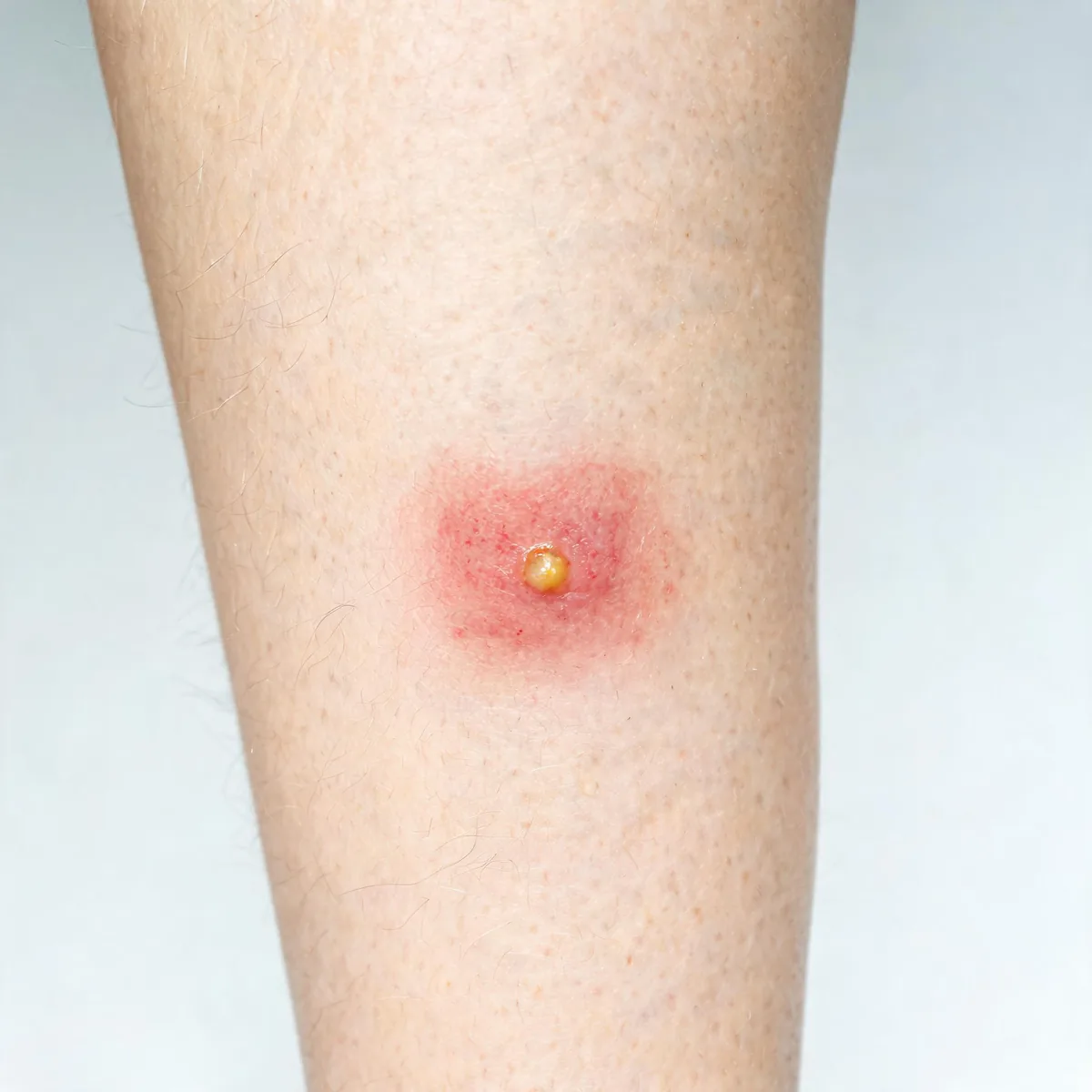
Understanding Pus and discharge
The tradition describes pus as the direct result of Heat and Toxins cooking the body fluids and tissues, with stagnation preventing the area from clearing.
Toxic-Heat gives thick yellow foul-smelling pus with a red hot swollen very painful lesion, high fever, intense thirst and restlessness. Toxic-Heat stagnation is the variant where pus drains poorly because it is trapped: a localised hot red swollen lump with a feeling of fullness or throbbing.
Damp-Heat gives thick turbid sticky discharge, often yellowish and foul, with local swelling that feels heavy rather than sharply painful. The distinction from Toxic-Heat is that the pain is less sharp and the body feels heavier.
Qi and Blood Deficiency is the pattern that matters for chronic wounds: thin watery or serous discharge that is pale or clear, with persistent fatigue, a pale complexion and slow healing. Clearing would weaken this person further, so the direction is to support.
Pus is not treated as a disease in itself but as evidence that heat and toxin have begun to break tissue down. Where the pathogen is strong and the person is robust, the struggle is loud: the lesion is red, hot, tight and painful, and the fluid that escapes is thick and yellow. Where the body is tired or the collection sits deep, the same struggle goes quiet, and the wound leaks a pale fluid with little smell or heat. The discharge is therefore read as a report on that struggle rather than as the illness.
The tongue and pulse confirm what the discharge suggests. A red tongue with a yellow coat and a racing pulse points to heat; a greasy coating with a slippery pulse adds dampness; a pale tongue with a weak pulse marks depletion. Because the picture can move from excess to deficiency as an infection drains, the practitioner reassesses at each visit and shifts the herbs from clearing towards supporting as the tissue settles.
Conventional view
In Western medicine, pus is a mixture of dead white cells, bacteria and broken-down tissue, and it usually means a bacterial infection is established. It collects when neutrophils are sent to the site and the resulting debris is walled off, which is what produces the creamy material seen in an abscess, an infected wound or an infected operation site. Assessment may include a swab for culture, and imaging such as ultrasound or CT when a deeper collection is suspected.
Standard care pairs antibiotics chosen for the likely organism with wound care, and where a collection has formed, incision and drainage. Pain relief and anti-inflammatory drugs may be added, and chronic sinuses or fistulas that keep discharging can require excision or more specialist wound management.
What this approach does not do is separate a wound discharging because the body is overheated and toxic from one leaking thin fluid because it is depleted. Antibiotics clear the organism but not the tissue damage or the tendency to recur, some collections need draining more than once, and discharge can persist after the bacteria have gone. That gap is where the pattern approach is offered, as an addition rather than a replacement.
Selected PubMed records
Real PubMed records for the conventional discussion above, selected by condition name and title relevance. They are references, not a claim that any treatment is proven for this condition.
- Elderly patients are at increased risk for treatment failure in outpatient management of purulent skin infections.. The American journal of emergency medicine, 2017. PMID: 27836315.
How it connects
Discharge rarely arrives alone. A Toxic-Heat abscess that is slow to drain can settle into a stagnant lump, and a lesion that keeps oozing in humid weather drifts towards Damp-Heat, while long-standing cases often end in a deficiency picture. That is why one person can show signs of two patterns at once, and why the reading changes as the wound changes. Which feature dominates, and what eases or aggravates it, is a more useful guide than counting symptoms, although tongue and pulse remain the deciding evidence. Spreading redness, high fever or feeling generally unwell means medical care first.
How it is assessed
The practitioner assesses the discharge, the surrounding tissue and the system response.
What a practitioner looks for
- Discharge: thick yellow foul suggests Toxic-Heat; thin watery suggests deficiency.
- Drainage: poor drainage from a tense lump suggests Toxic-Heat stagnation.
- Surrounding tissue: red hot and painful suggests active infection; pale and cool suggests deficiency.
- Red flags: spreading redness, red streaks or fever.
Inspection starts at the wound and works outward. A tense, shiny swelling that is pointing towards the surface behaves differently from a flat, weeping patch, and a discharge that stains a dressing yellow and smells strong is read differently from one that is clear and watery. The practitioner also notes how far the surrounding skin is involved, because a wide margin of redness suggests the pathogen is spreading rather than contained.
The interview then covers the whole picture: thirst, appetite, stool, sleep, energy and preference for warmth or cold. These details separate a hot, dry excess from a heavy, damp one, and they show whether the body still has the strength to respond. Points are chosen on the limbs to clear the channel without disturbing the wound, and the formula is adjusted as the discharge changes from thick to thin.
TCM patterns in Pus and discharge
The four patterns differ by what the discharge looks like and by how well the body is coping. Toxic-Heat is the acute, boisterous picture: intense redness, heat and throbbing pain with thick yellow pus, fever, thirst and restlessness. When that heat cannot escape, the same process becomes Toxic-Heat Stagnation, and the emphasis moves to a tense, tender lump whose pus will not drain, often with a dusky surface over the collection. Damp-Heat adds heaviness and stickiness; the discharge is turbid and clingy, the tissue feels boggy, the tongue coating is greasy, and the whole picture drags on because dampness moves slowly. Qi and Blood Deficiency sits at the other end, in wounds that stay open, leak a pale thin fluid and never quite close, in someone tired, pale and without appetite. Which dominates decides whether to clear, drain or rebuild, and many cases mix two.
| Pattern | Key signs | The itch | Tongue | Main formula |
|---|---|---|---|---|
| Toxic-Heat | Red hot swollen very painful lesion; High fever or burning heat | Not specified | Body: Red, often with raised red pointsCoat: Yellow, dry, sometimes thick | Not specified |
| Toxic-Heat Stagnation | Localised hot red swollen painful lump | Not specified | Body: Deep red or crimson with raised red pointsCoat: Thick, dry and yellow | Not specified |
| Damp-Heat | Local swelling with heaviness rather than sharp pain | Not specified | Body: Red, often swollen with teeth marksCoat: Yellow, greasy and thick, usually in the middle and at the root | Not specified |
| Qi and Blood Deficiency | Not specified | Not specified | Body: Pale, possibly thin or with teeth marksCoat: Thin white | Not specified |
Toxic-Heat
Thick yellow foul pus with a red hot painful lesion and fever.
A strong heat pathogen, whether it arrives from outside or builds up from spirits, chillies and fried food, overwhelms the defensive Qi before it can contain it. The heat burns through the fluids held in the tissue, and what escapes is thick, yellow and foul. Because the reaction is recent and intense, the surface is bright, the whole body is hot, and the pulse races.
The tongue is red with a dry yellow coat and often shows raised papillae, and the pulse is rapid and forceful. The person is thirsty for cold drinks, restless, and may pass dark, scanty urine or be constipated. Alcohol, hot stuffy weather and emotional strain all make it worse. Wu Wei Xiao Du Yin and Huang Lian Jie Du Tang are the formulas named for this presentation, with Jin Yin Hua, Lian Qiao and Huang Lian as the key herbs, and Quchi (LI-11), Hegu (LI-4) and Neiting (ST-44) as the points.
Signs
- Thick yellow foul-smelling pus
- Red hot swollen very painful lesion
- High fever or burning heat
- Intense thirst for cold drinks
- Restlessness
Diet and lifestyle for this pattern: Avoid all heating and stimulating food: no spicy dishes, alcohol, coffee or greasy fried items. Eat cooling, moistening food such as cucumber, watermelon, mung bean soup and chrysanthemum tea, rest in a cool quiet room, and drink plenty of room-temperature water to help the body clear toxins.
Toxic-Heat Stagnation
Trapped pus with a tense throbbing lump.
Here the heat is present but unable to disperse. The blockage holds Qi and blood in one place, so the tissue becomes tense and the pain takes on a full, bursting quality instead of a diffuse burn. Because the pus cannot find a way out, the collection becomes more concentrated, and the discharge, when it finally appears, is thick and slow to leave.
The tongue is deep red or crimson with a thick dry yellow coat, and the pulse is rapid and forceful, sometimes slippery or wiry depending on how deep the collection sits. Pressure makes it worse, and the person feels feverish and thirsty. Tou Nong San is the formula named for this stage, since it supports the body's own push rather than only cooling the surface, with Zao Jiao Ci and Huang Qi carrying that action. Quchi (LI-11), Hegu (LI-4) and Zusanli (ST-36) are the points chosen.
Signs
- Thick yellow foul pus that drains poorly
- Localised hot red swollen painful lump
- Feeling of fullness or throbbing
- May need drainage
Diet and lifestyle for this pattern: Eat cooling, light food such as mung beans, cucumber, watermelon and chrysanthemum tea, and strictly avoid spicy, greasy and fried food as well as alcohol, which add fuel to the fire. Keep the affected area clean and avoid tight clothing that presses on the abscess.
Damp-Heat
Thick turbid sticky discharge with heavy local swelling.
Dampness gives the pathogen weight and stickiness, so the inflammation smoulders rather than flaring. The tissue turns boggy, the surface may weep constantly, and the smell is heavy. Dampness shifts slowly, so these lesions outlast the fiery ones and settle where moisture already gathers, such as skin folds and the lower parts of the body.
A red tongue with a thick greasy yellow coating and a slippery, rapid pulse confirm the reading, together with stuffiness in the chest, a poor appetite, a sticky taste and loose stools that feel incomplete. Humidity, alcohol and inactivity all aggravate it. Long Dan Xie Gan Tang is the formula named, with Long Dan Cao and Huang Qin doing the drying, and Yinlingquan (SP-9), Quchi (LI-11) and Sanyinjiao (SP-6) used to drain the dampness.
Signs
- Thick turbid sticky yellowish foul discharge
- Local swelling with heaviness rather than sharp pain
- Heavy body sensation
- Greasy taste
Diet and lifestyle for this pattern: Favour light, cooling and drying food such as barley, mung beans, cucumber and bitter greens, and avoid greasy, sweet, rich and spicy food that creates more Dampness and Heat. Keep the affected area clean and dry, and avoid sitting or lying in damp humid places for long periods.
Qi and Blood Deficiency
Thin watery pale discharge with fatigue and slow healing.
After the acute phase, or in someone already run down, the body may lack what it needs to finish the job. New tissue is not built, the wound bed is poorly nourished, and the discharge thins to a pale watery fluid. There is little redness or heat because the reaction itself is weak, and the sore can stay open for weeks.
The tongue is pale, perhaps thin or marked by teeth, with a thin white coating, and the pulse is fine and weak. Fatigue, dizziness, palpitations, a poor appetite and loose stools accompany the local picture, and the person feels worse after exertion. Tou Nong San and Ba Zhen Tang are the formulas named, with Huang Qi, Dang Gui and Bai Zhu rebuilding the resources needed to close the wound, and Zusanli (ST-36), Sanyinjiao (SP-6), Qihai (REN-6) and Xuehai (SP-10) the points.
Signs
- Thin watery or serous pale discharge
- Persistent fatigue worse on exertion
- Pale sallow complexion with pale lips and nails
- Slow healing wound
Diet and lifestyle for this pattern: Put rest first and avoid overexertion, since the body needs energy to heal. Eat warm, easy, nourishing food such as bone broth, congee with lean protein and cooked root vegetables, steer clear of raw, cold and greasy food that taxes the Spleen, and keep movement gentle such as walking or tai chi so Qi builds without being depleted.
Treatment approach
How the tradition treats pus and discharge, with the herbs, formulas and points used for it.
Principles
- Get medical review of any wound with pus; drainage and antibiotics where indicated come first.
- Clear heat and resolve toxicity where discharge is thick and foul.
- Drain dampness where the discharge is turbid and the swelling heavy.
- Support Qi and Blood where the discharge is thin and watery, since that is a deficiency pattern.
- The strategy also changes with the stage. Once an acute collection has drained, the picture commonly turns from excess to mixed or deficient, so the formula is stepped down from strong clearing towards gentler tonifying, which lets the tissue close instead of leaving a weakened terrain that invites a return.
Herbs used
Formulas
Acupoints
- LI-11 (Quchi)
- LI-4 (Hegu)
- ST-44 (Neiting)
- ST-36 (Zusanli)
- SP-9 (Yinlingquan)
- SP-6 (Sanyinjiao)
- qihai-ren-6
- SP-10 (Xuehai)
What to expect
- Acute infections usually improve within days of appropriate medical treatment.
- Chronic wounds with thin discharge need constitutional support over weeks.
- Non-healing wounds need review for circulation, diabetes and other causes.
- Most people notice less discharge and less local heat within the first week, with herbs taken two or three times daily and acupuncture usually weekly. The tongue and pulse are checked at each visit and the formula is altered as the discharge changes. Chronic cases often need two to three months, but once the pattern is correctly identified the improvement is steady rather than dramatic.
Safety and when to get help
Seek medical help urgently for
- Rapidly spreading redness or red streaks from the wound.
- High fever or chills.
- Pus with a foul smell, gas in the tissue, or severe pain - this needs urgent surgical review.
For anything severe, sudden or spreading quickly, read when a skin problem needs urgent care.
Cautions
- Do not squeeze or drain an abscess at home.
- Diabetic foot wounds with discharge need urgent specialist review.
- Wounds that will not heal need medical assessment, not only topical herbs.
Using this alongside conventional care
- This page is complementary: wound care, drainage and antibiotics come first, with herbs supporting the pattern alongside.
- Combining is usually straightforward, but three points are worth stating. Blood-moving herbs such as Dang Gui and Chuan Xiong can add to the effect of warfarin and similar drugs, so the prescriber needs to know about them. If surgery or a drainage procedure is planned, a practitioner may advise pausing certain herbs for about a week beforehand to reduce bleeding. A full medication list, supplements included, should go to every consultation, because the formula is chosen around what is already being taken.
Diet and lifestyle
- Avoid spicy, greasy, fried and overly sweet food, alcohol and excess red meat.
- At the table, the aim is to stop adding fuel. Spicy dishes, fried food, alcohol, coffee, refined sugar and heavy red meat all push the body towards heat or dampness, while cooling, light foods such as mung bean soup, cucumber, bitter melon, pear and leafy greens do the opposite. A deficiency picture needs warmth and nourishment instead: bone broth, congee, cooked root vegetables and meals at regular times, since skipped meals and raw cold food weaken the Spleen that makes Qi and Blood. Plenty of room-temperature water supports the whole process.
If you're pregnant
Treatment during pregnancy is modified to protect the fetus. Strongly cold or purgative herbs such as Huang Lian and Da Huang are generally avoided, and milder heat-clearing herbs such as Jin Yin Hua and Lian Qiao are preferred when the picture is Toxic-Heat. Points traditionally avoided in pregnancy, Sanyinjiao (SP-6) and Hegu (LI-4) among them, are omitted, and work moves to Quchi (LI-11) with Zusanli (ST-36), stimulated gently. Where the pattern is Qi and Blood Deficiency, Ba Zhen Tang may be used at an adjusted dosage under professional guidance.
If you're breastfeeding
Herbs that are bitter and cold, Huang Lian and Long Dan Cao among them, are given for Toxic-Heat and Damp-Heat but can reach breast milk, and a baby may then pass loose stools or seem unsettled. Practitioners therefore prefer milder herbs, Jin Yin Hua and Lian Qiao for instance, or use acupuncture so that heat is cleared without that risk. Quchi (LI-11), Neiting (ST-44) and Zusanli (ST-36) are useful here, and a cooling topical wash containing Huang Bai can be applied to the lesion, since very little is absorbed.
If treating a child
In children the discharge usually comes from a Toxic-Heat pattern, with a fast onset and obvious local signs, while chronic ear and sinus infections in children often show Damp-Heat. Because a child cannot always describe what is happening, observation of the discharge, behaviour, tongue and pulse carries more weight than the history. Doses are usually a third to a half of an adult amount, scaled to age and weight, needling is brief and gentle, and non-needle approaches, acupressure or paediatric tui na among them, are often chosen instead. Moxibustion has little place in acute heat, though it may support recovery at Zusanli (ST-36) in deficiency.
If treating an elderly patient
In older patients the picture is often chronic: a low-grade ooze from a wound that will not close, a pale watery discharge, and little redness or heat, which points to Qi and Blood Deficiency. Tonifying formulas such as Tou Nong San and Ba Zhen Tang are used at lower doses so that digestion is not overwhelmed, and strong heat-clearing herbs are reserved for clear signs of acute Toxic-Heat. Acupuncture, kept gentle, is well tolerated, and moxibustion at Qihai (REN-6) with Zusanli (ST-36) can warm the body gently and encourage a chronic wound to close.
Urgent-sign guidance is based on standard sources: NHS anaphylaxis, NHS cellulitis, NHS Stevens-Johnson syndrome, NHS melanoma.
Evidence
Evidence status
Compiled for this page from the classical and modern literature; not a systematic review, so treat it as a pointer to sources rather than clinical guidance.
The classical literature records no condition-specific clinical studies or classical citations for this page, so there is no evidence base to report here. The general principles about pus and discharge belong to the toxic-heat and damp-heat families covered on other pages of this knowledge base. This tab is left explicit rather than filled with borrowed or unrelated citations.
Common questions
Should pus be drained?
Yes, when an abscess has formed - but by a medical professional, not at home.
Why is thin watery discharge different?
It is described as Qi and Blood deficiency rather than infection-driven excess, and the treatment direction reverses to support.
When is it urgent?
Spreading redness, red streaks, high fever, foul-smelling pus with gas, or severe pain.
Can herbs stop the discharge?
The tradition describes clearing heat or supporting deficiency. Infection needs medical treatment first.