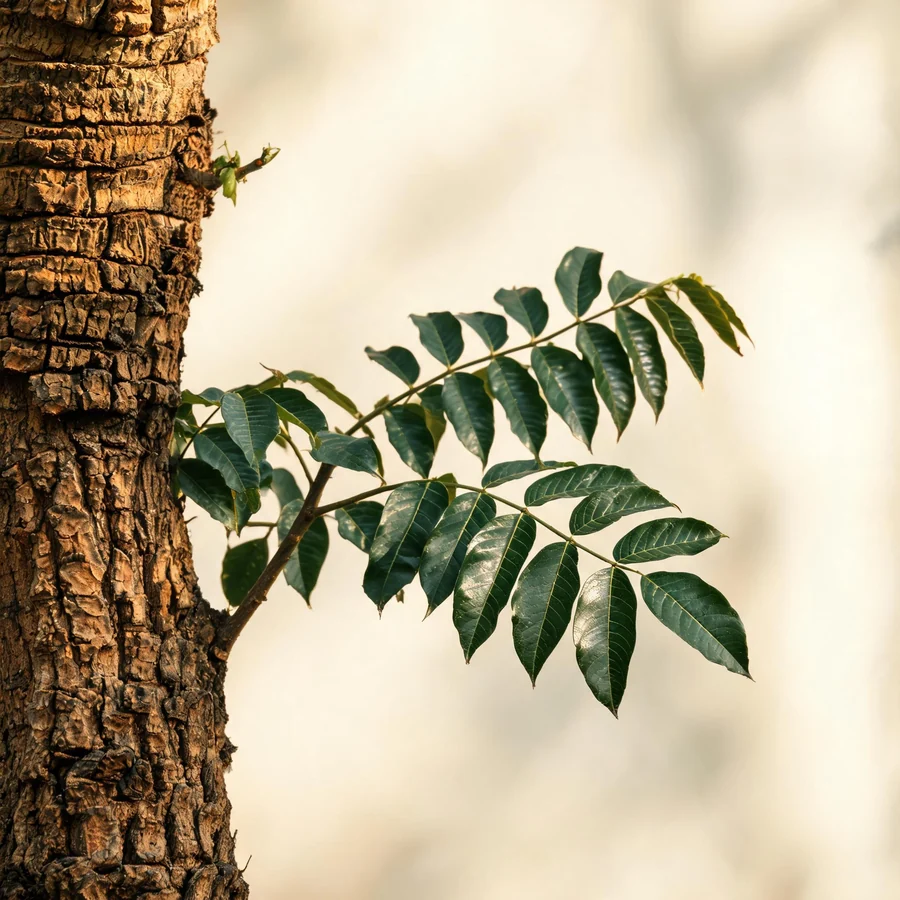
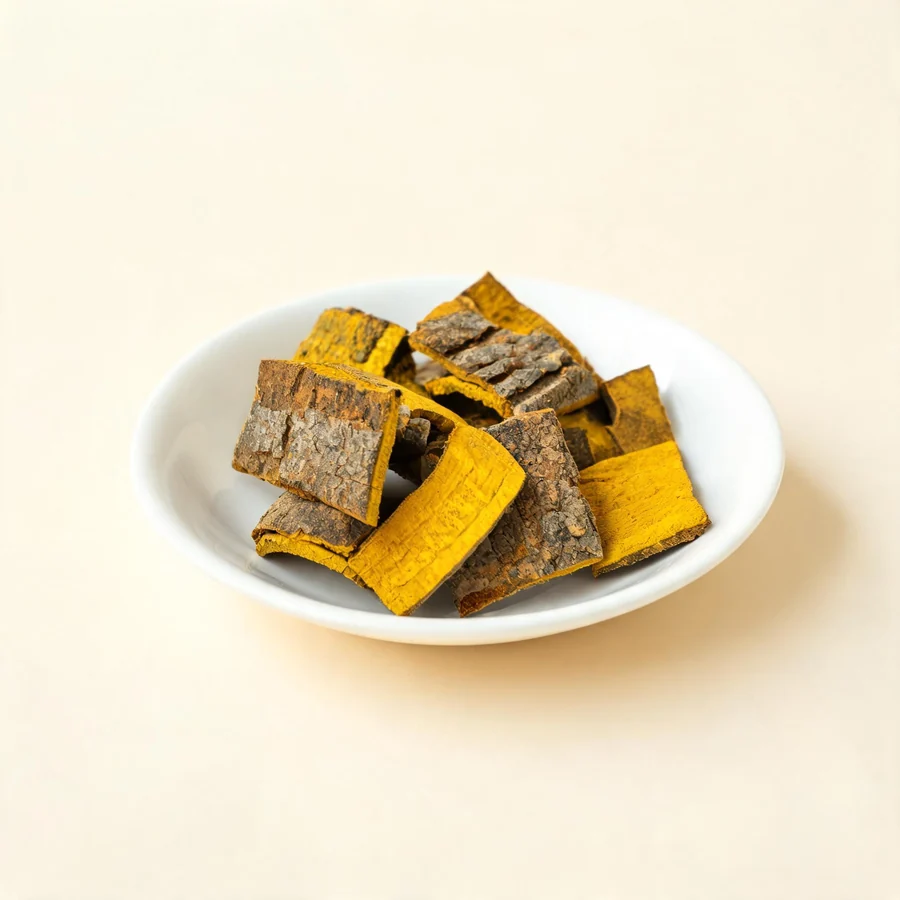
Skin profile
Where this herb sits in skin practice: the pattern it corrects, the skin signs it suits, and what it should not be used for.
Huang Bo is the bitter bark for damp-heat that has gone downward, and it is best known on the skin for weeping, itchy lesions of the legs, feet, groin and genitals. It dries hard and clears strongly, so it is used in short courses and it is not the herb for dry, cold or pale skin.
Skin signs that suggest it
- Weeping, red and itchy lesions on the legs, feet or in the skin folds, with a yellow discharge
- Maceration, scaling and an offensive smell between the toes or in the groin
- Burning or itching of the genitals or around the anus, with redness and moisture
- A heavy feeling in the legs with hot, swollen skin below the knee
- A yellow greasy tongue coating with dark, scanty urine and a rapid pulse
When it is not the right herb
Not for dry, cold, pale skin without heat, and not for the dry lichenified eczema of a cold-deficient constitution. It is a herb for the lower body and for dampness with heat; facial redness and upper-body rashes are better served by Huang Qin. Because it is intensely bitter and drying it can injure a weak digestion, and it is wrong where Yin is thin without genuine fire, since it consumes the fluids. Long courses in a frail person leave a hidden coldness behind.
What it does for skin
Skin-relevant actions only. Each one describes a mechanism in TCM terms and what it looks like on the skin.
Drains Damp-heat from the lower body
This is the defining action of the bark in skin practice. Dampness that collects in the legs, feet, groin and genitals keeps the skin moist, and heat keeps it red and irritable, so the lesion weeps and itches at the same time. Huang Bo is chosen because its bitterness is directed downward and dries the moisture at the site. It suits eczematous patches on the shins, peeling and maceration between the toes, and an itchy groin that is worse in warm weather.
Dries weeping and macerated skin
In a skin fold, or between the toes, the surface stays wet and the barrier breaks down, so the skin turns white, soggy and then red and raw. The drying quality of the bark is the point here: a powder or a cooled wash reduces the surface moisture so the skin can close again. It is used for intertrigo, for the macerated stage of athlete's foot and for weeping lesions on the lower leg, and it is always paired with a plain emollient on the surrounding skin.
Clears heat toxin from infected lesions
When a lower-body lesion becomes infected, with pustules, crusts or a hot tender edge, Huang Bo adds toxin-clearing power to its drying action. It is used for infected eczema on the legs, for folliculitis below the knee and for a boil that is spreading along the limb. It works alongside Ku Shen for itch and with Lian Qiao for the toxin, and it is not a substitute for medical care when the redness is advancing or the person is feverish.
Cools itch that comes with heat and moisture
The itch of damp-heat is different from the itch of dry skin: it is worse in warmth, better after washing with cool water, and the scratched surface oozes. Huang Bo reduces that itch by drying and cooling the surface rather than by sedating the sensation. This is why it is used in genital and anal itch and in foot itch, and why it is not the right herb for the dry, crawling itch of elderly or cold-deficient skin.
Restrains empty fire that flushes the skin
When Kidney Yin is depleted, a low-grade heat rises and shows as flushing of the face and chest, warmth of the palms and soles, and night sweats without a clear infection. The salt-processed bark is used here, with Zhi Mu and Yin-nourishing herbs, because the raw bark would dry the fluids further. On the skin this matters for flushing and warmth that have no pustules and no obvious trigger, and it is a supporting action rather than a primary skin treatment.
Skin conditions it is used for
Mapped to the condition pages on this site. The pattern column shows what the skin is doing when this herb is the right choice.
| Condition | Pattern | Why it suits | Typical setting |
|---|---|---|---|
| Eczema | Damp-heat pouring downward into the legs | Eczema on the shins and ankles that weeps, crusts and feels heavy rather than dry is read as damp-heat that has settled low. Huang Bo is chosen because its action is directed to the lower body, and it is combined with Cang Zhu so that the warm, aromatic herb offsets the coldness of the bark. The aim is to dry the ooze and cool the redness together, which is why the pair is the classic foundation for lower-body damp-heat. | Er Miao San with Ku Shen, or a Huang Bo and Ku Shen decoction used as a wash |
| Athlete's foot | Damp-heat and toxin between the toes | Itching, peeling and white maceration between the toes, with an offensive smell and sometimes small vesicles, is the classic picture of damp-heat trapped in a warm, moist space. The bark dries that surface and clears the heat, and it is one of the herbs most often used in foot soaks for this pattern. Because the moisture returns quickly, the soak is combined with careful drying and with a change of socks rather than used alone. | Modified Er Miao San, with a dilute Huang Bo decoction used as a foot soak |
| Tinea | Damp-heat and wind lodged in the skin | An annular, scaly, itchy patch with a raised and slightly red edge is read as damp-heat with wind in the skin. Huang Bo is used internally for the damp-heat and externally in washes that are traditional for this pattern, usually with Ku Shen. It reduces the itch and the moisture, but a persistent or spreading ring needs proper diagnosis, because several conditions look alike and some need specific treatment. | A Huang Bo and Ku Shen wash, within a damp-heat formula such as modified Er Miao San |
| Jock itch | Damp-heat in the groin folds | An itchy, red, slightly weeping rash in the groin crease, worse after heat and sweating, is a fold problem as much as a heat problem. The drying and cooling action of the bark suits both halves: it reduces the surface moisture that keeps the area macerated, and it lowers the heat that makes it red. It is used in a wash or a light powder, alongside measures that keep the fold dry. | Modified Er Miao San, or a dilute Huang Bo wash applied to the fold |
| Scrotal eczema | Damp-heat in the Liver channel, expressed below | Itching, redness and ooze of the scrotum, worse in heat and at night, is read as damp-heat pouring down through the Liver channel. Huang Bo is a standard herb for damp-heat that has settled in the genital area, and it is combined with Ku Shen for the itch and with Long Dan Cao for the channel heat. The skin here is thin and sensitive, so washes are dilute and short. | Modified Long Dan Xie Gan Tang, with a dilute Huang Bo and Ku Shen wash |
| Vulvar eczema | Damp-heat pouring down with Liver channel involvement | Vulvar itching, redness and a sticky discharge are read as damp-heat congesting the lower burner, often with Liver channel heat. The bark clears the heat and dries the moisture, and it appears in both internal formulas and gentle external washes for this area. Because the skin is delicate, the wash is weak, brief and patch tested, and persistent itch needs assessment to exclude infection or another cause. | Long Dan Xie Gan Tang with Huang Bo and Ku Shen, and a dilute external wash |
Combinations for skin
Herbs it is paired with when the skin, not an internal organ, is the target.
| Partner | Ratio | Why the pair is used |
|---|---|---|
| Cang Zhu | 6 to 10 g each, in equal parts | Cang Zhu is warm, aromatic and drying; Huang Bo is cold and clearing. Each corrects the other's excess: the warmth keeps the cold herb from unsettling the digestion, and the coldness stops the warm herb from feeding the heat. Together they cover both halves of a damp-heat picture. This is the whole of Er Miao San, the two-herb powder at the root of lower-body damp-heat treatment, used for heavy legs, hot swollen joints and discharge. |
| Ku Shen | 6 to 10 g Huang Bo with 6 g Ku Shen | Of the two, Ku Shen is the harsher and the more specifically drying, and it is chosen when itch leads the picture. Huang Bo is broader and gentler on the stomach, and it reaches the urinary and joint problems that Ku Shen does not. They are commonly combined for stubborn damp-heat on the lower body, in decoction or in a wash, and the harsher herb is given in the smaller share. |
| Zhi Mu | 6 to 10 g each, salt-processed | Zhi Mu feeds Yin and cools the Lung and Stomach; Huang Bo dries dampness and draws fire downward. One repairs the depletion and the other deals with its consequence, which is why the pair sits inside the formulas for empty fire. Both are usually salt-processed, a step said to steer the action toward the Kidney, and the combination is not continued for long. |
| Yi Yi Ren | 10 to 15 g Yi Yi Ren with 6 to 10 g Huang Bo | Yi Yi Ren drains dampness through the urine and is gentle enough to take for longer than the bark. Together they suit a lower-body picture with swelling, heaviness and a weeping rash on the legs, where the dampness needs a route out as well as drying at the surface. The grain also protects the digestion, which the bitter cold bark would otherwise unsettle. |
Formulas where it leads
- Er Miao San (二妙散) - The two-herb powder of Huang Bo and Cang Zhu, at equal parts, and the foundation for lower-body damp-heat. It is used for legs that feel heavy and weak, for joints that are hot and swollen, and for discharge and weeping skin on the lower half of the body. A third herb is commonly added: Niu Xi to strengthen the sinews, or Yi Yi Ren to drain the swelling.
- Long Dan Xie Gan Tang (龙胆泻肝汤) - The formula for damp-heat in the Liver and Gallbladder channels, where Huang Bo is often added to reinforce the lower-body clearing. It suits genital itch, scrotal or vulvar eczema and a weeping rash on the legs, with a bitter taste, irritability and a red tongue. It is a strong, cooling formula given for a short period.
Topical use
Huang Bo is one of the most commonly applied herbs for weeping skin on the lower body, used as a powder, a paste or a soak. Its bitterness dries the surface and its coldness lowers the local heat, which is why it appears in traditional powders for intertrigo, foot fungus and genital itch. The bark is strongly drying and staining, so it is used on limited areas and with a plain emollient elsewhere.
| Preparation | How and when it is used |
|---|---|
| Dry powder | The inner bark is ground to a fine powder and dusted thinly on macerated folds or between the toes, often blended with an equal part of a soothing powder. Stop if the area becomes more raw, and do not use it on broken skin that is already painful. |
| Paste with oil or vinegar | Powder is mixed with a little sesame oil or diluted vinegar to a soft paste for a small, well-defined patch. Vinegar stings on excoriated skin, so water or oil is the safer base where the surface is broken. |
| Soak or wash | 10 to 20 g of bark is simmered in a litre of water for 20 minutes, strained and cooled to a comfortable temperature, then used as a foot soak or a wash for 10 minutes once or twice daily. Dry the skin gently afterwards and use a separate towel. |
Patch test and cautions
Patch test before the first use, and do not apply to large raw areas, to deep ulcers, or to the eyes and the mucosal surface of the genitals. Stop if burning, stinging or spreading redness appears. The powder dries the skin and can crack it if used for more than a few days, so reduce the frequency once the ooze has settled and use a plain emollient on the surrounding skin.
Safety for skin use
What to check before recommending or using it, including the cautions that matter most for skin patients.
Do not use, or use with caution
- Spleen and Stomach deficiency-cold: a poor appetite, loose stools, bloating after meals and cold hands. The bitter cold produces exactly the watery stool the person can least afford.
- Yin deficiency without real fire: both chi pulses weak, no night sweats and no bitter taste. The drying quality consumes the fluids that remain, and empty fire and simple depletion are treated in opposite directions.
- Cold in the lower abdomen or uterus, with cramping pain that eases with heat, and anyone constitutionally frail. A cold herb that moves downward suits none of these pictures, and long courses in frail people leave a hidden coldness behind.
- Pale, indolent sores with thin clear discharge, which reflect deficiency rather than heat. Clearing in that picture delays healing and leaves the person colder.
Pregnancy and breastfeeding
Ordinary practice avoids the bark internally in pregnancy and reserves it for supervised use where damp-heat is severe. Its character is cold, drying and downward, which is why the tradition treats it cautiously at this time. In animals berberine reaches the foetus through the placenta; no human report ties the whole bark to harm, but that is not the same as evidence of safety. A small topical application is a far lower exposure and is generally regarded as acceptable.
Interactions
- Blood sugar medicines: berberine lowers blood glucose, so combined with insulin, metformin or a sulphonylurea there is a risk of additive hypoglycaemia. Readings are worth keeping and a dose change belongs to the prescriber.
- Warfarin and antiplatelet medicines: the alkaloid interferes with an enzyme that clears warfarin and also affects how platelets clump, and clotting readings have been reported to swing when it is started or stopped.
- Ciclosporin, tacrolimus, statins and digoxin: the alkaloid blocks CYP3A4 and P-glycoprotein, the two main routes by which these drugs are cleared, so their blood levels can rise. For the whole bark this is theoretical; for concentrated berberine products it is a practical concern.
- Blood pressure medicines: both the bark and its alkaloid lower blood pressure mildly, so the total effect with a calcium channel blocker, a beta blocker, an ACE inhibitor or a diuretic may exceed what was planned. Dizziness on standing is the usual signal, and it is a reason to sit down and have the doses reviewed.
Allergy and patch testing
Contact dermatitis to Phellodendron bark and to herbal powders is possible, and a patch test is sensible before a first application. The tree is in the citrus family, so a known sensitivity to citrus peel is a reason for extra care, although a cross-reaction is not established. Stop the preparation if the skin becomes more irritated rather than calmer.
General safety references
General references for herbal hepatotoxicity and herb-drug interactions; they are not specific to this herb.
- Review article: Herbal hepatotoxicity - an update on traditional Chinese medicine preparations. Alimentary Pharmacology & Therapeutics, 2014. PMID: 24844799.
- Interactions between herbal medicines and prescribed drugs: an updated systematic review. Drugs, 2009. PMID: 19719333.
- Warfarin and food, herbal or dietary supplement interactions: a systematic review. British Journal of Clinical Pharmacology, 2021. PMID: 32478963.
Evidence
The classical record is quoted with its source. The modern note states the level of evidence plainly.
Classical record
It governs the five viscera and the binding of heat in the lower part of the body.
Shen Nong Ben Cao Jing (Divine Husbandman's Classic of Materia Medica) - The earliest text already places this bark's territory in the lower body, and the skin uses grow out of that same downward movement.
疗惊气在皮间,肌肤热赤起,目热赤痛,口疮。
It settles fright that has lodged in the skin, hot red eruptions on the flesh, eyes that are hot, red and painful, and ulcers in the mouth.
Ming Yi Bie Lu (Supplement to the Classic of Materia Medica) - Here the bark is applied to the surface, to hot red eruptions and to the mouth, so by this period it was clearly more than a lower-body speciality.
泻膀胱龙火,利结小便,下焦湿肿,痢疾先见血,脐中痛,补肾水不足。
It drains the dragon fire of the Bladder, frees urine that has become blocked, resolves damp swelling in the lower burner, treats dysentery that starts with blood and pain about the navel, and makes good a shortage of Kidney water.
Yi Xue Qi Yuan (Medicine and Its Origins) - Damp swelling in the lower burner is the same territory the bark covers on the skin, and this passage gave the bark its name as the herb that brings that fire home.
Modern evidence
Evidence status
- Laboratory studies of berberine and of bark extracts report antibacterial and anti-inflammatory activity, and some in vitro work shows activity against dermatophyte fungi. These are laboratory findings at concentrations that a decoction does not reliably reach in the skin, and they are not a substitute for antifungal treatment.
- Berberine is poorly absorbed when swallowed, so the gut and the skin surface see much more of it than the bloodstream does. This is part of why oral doses are tolerated and part of why the herb is a traditional topical candidate.
- Clinical trial evidence for Huang Bo in skin disease is very limited, consisting mainly of small studies of multi-herb formulas published in Chinese. The bark is an accepted substance in the Chinese Pharmacopoeia; the page describes traditional practice and the state of the evidence rather than proven benefit.
PubMed records
Selected real PubMed records for this herb's species or its constituents, chosen by species name and title relevance. They are references for the non-TCM discussion above, not proof that the herb treats any skin condition.
- Limonoids With Antimicrobial Activity From Phellodendron chinense Schneid.. Chemistry & biodiversity, 2025. PMID: 40460283 (pharmacology or review record).
Dose and forms
Skin-practice dosing and the preparations that suit skin complaints.
| Form | Dose and notes |
|---|---|
| Decoction | 3 to 12 g of dried bark daily within a formula. In a larger formula most practitioners begin at 6 to 9 g and go higher only for a short time, when the lower body is acutely hot, weeping or burning on urination. |
| Salt-processed bark | The same range, used for empty fire with night sweats and flushing. Salt-frying is said to steer the bark toward the Kidney, and it is always given alongside Yin-nourishing herbs. |
| External use | Powder, paste or a soaked cloth, applied to a limited area. The external dose is not tied to the internal one, but broken skin stings and a wide raw surface takes up more than a small patch, so test on a small area and keep the first trial short. |
| Course length | Seven to ten days before review, and stopped once the ooze, the burning or the itch has settled. Continued use of an intensely bitter cold bark tends to leave a poor appetite behind it. |
The bark is non-toxic at ordinary doses, and the caution belongs to using an intensely bitter, drying substance for too long or in too large a dose, rather than to a dose ceiling. Because the action is directed downward, the dose is kept modest in anyone with a cold digestion or a frail constitution. The raw bark is the clearing form for hot skin, the salt-fried form is for empty fire, and the charred form, which has lost most of its coldness, is used for bleeding rather than for skin.
Citations and further reading
Only real sources are listed: the classical materia medica passages quoted above, and the source works behind the botanical and safety statements.
- Shen Nong Ben Cao Jing (Divine Husbandman's Classic of Materia Medica), attributed compilation of the Han period - classical entry quoted above.
- Ming Yi Bie Lu (Supplement to the Classic of Materia Medica), Tao Hongjing, Southern and Northern Dynasties - classical entry quoted above.
- Yi Xue Qi Yuan (Medicine and Its Origins), Jin period - classical entry quoted above.
- Phellodendron chinense monograph: Pharmacopoeia of the People's Republic of China - source for the accepted species, part used and berberine content requirement.
- Modern evidence statement: based on laboratory literature on berberine and on bark extracts, summarised as a statement about the level of evidence rather than as a cited finding.
- Botanical description and identification: botanical literature on Phellodendron chinense, Rutaceae.
Educational reference for qualified practitioners. This page is not medical advice, and skin conditions should be diagnosed by a clinician before treatment.