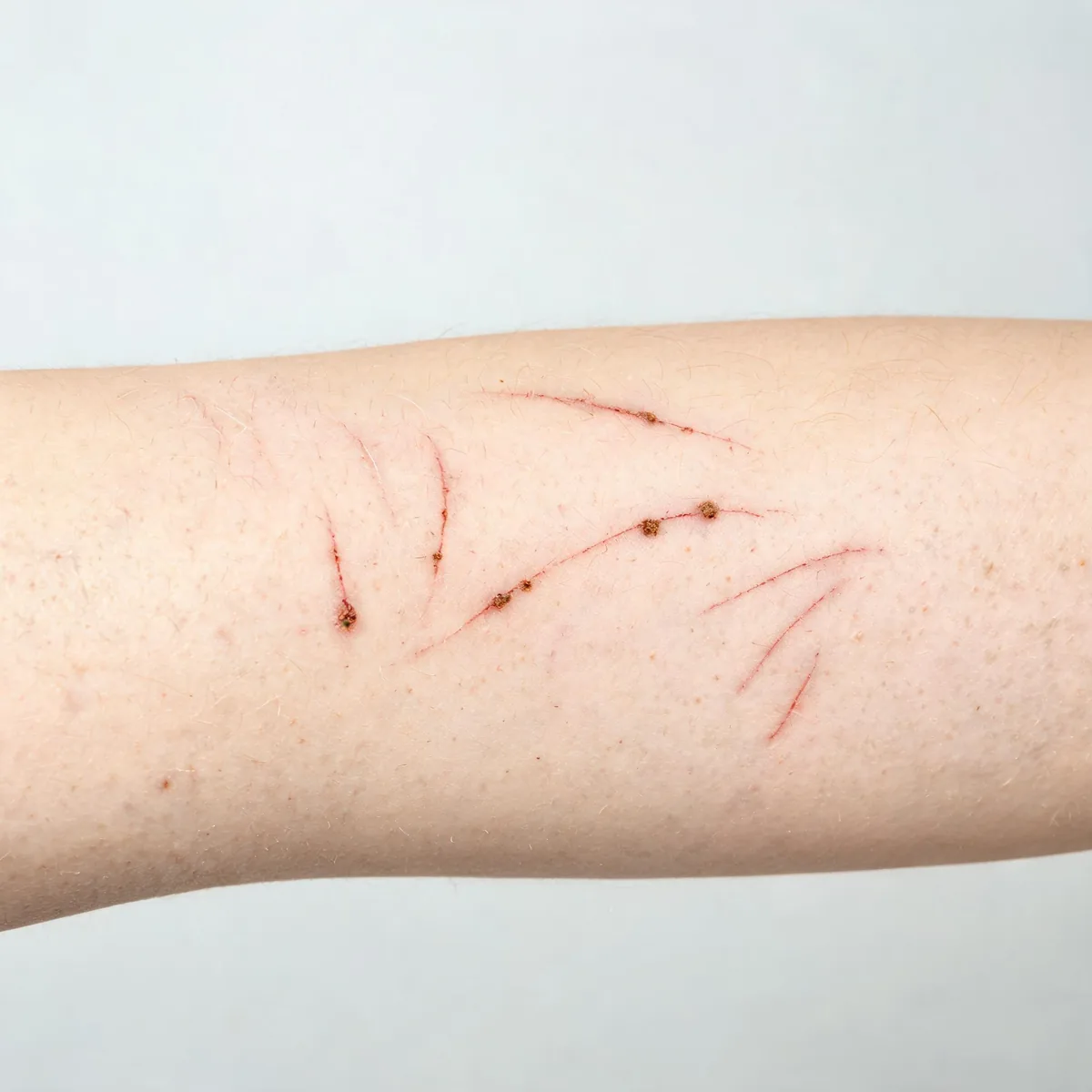
Understanding Itchy skin
The tradition describes the skin as an extension of the internal organs, particularly the Lungs, Spleen and Liver, with defensive Qi guarding the surface.
Dry, flaky, rough skin with itch that shifts location and worsens at night is read as Blood deficiency with external wind. Red skin with burning itch worse in wind or heat, with a sore throat, is Wind-Heat.
Where the skin is red with tiny blisters and oozing, with heaviness and a sticky taste, the pattern is Damp-Heat in the Stomach and Spleen. A dull persistent itch with moist weeping skin, bloating and fatigue is Spleen deficiency with dampness.
Itch triggered by stress, with irritability, a bitter taste and rib-side discomfort, is read as Liver Qi stagnation transforming into heat. Bright red eruptions that bleed easily with internal heat are read as heat in the Blood.
Itch is treated as a signal at the boundary, and that boundary belongs to the Lungs. The Lungs are said to govern the skin and to send defensive Qi out to the surface, where it meets wind, heat and dampness before they can settle deeper. When that outer layer is well supplied, a breeze or a hot afternoon passes without trace. When it is thin, the same weather gets in, and the result is a sudden red burning itch that wanders from one place to the next, which is why the pattern is named Wind-Heat and why it is treated by releasing the surface rather than by suppressing the sensation.
Most stubborn itching is not an invasion but an overflow. The Spleen turns food into Qi and Blood and keeps fluids moving; loaded with rich or greasy meals, or living in humid weather, it produces a heavy damp heat that seeps out to the skin and shows as weeping, blistered patches. The Liver keeps Qi in motion, and held-in frustration turns that Qi into heat which rises and makes the itch flare with the mood. A third route is emptiness: when Blood is low the skin is dry and undernourished, and dryness of that kind stirs a restless internal wind that shifts and settles again. Two people with the same diagnosis of pruritus can therefore need opposite herbs, one cool and drying and one warm and nourishing.
Conventional view
Conventional medicine defines pruritus as an unpleasant sensation that provokes a wish to scratch. It may be generalised or localised, acute or chronic, and it may arrive with or without a visible rash. The causes are wide: dry skin, allergic reaction, liver or kidney disease, insect bites, psoriasis, eczema, and reactions to certain medicines. Assessment is by history and examination, with blood tests or a skin biopsy used where a systemic cause is suspected. The sensation itself involves nerve fibres, immune cells and chemical mediators such as histamine, which is why antihistamines work for some itches and not for others.
Treatment is directed at the sensation and at whatever cause has been identified. Moisturisers and corticosteroid creams are the mainstays, oral or topical antihistamines are used for histamine driven itch, and more severe cases may be offered immunosuppressants, phototherapy or nerve targeting drugs such as gabapentin. Where itch comes from liver or kidney disease, treating that condition is the priority, because the skin will not settle while the underlying illness is active.
The limits are real. Antihistamines give temporary relief, fail entirely for many non-histamine itches, and cause drowsiness, while long courses of topical steroids thin the skin. More importantly, conventional practice tends to treat one dry itch in winter, one hive after stress and one weeping eczema as variations of a single problem, even though the drivers differ. The pattern approach differs precisely in that it asks which process is producing the itch before deciding what to do about it.
Selected PubMed records
Real PubMed records for the conventional discussion above, selected by condition name and title relevance. They are references, not a claim that any treatment is proven for this condition.
- The terminology of skin disorders. Primary Care, 2000. PMID: 10815043.
How it connects
Patterns are read as stages of one process rather than separate boxes, so overlap is expected. Dry skin can carry patches of redness, and digestive trouble can sit alongside stress related flares, which means one person may show signs of two patterns at once. The reason is mechanical: a Spleen too weak to move fluids also makes too little Blood, so dampness and deficiency travel together, and a Liver held in constraint for years generates heat that later dries the Blood. The less common pictures, Spleen deficiency with dampness and Heat in the Blood, are the ones most often mistaken for something else, which is where tongue and pulse examination earns its place.
How it is assessed
The practitioner looks at the skin under the itch and asks when the itch is worst.
What a practitioner looks for
- Skin state: dry and flaky suggests Blood deficiency; red and burning suggests heat; oozing suggests Damp-Heat.
- Timing: itch worse at night and shifting location is the wind signature.
- Triggers: stress, heat, wind, humidity and diet all point to different patterns.
- Systemic signs: itch with jaundice, weight loss, fever or widespread rash needs medical review.
The consultation starts with the quality of the itch rather than its address. A dry scaly surface that becomes unbearable at night, and is common in older patients, is read as Blood deficiency with external wind; here the tongue tends to be pale and thin with little coating, and the pulse thin and weak, which is the picture of blood too low to feed the skin while wind picks at the surface. An acute itch that burns and reddens and worsens in wind or heat points instead to Wind-Heat, with a red tongue, a thin yellow coat, and a pulse that floats and races as the body works to drive the intruder back out.
Where the skin is wet as well as red, with blisters or a sticky ooze, and the person reports heaviness, a sticky taste and uneasy digestion, the reading shifts towards Damp-Heat in Stomach and Spleen, where the tongue shows a red body under a thick greasy yellow coat while the pulse is slippery and rapid. If the itch follows stress closely and comes with irritability, a bitter taste and fullness under the ribs, the root is emotional, and the pattern is Liver Qi stagnation turning into heat, with a tongue reddened at the sides and a wiry, rapid pulse. The working diagnosis is revised as the tongue and pulse change.
TCM patterns in Itchy skin
Six patterns are recorded, and what separates them is the skin beneath the itch and what makes it flare. Dry flaky itch that shifts and peaks at night is Blood deficiency with external wind. A red burning itch that arrives fast and worsens in wind or heat is Wind-Heat. Oozing redness with blisters, heaviness and a sticky taste points towards Damp-Heat in Stomach and Spleen. A dull itch in moist weeping skin, with bloating and fatigue, comes from Spleen deficiency with dampness. Itch that follows stress, with a bitter taste and rib-side distension, is Liver Qi stagnation turning to heat. Bright red eruptions that bleed easily, with night heat and thirst, are Heat in the Blood. Ask whether the skin is dry or wet, and what makes it worse: wind moves, dampness weeps, deficiency is dry and worse at rest, heat is red and thirsty. Mixed pictures are usual, so the leading pattern sets the order.
| Pattern | Key signs | The itch | Tongue | Main formula |
|---|---|---|---|---|
| Blood Deficiency with External Wind | Dry flaky rough skin | Itch worse at night | Body: Pale and thin, sometimes slightly dryCoat: Thin, white and a little dry | Not specified |
| Wind-Heat | Red skin with burning | Itch worse with wind or heat | Body: Red at the tip and edgesCoat: Thin yellow or white turning yellow | Not specified |
| Damp-Heat in Stomach and Spleen | Redness with oozing or tiny blisters | Not specified | Body: Red, possibly swollen with teeth marksCoat: Thick, yellow and greasy in the centre and root | Not specified |
| Liver Qi Stagnation that transforms into Heat | Distending or burning pain along the ribs | Itch triggered by emotional stress | Body: Red, with the sides redder than the centreCoat: Yellow | Not specified |
| Spleen Deficiency with Dampness | Moist weeping skin or tiny vesicles | Dull persistent itch worse in humidity | Body: Pale and swollen, often with teeth marks along the edgesCoat: White, greasy and moist, thick in the middle | Not specified |
| Heat in the Blood | Bright red eruptions that bleed easily; Burning sensation in the skin | Not specified | Body: Deep red, often with red points or pricklesCoat: Thin, yellow and dry | Not specified |
Blood Deficiency with External Wind
Dry rough skin with itch that shifts and worsens at night.
Blood is what keeps the skin plump, moist and defended, so when it runs low the surface is left thin, dry and slightly cracked. That dryness is not only a cosmetic matter in this framework: a poorly nourished surface lets wind in, and wind produces itch that moves, comes and goes, and picks a new place each time. Night is the worst hour because Blood withdraws inward to the Liver when the body rests, leaving the skin even less supplied just when attention turns to it. Overwork, broken sleep and long illness all spend Blood, which is why the pattern so often follows a hard season rather than a rash.
The tongue is pale and slender, its coat thin, white and a little dry, and the pulse is fine, wiry on the left where the Liver sits, and floating at the right front. Wind and draughts, spicy fried or drying food, and exhaustion all worsen it, while sleep, warm soups, moisturiser and gentle movement ease it. Dang Gui Yin Zi is the formula named for this presentation, nourishing Blood and moistening dryness while it dispels wind, with Dang Gui, Fang Feng and He Shou Wu among its herbs. Xuehai (SP-10) with Sanyinjiao (SP-6) and Quchi (LI-11) are the points given for it.
Signs
- Dry flaky rough skin
- Itch worse at night
- Itch shifts or comes and goes
- Pale sallow complexion
- Aversion to wind and drafts
Diet and lifestyle for this pattern: Focus on nourishing Blood with food such as dark leafy greens, beetroot, black sesame and moderate amounts of organ meat or eggs, and avoid spicy, fried and very dry food that depletes fluids. Keep the skin well moisturised with gentle fragrance-free products, protect yourself from wind and draughts, and keep movement gentle such as walking or tai chi.
Wind-Heat
Red burning itch worsened by wind and heat.
This is the acute, exterior picture. Wind and heat arrive together at the surface, and defensive Qi gathers to push them back out; the struggle itself produces redness and a burning sensation, while the wind in the pathogen makes the itch dart about and flare whenever a draught or a warm spell arrives. Because the trouble sits at the surface rather than in an organ, it comes on quickly and often with the trappings of a mild cold: a sore throat, a slight fever, and an aversion to wind.
The tongue is red towards the tip and edges, carrying a thin yellow coat, with a pulse that floats and races. Hot weather, wind, spicy food, alcohol and hot baths all make it worse, and cool compresses, cool drinks, rest and staying out of the wind settle it. Xiao Feng San is the classic choice, dispelling wind while it clears heat and drains dampness, with Fang Feng, Jing Jie and Chan Tui as its named herbs. Hegu (LI-4), Quchi (LI-11) and Fengchi (GB-20) are the points listed.
Signs
- Red skin with burning
- Itch worse with wind or heat
- Sore throat
- Mild fever or aversion to wind
Diet and lifestyle for this pattern: Avoid spicy, greasy and hot-natured food such as chilli, lamb and alcohol, which add internal Heat. Drink plenty of cool water and eat cooling food such as cucumber, mung beans and watermelon, protect the skin from direct wind and hot sun, and wear light breathable clothing.
Damp-Heat in Stomach and Spleen
Red itchy skin with tiny blisters and a sticky taste.
Here the trouble starts in the middle rather than at the surface. The Spleen and Stomach are given the job of separating the clear from the turbid; when rich, greasy or sweet food, or a humid climate, keeps them overloaded, fluids gather and heat is trapped with them. That mixture rises and spreads outward, and the skin receives it as redness, tiny blisters and a sticky ooze, together with heaviness in the body and a taste that is at once sticky and bitter. It is the wettest of the itch patterns, and the urge to scratch it is intense.
The tongue is red and may be swollen with teeth marks, carrying a thick yellow greasy coat at the centre and root; the pulse is soggy and rapid, often slippery as well. Greasy, fried and sugary food, alcohol, rich dairy and hot humid weather all provoke it, while a cool dry room, light bland meals and moderate exercise to a light sweat help. Lian Po Yin clears heat and drains dampness while it harmonises the middle, with Bai Xian Pi, Ku Shen and Cang Zhu named among its herbs. Quchi (LI-11), Yinlingquan (SP-9) and Xuehai (SP-10) are the points used.
Signs
- Redness with oozing or tiny blisters
- Heaviness in body and limbs
- Sticky or bitter taste
- Bloating with loose sticky stools
- Worse in humid weather
Diet and lifestyle for this pattern: Avoid greasy, fried and very sweet food as well as dairy and alcohol, which all generate Dampness and Heat. Emphasise lightly cooked vegetables, whole grains such as barley and legumes such as mung beans, and keep exercise consistent to help the Spleen move fluids and clear Dampness.
Liver Qi Stagnation that transforms into Heat
Itch triggered by stress with irritability and rib-side discomfort.
Frustration that is swallowed rather than expressed is the starting point. The Liver is described as keeping Qi in smooth motion, and when that motion is checked, Qi gathers, presses, and eventually heats up. The heat rises towards the head and the surface, and the skin registers it as an itch that flares within hours of an argument, often with no rash at all. A bitter taste, distension or burning along the ribs, restlessness at night and dark urine belong to the same picture.
The tongue is red with redder sides and a yellow coat, and the pulse reads wiry and rapid, clearest at the left middle position. Anger and outbursts, stress, spicy greasy food, alcohol and lost sleep all feed it, while stress reduction, cooling foods, stretching, chrysanthemum tea and a quiet room calm it. Chai Hu Shu Gan San is the core formula, coursing the Liver and moving Qi, and Jia Wei Xiao Yao San is used where heat and Blood deficiency are mixed. Xingjian (LR-2), Taichong (LR-3), Qimen (LR-14) and Quchi (LI-11) are the points named.
Signs
- Itch triggered by emotional stress
- Irritability and explosive anger
- Bitter taste in the mouth
- Distending or burning pain along the ribs
- Restlessness with poor sleep
Diet and lifestyle for this pattern: Avoid spicy, greasy and fried food as well as alcohol, which can fuel internal Heat. Sip chrysanthemum tea to cool the Liver gently, and prioritise stress-reducing activity such as deep breathing, gentle yoga or walking outdoors to keep Qi flowing.
Spleen Deficiency with Dampness
Dull persistent itch with moist weeping skin and fatigue.
The Spleen is the body's fluid handling system, and a weak Spleen lets fluid pool instead of moving it on. Some of that pooled dampness surfaces at the skin, which becomes moist and sticky, sometimes with tiny vesicles, and produces a dull persistent itch rather than a sharp one. It is worse in humid weather and after heavy meals, which add to a load the Spleen is already failing to carry. Bloating, loose stools, heaviness in the limbs and poor appetite usually accompany it.
The tongue looks pale, swollen and tooth marked under a white greasy coat, and the pulse is soggy and slow. Heavy fried or greasy food, cold raw items, humid weather, overeating and inactivity all make it worse, while warmth, dry air, light easily digested meals, walking and rest improve it. Shen Ling Bai Zhu San strengthens the Spleen and drains dampness, and Bai Zhu, Fu Ling, Yi Yi Ren and Fang Feng are the herbs named for it. Yinlingquan (SP-9), Sanyinjiao (SP-6), Zusanli (ST-36) and Zhongwan (REN-12) are the points.
Signs
- Moist weeping skin or tiny vesicles
- Dull persistent itch worse in humidity
- Abdominal bloating and loose stools
- Heaviness in the limbs
- Fatigue with poor appetite
Diet and lifestyle for this pattern: Eat warm cooked food such as soups, stews and congees, and avoid cold, raw and greasy food that produces Dampness. Include Spleen-friendly food such as cooked grains, ginger and small amounts of lean protein, and walk daily to move Qi and drain Dampness.
Heat in the Blood
Bright red itch that bleeds easily with internal heat.
Heat that reaches the Blood level does not stay quietly there. It agitates the blood and speeds it, so it moves recklessly and pushes towards the surface, producing bright red eruptions that bleed easily and burn. The same heat dries the body's cooling fluids, which is why thirst for cold drinks, a feeling of internal heat that is worse at night, and restlessness arrive together with the rash. It is an excess pattern, and it is the one that most often needs cooling rather than nourishing.
The tongue is red to deep red with red spots or prickles and a thin dry yellow coat, and the pulse is rapid and wiry, sometimes slippery and forceful. Spicy and greasy food, alcohol, anger, hot weather and overwork all add heat, while a cool room, rest, cool drinks and a gentle cooling compress help. No single classic formula is named for this pattern, so the work falls to herbs that cool the Blood such as Mu Dan Pi and Zi Cao, with Dazhui (DU-14) and Quchi (LI-11), Xuehai (SP-10) also used, as the points.
Signs
- Bright red eruptions that bleed easily
- Internal heat worse at night
- Thirst for cold drinks
- Restlessness and irritability
- Burning sensation in the skin
Diet and lifestyle for this pattern: Avoid heating food such as spicy dishes, alcohol and coffee, and eat cooling food such as cucumber, watermelon and mung beans. Keep calm and avoid overexertion, since emotional stress and physical strain can stir up internal Heat.
Treatment approach
How the tradition treats itchy skin, with the herbs, formulas and points used for it.
Principles
- Settle Wind, which the framework treats as the mechanism of itch itself.
- Nourish Blood where the skin is dry, since dryness is what allows Wind to stir.
- Clear heat and drain dampness where the skin is red, hot or oozing.
- Address stress where the pattern is Liver Qi stagnation, since the itch follows the emotion.
- Every strategy here works on two levels at once. The branch is the sensation itself, which is settled so that sleep and the skin barrier can recover, and the root is whichever imbalance keeps producing it: wind to be released, dampness to be drained, heat to be cleared, Blood to be rebuilt, or a constrained Liver to be soothed. That is why Quchi (LI-11) works alongside Xuehai (SP-10) across patterns while the herbal choice changes completely, and why external washes and ointments are used for immediate relief alongside internal formulas rather than instead of them.
Herbs used
Formulas
- Dang Gui Yin Zi
- Xiao Feng San
- Lian Po Yin
- Chai Hu Shu Gan San
- Jia Wei Xiao Yao San
- Shen Ling Bai Zhu San
Acupoints
- SP-10 (Xuehai)
- SP-6 (Sanyinjiao)
- LI-11 (Quchi)
- LI-4 (Hegu)
- GB-20 (Fengchi)
- SP-9 (Yinlingquan)
- LR-3 (Taichong)
- LR-2 (Xingjian)
- LR-14 (Qimen)
- ST-36 (Zusanli)
- zhongwan-ren-12
- DU-14 (Dazhui)
What to expect
- Acute wind and heat itch is described as settling within days to weeks.
- Dry patterns improve more slowly, as the skin needs to be re-nourished.
- Itch that persists despite treatment needs medical review for systemic causes.
- Progress is uneven rather than linear. Acute wind and heat itch is expected to settle in days to weeks, while the dry deficiency picture is rebuilt over months because Blood has to be made, not merely applied. Flares often follow weather, food, stress or a run of poor sleep, so a bad week is read as information rather than failure. Once the picture is stable, treatment is spaced out, and the formula is adjusted whenever the tongue and pulse show that it has shifted.
Safety and when to get help
Seek medical help urgently for
- A sudden widespread rash with breathing difficulty or facial swelling.
- Itch with jaundice, or with unexplained weight loss and fever.
- Itch with a widespread rash and systemic illness.
For anything severe, sudden or spreading quickly, read when a skin problem needs urgent care.
Cautions
- Scratching damages the skin barrier and can introduce infection.
- Persistent generalised itch needs medical review, including blood tests.
- Sedating antihistamines and prescribed treatment should not be changed without advice.
Using this alongside conventional care
- TCM is described as complementary to conventional care: antihistamines and emollients can continue alongside herbs and acupuncture.
- There is no need to choose between the two approaches, but each needs to know what the other is doing. Prescribed moisturisers and topical treatments can continue while herbs are taken, with the timing of each explained to both the dermatologist and the practitioner. Blood moving herbs, Dang Gui among them, may interact with anticoagulants, and sedating herbs can add to the drowsiness of older antihistamines, so a full medication list belongs in the first consultation. Where immunosuppressants or phototherapy are in use, coordination matters more. A prescribed medicine is never stopped to make room for herbs without medical advice.
Diet and lifestyle
- Avoid spicy, greasy and fried food, and reduce sugar, dairy and alcohol, which are said to generate heat and dampness.
- Food is treated here as one of the inputs that decides which pattern dominates. The shared rule is to avoid what generates heat and dampness, namely spicy dishes, fried and greasy food, excess sugar and dairy, and alcohol, and to cut back caffeine, which is said to stir up Liver wind. What is added depends on the pattern: cooling moistening foods such as cucumber, pear and leafy greens for heat; dark leafy greens, beetroot and a little quality meat or egg to rebuild Blood; lightly cooked grains, barley and mung beans with less dairy and sugar where dampness dominates; and chrysanthemum tea with light plain meals where stress is the trigger.
If you're pregnant
Pregnancy pulls Blood and Yin towards the growing fetus, so the surface is left drier and more exposed to wind, which makes Blood deficiency with wind at the surface the pattern that most often appears. Dang Gui Yin Zi can still be used, but it is adjusted: the tail of Dang Gui is left out because it is described as stimulating uterine contractions, while Chuan Xiong and the other herbs that move blood are reduced or removed. Acupuncture is the gentler first option, with Sanyinjiao (SP-6) used cautiously and Xuehai (SP-10) alongside it, since Sanyinjiao is usually avoided in the first weeks.
One presentation needs medical attention rather than pattern work. Severe itching without any rash, especially on the palms and soles, is the picture of intrahepatic cholestasis of pregnancy, read here as Damp-Heat settling in the Liver and Gallbladder. Long Dan Cao, together with Da Huang, is set aside, and milder options, Yin Chen Hao and Zhi Zi among them, are used only under close professional supervision. Yanglingquan (GB-34) and Quchi (LI-11) are the points described for relieving the itch safely.
If you're breastfeeding
Topical herbal washes and compresses are the easiest part of treatment while feeding, and they can relieve a great deal on their own. Internally, the strong bitter cold herbs are the ones to avoid, Huang Lian and Da Huang among them, because they pass into milk and can cause diarrhoea or colic in the infant. Gentler heat clearing herbs, Bai Xian Pi and Ku Shen among them, suit Damp-Heat patterns at conservative doses, while Blood nourishing formulas such as Dang Gui Yin Zi usually sit well and may even help postpartum recovery.
Acupuncture is widely used while feeding, although trial evidence is limited, and the points chosen for the mother can include Xuehai (SP-10), with Quchi (LI-11) added where heat is present. Where night itching is wrecking sleep, Shenmen (HT-7) is added to calm the mind and restore rest, which itself supports milk supply. The practitioner should be told about breastfeeding so that points and herbs are chosen to protect the milk supply rather than reduce it.
If treating a child
In children the common patterns are Wind-Heat and Damp-Heat, and diet is often the trigger: sweets, dairy and fried food in quantity produce internal dampness and heat that surfaces on the skin. Food allergy and eczema are frequent underlying causes. Children cannot always describe the itch, so the practitioner reads the skin instead: red dry patches suggest Wind-Heat, weeping oozing patches suggest Damp-Heat, and the tongue coating, often thick and greasy, is a central clue.
Doses are reduced by age and weight, usually to a quarter or a half of the adult amount, and Xiao Feng San in particular is calculated carefully. Tuina is a genuine alternative or adjunct, with techniques such as clearing along the Spleen meridian and pushing on the Lung channel used to dispel wind and drain dampness without bitter herbs. In young children needles are usually replaced by acupressure or laser acupuncture.
If treating an elderly patient
In older patients the commonest picture by a wide margin is Blood deficiency with wind at the surface, because Jing and Blood decline with age and the skin loses both its nourishment and its moisture. The result is dry, scaly, intensely itchy skin that is worst at night. Dang Gui Yin Zi remains the foundation formula and is often combined with Gou Qi Zi and He Shou Wu to support Kidney and Liver essence. Improvement is gradual and slower than in younger patients, but steady treatment can change quality of life considerably.
Medication is the main safety consideration. Many older patients are already on blood thinners, antihistamines or corticosteroids, and blood moving herbs can add to the effect of the first group; Dang Gui itself has a mild anticoagulant action. The practitioner needs the whole medication list, and the formula is kept simple where several drugs are already in use. Sedating herbs are also used cautiously alongside antihistamines that cause drowsiness.
Urgent-sign guidance is based on standard sources: NHS anaphylaxis, NHS cellulitis, NHS Stevens-Johnson syndrome, NHS melanoma.
Evidence
Evidence status
Compiled for this page from the classical and modern literature; not a systematic review, so treat it as a pointer to sources rather than clinical guidance.
This page describes a symptom rather than a single disease, so the evidence is drawn from itchy conditions generally and is indirect. The classical sources describe two mechanisms repeatedly: wind producing itch, and blood deficiency producing dryness that generates wind. Modern trials of itch are mostly condition-specific, so a general itchy-skin page should present the traditional reasoning and not claim condition-level trial support.
Classical record
When Blood Deficiency generates Wind, causing dry and itchy skin, Dang Gui Yin Zi is appropriate.
- Chong Ding Yan Shi Ji Sheng Fang (Revised Yan's Formulas for Saving Lives), dermatology volume.
Wind is characterised by rapid movement and constant change, and it is the cause of itching.
- Classical formulation on Wind as the mechanism of itch, as recorded in the classical literature source.
风热相搏,结于皮肤,则致痒。治宜消风散。
When wind and heat strike against one another and bind in the skin, itching follows, and the treatment is to scatter wind with Xiao Feng San.
Wai Ke Zheng Zong, Volume 4, on wind and heat in the skin - Classical citation recorded in the classical literature for this condition; it names Xiao Feng San as the formula for wind-heat itch.
Common questions
Why is itch worse at night?
Night-time worsening is described as a feature of Wind and of Blood deficiency patterns, when the body is at rest and the skin is less distracted.
Can herbs stop itching?
The tradition describes settling Wind and correcting the pattern behind it, with acute itch improving within weeks.
Is itching a sign of liver disease?
It can be, and itch with jaundice needs medical review. Most itch is not liver-related.
Should I stop scratching?
Yes. Scratching is described as damaging the barrier and worsening the cycle; keeping nails short and skin moist helps.
Does moisturising help every kind of itch?
It helps most where the surface is dry. An itch that settles with moisturiser usually belongs to a dry deficiency picture, because the skin there lacks the Blood that would keep it supple, and the cream replaces some of what is missing at the surface without rebuilding Blood. Where the skin is wet and weeping, a cool dry environment is favoured instead.