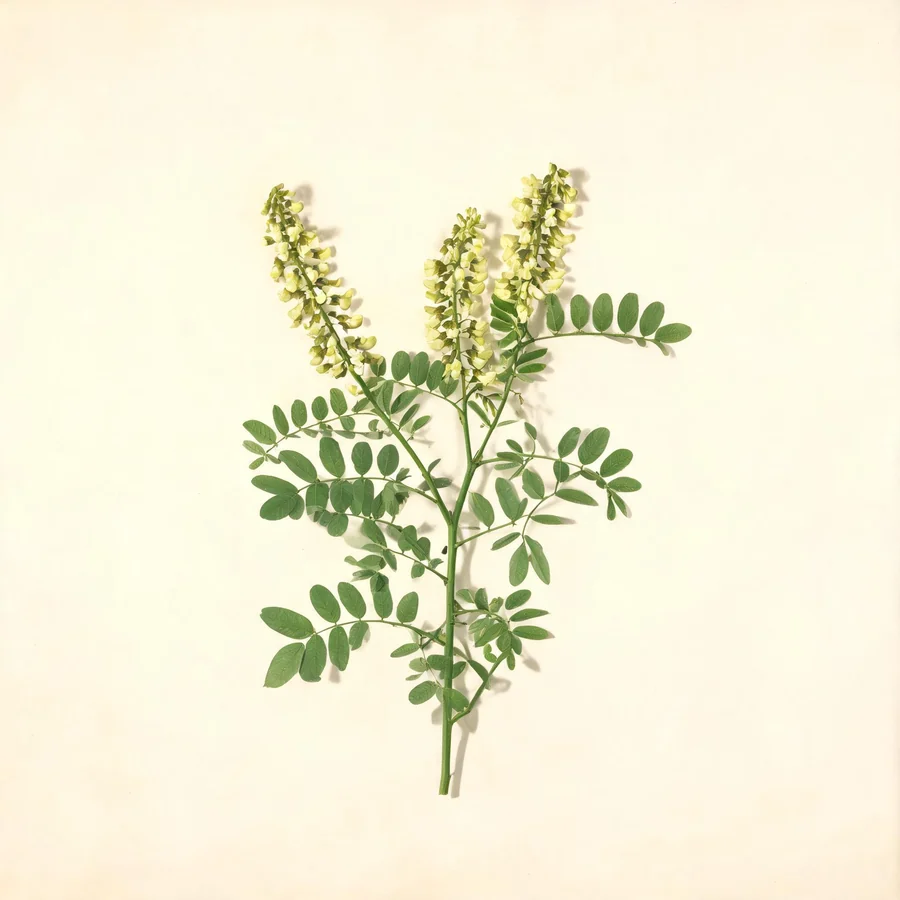
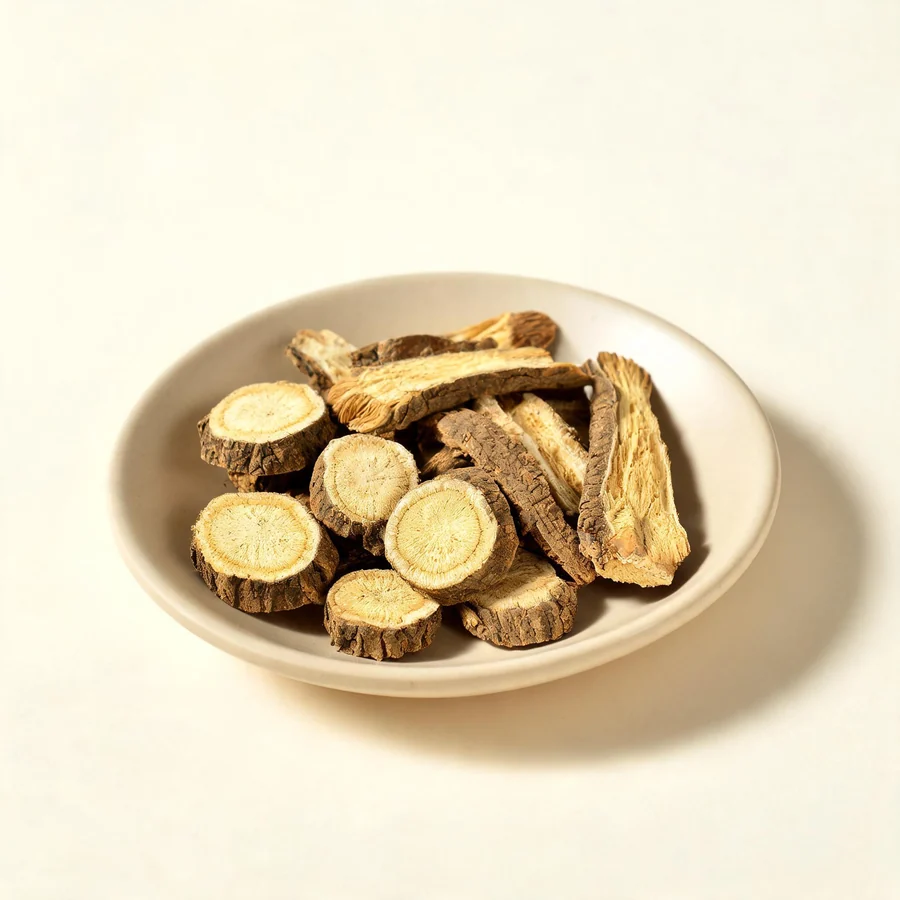
Skin profile
Where this herb sits in skin practice: the pattern it corrects, the skin signs it suits, and what it should not be used for.
Ku Shen is chosen when the skin is both inflamed and wet, and when itch is severe enough to disturb sleep. It is the strongest drying herb of the cold group, used mainly for damp-heat and parasitic pictures and kept to short courses because of its bitterness.
Skin signs that suggest it
- Intensely itchy, weeping or oozing patches with redness and a sticky discharge (damp-heat in the skin)
- Itch that is worse at night, in warmth and in humid weather, and eases once the ooze dries
- Ring-shaped, scaly or spreading itchy patches on the trunk, limbs or feet (a parasitic or fungal picture)
- Genital or scrotal itch with dampness, discharge and a heavy, bearing-down feeling
- A red tongue with a greasy yellow coating, and a slippery or rapid pulse
When it is not the right herb
Not for skin that is dry, pale, thin and cold, with no redness and no ooze, and not for a person whose digestion is weak and cold, with loose stools, a poor appetite and a cold abdomen. In those pictures the extreme bitterness and coldness dry the skin further and upset the Stomach.
What it does for skin
Skin-relevant actions only. Each one describes a mechanism in TCM terms and what it looks like on the skin.
Clears Heat and drains Dampness
This is the core action for skin. Damp-heat shows as a lesion that is inflamed and moist at the same time: a weeping eczema, an intertrigo in the groin or under the breast, a scalp that crusts and oozes, or a rash that leaves a yellow stain on the dressing. Ku Shen is described as more intensely drying than Huang Qin or Huang Lian, so it is chosen when the moisture, rather than the redness alone, dominates the picture.
Kills parasites and stops itch
The classical reading is that Heat generates Wind and Dampness breeds parasites, so an itch that spreads, burrows or returns to the same place is treated by removing both. This is the basis of its long use for scabies, tinea and itchy genital conditions, internally in formulas and externally as a wash. The word parasite should not be taken literally in every case: clinically the root is used for itchy skin disease whatever the microscopic cause, while a confirmed infestation still needs its specific treatment.
Dries ooze and settles weeping lesions
Applied as a cooled decoction, the root reduces the wet surface that keeps a lesion macerated and that favours secondary infection. It is used on weeping eczema, on eroded skin around the genitals, and on the soggy skin of folds where moisture has no room to escape. Because it is drying as well as antimicrobial in reputation, it is stopped once the ooze settles, or the skin becomes tight and cracked.
Drains damp-heat from the lower body
The root enters the Heart, Liver, Stomach, Large Intestine and Bladder channels and is strongly descending, which is why the genital and urinary uses sit alongside the skin ones. Scrotal eczema, vulval itch with discharge, jock itch and the damp itchy skin of the inner thigh are treated with the same herb, often in a wash and sometimes with an internal formula that clears the lower burner.
Skin conditions it is used for
Mapped to the condition pages on this site. The pattern column shows what the skin is doing when this herb is the right choice.
| Condition | Pattern | Why it suits | Typical setting |
|---|---|---|---|
| Eczema | Damp-heat in the skin with oozing and severe itch | An eczema flare that is red, wet and crusted is the clearest damp-heat picture in dermatology, and Ku Shen is the herb chosen when ooze and itch outweigh simple redness. It is used in an internal formula and, just as often, as a cooled wash applied to the affected patches, which puts the drying and antiparasitic action directly on the skin. Dry, lichenified eczema of the cold type is not its target. | Modified Xiao Feng San, or Ku Shen in a wash alongside an internal damp-heat formula |
| Itchy skin | Wind riding on Dampness and Heat, with itch as the main complaint | When itch is the leading symptom, with little to see between the scratched areas, the tradition reads Wind riding on Dampness and Heat. Ku Shen addresses all three: bitter cold for the Heat, drying for the Dampness, and the parasite-killing action for the itch itself. It is a standard ingredient of washes for generalised itch and is paired with Bai Xian Pi and Di Fu Zi for that purpose. | Ku Shen with Bai Xian Pi and Di Fu Zi, as a wash or in a modified Xiao Feng San |
| Scabies | Parasitic infestation with a secondary damp-heat eruption | Scabies is the condition the classical texts describe most directly when they speak of parasites bred by Dampness, and Ku Shen has been used against it for centuries, usually as a wash. It relieves the itch and dries the secondary eruption, but a confirmed infestation needs the specific scabies treatment as well, and household contacts have to be treated at the same time. | Ku Shen and She Chuang Zi decoction for washing, alongside conventional scabies treatment |
| Tinea | Dampness with Heat and a parasitic fungus on the skin | Tinea is read as Dampness with Heat and a parasite, which is exactly the combination Ku Shen is said to resolve, and washes of the root are a long-standing external use for ringworm of the body, groin and feet. The herb reduces itch and surface moisture; where the infection is extensive or the nails are involved, an antifungal medicine is needed as well rather than a wash alone. | Ku Shen wash with Bai Xian Pi, alongside a conventional antifungal where indicated |
| Itchy genitalia | Damp-heat pouring downward into the genital region | Genital itch with dampness and a discharge is the lower-burner version of the same damp-heat picture, and Ku Shen is one of the few herbs equally at home on the skin and in the genital area. It is given internally to drain the Heat and used as a wash to settle the surface itch, often with She Chuang Zi and Huang Bai. Persistent itching, bleeding or a change in the skin needs assessment, because infection and other causes must be excluded. | Ku Shen with She Chuang Zi and Huang Bai, internally and as a wash |
| Scrotal eczema | Damp-heat in the scrotum with ooze, itch and maceration | The scrotum is a place where sweat, warmth and occlusion meet, so damp-heat collects and the skin becomes red, soggy and intensely itchy. Ku Shen suits this because it dries the surface and clears the Heat at once, and a dilute wash is often better tolerated here than a strong ointment. The wash should be cooled to skin temperature and kept weak, since the skin in this area is thin and stings easily. | Modified Long Dan Xie Gan Tang with Ku Shen added, or a Ku Shen and She Chuang Zi wash |
Combinations for skin
Herbs it is paired with when the skin, not an internal organ, is the target.
| Partner | Ratio | Why the pair is used |
|---|---|---|
| Bai Xian Pi | 6 to 10 g each in decoction, or 15 g each in a wash | Bai Xian Pi brings a wind-dispersing, itch-specific action that Ku Shen lacks, while Ku Shen supplies the deeper drying and the parasite-killing reputation. The pair is the backbone of washes for eczema, scabies and itchy rashes, and it works because one herb moves the Wind and the other removes the Dampness the Wind is riding on. |
| She Chuang Zi | 10 to 15 g each in a wash | The classic external pairing for genital and scrotal itch. She Chuang Zi is warm and drying and Ku Shen is cold and drying, so together they cover an itch whether it runs hot or cold, and the combination is used as a wash rather than a drink. It is the first choice for the damp itchy skin of the groin and the scrotum. |
| Di Fu Zi | 9 to 15 g Di Fu Zi with 6 to 9 g Ku Shen | Ku Shen dries the surface and works against parasites, while Di Fu Zi sends Dampness out through the urine and has its own itch-stopping action. The pair gives two exits for the same pathogen, one through the skin and one through the bladder, which suits a skin eruption accompanied by hot, scanty urination or a discharge that keeps returning. |
| Huang Bai | 6 to 10 g each | Both are bitter and cold and both clear damp-heat from the lower body, but Huang Bai is directed at the Bladder and Kidney and Ku Shen at the skin. They are combined for damp-heat that shows above and below at once, such as eczema of the legs with a yellow discharge and burning urination, and Huang Bai is added when the discharge is the dominant complaint. |
| Huang Qin | 6 to 10 g each | Huang Qin clears heat from the upper body and resolves toxin, while Ku Shen drains damp-heat from the lower half of the body and from the skin. Together they span the body, which is useful in a widespread weeping eruption or a rash with pustules, and the combination is one of the standard bitter-cold pairings in dermatological formulas. |
Formulas where it leads
- Xiao Feng San (消风散) - The wind-damp-heat formula for itchy, weeping and spreading eruptions, and one of the standard contexts in which Ku Shen is prescribed internally. The root supplies the drying, antiparasitic and itch-stopping element while Jing Jie, Fang Feng and Chan Tui move the Wind and Shi Gao and Zhi Mu cool the Heat.
Topical use
Ku Shen is probably used more often on the skin than in the mouth. The dried root is simmered, strained and cooled, and the liquid is applied as a compress, a wash or a short soak to red, weeping or itchy areas. It is a standard ingredient of external washes for eczema, scabies, tinea and genital itch, and it appears in medicated soaps and ointments. Topical use puts the drying action where the ooze is and avoids the digestive penalty of taking a very bitter cold herb by mouth.
| Preparation | How and when it is used |
|---|---|
| Cooled decoction wash | Simmer 15 to 30 g of dried root in about 700 ml of water for 20 minutes, strain, and cool to skin temperature. Bathe or compress the affected area for 10 to 15 minutes once or twice daily, then pat dry, and use a fresh batch each time. |
| Dilute soak for hands and feet | For tinea of the feet or an itchy hand eruption, use a weaker decoction in a basin and soak for 10 minutes. Keep the concentration low enough that the skin does not sting, and stop if the skin becomes redder or tighter rather than calmer. |
| Ointment and soap bases | Ku Shen extract is included in some medicated ointments and soaps sold for itchy skin. Choose products from a reputable maker, check the full ingredient list, and do not use a strong product on the face or on broken skin. |
Patch test and cautions
Patch test on a small area of normal skin for 24 hours before the first proper use. Do not apply to broken, ulcerated or openly infected skin without clinical supervision, keep washes away from the eyes, and stop at once if burning, stinging or spreading redness develops. Do not cover a treated area with an occlusive dressing, and do not use a strong decoction on the face or genitals.
Safety for skin use
What to check before recommending or using it, including the cautions that matter most for skin patients.
Do not use, or use with caution
- Spleen and Stomach deficiency-cold, with loose stools, a poor appetite, a cold abdomen and a pale tongue. The root is the most bitter and cold of the skin herbs and can turn an already weak digestion into diarrhoea and cramping.
- Yin deficiency without Dampness. Without real dampness to work on, the intensely drying nature can further deplete fluids, leaving the mouth dry, the skin tighter and the stools hard.
- Kidney Yang deficiency and old age with a cold, depleted constitution. The classical commentaries warn against the root when the fire of life is weak and the essence cold, and advise against prolonged high doses, which can cause lower back heaviness and fatigue.
- Prolonged use at high dose without review. The downward draining action is not meant for indefinite maintenance, and a short course with a defined end point is the safer pattern.
Pregnancy and breastfeeding
Avoid internally unless someone experienced with the herb recommends it, for a clear damp-heat picture, and keeps the course short. The root is strongly cold and descending, and the tradition lists it among the herbs to avoid in pregnancy; it also burdens digestion, which is already delicate in many pregnancies. External washing of a limited area is the safer setting and should still be discussed with a practitioner, while breastfeeding mothers are advised to keep internal use to short supervised courses and to prefer a wash.
Interactions
- Medicines processed by CYP3A4 or CYP2B6. Laboratory work shows the alkaloids matrine and oxymatrine inducing CYP2B enzymes and having a mild inhibitory effect on CYP3A at higher doses, so levels of drugs handled by these pathways may change; anyone on a narrow-margin medicine needs supervision.
- Anticoagulants and antiplatelet drugs. Laboratory work reports that these alkaloids affect platelet function in vitro, so anyone taking warfarin, aspirin or a similar drug needs supervision and should report unexplained bruising.
- Antiarrhythmic drugs. Laboratory work describes quinidine-like activity, so combining the root with amiodarone, quinidine or a similar medicine could add to cardiac effects and calls for medical oversight.
- Immunosuppressants and chemotherapy. The root shows immunomodulatory and antiproliferative activity in the laboratory, so its use alongside these treatments should be discussed with the treating team rather than started quietly.
- Laxatives, and antibiotics that loosen the stool. Because the bitter cold can loosen the bowel, the combination may add to gut effects and to reduced absorption of other medicines; this is watched rather than forbidden.
Allergy and patch testing
Contact dermatitis to herb washes is well recognised. Patch test first, keep the wash to limited areas, and stop immediately if the skin becomes more irritated rather than calmer. A reaction to Ku Shen can occur in people who have reacted to other herb-containing washes, and the root should not be used where a previous wash containing it caused a rash.
General safety references
General references for herbal hepatotoxicity and herb-drug interactions; they are not specific to this herb.
- Review article: Herbal hepatotoxicity - an update on traditional Chinese medicine preparations. Alimentary Pharmacology & Therapeutics, 2014. PMID: 24844799.
- Interactions between herbal medicines and prescribed drugs: an updated systematic review. Drugs, 2009. PMID: 19719333.
- Warfarin and food, herbal or dietary supplement interactions: a systematic review. British Journal of Clinical Pharmacology, 2021. PMID: 32478963.
Evidence
The classical record is quoted with its source. The modern note states the level of evidence plainly.
Classical record
It drains water, removes abscesses, and dries the affected skin.
Shen Nong Ben Cao Jing (Divine Husbandman's Classic of Materia Medica) - The draining, abscess and dry-skin indications in the oldest entry are the root of its later dermatological use.
The bitter-cold nature of Ku Shen and Huang Bai can both supplement the Kidney, but this is achieved through bitterness drying Dampness and coldness clearing Heat. Heat gives rise to Wind and Dampness breeds parasites, so they also treat Wind and kill parasites. They suit only those whose Kidney Water is weak and Ministerial Fire excessive; where fire is weak and essence cold, where fundamental vitality is insufficient, or in the elderly, they must not be used.
Ben Cao Gang Mu (Compendium of Materia Medica), Li Shizhen - This passage reads the old claim that the root supplements the Kidney as an effect of drying and clearing rather than of tonifying, and it warns against cold-deficiency and old age.
Ku Shen is extremely bitter and extremely cold, dispersing Heat downward and scouring away Damp-Fire. Its effects resemble those of Huang Qin, Huang Lian and Long Dan Cao, but its bitterness is more intense and its drying fiercer, so it kills the parasites bred by Damp-Heat more powerfully than either Huang Qin or Huang Lian.
Ben Cao Zheng Yi (Correct Meaning of Materia Medica) - The comparison places Ku Shen as the skin herb of the bitter-cold family, stronger against itch and damp skin disease than its relatives.
Modern evidence
Evidence status
- Laboratory studies of Sophora flavescens alkaloids, chiefly matrine and oxymatrine, report anti-inflammatory, antibacterial, antipruritic and immunomodulatory activity in cell and animal models. These are laboratory findings and do not establish benefit in skin disease.
- Clinical trial evidence for Ku Shen in skin disease is limited, mostly small, and usually embedded in studies of multi-herb washes or formulas rather than of the single herb. No firm conclusion about efficacy in eczema, scabies or tinea can be drawn from the published literature.
- The alkaloid safety signal is best documented for concentrated extracts and injectable preparations. At standard decoction doses the exposure stays well below the toxic range described in the literature, which is why formulation and dose, rather than the herb itself, are the safety variables.
PubMed records
Selected real PubMed records for this herb's species or its constituents, chosen by species name and title relevance. They are references for the non-TCM discussion above, not proof that the herb treats any skin condition.
- Radix Sophorae Flavescentis of Sophora flavescens Aiton inhibits LPS-induced macrophage pro-inflammatory response via regulating CFHR2 expression.. Journal of ethnopharmacology, 2024. PMID: 38641074 (skin-related record).
Dose and forms
Skin-practice dosing and the preparations that suit skin complaints.
| Form | Dose and notes |
|---|---|
| Decoction (internal) | 4.5 to 9 g of dried root daily in a formula. Up to 15 g is used short term in severe damp-heat under practitioner supervision, with attention to digestive upset, and the bitter taste makes pills or powder a common alternative. |
| External wash | A larger amount than an internal dose, commonly 15 to 30 g, is simmered for a wash. The root is not swallowed by this route, so the quantity can be higher, but the concentration should still be reduced for sensitive skin and for children. |
| Course length | Short courses of one to two weeks for an acute flare, with review. Stop or reduce if loose stools, cramping or a cold abdomen develop, and do not use the root as an indefinite maintenance herb. |
The safety question for Ku Shen is about formulation rather than a narrow dose margin. At decoction doses the alkaloid exposure stays far below the levels associated with toxicity, and the reported problems belong to concentrated and injectable preparations. Because the root is so bitter it is commonly dispensed as pills or powder, and it is commonly used as an assistant rather than as the leading herb; the wash route carries no digestive cost and is the better way to treat a large itchy surface.
Citations and further reading
Only real sources are listed: the classical materia medica passages quoted above, and the source works behind the botanical and safety statements.
- Shen Nong Ben Cao Jing (Divine Husbandman's Classic of Materia Medica), attributed compilation of the Han period - classical entry quoted above.
- Ben Cao Gang Mu (Compendium of Materia Medica), Li Shizhen, Ming dynasty - classical entry quoted above.
- Ben Cao Zheng Yi (Correct Meaning of Materia Medica), late Qing period - classical entry quoted above.
- Ku Shen monograph: Pharmacopoeia of the People's Republic of China - source for the accepted botanical source, part used and quality requirements.
- Modern evidence statement: based on laboratory and toxicological literature on Sophora flavescens alkaloids, summarised as a statement about the level of evidence rather than as a cited finding. No clinical trial is presented as proof of effect.
- Botanical description and identification: botanical literature on Sophora flavescens, Fabaceae.
Educational reference for qualified practitioners. This page is not medical advice, and skin conditions should be diagnosed by a clinician before treatment.