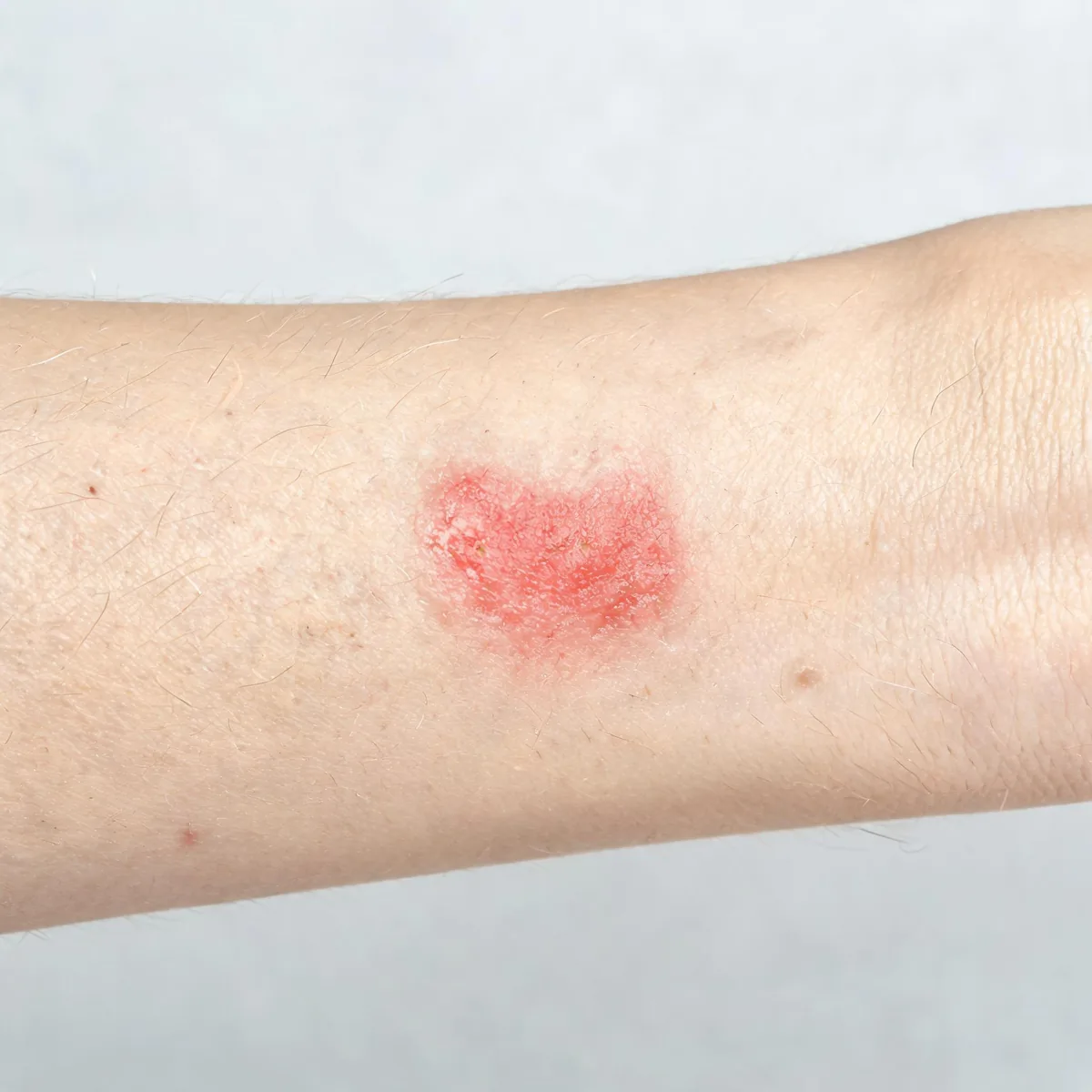
Understanding Skin erosion
Skin erosion is described as pointing to internal disharmony, specifically the failure of fluids to be transformed properly so that they leak out through the skin.
Damp-Heat gives the classic picture: red swollen skin with oozing and vesicles, a thick greasy yellow coating, a heavy body and burning pain at the erosion. Spleen deficiency with dampness gives weeping lesions with pale skin around them, bloating, loose stools and fatigue.
Blood deficiency with external wind gives dry cracked erosions with little oozing, itch worse at night and a pale complexion. Qi and Blood stagnation gives dark red or purplish erosions with fixed stabbing pain and thickened rough skin around them.
A separate pattern is described for erosions on the genitals or lower limbs: Kidney and Liver Yin deficiency, with dry mouth, night sweats and low back soreness. The site matters because it changes the pattern.
The skin is treated as an outward face of the internal organs, fed by Blood and Qi and guarded by Wei Qi. An erosion therefore points to two failures at once: fluid metabolism has gone wrong, and the surface is no longer being fed. The Spleen is central to that account, because it turns food and drink into usable energy and moisture. When it is weak, fluid is not transported, dampness gathers and seeps through the skin as weeping erosions that close slowly. Mixed with heat, whether from food, stress or infection, the same erosion turns red, hot and angry.
Not every erosion is wet. When Blood or the deeper Yin is short, the surface loses its building material and goes dry, cracked and fragile, itching hard and healing badly because there is nothing to repair with. Stress adds a third route: frustration knots Liver Qi, Blood stops moving freely, and the erosion turns dark or purplish with fixed stabbing pain. The old literature describes soaking sores as wind heat from the Heart channel erupting on the skin, small at first, itching before they hurt, weeping fluid and spreading, which is close to a modern spreading oozing lesion.
Conventional view
An erosion is a shallow loss of the epidermal surface, leaving an area that looks raw, may be moist or crusted, and can ooze clear fluid or bleed a little. It is a description rather than a diagnosis, and the causes are many: eczema, contact dermatitis, intertrigo in skin folds, fungal or bacterial infection, or simple friction and scratching. Because the barrier is broken, an erosion is also a way in for infection, which is why the surrounding skin is examined as carefully as the lesion itself.
Diagnosis is usually clinical, from the appearance and the history. A swab is taken where infection is suspected, and a biopsy is reserved for unusual lesions or to exclude autoimmune blistering disease. Care is directed at the cause and at protecting the area: keeping the area clean and dry, protecting it with a barrier cream or ointment, and settling inflammation with a topical corticosteroid. Infection calls for antibiotics, antifungals or antivirals, applied locally or taken by mouth, chronic eczema may need calcineurin inhibitors or drugs that modulate the immune system, and wet dressings or medicated baths help dry an oozing surface.
The gap is that local treatment controls the symptom without explaining why the skin keeps breaking down. Prolonged steroid use thins the skin and makes it more fragile, and erosions often return once creams stop if the internal drivers of diet, stress and dampness remain. Conventional care also treats every erosion as a local wound, whereas TCM reads the same lesion as one of five internal patterns, which is where the systemic approach on this page begins.
Selected PubMed records
Real PubMed records for the conventional discussion above, selected by condition name and title relevance. They are references, not a claim that any treatment is proven for this condition.
- The Importance of Skincare for Neonates and Infants: An Algorithm.. Journal of drugs in dermatology : JDD, 2021. PMID: 34784132.
How it connects
Skin erosion and atopic dermatitis frequently appear together because they share one root: a weak Spleen that cannot transform fluids, so dampness collects and surfaces as oozing lesions and itch. Strengthening the Spleen while clearing damp heat often settles both at once, which is why the erosion is rarely managed as a local problem alone. Where the erosion sits on long standing eczema, the dry and Blood deficient picture becomes more likely over time, and the plan shifts towards nourishing rather than draining.
How it is assessed
The practitioner assesses the erosion, its moisture and its site.
What a practitioner looks for
- Moisture: oozing with vesicles suggests Damp-Heat; dry cracked erosions suggest Blood deficiency.
- Surrounding skin: pale suggests Spleen deficiency; dark red or purplish suggests stagnation.
- Site: genital or lower limb erosions suggest Kidney and Liver Yin deficiency.
- Red flags: spreading redness with fever indicates infection and needs urgent care.
The practitioner starts with the lesion and works backwards. How it began, how it looks, what the ooze is like, whether vesicles are present and whether itch or pain dominates are the first clues, and so is the site, because genital and lower limb erosions follow a different route from those on the trunk. Acute, bright and wet suggests excess; chronic, pale and dry suggests deficiency; dark and thickened suggests stagnation. Each answer narrows the field before the tongue and pulse decide.
Bright red swelling with copious weeping, a feeling of heat, thirst and a bitter taste, a yellow greasy coating and a slippery rapid pulse confirm Damp-Heat. Pale, slightly oozing lesions with bloating and loose stools, a pale puffy tongue with a white greasy coat and a soft pulse confirm Spleen Deficiency with Dampness. Dry cracked erosions with night itch, rough scaly skin, a pale face, light headedness or brittle nails, a pale thin tongue and a thin pulse confirm Blood Deficiency with External Wind. Dark red or purple thick lesions with stubborn itch, a history of stress, menstrual irregularity or trauma, a dark purple tongue and a wiry or choppy pulse confirm Qi and Blood Stagnation. Genital or lower limb erosions with night sweats, tinnitus and low back soreness, a red tongue with little coating and a thin rapid pulse confirm Kidney and Liver Yin Deficiency.
TCM patterns in Skin erosion
Five patterns are described for skin erosion, and two questions sort them. The first is whether the erosion is wet or dry: weeping tissue that closes slowly points to dampness, while cracked itchy tissue points to a lack of Blood or Yin. The second is the site, because pale skin beside a weeping lesion belongs to the Spleen, dark thickened skin belongs to stagnation, and genital or lower limb erosions follow the Liver and Kidney. Wet lesions with bright redness, vesicles and burning pain are read as Damp-Heat. Pale oozing lesions with bloating, loose stools and fatigue are read as Spleen Deficiency with Dampness. Dry cracked lesions with night itch and a pale complexion are read as Blood Deficiency with External Wind. Dark red or purple lesions with fixed stabbing pain are read as Qi and Blood Stagnation. Drying a dry erosion is the mistake the classical literature warns about most often.
| Pattern | Key signs | The itch | Tongue | Main formula |
|---|---|---|---|---|
| Damp-Heat | Red swollen skin with oozing and vesicles; Burning or stinging pain at the erosion | Not specified | Body: Red, often swollen with teeth marksCoat: Yellow, greasy and thick, usually in the middle and at the root | Not specified |
| Spleen Deficiency with Dampness | Oozing weeping lesions; Pale or normal skin colour around erosion | Not specified | Body: Pale and swollen, often with teeth marks along the edgesCoat: White, greasy and moist, thick in the middle | Not specified |
| Blood Deficiency with External Wind | Dry cracked erosions with little oozing; Brittle nails and dry hair | Intense itch worse at night | Body: Pale and thin, sometimes slightly dryCoat: Thin, white and a little dry | Not specified |
| Qi And Blood Stagnation | Dark red or purplish lesions; Fixed stabbing pain worse with pressure | Not specified | Body: Purple or dark, with stasis spots; sublingual veins dark and distendedCoat: Thin white | Not specified |
| Kidney and Liver Yin Deficiency | Dry mouth and throat at night | Not specified | Body: Red, thin and dry, often crackedCoat: Little or none; the tongue may look peeled | Not specified |
Damp-Heat
Red swollen erosions with oozing, burning and a heavy body.
Dampness and heat together act like hot steam trapped under the skin. Heat brings the redness, the swelling and the burning or stinging pain; dampness brings the oozing, the vesicles and a heavy sluggish feeling. The pair blocks the pores and the channels, so tissue breaks down into the raw moist surface that defines this pattern. Poor appetite, nausea, loose sticky stools and a thick yellow coating show that the same damp heat is sitting in the middle burner and feeding the skin.
The tongue is red with a yellow greasy coat thickest at the centre and root, sometimes swollen with teeth marks; the pulse is slippery and rapid, or soggy and rapid. Spicy, greasy and fried food, alcohol, hot humid weather and scratching all aggravate it, while light meals, cooling compresses, a cool dry room and keeping the area clean and dry help. Long Dan Xie Gan Tang drains Liver and Gallbladder Damp-Heat, clears Fire and resolves toxicity, with Huang Qin, Zhi Zi and Ku Shen named, and LI-11 Quchi, SP-9 Yinlingquan and ST-36 Zusanli as points.
Signs
- Red swollen skin with oozing and vesicles
- Thick greasy yellow coating
- Heavy sluggish body sensation
- Burning or stinging pain at the erosion
- Poor appetite
Diet and lifestyle for this pattern: Avoid spicy, greasy and fried food as well as alcohol and sugar, which add fuel to the Damp-Heat fire. Eat cooling, Dampness-draining food such as mung beans, cucumber, watermelon and barley, keep the affected skin clean and dry, and resist scratching, which spreads Heat and damages tissue further.
Spleen Deficiency with Dampness
Weeping erosions with pale surrounding skin and fatigue.
The Spleen governs transformation, and when it is weak fluid is not moved on but pooled as dampness. That dampness has to go somewhere, and the skin becomes the overflow channel, producing pale weeping erosions that resist healing because the underlying transport problem remains. The lack of strength shows elsewhere too, in heaviness of the limbs, bloating, loose stools, poor appetite and a tiredness that deepens after eating.
The tongue is pale and swollen, marked by the teeth, coated white and greasy; the pulse is soggy and slow. Cold raw food, overeating, rich greasy meals, overwork, worry and humid weather all weaken the Spleen further, while warmth, light cooked meals, gentle exercise, dry weather and elevating the affected limb ease the weeping. Shen Ling Bai Zhu San strengthens the Spleen and drains dampness, with Bai Zhu and Fu Ling named, supported by ST-36 Zusanli, SP-9 Yinlingquan and BL-20 Pishu.
Signs
- Oozing weeping lesions
- Pale or normal skin colour around erosion
- Bloating and loose stools
- Heaviness with fatigue and poor appetite
Diet and lifestyle for this pattern: Eat warm cooked food such as soups and stews, and avoid raw salad, cold drinks, dairy and greasy food that overwhelm the Spleen and create more Dampness. Gentle daily movement helps the body process fluids.
Blood Deficiency with External Wind
Dry cracked erosions with night itch.
Blood carries the nourishment the skin needs, and when it is short the surface goes dry, rough and fragile. Cracks form, and because there is no material to rebuild with they deepen into erosions that do not ooze and do not close. The internal dryness also stirs a Wind that produces itching out of proportion to what is visible, coming and going and settling in at night, when the body's fluids are at their lowest.
The tongue is pale and thin with a thin white, slightly dry coating; the pulse is fine, wiry on the left middle and floating at the right front. Windy dry weather, spicy greasy fried food, overwork and heavy periods all deplete Blood further, while moisturising skincare, warm nourishing meals, adequate rest and gentle exercise support it. Dang Gui Yin Zi nourishes Blood, moistens dryness, dispels Wind and stops itch, with Dang Gui, Shu Di Huang and Fang Feng named, and SP-6 Sanyinjiao, ST-36 Zusanli, LI-11 Quchi and SP-10 Xuehai as points.
Signs
- Dry cracked erosions with little oozing
- Intense itch worse at night
- Pale or sallow complexion
- Brittle nails and dry hair
- Dizziness or light-headedness
Diet and lifestyle for this pattern: Eat blood-nourishing food such as dark leafy greens, beetroot, eggs, liver, black sesame and goji berries, and avoid spicy, dry or overly heating food that consumes fluids. Protect the skin from wind and dry environments with gentle fragrance-free moisturisers, and keep exercise gentle such as walking or tai chi so Blood circulates without exhausting Qi.
Qi And Blood Stagnation
Dark red or purplish erosions with fixed stabbing pain.
Emotional stress and frustration tighten the free flow of Liver Qi, and blood that should circulate smoothly begins to pool. Where it pools the skin turns dark red or purple, thickens and hardens, and the tissue over it erodes in a way that feels fixed and stabbing rather than diffuse. The body appears to wall the area off, which is why these lesions are stubborn and why pressure makes them worse.
The tongue is dark or purple, with stasis spots here and there, prominent veins beneath it and a thin white coat; the pulse is wiry and choppy. Stress and frustration, a sedentary routine, greasy and spicy food and alcohol all compound the blockage, while gentle movement, stress reduction, a warm compress and light meals ease it. Tao Hong Si Wu Tang invigorates Blood, breaks stasis and restores flow, with Tao Ren and Hong Hua named, and SP-10 Xuehai, BL-17 Geshu and LR-3 Taichong as points.
Signs
- Dark red or purplish lesions
- Fixed stabbing pain worse with pressure
- Thickened rough skin around the erosion
- Irritability or mood swings
Diet and lifestyle for this pattern: Eat lightly and avoid greasy, spicy or deep-fried food that can gum up the blood. Gentle daily walking or stretching keeps Qi and blood flowing, and a calming routine matters most, since stress is the main driver of this pattern.
Kidney and Liver Yin Deficiency
Erosions on genitals or lower limbs with night sweats.
The Liver and Kidneys hold the deepest moisture reserves in the body, and when those run low the skin loses its internal hydration and thins. The Liver and Kidney channels pass through the genital area and the lower limbs, which is why erosions there point to this pattern rather than to simple dampness. The deficiency heat that comes with depleted Yin dries the area further, so minor friction is enough to break the surface and healing is slow.
The tongue is red and thin with cracks, little or no coating and a dry surface; the pulse is fine, rapid and often wiry, and weak at the left Chi position. Spicy greasy food, overwork, frustration and dry heated indoor air use up more Yin, while a cool moist environment, moistening foods such as pear and congee, rest and gentle moisturising help. Zuo Gui Yin nourishes Kidney and Liver Yin, with Shu Di Huang and Gou Qi Zi named, and KI-3 Taixi, SP-6 Sanyinjiao and BL-18 Ganshu as points.
Signs
- Erosion mainly on genitals or lower limbs
- Dry mouth and throat at night
- Night sweats with hot palms and soles
- Dizziness, tinnitus or sore lower back
Diet and lifestyle for this pattern: Focus on food that builds Yin fluids, such as pear, honey, black sesame, goji berries and congee, and avoid spicy, fried or drying food as well as alcohol and coffee. Keep the skin gently moisturised with natural emollients and avoid harsh soap, protect restful sleep, and manage emotional stress, since frustration and overwork burn through Yin.
Treatment approach
How the tradition treats skin erosion, with the herbs, formulas and points used for it.
Principles
- Drain dampness and clear heat while the erosion is oozing.
- Support the Spleen where the skin around is pale and digestion is weak.
- Nourish Blood and Yin where erosions are dry or recurrent.
- Treat infection first: spreading redness, warmth or pus needs medical care.
- Treatment is shaped by the pattern rather than by the lesion. While an erosion weeps, the priority is draining dampness and clearing heat. Where the surrounding skin is pale and digestion is poor, the Spleen is strengthened instead, since the weeping starts there. A dry erosion calls for nourishing Blood or Yin, a dark fixed one for moving Qi and Blood, and a genital or lower limb one for enriching Yin. The same wash is not used across all of them, and drying a dry erosion makes it worse.
Herbs used
Formulas
Acupoints
- LI-11 (Quchi)
- SP-9 (Yinlingquan)
- ST-36 (Zusanli)
- BL-20 (Pishu)
- SP-6 (Sanyinjiao)
- SP-10 (Xuehai)
- BL-17 (Geshu)
- LR-3 (Taichong)
- KI-3 (Taixi)
- BL-18 (Ganshu)
What to expect
- Superficial erosions are described as healing within one to two weeks with barrier care.
- Recurrent erosions need the underlying pattern and trigger treated.
- Scarring does not usually follow superficial erosion, unlike ulceration.
- Most plans combine weekly acupuncture with a daily formula and an external wash or ointment. Oozing and itch usually settle first, within one to two weeks, then the redness fades and the surface closes. Chronic erosions take longer, and the formula is adjusted as the pattern shifts from damp to dry, so progress is judged over weeks rather than days.
Safety and when to get help
Seek medical help urgently for
- Fever, chills or rapidly spreading redness around the erosion.
- Severe pain, foul discharge or a bad smell.
- An erosion that enlarges quickly or does not heal.
For anything severe, sudden or spreading quickly, read when a skin problem needs urgent care.
Cautions
- Do not apply strong topical agents to broken skin without advice.
- Keep the area clean and covered as needed.
- Erosions on the genitals need medical review.
Using this alongside conventional care
- TCM is described as complementary to conventional care: prescribed topical treatment and antibiotics where indicated continue alongside herbs.
- Steroid creams, barrier ointments and medicated dressings are all compatible with herbs and acupuncture, and prescribed antibiotics where infection is present should be completed. Anyone taking immunosuppressants, anticoagulants or long term antibiotics should tell both practitioners, because Blood-moving herbs such as Dang Gui and Tao Ren can interact with blood thinners. Prescribed medication is never stopped abruptly, and any reduction is supervised by the prescriber.
Diet and lifestyle
- Avoid greasy, fried and heavily spiced food, alcohol and sugar, which are said to drive dampness and heat.
- Since dampness and heat drive most erosions, the base rule is to cut greasy, fried and heavily spiced food along with sugar, alcohol and excess dairy. Cold drinks and raw food weaken the Spleen and add to dampness, so warm cooked meals, cooked grains such as rice and millet, squash and a little lean protein are preferred. Dry erosions benefit from moistening additions such as pear, spinach and bone broth, while greasy food is still avoided because it recreates dampness even in a dry picture.
If you're pregnant
Pregnancy already increases dampness and heat, so erosions can become more active. The Damp-Heat picture is the usual one, but strong bitter cold herbs such as Huang Qin and Long Dan Cao, including those in Long Dan Xie Gan Tang, are considered too harsh in pregnancy and are avoided. Topical Ku Shen washes or calamine are preferred. Acupuncture is considered safe at points such as LI-11 Quchi and SP-9 Yinlingquan, while points that move Qi and Blood strongly, such as SP-6 Sanyinjiao and LI-4 Hegu, are avoided, particularly in the first trimester.
If you're breastfeeding
Herbs taken internally can reach the infant, so potent herbs that clear heat and drain dampness, Huang Qin and Long Dan Cao among them, are avoided because they may loosen the baby's stools. External washes are the safer first line. Where internal treatment is needed, gentle formulas such as Shen Ling Bai Zhu San are preferred where the Spleen is deficient. Acupuncture is a good option, and the baby's digestion and skin should be watched for any reaction.
If treating a child
In children, erosion usually appears within atopic dermatitis or nappy rash, most often as Damp-Heat or Spleen Deficiency with Dampness, because a child's Spleen is immature and dampness gathers easily. Doses run at one third to one half of the adult amount by age and weight, and children tolerate Shen Ling Bai Zhu San well. Herbal baths are often enough on their own, and assessment leans on observing the skin, feeding and stool rather than on what the child can describe.
If treating an elderly patient
In older people, erosion often follows Kidney and Liver Yin deficiency, so the skin is dry and fragile and breaks with minimal trauma, and healing is slower as Qi and Blood decline. Formulas such as Zuo Gui Yin nourish Yin and support repair, at about two thirds of the adult dose, and harsh drying or dispersing herbs are avoided. Acupuncture helps local circulation but needs gentle technique on fragile skin, and polypharmacy with possible herb and drug interactions deserves a careful review.
Urgent-sign guidance is based on standard sources: NHS anaphylaxis, NHS cellulitis, NHS Stevens-Johnson syndrome, NHS melanoma.
Evidence
Evidence status
Compiled for this page from the classical and modern literature; not a systematic review, so treat it as a pointer to sources rather than clinical guidance.
The evidence is indirect, drawn from atopic dermatitis. A Cochrane review found some individual trials showing benefit from herbal medicine while rating the overall evidence as limited by small samples and high risk of bias, a meta-analysis found herbal medicine improved atopic dermatitis symptoms with a favourable safety profile, and a further review found acupuncture reduced itching and lesion severity. Eroded skin also carries an infection risk that needs medical attention.
Direct research on erosion is sparse, so the evidence is borrowed from eczema. A Cochrane review from 2013 examined Chinese herbs in atopic eczema, found some individual trials in favour, and judged the overall evidence limited by small samples and high risk of bias. A 2013 meta analysis reported significant symptom improvement with a favourable safety profile, and a 2016 systematic review of acupuncture found reduced itch and lesion severity while asking for larger trials. Eroded skin also carries an infection risk that needs medical attention.
Studies often cited
While some individual trials showed benefit, the overall evidence was limited by small sample sizes and high risk of bias, which prevented firm conclusions. Zhang W, et al. Cochrane Database of Systematic Reviews. 2013. doi:10.1002/14651858.CD008642.pub2
The meta-analysis found that herbal medicine significantly improved symptoms of atopic dermatitis compared with placebo or conventional medications, with a favourable safety profile. Gu S, et al. Journal of Alternative and Complementary Medicine. 2013. doi:10.1089/acm.2012.0159
The review concluded that acupuncture is an effective treatment for atopic dermatitis, reducing itching and lesion severity, while calling for larger and more rigorous trials. Lee JH, et al. Evidence-Based Complementary and Alternative Medicine. 2016. doi:10.1155/2016/5816327
Classical record
Eczema arises from Spleen deficiency with exuberant dampness, contracted externally by wind-dampness fighting on the skin. It begins with red papules and vesicles; scratching breaks them into erosions with incessant oozing.
- Classical description of the erosion stage of damp sores, as recorded in the classical literature source.
浸淫疮,是心家有风热,发于肌肤,初生甚小,先痒后痛而成疮,汁出,浸淫肌肉,浸淫渐阔乃遍体。
Soaking sores come from wind heat in the Heart channel erupting on the skin. They appear as tiny spots that itch first and then hurt, forming sores that discharge fluid and soak into the flesh, widening until they cover the whole body.
Soaking sores (Zhu Bing Yuan Hou Lun) - Classical citation: for this page: Zhu Bing Yuan Hou Lun, volume 35, on soaking sores.
Common questions
Is an erosion the same as an ulcer?
No. An erosion is superficial and heals without scarring; an ulcer is deeper. The classical literature treats the same patterns but with different urgency.
Can herbs dry up a weeping erosion?
The tradition describes draining dampness with improvement over one to two weeks. Infection needs medical treatment.
Why is the site important?
Because erosions on the genitals or lower limbs follow the Kidney and Liver Yin deficiency pattern rather than simple damp heat.
When is it urgent?
Spreading redness with fever, severe pain, or foul discharge.
Are dry and weeping erosions treated differently?
Yes, and in opposite directions. A weeping erosion is drained and cooled, with bitter herbs that dry dampness and points that support fluid metabolism. A dry cracked erosion is nourished and moistened, because drying herbs would leave the skin more brittle. The tongue and the quality of the ooze decide which is which.
Can I keep using my steroid cream?
Topical treatment prescribed by a doctor can continue alongside herbs and acupuncture. It is sensible to space applications apart rather than layer them at the same moment, and to tell both practitioners what is being used. Any decision to reduce a steroid belongs with the prescriber, and it is not stopped suddenly.