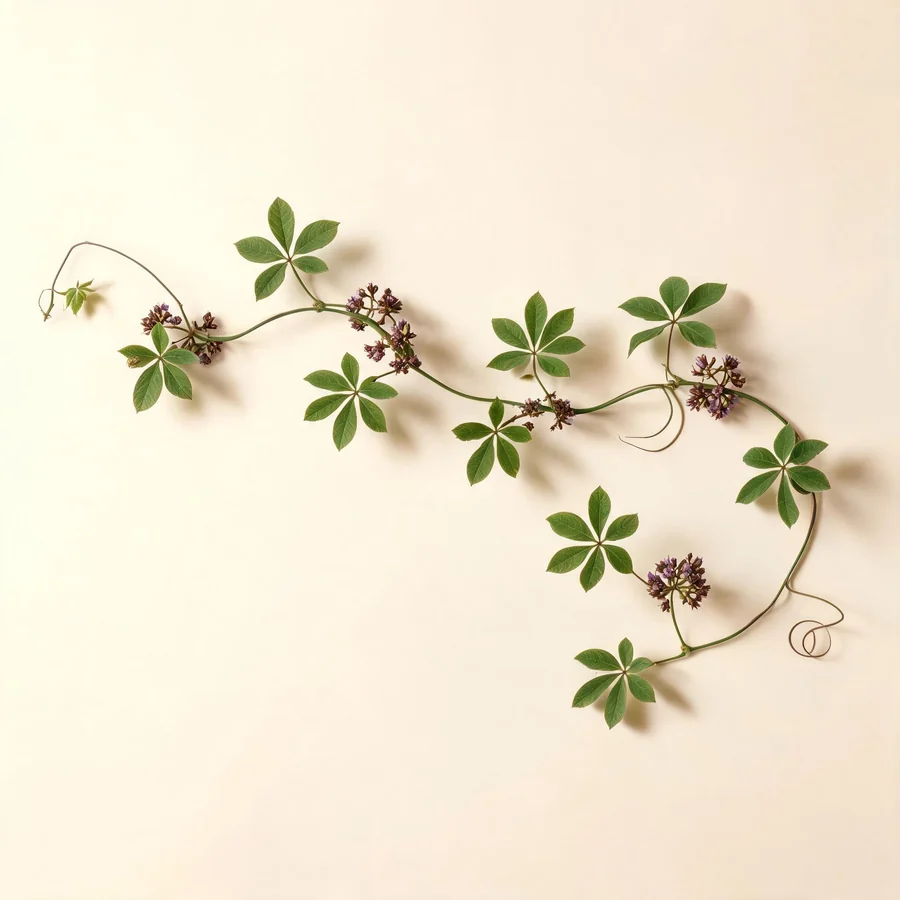
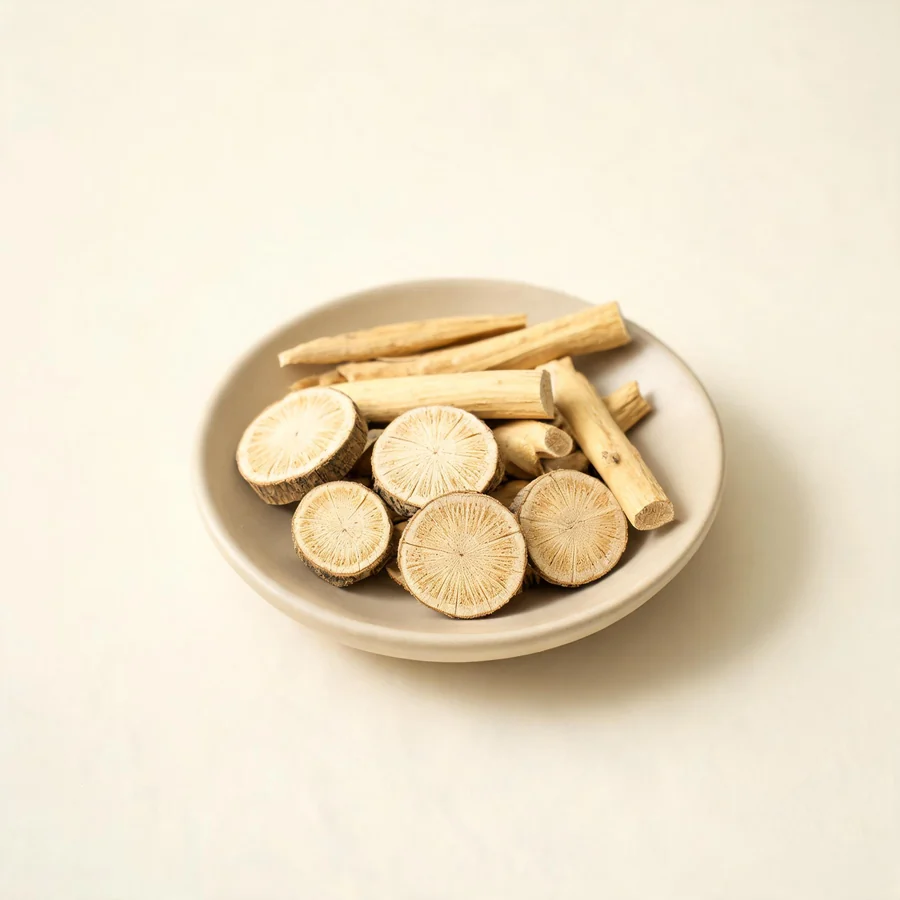
Skin profile
Where this herb sits in skin practice: the pattern it corrects, the skin signs it suits, and what it should not be used for.
Mu Tong is a supporting herb in skin work and its place is narrow: a wet, eroded lesion with scanty hot urine, usually in a fold, inside a damp-heat formula. Everything else on this page is secondary to the identity question, because the wrong stem is a carcinogen rather than a weak medicine.
Skin signs that suggest it
- Weeping, macerated skin in the groin, between the buttocks or under a breast, with a red inflamed edge and a sour smell
- Genital itch with a sticky discharge and a burning feeling when passing urine
- Scanty, dark, hot urine that scalds, at the same time as the skin flare
- A sticky taste in the mouth, thirst without much wish to drink, and a heavy feeling low in the abdomen
- A red tongue with a thick yellow greasy coat and a slippery, rapid pulse
- A lesion that settles when the urine flows freely and worsens during a spell of scanty urine
When it is not the right herb
Not for dry, thin, pale skin without moisture, and not for the cold-deficient eczema that is lichenified, dry and cold to the touch; a bitter cold draining stem will make that skin drier and the person more tired. Not where the urine is already copious and clear, because there is no damp-heat to lead away, and not for the frail or elderly person with a dry mouth and a thin rapid pulse, who is short of fluid already. A weeping lesion that is spreading, hot and tender, or that comes with fever, needs medical assessment rather than a herbal wash.
What it does for skin
Skin-relevant actions only. Each one describes a mechanism in TCM terms and what it looks like on the skin.
Drains damp-heat through the bladder
This is the whole basis of the skin use. The lesion and the urinary signs are read as one process, and the treatment is to open the route by which the damp-heat leaves. Where the skin is eroded and wet and the urine is scanty and hot, the stem is added to a damp-heat formula so that the surface dries as the water flow improves. It is an adjunct rather than a cure, and it is chosen for the moist and heavy presentation rather than for the red and dry one.
Clears Heart fire that shows on the skin and mucosa
Fire in the Heart is read from the tongue and from the mind, and it is also read from small red lesions that appear with restlessness, thirst and dark urine. The stem is paired with raw rehmannia so that the fire is cooled and given a way out below at the same time, which is the logic of the classical formulas that guide fire downward. In skin practice this matters for the red, irritable eruption that comes with mouth ulcers and a child who will not settle.
Dries ooze and maceration in skin folds
Folds hold moisture, and moisture holds heat. A groin, an inframammary crease or a natal cleft that is red, sodden and excoriated is read as damp-heat trapped where air does not reach. The draining action is supported by measures that matter as much: drying the area, loose cotton clothing and treating any fungal overgrowth, since a moist fold is also where Candida and dermatophytes flourish. The stem does not treat the fungus and should not be presented as if it did.
Opens the channels so that other herbs reach the lesion
The old descriptions of this stem are less about any single organ than about opening what is blocked, and that quality is why a small amount is added to a larger formula. It is not a surface herb and it does not release the exterior; its contribution is to keep things moving downward and to stop a formula from stagnating. In a skin formula this is a supporting role, and it is one reason the stem appears among the ingredients of damp-heat prescriptions rather than as a single remedy.
Skin conditions it is used for
Mapped to the condition pages on this site. The pattern column shows what the skin is doing when this herb is the right choice.
| Condition | Pattern | Why it suits | Typical setting |
|---|---|---|---|
| Skin Erosion | Damp-heat with maceration and ooze in a skin fold | Eroded, weeping skin in a fold is the clearest skin picture this stem is used for, and it is chosen when the erosion belongs to a general damp-heat state rather than to a local irritant dermatitis. A wet surface, a red edge and scanty hot urine together are what justify a draining herb at all. If the area is instead dry and fissured, or the erosion follows a burn or an injury, the reasoning does not apply and the stem will not help. | Long Dan Xie Gan Tang, with Ku Shen and Huang Bo |
| Eczema | Acute weeping eczema with damp-heat below | In eczema the stem is reserved for the wet, oozing flare that comes with urinary heat, and it sits inside a formula rather than at its head. The distinction that matters is between a wet flare and a dry one; the dry, thickened, itching plaque of long standing is not a damp-heat picture and draining makes it worse. It is also not the herb to reach for when the eczema is secondarily infected, where clearing toxin and, where needed, antibiotics do the work. | Modified Long Dan Xie Gan Tang with Bai Xian Pi and Ku Shen |
| Itchy Genitalia | Damp-heat in the Liver channel with discharge and itch | Genital itch with a sticky discharge, a burning sensation on urination and an irritable mood is a Liver-channel damp-heat picture, and this is the one place where the stem's downward draining is central rather than marginal. It appears in the classical formula for that pattern alongside Long Dan Cao and Zhi Zi. The herb supports hygiene, barrier care and the treatment of any infection, and a persistent discharge or a new ulcer needs assessment before herbs are considered. | Long Dan Xie Gan Tang |
| Scrotal Eczema | Damp-heat settling in the scrotal skin | Scrotal skin that is red, soggy, itchy and sore, worse in heat and after sweating, is read as damp-heat with a downward tendency. The stem is used for its draining action and its route out through the urine, and it is combined with herbs that dry dampness and quiet itch. Care is needed because scrotal skin is thin and absorbs well, so topical applications are kept bland and short and the internal formula is brief. | Long Dan Xie Gan Tang with Che Qian Zi and Ku Shen |
| Vulvar Eczema | Damp-heat with discharge in the vulval skin | Vulval eczema with a discharge, burning and a red glazed surface fits the same Liver-channel pattern, and the stem is included for the same draining reason. It is not a treatment for infection, and a change in discharge, bleeding or a persistent erosion must be examined rather than managed with herbs. Where the skin is atrophic and dry, the damp-heat reasoning fails entirely and the stem is the wrong choice. | Modified Long Dan Xie Gan Tang with Bai Xian Pi and Tu Fu Ling |
Combinations for skin
Herbs it is paired with when the skin, not an internal organ, is the target.
| Partner | Ratio | Why the pair is used |
|---|---|---|
| Sheng Di Huang | 3 to 6 g Mu Tong with 10 to 15 g Sheng Di Huang | Pairing a draining stem with a nourishing root is deliberate: the stem cools the fire and opens an escape route for it, while raw rehmannia restores the yin the heat has dried. In skin practice it suits the red, irritable eruption with mouth ulcers and dark scanty urine, where clearing alone would leave the person drier. It is the reason a draining herb can be given to someone thin and dry without making them worse. |
| Long Dan Cao | 3 to 6 g each in decoction | Both are bitter, both are cold, and each drains damp-heat downward, so together they define the Liver-channel formula on which most genital skin practice rests. Long Dan Cao is the stronger clearer of channel fire, and the stem supplies the route out. The pair is intense and cold, so courses are short and the digestion is watched throughout. |
| Hua Shi | 6 to 10 g Hua Shi with 3 to 6 g Mu Tong | Talc is slippery and bland and moves heat out in the urine with a smoothness the stem lacks, while the stem adds the fire-clearing and the channel-opening. Together they are the draining core of the formulas for hot, scanty, painful urine, which is the urinary picture that accompanies the skin flares this herb is chosen for. Talc is a mineral and is not dusted on broken skin. |
| Che Qian Zi | 6 to 10 g each | The plantain seed drains damp-heat through the urine and is gentler than the stem, so the pair suits a person who needs the downward route opened without a strong bitter cold effect. It is used where a moist skin lesion and urinary heaviness appear together in someone easily chilled by treatment. Both are stopped once the urine runs clear and the skin has dried. |
Formulas where it leads
- Long Dan Xie Gan Tang (龙胆泻肝汤) - The classical formula for damp-heat in the Liver and Gallbladder channel, and the main reason this stem appears in skin practice at all. Genital itch, scrotal and vulval eczema and moist lesions in the groin are its territory when the tongue is red with a yellow greasy coat. The stem is one ingredient among several and is not the active principle of the formula.
- Dao Chi San (导赤散) - A small formula for Heart fire moving to the small intestine, with mouth and tongue ulcers, restlessness and dark scalding urine. Its relevance to the skin is the red, irritable eruption that accompanies those signs. The stem is the draining element and raw rehmannia protects the yin; the formula is not a treatment for a primary dermatosis.
Safety for skin use
What to check before recommending or using it, including the cautions that matter most for skin patients.
Do not use, or use with caution
- Material that cannot be shown to be Akebia or Clematis. Guan Mu Tong, Aristolochia manshuriensis, was deleted from the Chinese Pharmacopoeia during 2003 and 2004 and banned or restricted in Taiwan, the European Union and the United States because it causes irreversible kidney scarring and cancer of the renal tract. Ask for the botanical name and a certificate of analysis, and refuse loose stem with no stated origin.
- Any kidney disease, a single kidney, or a history of reduced kidney function. Even the authentic stem is a strong draining diuretic working on a kidney that may already be damaged, and anyone with known renal disease should not take it unless both a nephrologist and the prescribing practitioner agree.
- Yin deficiency or fluid depletion: a dry mouth, night sweats, a thin rapid pulse and scanty concentrated urine. Draining a person whose fluids are already low makes the skin drier and the weakness worse.
- Pregnancy and breastfeeding. The stem is cold, strongly downward-draining and blood-moving, which is the classical picture of a medicine liable to disturb a pregnancy, and no safety data exist in either situation.
- Dry, cold or lichenified skin with no moisture and no urinary heat. There is no damp-heat to lead away, and the bitter cold thins the skin further.
Pregnancy and breastfeeding
Avoided in every form, including a topical wash. The stem is cold and strongly downward-draining and it moves blood, which is the pattern the classical pregnancy prohibitions describe, and its diuretic effect reduces fluid volume at a time when volume matters. There are no human safety data, and the aristolochic acid question, if the species is uncertain, is an additional and separate reason. A pregnant woman with a weeping groin lesion or with urinary symptoms should be assessed by a clinician and treated with measures known to be safe.
Interactions
- Diuretics. The stem has a real diuretic action and is rich in potassium salts, so combining it with furosemide, bumetanide or a thiazide may drain more fluid than intended, with potassium dropping and the familiar tiredness. A person already taking a diuretic who adds this herb should have blood electrolytes measured, not guessed from how they feel.
- Nephrotoxic medicines. The aminoglycoside antibiotics, amphotericin, cisplatin, ciclosporin and long courses of anti-inflammatory drugs all burden the kidney, and a herb with this particular safety history adds to that burden. The combination is avoided outright, and never considered when no botanical identity has been confirmed in writing.
- Lithium. Any diuretic slows the kidney's clearance of lithium and can push the blood level towards toxicity. Someone taking lithium should not use a draining herb without the prescriber knowing, and levels should be monitored if it is used at all.
- Anticoagulants. The stem is classified as blood-moving, so it may in theory add to warfarin or a direct oral anticoagulant; this is a theoretical caution rather than a documented interaction, and it means telling the prescriber rather than assuming safety.
Allergy and patch testing
A new rash, itching or swelling during a course should be treated as a possible reaction and the herb stopped, with the batch and supplier recorded. Because the same name has covered more than one plant, a reaction may in principle be a reaction to the wrong stem, which is one more reason to keep the botanical identity with the clinical notes. Topical washes are not traditional for this herb and are not advised.
General safety references
General references for herbal hepatotoxicity and herb-drug interactions; they are not specific to this herb.
- Review article: Herbal hepatotoxicity - an update on traditional Chinese medicine preparations. Alimentary Pharmacology & Therapeutics, 2014. PMID: 24844799.
- Interactions between herbal medicines and prescribed drugs: an updated systematic review. Drugs, 2009. PMID: 19719333.
- Warfarin and food, herbal or dietary supplement interactions: a systematic review. British Journal of Clinical Pharmacology, 2021. PMID: 32478963.
Evidence
The classical record is quoted with its source. The modern note states the level of evidence plainly.
Classical record
通草,味辛,平,无毒。主除脾胃寒热,通利九窍,血脉,关节,令人不忘,去恶虫。一名附支,生山谷。
Tong Cao is acrid, neutral and non-toxic. Cold and heat in the spleen and stomach it disperses; the nine openings, the vessels and the joints it frees; memory it aids, and malign parasites it expels. It is also called Fu Zhi and grows in mountain valleys.
Shen Nong Ben Cao Jing (Divine Husbandman's Classic of Materia Medica), entry under the older name Tong Cao - The oldest layer says nothing about skin. What it describes is a plant that opens what is closed, and that quality is the root of the later use in damp-heat that has congested the surface.
有细细孔,两头皆通,故名通草,即今所谓木通也。今之通草,乃古之通脱木也。
Fine pores run through it and both ends are open, hence the name tong cao, the plant that is open; the wood sold under that name now is what this text calls mu tong. What passes for tong cao in later times is the tree the ancients knew as tong tuo mu.
Ben Cao Gang Mu (Compendium of Materia Medica), Li Shizhen - A naming correction, and the reason two different medicines still share a history. For skin practice it is a reminder that the name on a label is not an identification.
木通藤蔓空通,其色黄白,气味辛平,禀土金相生之气化,而为通关利窍之药也。
Hollow throughout, the mu tong vine is pale yellow-white, acrid and neutral to the taste; it takes its nature from earth and metal generating one another, and so it is the medicine for opening barriers and freeing the orifices.
Shen Nong Ben Cao Jing Du (Reading of the Classic of Materia Medica) - The reasoning behind the name, and the clearest classical statement that the role is to open a route rather than to act on a tissue. A draining route below is what a weeping lesion is thought to need.
Modern evidence
Evidence status
- The aristolochic acid story is the best documented thing about this name. The vine Aristolochia manshuriensis holds aristolochic acid, which the International Agency for Research on Cancer places in Group 1; the compound binds DNA permanently, leaves a mutation pattern that is recognisable, and produces a slowly progressive interstitial nephropathy that may end in dialysis, along with cancers of the renal pelvis, ureter and bladder. The injury is cumulative and can surface years or decades later.
- The pharmacology of the authentic stem is characterised but modest: akebia saponins and related triterpenoids have shown diuretic and anti-inflammatory activity in animal work, which is consistent with the traditional description without proving a clinical effect. No trial of the single herb in any skin condition was identified.
- Skin use rests on formula-level practice, chiefly Long Dan Xie Gan Tang, and the evidence for that formula in dermatology is sparse and of low quality, drawn mostly from small Chinese case series. The herb should be presented as a traditional adjunct with a serious identity requirement, not as a treatment with demonstrated benefit.
PubMed records
Selected real PubMed records for this herb's species or its constituents, chosen by species name and title relevance. They are references for the non-TCM discussion above, not proof that the herb treats any skin condition.
- Akebia quinata and Akebia trifoliata - a review of phytochemical composition, ethnopharmacological approaches and biological studies.. Journal of ethnopharmacology, 2021. PMID: 34352331 (pharmacology or review record).
- Comparative 28-day repeated oral toxicity of Longdan Xieganwan, Akebia trifoliate (Thunb.) koidz., Akebia quinata (Thunb.) Decne. and Caulis aristolochiae manshuriensis in mice.. Journal of ethnopharmacology, 2008. PMID: 18582552 (safety record).
Dose and forms
Skin-practice dosing and the preparations that suit skin complaints.
| Form | Dose and notes |
|---|---|
| Decoction | 3 to 6 g of dried stem from a named Akebia or Clematis source, inside a formula. The upper figure is a ceiling rather than a target; it exists because draining depletes fluid, not because of the banned compound. |
| Ceiling | Six grams a day is the limit, and it holds even when the species is confirmed. Larger amounts drain fluid and electrolytes without improving the result, and there is no traditional use at high dose for skin disease. |
| Identity | The prescription and the label should carry the botanical species. Material described only as mu tong, with no origin and no certificate, is not dispensed at all, since no inspection of the dried stem can rule out the banned vine. |
| Course length | Days to two weeks for a defined damp-heat flare, then review. The aim is to restore flow and dry the lesion, not to keep draining, and treatment stops when the skin has settled and the urine is clear. |
The species question outranks the dose. Three grams suits a slight or elderly person, six a sturdy one with definite heat, yet no number is meaningful until the species is proven, and dried stem cannot be told apart with confidence by eye. A prescriber should be able to produce a certificate of analysis for the batch; without one the herb is not dispensed. Courses are short because the purpose is to restore flow, and because prolonged draining depletes fluid that dry skin has none of to spare.
Citations and further reading
Only real sources are listed: the classical materia medica passages quoted above, and the source works behind the botanical and safety statements.
- Shen Nong Ben Cao Jing (Divine Husbandman's Classic of Materia Medica), Han compilation, entry under the older name Tong Cao - classical passage quoted above.
- Ben Cao Gang Mu (Compendium of Materia Medica), Li Shizhen, 1578 - classical passage quoted above.
- Shen Nong Ben Cao Jing Du (Reading of the Classic of Materia Medica), commentary - passage quoted above.
- Pharmacopoeia of the People's Republic of China - source for the accepted Akebia and Clematis sources, the part used and the removal of Aristolochia manshuriensis.
- IARC Monographs on the Evaluation of Carcinogenic Risks to Humans, aristolochic acid - basis for the Group 1 classification and the urothelial cancer risk.
- Modern evidence statement: assembled from the toxicological literature and from formula-level dermatology reports; no dermatological trial of mu tong is presented as proof of effect.
Educational reference for qualified practitioners. This page is not medical advice, and skin conditions should be diagnosed by a clinician before treatment.