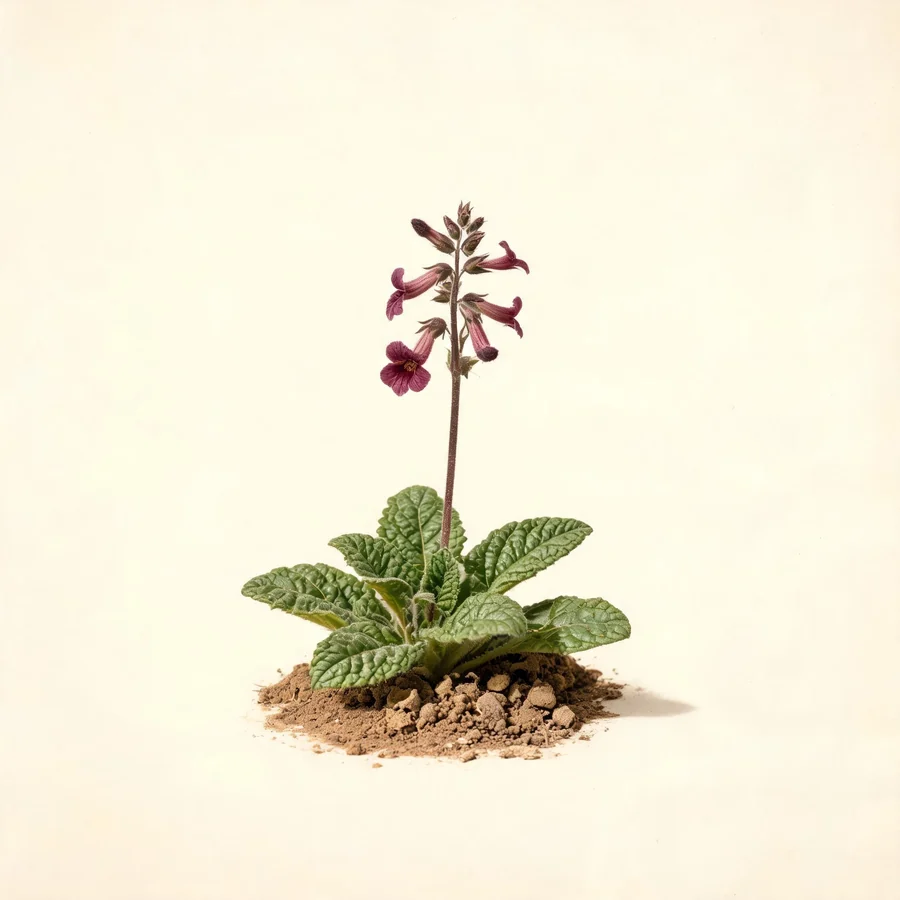
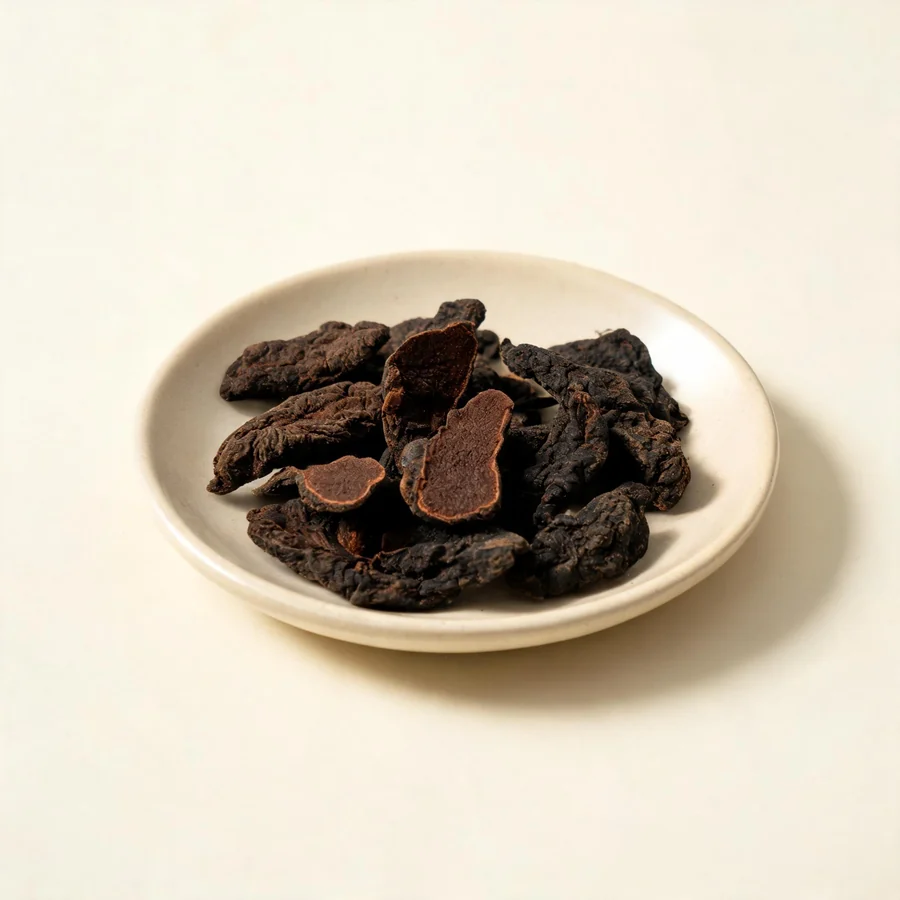
Skin profile
Where this herb sits in skin practice: the pattern it corrects, the skin signs it suits, and what it should not be used for.
Sheng Di Huang is the cooling, moistening root for a rash that has darkened and for skin left dry by heat. It is a formula herb, it is heavy on weak digestion, and it belongs to the raw article rather than the prepared tonic.
Skin signs that suggest it
- A rash that is deep red, dusky or purplish, and slow to fade when pressed
- Fine purple spots or small bruises in the skin during or after a fever
- A flare that is worse at night, with low fever, hot palms and thirst
- Dry, thin, tight skin with redness and fine scaling over the shins or forearms
- A red or crimson tongue that has lost its coating, with a pulse that is fine and fast
When it is not the right herb
Not for a wet, cold or sluggish picture, and not where the digestion is weak: the root is cold, sweet and sticky, and it can leave the abdomen bloated, the appetite poor and the stool loose. Not for a greasy tongue and a heavy chest, which point to dampness that a moistening herb would deepen. Not for an acute weeping flare, where cooling the Blood is not the task. And not as a long-term skin tonic, since the prepared form is the tonic and this one is the cooling form.
What it does for skin
Skin-relevant actions only. Each one describes a mechanism in TCM terms and what it looks like on the skin.
Cools Blood that is driving a dusky rash
When heat moves past the surface into the Blood, the colour of a rash deepens, the lesions stop blanching quickly and the person is restless with a dry mouth. The root is described as entering at that level, and its coldness is what changes a spreading crimson eruption into a settling one. It is not a surface herb: it does nothing for a rash that is still confined to the Qi level, and it is chosen when the colour itself has darkened.
Stops heat from leaking out of the vessels
Fine bleeding into the skin, whether pinpoint petechiae or larger purpuric patches, is read as heat forcing blood through vessel walls, and the traditional response is to cool the Blood rather than to staunch the surface. The root is the nourishing half of that approach: it cools while it restores the fluid that keeps the vessels intact. Purpura always needs a cause found, whether platelets, a vasculitis, a drug or an infection, so the herb sits beside investigation and not before it.
Restores fluid and moisture to overheated skin
The sweet, cold, sticky quality is read as replenishing what a fever or a chronic flare has dried out. On the skin this shows as less tightness, less fine scaling and a rash that is less irritable by evening, and it is accompanied by a return of moisture in the mouth and a softer stool. The effect is slow and it is not a substitute for an emollient, which is what actually holds water in the skin surface from outside.
Keeps a cooling formula from drying the skin
Bitter, cold, drying herbs clear heat at a cost, and a long course can leave the skin thinner and more irritable than the eruption that prompted it. The root is included for that reason as much as for its own action, balancing the dryers within a formula. This is a formula-level skill rather than a single-herb effect, and it is the practical reason the herb recurs in the classical blood-cooling decoctions for chronic relapsing eruptions.
Skin conditions it is used for
Mapped to the condition pages on this site. The pattern column shows what the skin is doing when this herb is the right choice.
| Condition | Pattern | Why it suits | Typical setting |
|---|---|---|---|
| Purpura | Blood heat with Yin damage | Non-blanching purple patches with heat signs are read as heat driving blood out of the vessels while the fluid that should hold it is depleted, and the classical answer is a blood-cooling formula in which this root is the nourishing element. It restores fluid while the colder minerals and barks do the cooling. A purpuric rash needs a full blood count, a clotting screen and a cause found, and a rapidly spreading purpuric eruption with fever is an emergency. | Xi Jiao Di Huang Tang, with Shui Niu Jiao in place of rhinoceros horn |
| Petechiae | Fine blood-heat bleeding under the skin | Pinpoint non-blanching spots are the smallest visible form of the same picture, and the root is used where they come with a crimson tongue, thirst and a fine rapid pulse. It is the moistening half of the formula, and it is paired with a blood-moving bark so that cooling does not congeal what it cools. The clinical priority is the same as for purpura: the spots are investigated before a herbal course is started. | A modified Xi Jiao Di Huang Tang or Wen Qing Yin, with Mu Dan Pi and Chi Shao |
| Psoriasis | Blood heat with dryness in a flare | Active psoriasis is read as blood heat with stasis, and the plaques are red, thick and often worse in winter when the air is dry. The root is used in the blood-cooling formulas for a hot, spreading flare, where its moistening quality offsets the drying herbs that clear the redness. It is not the whole treatment, and it does nothing for a cold, static, thick plaque in a person with no heat signs. | A Xiao Yin Ke Li style formula, or Wen Qing Yin with Mu Dan Pi and Chi Shao |
| Eczema | Dry, hot eczema after the weeping phase | Once an acute weep has settled, chronic eczema often leaves dry, red, excoriated skin that is worse for heat and washing, and that dryness is read as heat having consumed the fluids. The root is used then, alongside a blood-moving bark and an antipruritic herb, to cool what remains without adding to the dryness. It is the wrong choice while the skin is still oozing and cold to the touch. | A modified blood-cooling formula with Mu Dan Pi and Bai Xian Pi, with an emollient used alongside |
| Dry skin | Yin and fluid depletion with low-grade heat | Generalised dryness with a low afternoon fever, hot palms, a dry throat and a tongue without coating is the deficiency picture rather than an external one, and the root moistens the deep reserve while it cools. It is used in small amounts inside a nourishing formula rather than as a single herb. Dryness without any heat, in a cold person with a pale tongue, is a different problem and belongs to the warming tonics. | Zeng Ye Tang with Mai Dong and Xuan Shen, where dryness and thirst dominate |
| Drug rash | Heat toxin entering the Blood | A morbilliform eruption appearing after a new medicine, with fever and a darkening colour, is read as heat toxin entering the Blood, and the root is used in the cooling formulas for that stage. It does not replace stopping the drug or assessing the reaction. Blistering, mucosal involvement, skin peeling or a rapidly worsening rash is a medical emergency, and no herb is appropriate at that point. | Wen Qing Yin, or a modified Qing Ying Tang, alongside withdrawal of the suspected medicine |
Combinations for skin
Herbs it is paired with when the skin, not an internal organ, is the target.
| Partner | Ratio | Why the pair is used |
|---|---|---|
| Mu Dan Pi | 15 g Sheng Di Huang with 6 to 10 g Mu Dan Pi | Both cool the Blood and they pull in opposite directions while doing so. The root nourishes and moistens; tree peony bark moves the Blood and disperses the stasis that heavy cooling can otherwise congeal. That is the reasoning behind the classical decoctions for a purplish rash with heat, and it explains why a cooling herb is seldom given alone once the colour has darkened. |
| Xuan Shen | 15 g of each in decoction | Scrophularia shares the cold, sweet, bitter profile and moistens while it clears, which is why the two are the standard answer to a dry throat, a red tongue and hard stool after a fever. It adds two things the root lacks, its ability to soften nodules and to clear fire from the Kidney, and together they form two parts of the fluid-generating formula used in convalescence. |
| Shui Niu Jiao | 15 to 30 g Sheng Di Huang with 15 to 30 g Shui Niu Jiao | The backbone of the classical blood-cooling decoction, with buffalo horn in place of the prohibited rhinoceros material. The horn takes the deep cooling and the toxin, while the root restores the fluid and helps arrest bleeding from vessels that heat has damaged. Cooling alone leaves a person drier and more restless, so the nourishing half is not optional in a genuine blood-heat picture. |
| Huang Qin | 10 to 15 g Sheng Di Huang with 6 to 10 g Huang Qin | Scutellaria is a bitter drying herb that clears heat with some force; rehmannia is sweet and moistening. Each corrects the other's excess, so heat is cleared without the dryness that would injure the fluids further. That balance explains why the pair recurs where damp-heat and fluid damage coexist, as in a chronic flare that is red and dry at once. |
Formulas where it leads
- Xi Jiao Di Huang Tang (犀角地黄汤) - The classical blood-cooling formula, rebuilt around buffalo horn since the trade in rhinoceros horn was prohibited, with raw rehmannia, moutan bark and red peony. It is used for a dark or purplish rash, bleeding into the skin and a crimson tongue. The raw root is the nourishing element, cooling the Blood while it restores the fluid that the heat has consumed.
- Wen Qing Yin (温清饮) - A formula for blood heat with dampness in chronic relapsing eruptions, and one of the most used decoctions in Japanese and Chinese skin practice for stubborn eczema and psoriasis. The raw root cools and moistens while moutan and red peony move the Blood, and the combination is chosen when a flare is both red and dry rather than wet and cold.
- Qing Ying Tang (清营汤) - A warm-disease formula for heat that has reached the nutritive layer, with fever worse at night, restlessness and a crimson tongue. The root is the blood-cooling and fluid-restoring element, and the rest of the formula turns the heat back out towards the surface rather than driving it deeper. It belongs to supervised care of a febrile illness.
Safety for skin use
What to check before recommending or using it, including the cautions that matter most for skin patients.
Do not use, or use with caution
- Weak Spleen and Stomach with a poor appetite, a distended abdomen or loose stools. The root is rich, cold and sticky and makes those symptoms worse; when it has to be used, a pinch of Sha Ren or Chen Pi is added to keep digestion moving.
- Dampness or phlegm, with a thick greasy coating, a muzzy head, a heavy chest and an absence of thirst. A moistening root feeds a damp picture instead of clearing it.
- Cold with watery diarrhoea and cold limbs. The raw form is cold, whatever else the picture shows.
- The first weeks after childbirth, when the appetite is poor or the stool is loose. The classical writers warn that the root can set up persistent loose stools in that state.
Pregnancy and breastfeeding
Standard doses are used under supervision. Its reputation in the older literature as an emmenagogue puts a question mark over uterine safety, and a cold or threatened pregnancy is not the setting for the cold raw article. It also appears in formulas for threatened miscarriage where the pattern is blood heat, and that judgement belongs to a practitioner who has taken the whole picture. No external tradition exists to fall back on, so an internal course in pregnancy should not begin without advice.
Interactions
- Blood sugar lowering medicines. Catalpol and the root itself have lowered glucose in animal work, so readings should be checked in anyone using insulin, metformin or a sulfonylurea.
- Anticoagulants and antiplatelet drugs. The root cools and moves the Blood and has altered measures of haemostasis in laboratory work, so warfarin, heparin, aspirin and clopidogrel are worth mentioning to the prescriber.
- Medicines handled by the liver enzymes. Water extracts changed CYP3A, CYP2E1 and CYP1A2 activity in vitro, and how large that effect is in a person has not been established.
- Immunosuppressants. Laboratory work reports immune effects from the extracts, which is a theoretical concern with ciclosporin and tacrolimus.
Allergy and patch testing
Reactions to the root itself are uncommon, but a herb-containing formula can produce a reaction through another ingredient. Stop and seek advice if a new rash, itching or swelling appears during a course, and do not assume that a fresh eruption is the original condition worsening.
General safety references
General references for herbal hepatotoxicity and herb-drug interactions; they are not specific to this herb.
- Review article: Herbal hepatotoxicity - an update on traditional Chinese medicine preparations. Alimentary Pharmacology & Therapeutics, 2014. PMID: 24844799.
- Interactions between herbal medicines and prescribed drugs: an updated systematic review. Drugs, 2009. PMID: 19719333.
- Warfarin and food, herbal or dietary supplement interactions: a systematic review. British Journal of Clinical Pharmacology, 2021. PMID: 32478963.
Evidence
The classical record is quoted with its source. The modern note states the level of evidence plainly.
Classical record
Di Huang is sweet and cold. It governs fracture and severed sinew, injury of the middle, and drives out Blood impediment; it fills the bone marrow, grows flesh, and as a decoction removes accumulations of cold and heat. The fresh root is especially good, and long use lightens the body and prevents ageing.
Shen Nong Ben Cao Jing (Divine Husbandman's Classic of Materia Medica) on the fresh root - An upper-grade entry, which is why the root was always treated as safe for long courses; the phrase about filling marrow and growing flesh is the oldest warrant for the tissue uses.
The raw root is very cold and cools the Blood, and is for those whose Blood is hot; the steamed root is mildly warm and supplements the Kidney, and is for those whose Blood is failing. Men are more often short of Yin, so the steamed form suits them, while women more often have hot Blood, so the raw form suits them.
Ben Cao Gang Mu (Compendium of Materia Medica): raw and prepared - The clearest classical statement of the one-plant-two-medicines idea, and the source of the rule that the raw root is the heat herb and the prepared root the tonic.
Sheng Di Huang treats heat in the palms and soles and in the Heart, benefits the Kidney's water and treats disorders of the Blood, and a full, forceful pulse calls for it. Where the pulse is weak, prepared Di Huang is the better choice, since the steaming gives it the power to supplement the Kidney's original Qi.
Li Gao on the pulse - A rule of thumb that still works: the raw root for a full pulse with heat, the prepared root for an empty one, which is why a dusky hot rash and a pale dry one call for different articles.
Modern evidence
Evidence status
- No controlled trial of Sheng Di Huang alone in a skin condition was identified. Its skin use is as one component of blood-cooling formulas, and the evidence for those formulas is formula-level and largely observational.
- Laboratory work on catalpol and on the root's polysaccharides reports anti-inflammatory and glucose-lowering activity, mostly in cell and animal models. That work is a reason to watch blood sugar, not a demonstration of a skin effect.
- Regulatory status: the dried root of Rehmannia glutinosa is an accepted pharmacopoeial substance, and the raw and wine-steamed forms are defined as separate articles with different uses. The distinction is a quality question as well as a clinical one.
PubMed records
Selected real PubMed records for this herb's species or its constituents, chosen by species name and title relevance. They are references for the non-TCM discussion above, not proof that the herb treats any skin condition.
- Rehmannia glutinosa for perimenopausal syndrome in patients with breast cancer: A systematic review and meta-analysis.. Saudi medical journal, 2025. PMID: 40628433 (pharmacology or review record).
- Rehmannia glutinosa: review of botany, chemistry and pharmacology.. Journal of ethnopharmacology, 2008. PMID: 18407446 (pharmacology or review record).
Dose and forms
Skin-practice dosing and the preparations that suit skin complaints.
| Form | Dose and notes |
|---|---|
| Decoction (raw root) | 9 to 15 g a day in a formula, and up to 30 g in warm disease with a high fever and a dry crimson tongue. The root is heavy and sticky, so it is decocted with the rest rather than added late. |
| Fresh root | 12 to 30 g, usually crushed and juiced rather than boiled, for the strongest cooling when heat is acute. The fresh article is not interchangeable with the dried one at the same weight. |
| Charred form | Sheng Di Tan, the charred root, is used where bleeding into the skin is the main problem, at doses similar to the raw form. The charring adds a haemostatic quality that plain cooling does not have. |
| Course length | Weeks, with review. Stop or reduce if the appetite falls, the abdomen distends or the stool loosens, and move to the prepared form only if the aim has changed from cooling to nourishing. |
Purpose decides both the quantity and the preparation. Cooling the Blood takes nine to fifteen grams; the warm-disease accounts go as high as thirty where fever is high, the tongue is crimson and the mouth is dry. Similar weights of the steamed root sit much more heavily on the stomach, so a smaller amount with a digestive corrective is often the wiser choice. Fresh root is juiced rather than boiled because the cooling is the point, and none of these forms belongs in indefinite use.
Citations and further reading
Only real sources are listed: the classical materia medica passages quoted above, and the source works behind the botanical and safety statements.
- Shen Nong Ben Cao Jing (Divine Husbandman's Classic of Materia Medica), attributed compilation of the Han period - entry on the fresh root quoted above.
- Ben Cao Gang Mu (Compendium of Materia Medica), Li Shizhen, 1578 - passage on the raw and prepared root quoted above.
- Li Gao (Li Dongyuan), Jin and Yuan period - observation on the pulse and the choice of form, quoted above.
- Radix Rehmanniae monograph: Pharmacopoeia of the People's Republic of China - accepted species, part and the distinction between the raw and steamed articles.
- Modern evidence statement: based on laboratory literature on catalpol and the root's polysaccharides, summarised as a statement about the level of evidence rather than as a cited finding.
- Botany: literature on Rehmannia glutinosa of the Orobanchaceae, its tuberous root and the preparations made from it.
Educational reference for qualified practitioners. This page is not medical advice, and skin conditions should be diagnosed by a clinician before treatment.