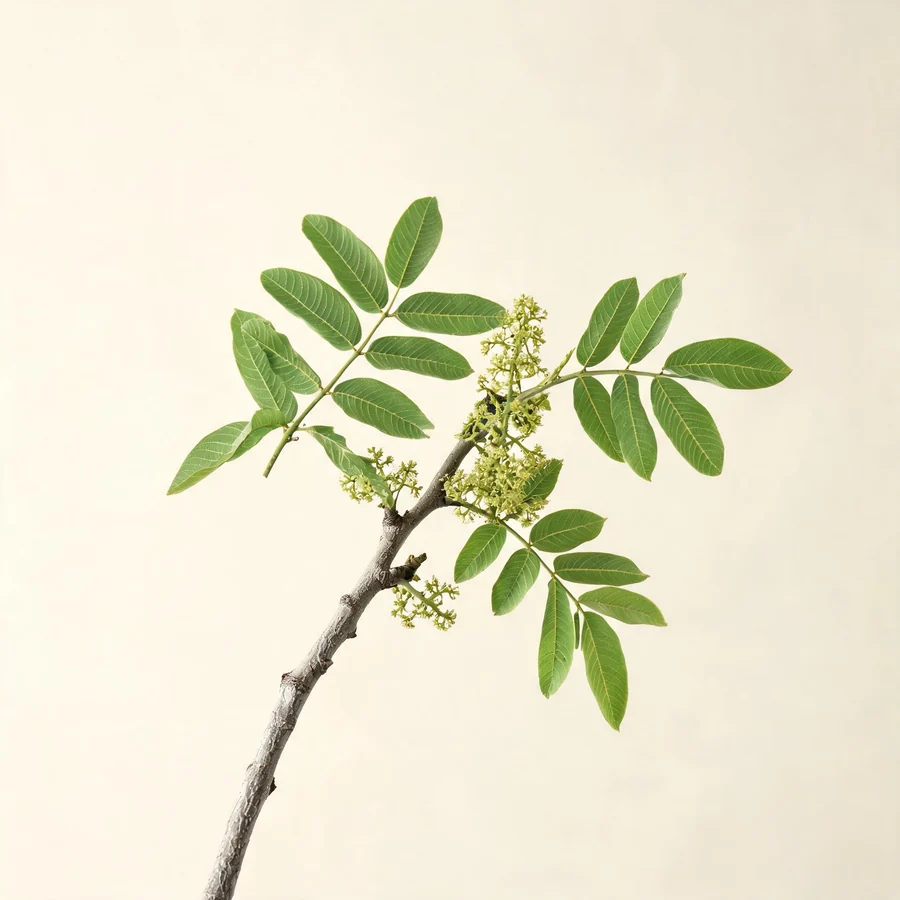
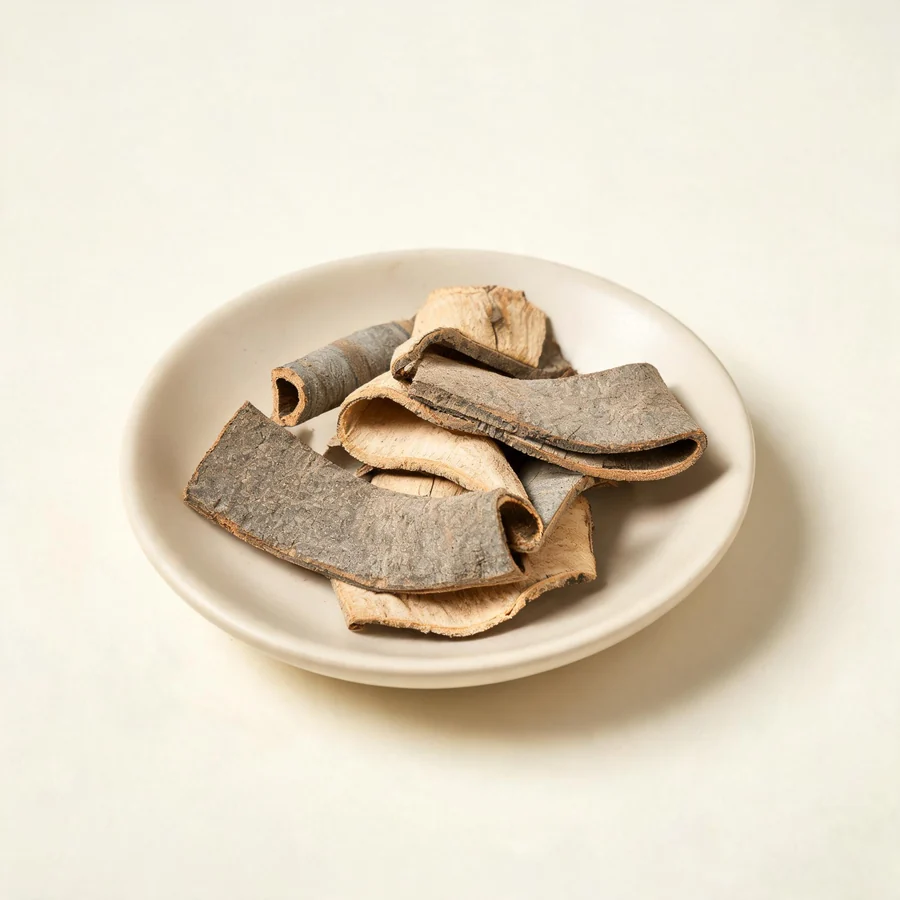
Skin profile
Where this herb sits in skin practice: the pattern it corrects, the skin signs it suits, and what it should not be used for.
Qin Pi is chosen for damp-heat that weeps: a red, sodden, itchy surface in a fold or the lower body, where the skin needs both clearing and tightening. It dries and binds, so it is stopped as soon as the ooze settles and kept away from dry, scaly skin.
Skin signs that suggest it
- A weeping, macerated, red eruption with a thin discharge, often in a skin fold or the groin (damp-heat with moisture)
- Yellow or greenish discharge with itching and irritation in the genital or perianal area
- Skin that stays wet and sodden under a diaper or a dressing, with a raw, excoriated surface
- A red tongue with a yellow greasy coating, and a bitter taste or irritability
- Itch and moisture that settle only when the area is kept dry
When it is not the right herb
Not for dry, scaly, lichenified skin, which has no dampness for the astringent action to work on, and not for a cold, pale, weak patient whose stools are already loose. The bark is bitter, astringent and cold, so it is hard on a delicate stomach, and it is not used for a discharge that is clear and thin without heat. It is also not a treatment for an infection that needs an antibiotic or an antifungal: it is an adjunct, not a substitute.
What it does for skin
Skin-relevant actions only. Each one describes a mechanism in TCM terms and what it looks like on the skin.
Clears Heat and dries Dampness in the skin
Damp-heat on the skin shows as redness with moisture: a weeping patch, a macerated fold, a rash that leaves a damp mark on clothing. The bark is cold enough to clear the heat and bitter enough to dry the dampness, and it is chosen where the moisture is thin and persistent rather than thick and purulent. It is used internally and, more often for the skin, as a cooled wash applied to the affected area.
Astringes and tightens a weeping surface
The astringent taste is what separates this bark from the other bitter cold herbs. It firms tissue that has become slack, reduces the loss of fluid from an eroded surface and dries the sodden skin of folds and flexures. That action is helpful in a weeping lesion and harmful in a dry one, which is why the herb is stopped as soon as the surface stops oozing.
Drains damp-heat that pours downward
The bark enters the Liver, Gallbladder and Large Intestine, and its classic territory is the lower half of the body: yellow discharge, genital and perianal itch, and the damp skin between the thighs. In skin practice that means jock itch, diaper rash, pruritus ani and the macerated skin around a genital discharge, where clearing and tightening are both needed.
Cools the surface and reduces the itch of a hot, moist lesion
Itch in a weeping lesion is driven by heat and dampness rather than by Wind, and the bark reduces it by clearing both instead of numbing the skin. It is used as a wash where the itch comes with warmth and moisture, and it is paired with antipruritic herbs when the itch dominates. It is not a herb for dry neuropathic itch, which needs moisture rather than astringency.
Skin conditions it is used for
Mapped to the condition pages on this site. The pattern column shows what the skin is doing when this herb is the right choice.
| Condition | Pattern | Why it suits | Typical setting |
|---|---|---|---|
| Eczema | Damp-heat with a weeping, macerated surface | A wet eczema flare in a fold, or an area that stays soggy under a dressing, is the clearest use for the bark. It clears the heat, dries the ooze and tightens the macerated skin, and it is applied as a cooled wash so that the action lands on the surface. It is not for the dry, lichenified end of eczema, where the skin needs moisture rather than astringency. | A Qin Pi wash with Huang Bo and Ku Shen, or a modified Long Dan Xie Gan Tang |
| Jock itch | Damp-heat pooling in the groin | The groin is warm, occluded and damp, and jock itch is read as dampness and heat pooling where the Liver channel runs. The bark suits the thin, weeping, itchy rash of the inner thigh because it clears the heat and tightens the surface at once, and it is used as a wash with the area kept dry between applications. A rash that is scaly and ring-shaped needs an antifungal as well. | Qin Pi with Huang Bo and Ku Shen as a wash, with a modified Long Dan Xie Gan Tang internally |
| Diaper rash | Damp-heat trapped against the skin in the Lower Burner | A diaper holds warmth and moisture against the skin, so the rash is read as heat and dampness trapped in the Lower Burner. The astringency is helpful on the sodden, excoriated skin that results and the cold clears the inflammation, but the wash must be weak because an infant's skin is thin. Barrier care and frequent nappy changes remain the basis of treatment, and a rash that blisters, spreads or refuses to settle needs medical review. | A weak Qin Pi and Huang Bo wash, alongside barrier cream and nappy-free time |
| Anal irritation | Damp-heat sinking to the anus | The anus is the lowest opening of the Large Intestine, and itch there is read as dampness and heat sinking downward. The bark enters the Large Intestine and is astringent, which suits the moist, excoriated skin of pruritus ani, and it is used as a cooled wash rather than internally where the problem is local. Bleeding, a new lump or a persistent change in bowel habit needs examination before any herb is used. | A Qin Pi wash with Ku Shen and Huang Bo, or a modified Long Dan Xie Gan Tang |
| Itchy genitalia | Damp-heat with discharge and itch | Genital itch with a discharge is the lower-burner form of damp-heat, and the astringent action is useful where the skin is moist and irritated. The bark is used in a wash and, when the pattern is internal as well, in a formula that drains the Liver channel. An infection needs its specific treatment, and a persistent itch with a change in the skin needs assessment. | Qin Pi with Ku Shen and She Chuang Zi as a wash |
Combinations for skin
Herbs it is paired with when the skin, not an internal organ, is the target.
| Partner | Ratio | Why the pair is used |
|---|---|---|
| Huang Bo | 6 to 10 g each internally, or 15 g each in a wash | Both prefer the lower body and both clear damp-heat. Huang Bo drains harder, while the ash bark contributes the astringent hold, so the pair covers a hot, weeping lesion that will not dry. They are used both internally and as a wash for the groin and perianal skin. The proportions are usually equal in a wash and weighted toward Huang Bo internally. |
| Ku Shen | 6 to 10 g each in a wash | Ku Shen is the stronger herb against itch and parasites, and Qin Pi is the one that tightens and dries. Together they make a wash for a weeping, itchy eruption in a fold or the groin, with one herb addressing the cause of the itch and the other the wet surface that keeps it going. The wash is kept weak and cooled to skin temperature. |
| Mu Dan Pi | 9 g Qin Pi with 6 g Mu Dan Pi | Tree peony bark cools the Blood, and the ash bark clears damp-heat and binds a discharge, so the pair suits a lesion or a flow that is yellow and blood-tinged. The recorded proportion sets three parts bark against two of tree peony, and the combination is used where heat has reached the Blood as well as the surface. |
| Huang Lian | 3 to 6 g Huang Lian with 6 to 10 g Qin Pi | Huang Lian clears with more force, while the ash bark binds, and a lesion that keeps weeping needs both actions at once. It is used internally for damp-heat with a discharge and as a strained wash for a hot, moist surface. |
Topical use
Qin Pi is used on the skin as a cooled wash more often than it is taken for it. The bark is simmered, strained through fine cloth and cooled to skin temperature, and the liquid is applied to weeping, macerated or itchy areas as a compress or a short soak. The tradition also boiled it as an eye wash, and that preparation is the basis for skin use. Straining matters, both because particles in a wash irritate the skin and because the bark gives up a fine sediment.
| Preparation | How and when it is used |
|---|---|
| Cooled decoction wash | Simmer 10 to 20 g of dried bark in about 500 ml of water for 20 minutes, strain through fine cloth, and cool to skin temperature. Apply with clean gauze for 10 minutes once or twice daily, then pat the area dry and keep it uncovered. |
| Dilute soak for hands, feet and groin | Use a weaker decoction in a basin for a short soak where the skin is sodden and itchy. Keep the concentration low enough that the skin does not sting, and do not share the basin or the cloth between people. |
| Strained eye wash | The classical eye wash uses 3 to 6 g, simmered, cooled and passed through fine cloth, after which the eye is bathed. It is not for a red eye in someone who wears contact lenses, for sudden loss of vision or for severe eye pain, all of which need urgent care. |
Patch test and cautions
Patch test on normal skin for 24 hours before the first proper use. Do not apply to broken, ulcerated or infected skin without clinical supervision, keep the wash away from the eyes unless it has been prepared and strained for that purpose, and stop at once if burning, stinging or spreading redness develops. A wash kept for more than a day should be discarded rather than reused.
Safety for skin use
What to check before recommending or using it, including the cautions that matter most for skin patients.
Do not use, or use with caution
- Spleen and Stomach deficiency-cold, with little appetite, unformed stools, a pale tongue and an abdomen that feels cold but comfortable. With no heat present, the bitter cold only increases the looseness.
- A discharge or an ooze that is clear and thin without heat, as in a cold-damp picture. The bark clears heat, so there is nothing for it to act on, and its astringency can trap what should be draining.
- Dry, scaly or lichenified skin, where the astringent action tightens what is already too tight, and a lesion that has stopped weeping.
- A known sensitivity to ash bark or to its coumarins, and any earlier reaction to a related preparation applied to the skin.
Pregnancy and breastfeeding
Avoid unless a practitioner has prescribed it for a specific reason. The bark does not belong to the strongly prohibited group, yet it is cold and bitter and can weaken Spleen Yang at a time when the mother's digestive warmth matters to the fetus, while its coumarins thin the blood mildly. The old texts also annotate a stye formula containing it as unsuitable in pregnancy. A short, weak external wash is the safer setting, and a breastfeeding mother should keep any course brief.
Interactions
- Anticoagulants and antiplatelet drugs. Esculin and esculetin, the two coumarins, resemble dicoumarol closely enough to matter, and even though oral absorption is poor, adding the bark to warfarin, heparin, aspirin or clopidogrel calls for monitoring rather than a shrug.
- Surgery and bleeding risk. Anyone due for an operation should mention the herb, and anyone who already bruises easily should not add it casually.
- Thiamine (vitamin B1). Tannins can bind thiamine in the gut, so a supplement should be taken a couple of hours away from the decoction.
- Narrow-margin medicines handled by liver enzymes. Esculetin has changed cytochrome P450 activity in laboratory work, a theoretical reason for care whose size at decoction doses is unknown.
Allergy and patch testing
A sensitivity to ash bark or its coumarins is reason enough to avoid it, and a reaction to a related preparation should be treated as a warning. External use adds a contact risk, so patch test a cooled wash on normal skin for a day before using it on a larger area. Stop at once if the skin grows more irritated rather than calmer, and seek urgent care for lip or throat swelling, wheeze or faintness.
General safety references
General references for herbal hepatotoxicity and herb-drug interactions; they are not specific to this herb.
- Review article: Herbal hepatotoxicity - an update on traditional Chinese medicine preparations. Alimentary Pharmacology & Therapeutics, 2014. PMID: 24844799.
- Interactions between herbal medicines and prescribed drugs: an updated systematic review. Drugs, 2009. PMID: 19719333.
- Warfarin and food, herbal or dietary supplement interactions: a systematic review. British Journal of Clinical Pharmacology, 2021. PMID: 32478963.
Evidence
The classical record is quoted with its source. The modern note states the level of evidence plainly.
Classical record
It is used for impediment from wind, cold and dampness, for the chilly skin of an exterior invasion, to remove Heat, and to clear the green film and white membrane that grow across the eye.
Shen Nong Ben Cao Jing (神农本草经), on the eye and the joints - The oldest notice sets the eye use beside a surface one, the earliest hint that the bark was applied more broadly than to the eye alone.
It treats scant essence in men, discharge in women and convulsions with fever in children, and it can be boiled to make a wash for the eyes.
Ming Yi Bie Lu (名医别录), on the discharge uses - The discharge and wash uses are joined in one short entry, which is why the bark is associated with a leaking surface and an external application at once.
Its taste is bitter and its nature astringent and firm, so it gathers the essence that is leaking away. This is why Zhang Zhongjing put it in Bai Tou Weng Tang for diarrhoea from deficient Heat in the lower burner, taking bitterness as the means of astringing.
Ben Cao Hui Yan (本草汇言), on the astringency - The clearest statement that the bitter and the astringent work as one action, which is the reasoning behind using the bark on a weeping skin lesion.
Modern evidence
Evidence status
- Laboratory studies of the coumarins esculin and esculetin, and of bark extracts of Fraxinus species, report anti-inflammatory, antioxidant and antimicrobial activity, with some antifungal work. These are laboratory findings and do not establish benefit in weeping skin disease.
- Clinical trial evidence for Qin Pi in skin disease is very limited. It is used mainly inside multi-herb washes for eczema and genital itch, and no controlled trial of the single bark in a skin condition was identified.
- Safety: the coumarin structure is why the anticoagulant question is asked, though oral absorption of esculin is low and no serious reaction has been recorded at the ordinary dose range. The statements here describe traditional practice and the state of the evidence, not proof of benefit.
PubMed records
Selected real PubMed records for this herb's species or its constituents, chosen by species name and title relevance. They are references for the non-TCM discussion above, not proof that the herb treats any skin condition.
- Fraxini cortex: Progresses in phytochemistry, pharmacology and ethnomedicinal uses.. Journal of ethnopharmacology, 2024. PMID: 38301981 (pharmacology or review record).
- Hepatoprotective standardized EtOH-water extract from the seeds of Fraxinus rhynchophylla Hance.. Journal of traditional and complementary medicine, 2017. PMID: 28417085 (safety record).
Dose and forms
Skin-practice dosing and the preparations that suit skin complaints.
| Form | Dose and notes |
|---|---|
| Decoction (internal) | 6 to 12 g of dried bark daily. Six to nine grams is enough for the eyes and the upper body, while nine to twelve is used for a discharge that needs clearing and binding together. |
| External wash | 10 to 20 g is simmered for a cooled wash, and a weaker decoction is used for a soak or for an infant's skin. The bark is not swallowed by this route, so the quantity can be higher than an internal dose. |
| Eye wash | 3 to 6 g is boiled, cooled and strained through fine cloth before use, and the straining is part of the preparation rather than an optional step. |
| Course length | Short courses. The bark is stopped when the ooze settles or the discharge dries, so that its cold astringency does not wear down the digestion or trap what should be draining. |
The part of the body being treated shapes the dose as much as the pattern does: little for the eyes, a moderate amount for a discharge and more for a wash that is never swallowed. Digestion is the practical ceiling, since bitter, binding and cold is a difficult combination for a weak stomach, and the bark is often taken after food. Courses stay short so the astringency does not outlast the dampness.
Citations and further reading
Only real sources are listed: the classical materia medica passages quoted above, and the source works behind the botanical and safety statements.
- Shen Nong Ben Cao Jing (Divine Husbandman's Classic of Materia Medica), attributed compilation of the Han period - classical passage quoted above.
- Ming Yi Bie Lu (Supplement to the Classic of Materia Medica), Tao Hongjing, Southern and Northern Dynasties - classical passage quoted above.
- Ben Cao Hui Yan (Collected Sayings on Materia Medica), Ming dynasty - classical passage quoted above.
- Qin Pi monograph: Pharmacopoeia of the People's Republic of China - source for the accepted botanical source, part used and quality requirements.
- Modern evidence statement: based on laboratory literature on esculin, esculetin and Fraxinus bark extracts, summarised as a statement about the level of evidence rather than as a cited finding.
- Botanical description and identification: botanical literature on Fraxinus rhynchophylla, Oleaceae.
Educational reference for qualified practitioners. This page is not medical advice, and skin conditions should be diagnosed by a clinician before treatment.