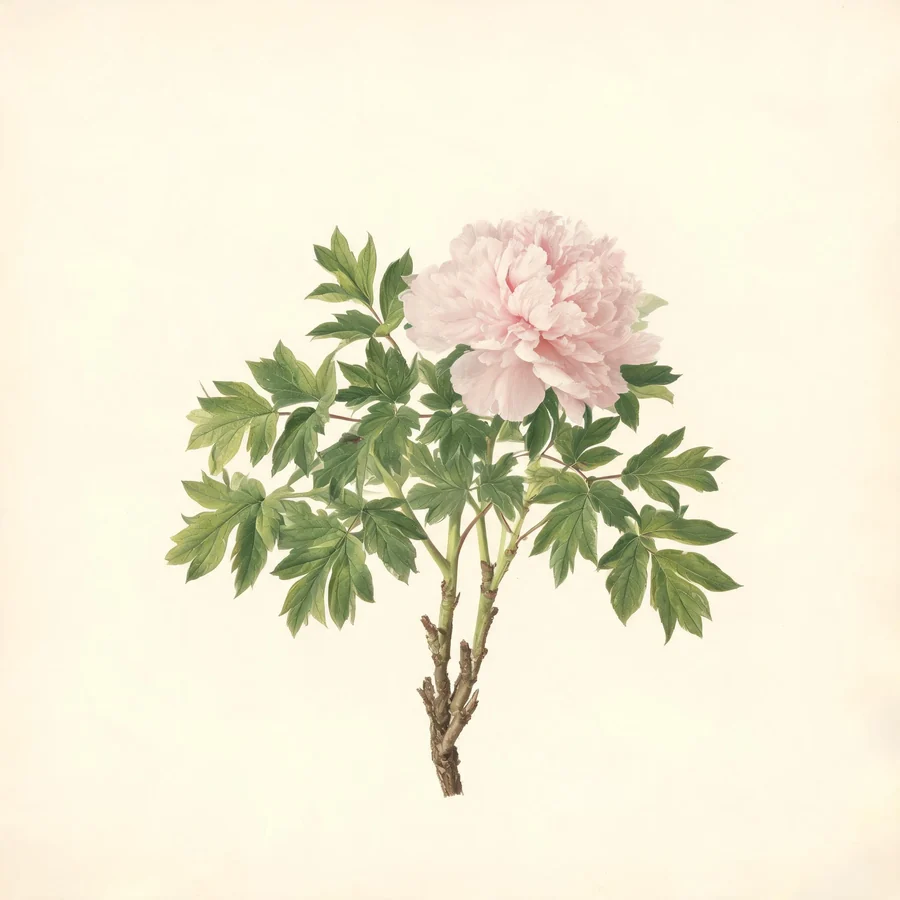
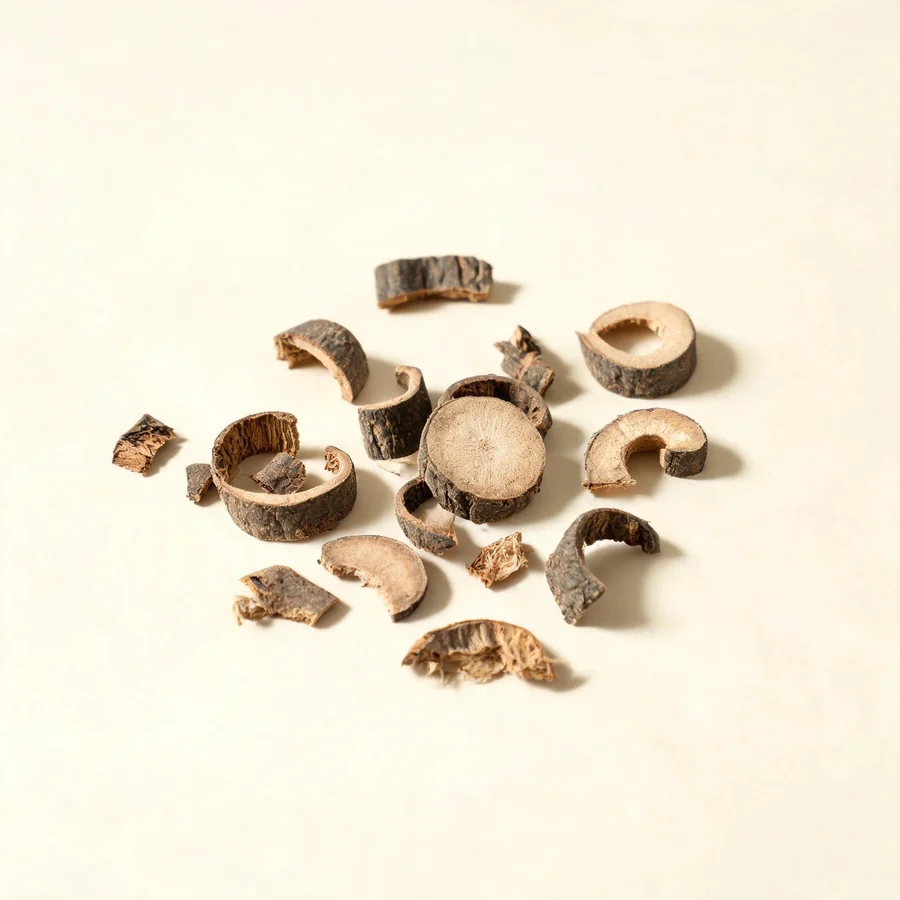
Skin profile
Where this herb sits in skin practice: the pattern it corrects, the skin signs it suits, and what it should not be used for.
Mu Dan Pi is chosen when a skin eruption is hot and deep: purple or dark red, spreading quickly, or fixed and tender. It cools the Blood and keeps it moving, and it is the herb that handles the quiet heat of depletion as well as the fierce heat of an acute rash.
Skin signs that suggest it
- Deep red or purplish patches that feel hot and spread quickly
- Facial flushing with burning, heat and visible vessels
- Petechiae or purpura that do not blanch, with heat signs
- A rash that follows a fever or a medicine, dark red and confluent
- Fixed, tender, dusky patches or nodules
- A dark red tongue with little coating and a rapid, thin pulse
When it is not the right herb
Not for pale, cold, dry skin with no heat, and not for a weak digestion with a poor appetite, loose stools and a pale wet tongue. It is avoided in pregnancy and where periods are already heavy. Because it both cools Blood and sets it in motion, it is not the herb for bleeding that is difficult to control.
What it does for skin
Skin-relevant actions only. Each one describes a mechanism in TCM terms and what it looks like on the skin.
Cools the Blood and clears a hot rash
When heat moves past the surface into the Blood, the rash becomes deep red or purplish, spreads quickly and may come with fever, thirst or a dark tongue. Mu Dan Pi cools that level, and its acrid quality vents the heat outward so it is not trapped. It is used in drug eruptions, in the eruptive stage of febrile illness and in the inflammatory phase of psoriasis.
Moves Blood and disperses stasis in the skin
Fixed dusky patches, tender nodules and old marks that will not fade are read as Blood that has stopped moving. Mu Dan Pi cools and moves at once, which the tradition describes as cooling without congealing and moving without causing reckless bleeding. It suits stasis that has bred its own heat, such as bruising that remains sore and discoloured for weeks.
Clears deficiency heat that flushes the face
When Yin is depleted the heat is quiet rather than fierce: flushing in the afternoon, warmth of the palms and soles, night sweating and a red tongue with little coating. Mu Dan Pi reaches into the Yin level to clear that heat, which explains its place in formulas for empty fire with a flushed face. It clears the heat rather than simply stopping the sweat.
Reduces swelling and disperses an early abscess
A hot, tender swelling before pus forms is heat and stagnation locked together. The bitter cold clears the heat while the acrid movement breaks the clump, and the classical record names it for early abscess. It suits the early stage, and a pointing abscess needs surgical care.
Skin conditions it is used for
Mapped to the condition pages on this site. The pattern column shows what the skin is doing when this herb is the right choice.
| Condition | Pattern | Why it suits | Typical setting |
|---|---|---|---|
| Acne | Blood heat with stasis in inflamed lesions | Acne with deep red or dusky papules, nodules and marks that persist is read as heat in the Blood with stasis. Mu Dan Pi cools that Blood and disperses the clump, and it is a standard partner for Huang Qin and Zhi Zi in heat-clearing acne formulas. It is a supporting herb rather than a treatment for the follicular infection alone. | Modified Qing Wei San with Mu Dan Pi, Huang Qin and Zhi Zi |
| Rosacea | Heat in the face with blood stasis | Persistent redness, burning and visible vessels are read as heat held in the facial Blood, with stasis keeping it fixed. Mu Dan Pi vents and cools that heat while moving the stagnant Blood, which is why it recurs in formulas for facial redness and flushing. Sun protection, trigger avoidance and assessment for underlying rosacea care still come first. | Zhi Bo Di Huang Wan with Mu Dan Pi and Lian Qiao |
| Psoriasis | Blood heat with stasis in thick plaques | Psoriasis plaques that are deep red, thick and slow to clear are read as heat in the Blood with stasis. Mu Dan Pi cools and moves together, and it is used with Sheng Di Huang and Chi Shao in the blood-cooling approach. It is not a cure, and severe disease needs dermatological management rather than herbs alone. | Liang Xue Di Huang Tang with Mu Dan Pi and Chi Shao |
| Purpura | Heat in the Blood damaging the vessels | Purpuric spots that do not blanch, with a red or dark tongue and heat signs, are read as heat that has entered the Blood and damaged the vessels. Mu Dan Pi cools the Blood and disperses the stasis left in the skin, and it is combined with other cooling herbs. All purpura needs medical assessment, because the causes include conditions this herb cannot treat. | Liang Xue Di Huang Tang or Qing Ying Tang with Mu Dan Pi |
| Drug rash | Heat toxin in the Blood after a medicine | A rash that appears after a drug, dark red and confluent, with fever and a red tongue, is read as heat toxin that has entered the Blood. Mu Dan Pi cools and vents that heat and moves the stasis it leaves behind, and it is used with Sheng Di Huang in the classical blood-cooling pattern. The first step is always to stop the suspected drug and seek medical advice. | Qing Ying Tang with Mu Dan Pi and Sheng Di Huang |
| Melasma | Stasis with heat in the facial vessels | Grey-brown facial patches without scaling are read as stasis, and where the complexion is also flushed or the person feels hot, a cooling mover is preferred to a warming one. Mu Dan Pi disperses the stasis without adding heat, and it is used in formulas that also nourish Yin or Blood. Sun protection is essential, and improvement is slow. | Gui Zhi Fu Ling Wan, or Liu Wei Di Huang Wan with added stasis-moving herbs |
Combinations for skin
Herbs it is paired with when the skin, not an internal organ, is the target.
| Partner | Ratio | Why the pair is used |
|---|---|---|
| Chi Shao | 10 g each | Both cool and move the Blood, and they are usually given together. Chi Shao breaks stasis more forcefully and is the better choice for painful swelling, while Mu Dan Pi reaches further into heat, including the quiet heat of depleted Yin, so the pair covers a wide range of hot, dusky lesions. |
| Sheng Di Huang | 10 to 15 g Sheng Di Huang with 6 to 10 g Mu Dan Pi | Sheng Di Huang cools and nourishes the Blood, and Mu Dan Pi keeps that rich, sticky cooling from stagnating. The pair is the backbone of blood-cooling for a hot rash with dryness, and it is used where clearing alone would leave the skin dry. |
| Huang Qin | 6 to 10 g each | Huang Qin clears heat and dries Dampness above, while Mu Dan Pi works a level deeper, in the Blood. The pair is used where a hot eruption has both a damp component and a fixed, dusky quality, and it suits inflamed acne and facial redness. |
| Zhi Zi | 6 to 10 g each | Zhi Zi drains heat from all three burners and calms restlessness, whereas Mu Dan Pi cools the Blood and vents it. The pair is used for hot skin with irritability and broken sleep, which is the picture in which a flare and a poor night feed each other. |
| Gui Zhi | 6 to 10 g Gui Zhi with 6 to 9 g Mu Dan Pi | An odd-looking pair: Gui Zhi is warm and moves Blood held by cold, Mu Dan Pi is cold and frees Blood held by heat. The two are combined when stasis has aged into a mixture of cold within the vessels and heat within the Blood, and each tempers the other. |
Formulas where it leads
- Liu Wei Di Huang Wan (六味地黄丸) - The foundational Yin-nourishing formula, where Mu Dan Pi belongs to the group of three draining herbs, present to clear empty fire that the rich tonics would otherwise feed. It is the context for flushing, night heat and a red tongue with little coating.
- Qing Ying Tang (清营汤) - A formula for heat that has entered the nutritive and Blood levels, with fever at night, a rash and a dark red tongue. Mu Dan Pi cools and moves the Blood while the other herbs clear the deeper heat.
- Liang Xue Di Huang Tang (凉血地黄汤) - A blood-cooling formula for hot rashes, purpura and bleeding with heat. Mu Dan Pi is added for its cooling and moving combination when the lesions are dark and fixed rather than bright red.
- Gui Zhi Fu Ling Wan (桂枝茯苓丸) - A formula for stasis, with cinnamon twig, peach kernel, red peony and Fu Ling. Mu Dan Pi is one of its five herbs, cooling the stasis so that the movement does not generate heat, and the formula is a context for dusky patches and fixed nodules.
Safety for skin use
What to check before recommending or using it, including the cautions that matter most for skin patients.
Do not use, or use with caution
- Pregnancy: the bark cools and moves Blood, and the classical texts list it among herbs to avoid in pregnancy because it can disturb the fetus.
- Cold, weak digestion: poor appetite, loose stools and a pale wet tongue. A bitter cold herb makes that picture worse.
- Heavy periods or bleeding that is difficult to control, because the bark both cools Blood and sets it moving.
- Deficiency cold, or a long illness without rebuilt strength: the cold nature is inappropriate where the warming fire of the body is already low.
- Profuse spontaneous sweating, which the Qing commentators list as a caution because the bark disperses, and someone already losing fluids has nothing to spare.
Pregnancy and breastfeeding
Contraindicated. Mu Dan Pi moves Blood and cools it, and the classical record names it explicitly among herbs prohibited in pregnancy; animal work has also reported effects on early pregnancy. For a woman who is bleeding or threatening to miscarry, a cooling bark that moves Blood is the wrong choice at the wrong moment. Anything beyond that needs a clear indication and close supervision; ordinary practice leaves it out altogether. Breastfeeding is not established either: short courses at ordinary doses are preferred, and the infant's stools and feeding should be watched.
Interactions
- Anticoagulants and antiplatelet drugs such as warfarin, heparin, aspirin and clopidogrel: Antiplatelet activity for paeonol has been reported from laboratory work, so bleeding risk may rise. Tell both prescribers before starting a formula that contains it.
- Blood pressure medicines: Animal studies show decoctions lowering blood pressure, so an additive effect is plausible and readings are worth checking once treatment starts.
- Diabetes medicines: preclinical work reports glucose lowering by paeonol and its metabolites, which matters for people on insulin or a sulphonylurea.
- Sedatives and alcohol: animal work also reports sedation, so a formula containing the bark may feel stronger alongside sleeping tablets or alcohol.
Allergy and patch testing
Allergy to Mu Dan Pi is uncommon. Contact reactions to herb-containing preparations occur, and sulphur-fumigated bark is the more likely irritant, so material that smells of a struck match should be avoided. Patch test topical preparations, and stop if itching or redness increases.
General safety references
General references for herbal hepatotoxicity and herb-drug interactions; they are not specific to this herb.
- Review article: Herbal hepatotoxicity - an update on traditional Chinese medicine preparations. Alimentary Pharmacology & Therapeutics, 2014. PMID: 24844799.
- Interactions between herbal medicines and prescribed drugs: an updated systematic review. Drugs, 2009. PMID: 19719333.
- Warfarin and food, herbal or dietary supplement interactions: a systematic review. British Journal of Clinical Pharmacology, 2021. PMID: 32478963.
Evidence
The classical record is quoted with its source. The modern note states the level of evidence plainly.
Classical record
It governs alternating chills and fever, wind strike with twitching and convulsion, fright and epilepsy from noxious qi. It removes hard masses and blood that has lodged in the stomach and intestines, settles the five viscera, and treats abscesses and sores.
Shen Nong Ben Cao Jing - Already the oldest record holds both themes together: heat deep in the body, and clumped blood that must be broken, with abscesses and sores named among the targets.
It nourishes yin and subdues fire, resolves the toxin of macules, benefits the throat and frees blood that is stagnant in the urine. Later physicians used phellodendron alone for ministerial fire, not knowing that tree peony bark does it better. The red flowered kind moves, the white flowered kind supplements, and few people make the distinction.
Ben Cao Gang Mu - The line on macules is the skin warrant; the rest is an argument with his contemporaries about empty fire.
Tree peony bark enters the Heart and frees what is blocked inside the blood vessels, much as cinnamon twig does. The difference is temperature: cinnamon twig is warm, so it frees cold that has bound the vessels, while tree peony bark is cold, so it frees heat that has bound them.
Ben Jing Shu Zheng - A neat summary of its place: the door cinnamon twig opens, entered from the other side.
Modern evidence
Evidence status
- Laboratory studies of paeonol and of whole bark extracts report anti-inflammatory, antioxidant and microcirculation activity. These are mainly cell and animal studies rather than trials in people with skin disease.
- Clinical trial evidence for Mu Dan Pi in acne, rosacea or psoriasis is very limited, and most of it comes from studies of multi-herb formulas rather than of the herb alone.
- The antiplatelet, blood pressure and glucose effects reported in laboratory work are the basis of the interaction notes, not evidence of a skin benefit.
PubMed records
Selected real PubMed records for this herb's species or its constituents, chosen by species name and title relevance. They are references for the non-TCM discussion above, not proof that the herb treats any skin condition.
- Paeonia × suffruticosa (Moutan Peony)-A Review of the Chemical Composition, Traditional and Professional Use in Medicine, Position in Cosmetics Industries, and Biotechnological Studies.. Plants (Basel, Switzerland), 2022. PMID: 36501418 (pharmacology or review record).
- Origins, Phytochemistry, Pharmacology, Analytical Methods and Safety of Cortex Moutan (Paeonia suffruticosa Andrew): A Systematic Review.. Molecules (Basel, Switzerland), 2017. PMID: 28590441 (safety record).
- Safety and efficacy of tyrosinase inhibition of Paeonia suffruticosa Andrews extracts on human melanoma cells.. Journal of cosmetic dermatology, 2019. PMID: 30895725 (safety record).
Dose and forms
Skin-practice dosing and the preparations that suit skin complaints.
| Form | Dose and notes |
|---|---|
| Decoction | 6 to 12 g of dried root bark daily. Six to nine grams cools the Blood and clears empty heat, and nine to twelve grams moves stasis. |
| Upper range | Some clinical sources permit 15 to 20 g when blood heat is acute, with fever or bleeding, under supervision. Routine use above 12 g is not advised. |
| Decoction handling | Paeonol evaporates easily, so the bark goes in for the final ten to fifteen minutes instead of the whole decoction. Remove the woody core before use. |
| Charred and raw | Charred bark is chosen where bleeding dominates, raw bark where heat does. In skin practice the raw form is the usual one, and the two are not interchangeable. |
Purpose, not body size, governs the dose. The lower half of the range cools blood and clears empty heat, the upper half moves stasis in a fixed lesion, and the highest figures are for acute febrile bleeding managed under supervision. Because the cooling and moving actions define the limit rather than any known toxicity, the question is whether the pattern still needs them, not how much can be tolerated.
Citations and further reading
Only real sources are listed: the classical materia medica passages quoted above, and the source works behind the botanical and safety statements.
- Shen Nong Ben Cao Jing (Divine Husbandman's Classic of Materia Medica), attributed compilation of the Han period - classical entry quoted above.
- Ben Cao Gang Mu (Compendium of Materia Medica), Li Shizhen, 1578 - classical entry quoted above.
- Ben Jing Shu Zheng, on the action of tree peony bark in the vessels - classical entry quoted above.
- Mu Dan Pi monograph: Pharmacopoeia of the People's Republic of China - source for the accepted botanical source, part used and quality requirements.
- Modern evidence statement: based on laboratory and review literature on paeonol, summarised as a statement about the level of evidence rather than as a cited finding.
- Botanical description and identification: botanical literature on Paeonia suffruticosa, Paeoniaceae.
Educational reference for qualified practitioners. This page is not medical advice, and skin conditions should be diagnosed by a clinician before treatment.