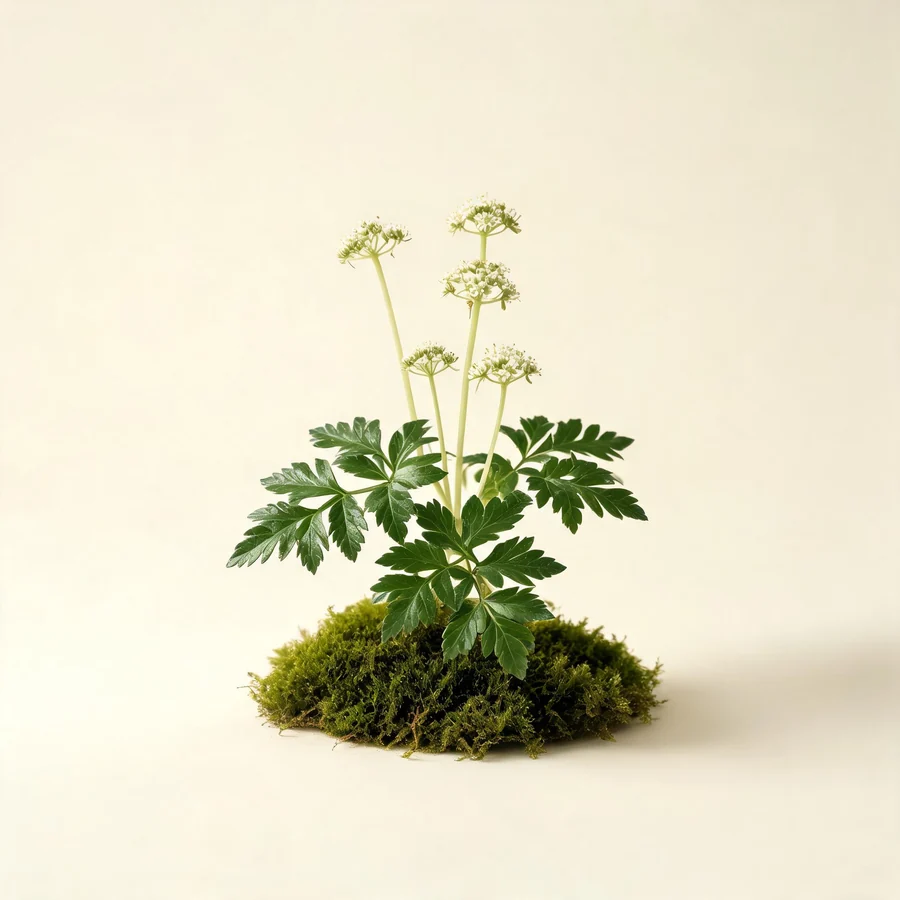
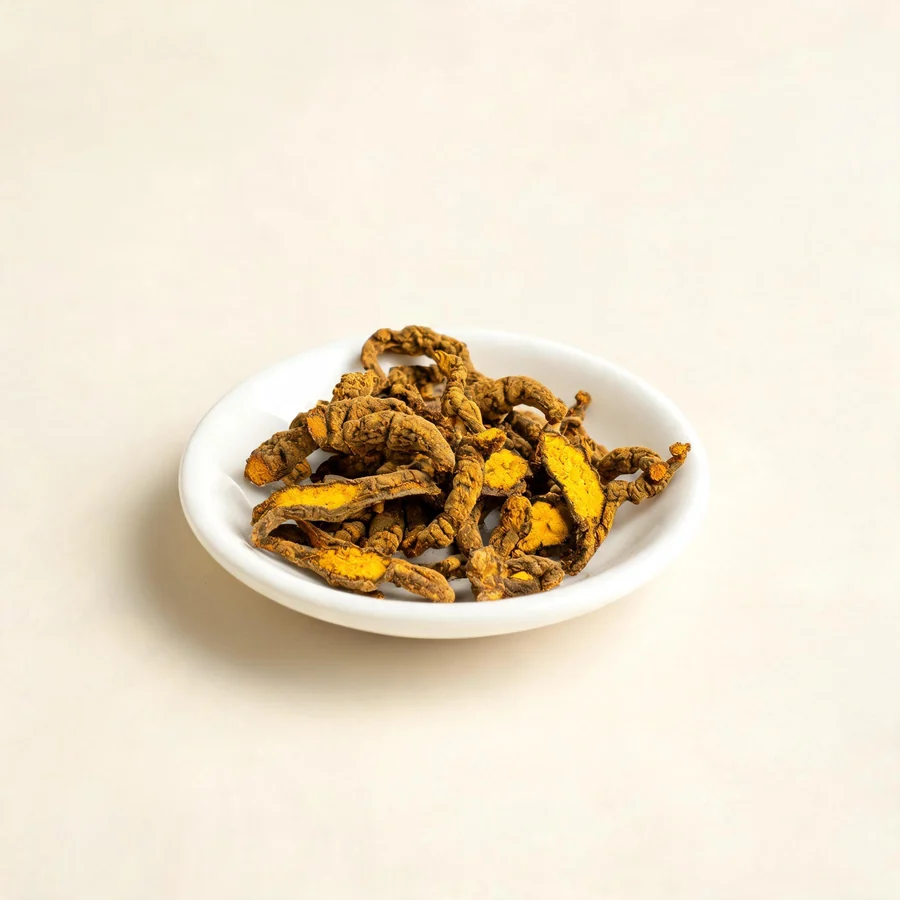
Skin profile
Where this herb sits in skin practice: the pattern it corrects, the skin signs it suits, and what it should not be used for.
Huang Lian is the herb for fire and toxin that have become moist and pustular, and for the same heat when it appears in the mouth. It is the strongest and harshest of the bitter roots, so it is given briefly and in small doses, and it is not used for dry or cold skin.
Skin signs that suggest it
- Red, hot, swollen and painful lesions with yellow pus, crusting or a sticky discharge (heat toxin)
- Pustules and boils with surrounding redness, or folliculitis that keeps returning in the same area
- Sores around or inside the mouth, with a red tongue tip, a bitter taste and burning when eating
- Burning or itchy skin that is worse for warmth and easier with cool applications
- A red tongue coated thickly with yellow, and a rapid, forceful pulse
When it is not the right herb
Not for dry, pale, thin skin without heat, and not for cold-type eczema that is lichenified, dry and cold to the touch. Sores that are pale, sunken and discharging thin clear fluid reflect deficiency rather than excess, and clearing them with a bitter cold herb weakens the person further. Heat that comes from deficiency, with night sweats, a dry mouth and a thin rapid pulse, is also the wrong picture, because the drying quality takes away the little moisture that remains. Because the root is intensely bitter and cold, courses are kept short and doses small, especially where the digestion is already weak.
What it does for skin
Skin-relevant actions only. Each one describes a mechanism in TCM terms and what it looks like on the skin.
Drains Dampness and clears Heat from inflamed skin
This is the core skin action: a lesion that is both inflamed and moist. Huang Lian suits weeping eczema, maceration in the skin folds, a scalp with thick yellow greasy scale, and intertrigo under the breasts or between the toes. The bitterness dries the moisture while the coldness lowers the heat, so the ooze and the redness settle together. It is chosen where the discharge is yellow and sticky rather than clear and watery, and where the surface feels hot to the back of the hand.
Purges Fire and resolves Toxin in pustular and infected skin
When inflammation has become infection, with pustules, boils, impetigo or a hot tender swelling that is spreading, Huang Lian is one of the strongest herbs available. It clears the fire that drives the lesion and addresses the toxin that makes it suppurate and spread. In practice it is combined with Lian Qiao or Pu Gong Ying for boils, and with Huang Qin when redness extends beyond the pustules. Broken skin with spreading redness and fever needs medical assessment rather than another wash.
Clears Heart and Stomach fire that shows on the face and mouth
Tongue sores and a red tongue tip point to the Heart, while gum inflammation and ulcers beside the lips point to the Stomach, because those channels run to the tongue and the gums. The same reading is applied to facial eruptions that flare with stress, sleeplessness or rich food, and to a persistent redness around the mouth or nose. Nothing else in the materia medica reaches that fire so directly, which is why both internal formulas and simple pastes for the mouth rely on it.
Cools the Blood and calms burning itch
Where heat has entered the blood the rash is a deeper red or purplish colour, spreads quickly, and may carry a burning rather than a crawling itch. Huang Lian cools that heat, and it is used as a supporting herb in formulas for acute eruptive rashes and hot, angry dermatitis. It is not a sedating antipruritic: it reduces itch by removing the heat that drives it, which is why it works in red, warm skin and not in dry neuropathic itch.
Skin conditions it is used for
Mapped to the condition pages on this site. The pattern column shows what the skin is doing when this herb is the right choice.
| Condition | Pattern | Why it suits | Typical setting |
|---|---|---|---|
| Acne | Heart and Stomach fire with heat toxin | Inflamed papules and pustules on a flushed, oily face, with a red tongue tip and a bitter taste, point to fire in the Heart and Stomach. Huang Lian drains that fire and resolves the pustular toxin, and it is used when the lesions are angry and red rather than deep, cold and cystic. It usually appears alongside Huang Qin and Zhi Zi so that the upper-body heat is cleared from more than one direction. | Huang Lian Jie Du Tang, or a modified Pi Pa Qing Fei Yin with Huang Qin and Zhi Zi |
| Boils | Toxic heat gathering in the flesh | A hot, hard, tender swelling that is heading toward suppuration is the clearest expression of toxic heat. Huang Lian is chosen for its strength: it clears the fire and resolves the toxin before the lesion points, and it is combined with herbs that disperse swelling and with herbs that address the surface. Once an abscess has opened and is draining freely, the emphasis shifts toward healing and the clearing herbs are reduced. | Huang Lian Jie Du Tang or Wu Wei Xiao Du Yin, modified |
| Folliculitis | Heat toxin lodged in the hair follicles | Scattered pustules on a red base at the openings of the follicles, often on the scalp, the beard area or the limbs, are read as heat toxin in the skin. Huang Lian dries the dampness that keeps the follicles inflamed and clears the toxin that produces the pus. It is a standard ingredient of the internal formulas used for recurrent folliculitis, and a dilute decoction is sometimes used as a wash in the same picture. | Modified Huang Lian Jie Du Tang with Lian Qiao and Pu Gong Ying |
| Impetigo | Damp-heat toxin with yellow crusting | Honey-coloured crusts over red, oozing skin, most often around the nose and mouth in a child, are read as damp-heat toxin sitting close to the surface. The bitter drying quality of Huang Lian suits the weeping stage, and its toxin-clearing action suits the crusting and the spread. Because impetigo is contagious and can move quickly, it needs medical assessment, and a herb wash is only an adjunct where the area is small. | A modified Huang Lian Jie Du Tang, with a dilute cooled decoction used as a local wash |
| Eczema | Damp-heat with marked ooze and redness | An acute eczema flare that weeps, crusts and burns rather than simply itching is the classic damp-heat picture, and Huang Lian is the strongest of the drying herbs for it. It is used where the lesions are hot and wet, and it is usually combined with Huang Qin for the upper body and Huang Bo for the lower body so that the whole affected area is covered. Dry, chronic lichenified eczema is a different pattern and does not suit this herb. | Modified Long Dan Xie Gan Tang, or a damp-heat wash with Ku Shen and Huang Bo |
| Skin abscess | Toxic heat with pus and deep swelling | A deeper collection of pus with heat, pain and swelling is treated with the same toxin-clearing strategy as a boil, with more attention to dispersing the mass and preventing spread. Huang Lian supplies the strongest fire-clearing and toxin-resolving action among the bitter roots, and it is combined with herbs that soften and disperse. A large, deep or febrile abscess belongs in medical care, and herbs are used only inside a supervised formula. | Wu Wei Xiao Du Yin with Huang Lian and Lian Qiao added |
Combinations for skin
Herbs it is paired with when the skin, not an internal organ, is the target.
| Partner | Ratio | Why the pair is used |
|---|---|---|
| Huang Qin | 3 to 6 g Huang Lian with 6 to 10 g Huang Qin | Both are bitter and cold and both drain damp-heat, but they cover different territory. Huang Qin works on the upper body and the skin surface, while Huang Lian works on the Heart and Stomach and is stronger against toxin. Together they are used when redness and pustulation extend across the face, chest and back, and they form the core of the great fire-purging formulas. |
| Huang Bo | 3 to 6 g Huang Lian with 6 to 10 g Huang Bo | The two together are part of the classic trio of bitter-cold roots that covers the whole body. Huang Lian handles the middle and the Heart, Huang Bo the lower body and the legs, and the pairing is used when a damp-heat eruption affects both the trunk and the lower limbs. The combination is strongly drying, so it is kept short and paired with a Spleen-protecting herb when the digestion is delicate. |
| Zhi Zi | 2 to 5 g Huang Lian with 6 to 10 g Zhi Zi | Zhi Zi drains heat from the three burners and gives it a route out through the urine, which complements the fire-draining action of Huang Lian. The pair appears in the formulas for hot, restless people with inflamed skin, a bitter taste and a flushed face. Zhi Zi is the gentler of the two, so it is given in the larger amount while Huang Lian supplies the force against the toxin. |
| Ku Shen | 3 to 6 g Huang Lian with 6 to 10 g Ku Shen | Ku Shen is the skin specialist among the bitter cold herbs, strongest against itch and lower-body damp-heat, while Huang Lian is stronger against fire and toxin. Together they suit infected, itchy eczema where scratching has produced oozing and crusting, and they are a common pairing in both internal formulas and washes. Both are drying, so an emollient routine is needed alongside. |
| Mu Dan Pi | 3 to 5 g Huang Lian with 6 to 10 g Mu Dan Pi | Mu Dan Pi cools the blood and moves stasis, which reaches the deep redness and purplish tone that Huang Lian alone does not address. The pair is used when an eruption is angry, dusky and slow to resolve, and it is a standard element of formulas for blood-heat rashes. Mu Dan Pi also restrains the tendency of the cold herbs to stagnate blood in the lesions. |
Formulas where it leads
- Huang Lian Jie Du Tang (黄连解毒汤) - The classic formula for fire and toxin, built on Huang Lian, Huang Qin, Huang Bo and Zhi Zi. It is used for hot, swollen, pustular and spreading skin lesions with a red tongue and a rapid pulse. It is a strong, drying formula given for a short period, and it is not a maintenance treatment.
- Wu Wei Xiao Du Yin (五味消毒饮) - A formula for toxic heat gathering into boils and abscesses, where Huang Lian may be added to the five leading toxin-clearing herbs. It is used before a lesion points, when the aim is to disperse the swelling and stop the toxin from spreading. The classic version rests on Jin Yin Hua, Pu Gong Ying and Zi Hua Di Ding.
- Pi Pa Qing Fei Yin (枇杷清肺饮) - A classical formula for acne driven by Lung and Stomach heat, in which Huang Lian is one of the heat-clearing ingredients. It suits red papules and pustules on an oily complexion, and it is gentler for longer use than the fire-purging formulas.
Topical use
Huang Lian has a long external record for hot, weeping and infected skin, and the root is used as a cooled decoction, a paste or a fine powder. Applied to a limited area it dries ooze, reduces redness and addresses surface toxin directly. It stains fabric and skin a strong yellow, and it is used on small areas rather than as a general body application.
| Preparation | How and when it is used |
|---|---|
| Cooled decoction compress | Simmer 5 to 10 g of sliced root in 500 ml of water for 15 minutes, strain, and cool to skin temperature. Soak clean gauze and apply to the affected area for 10 to 15 minutes once or twice daily; make a fresh batch each day and discard what is left. |
| Powder and paste | Finely ground root is mixed with a little water, honey or a bland cream to a soft paste and dabbed thinly on pustules or crusted lesions. Keep the layer thin, and wash it off after 20 to 30 minutes if the skin is sensitive. |
| Dilute wash | A weaker decoction is used to rinse larger areas such as the scalp or the back, or as a hand and foot soak. Strain carefully so that no grit remains, and do not share the bowl or cloth between people, because infected lesions can spread by contact. |
Patch test and cautions
Patch test on a small area of normal skin for 24 hours before first use. Do not apply to deep, ulcerated or openly infected skin without supervision, and do not use near the eyes or on the eyelids. Stop at once if burning, stinging or spreading redness develops, and do not cover the treated area with an airtight dressing. The strong yellow colour stains skin and fabric and takes several days to fade.
Safety for skin use
What to check before recommending or using it, including the cautions that matter most for skin patients.
Do not use, or use with caution
- Spleen and Stomach deficiency-cold: a poor appetite, loose stools, a cold abdomen and a pale tongue. The bitter cold weakens digestion further and can cause diarrhoea, which is the most important limit on this herb.
- Deficiency heat rather than excess fire: night sweats, a dry mouth, a thin rapid pulse and a red, peeled tongue. The drying quality removes moisture that is already scarce.
- Pale, sunken sores with thin clear discharge, which reflect Qi deficiency rather than toxic heat. Clearing in that picture delays healing and leaves the person more tired.
- Long courses without review. This is not a maintenance herb, and the digestive cost accumulates with duration rather than appearing at a single dose.
Pregnancy and breastfeeding
Use only under practitioner supervision. No classical list of banned herbs includes Huang Lian, but it is intensely cold and bitter, and the tradition holds that it can injure the Spleen and Stomach on which a pregnancy depends. Laboratory studies of berberine have raised questions about the uterus, but at exposures far above those of a decoction. Topical use on a small area is generally considered lower risk, but it should still be checked, and the mouth and nipple should be avoided.
Interactions
- Berberine inhibits several liver enzymes, including CYP2D6, CYP2C9 and CYP3A4, in laboratory work and in a small human study. Medicines handled by these pathways can in theory rise in the blood while the herb is taken, so a prescriber should be told about it.
- Warfarin and other anticoagulants: berberine has been linked to swings in clotting readings, and the herb should not be started or stopped without an INR check and advice.
- Glucose-lowering medicines: berberine has its own glucose-lowering effect. Added to metformin, a sulphonylurea or insulin it can push blood sugar below the intended range, so readings should be checked more often and the prescriber told.
- Ciclosporin and similar immunosuppressants: the alkaloid blocks CYP3A4 and the P-glycoprotein transporter, and raised ciclosporin levels have been reported. This is one of the few genuinely important interactions and it belongs to the prescriber.
- G6PD deficiency is a reason to avoid the herb rather than a drug interaction: in people with the enzyme deficiency, berberine-containing herbs can trigger haemolysis. Anyone with this diagnosis should not take it without specialist advice.
Allergy and patch testing
Contact dermatitis to herbal washes and pastes is well recognised, and a patch test is sensible before the first application. The root belongs to the buttercup family rather than to the mint family, so a reaction to mint does not predict one here, but a previous reaction to a herb-containing cream is a reason for caution. Stop the preparation if the skin becomes more irritated rather than calmer.
General safety references
General references for herbal hepatotoxicity and herb-drug interactions; they are not specific to this herb.
- Review article: Herbal hepatotoxicity - an update on traditional Chinese medicine preparations. Alimentary Pharmacology & Therapeutics, 2014. PMID: 24844799.
- Interactions between herbal medicines and prescribed drugs: an updated systematic review. Drugs, 2009. PMID: 19719333.
- Warfarin and food, herbal or dietary supplement interactions: a systematic review. British Journal of Clinical Pharmacology, 2021. PMID: 32478963.
Evidence
The classical record is quoted with its source. The modern note states the level of evidence plainly.
Classical record
主五脏冷热,久下泄澼脓血,止消渴、大惊,除水、利骨、调胃、厚肠益胆,治口疮。
It addresses cold and heat in the five organs and long-standing dysenteric discharge containing pus and blood. It stops wasting-thirst, settles severe fright, clears retained water, strengthens the bones, harmonises the Stomach, consolidates the intestines, benefits the Gallbladder and heals mouth sores.
Ming Yi Bie Lu (Supplement to the Classic of Materia Medica) - The mouth sores and purulent discharge in this early passage are the mucosal and suppurative skin uses the root still serves, in the language of the time.
入心泻火,镇肝凉血,燥湿开郁,解渴除烦,益肝胆,浓肠胃,消心瘀,止盗汗。
Entering the Heart it drains fire; it settles the Liver and cools the blood, dries dampness and releases constraint, eases thirst and dispels restlessness, supports the Liver and Gallbladder, firms the Stomach and intestines, scatters stasis within the Heart and halts night sweats.
Ben Cao Bei Yao - Cooling the blood and drying dampness are named together here, which is the classical basis for using the root in hot, weeping and inflamed skin.
Modern evidence
Evidence status
- Laboratory work on berberine and the whole-root extract reports antibacterial, antifungal and anti-inflammatory activity, including against organisms commonly found on infected skin. These are mainly cell and animal studies, and the concentrations used are often far above what a decoction achieves in tissue.
- The oral bioavailability of berberine is low, under about 5 per cent in most reports. That explains why the herb is tolerated internally at small doses, and also why its systemic effects are hard to predict from laboratory data alone.
- Clinical trial evidence for Huang Lian in skin disease is thin, mostly small studies published in Chinese and usually testing multi-herb formulas rather than the single root. The rhizome is an accepted substance in the Chinese Pharmacopoeia; the material here describes traditional practice and the level of evidence, not proven benefit.
PubMed records
Selected real PubMed records for this herb's species or its constituents, chosen by species name and title relevance. They are references for the non-TCM discussion above, not proof that the herb treats any skin condition.
- Biological properties and clinical applications of berberine.. Frontiers of medicine, 2020. PMID: 32335802 (pharmacology or review record).
- Landscape of Berberine Targets: A Potential Pharmacological Insight for Heart Failure Treatment.. Journal of cardiovascular pharmacology, 2025. PMID: 40833320 (pharmacology or review record).
Dose and forms
Skin-practice dosing and the preparations that suit skin complaints.
| Form | Dose and notes |
|---|---|
| Decoction | 2 to 5 g of dried rhizome daily within a formula. Small doses clear heat gently; 3 to 5 g is the range for established damp-heat and toxin, and anything above that is a short supervised course. |
| Powder and pills | 1 to 2 g a day in divided doses as a powder or in ready-made pills, which is often better tolerated than a decoction because the taste is extremely bitter. Follow the product label and a practitioner's direction. |
| Topical decoction | 5 to 10 g simmered in 500 ml of water, strained and cooled, used as a compress or wash once or twice daily on a limited area of skin. |
| Course length | Days to a couple of weeks, stopped when the heat signs resolve. A course beyond two weeks should be reviewed, and the herb reduced or stopped if the appetite falls or the stools loosen. |
The dose is small because the root is the most bitter and cold in common use, and because the risk is cumulative rather than acute. Berberine is poorly absorbed, so the gut sees a high local concentration, which is the source of both the effect on the digestion and the nausea that limits the dose. In decoction the root goes in near the end, for the final five to ten minutes of cooking, and the ginger-processed form is chosen when the Stomach is sensitive or nausea is part of the picture. Topical preparations can be stronger than the internal dose but are still used on limited areas.
Citations and further reading
Only real sources are listed: the classical materia medica passages quoted above, and the source works behind the botanical and safety statements.
- Ming Yi Bie Lu (Supplement to the Classic of Materia Medica), Tao Hongjing, Southern and Northern Dynasties - classical entry quoted above.
- Ben Cao Bei Yao (Essentials of Materia Medica) - classical entry quoted above.
- Coptis chinensis monograph: Pharmacopoeia of the People's Republic of China - source for the accepted botanical source, part used and quality requirements.
- Modern evidence statement: based on laboratory literature on berberine and the whole rhizome, summarised as a statement about the level of evidence rather than as a cited finding.
- Botanical description and identification: botanical literature on Coptis chinensis, Ranunculaceae.
Educational reference for qualified practitioners. This page is not medical advice, and skin conditions should be diagnosed by a clinician before treatment.