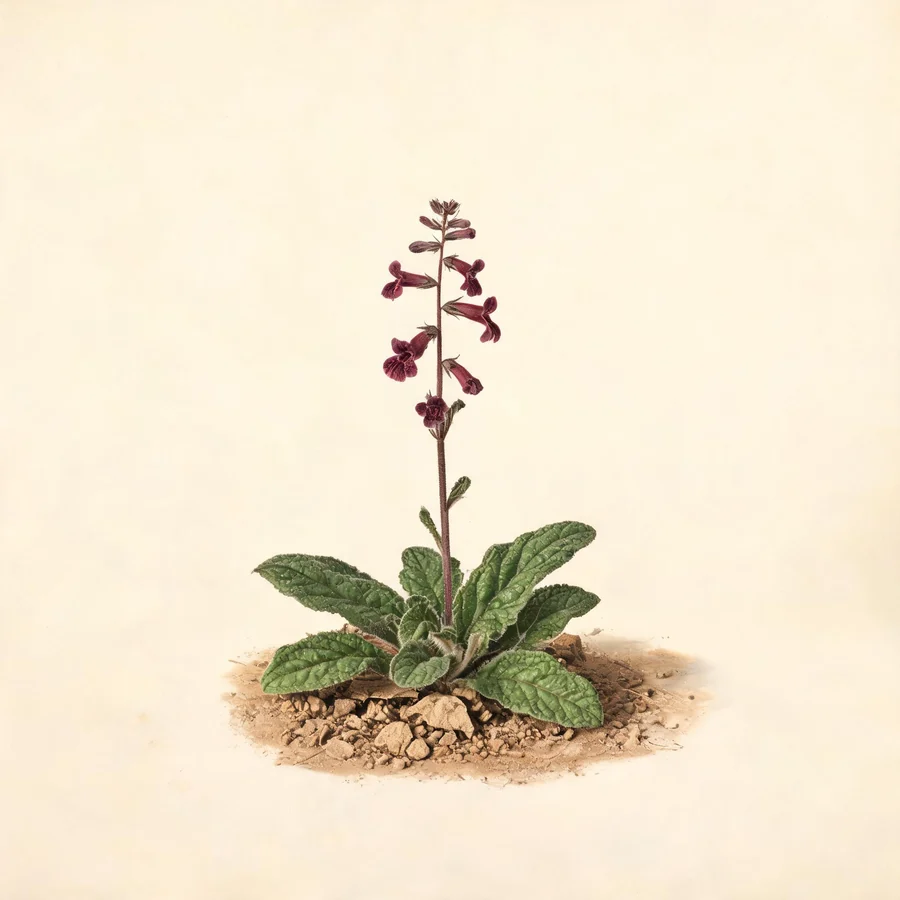
Skin profile
Where this herb sits in skin practice: the pattern it corrects, the skin signs it suits, and what it should not be used for.
Shu Di Huang is chosen when dry skin reflects a lack of Blood and Essence rather than a lack of oil, and when the eruption has stopped oozing. It is a tonic of unmatched richness, so the state of the digestion belongs in the prescription rather than being an afterthought.
Skin signs that suggest it
- Dry, dull, sallow or greyish skin that has lost its lustre, with fine lines and a papery feel
- Thin skin that bruises or splits easily in a person who is pale and tired
- Chronic dry, thickened or lichenified eczema after the weeping phase has passed
- Dry eyes, thinning hair and a sore lower back alongside the skin changes
- A pale tongue with a thin coat and a fine pulse, with night sweats and heat in the palms where Yin is also low
When it is not the right herb
Not for skin that is oily, congested, pustular or weeping. Acne, seborrhoeic skin and the wet phase of eczema all tend to worsen with a rich, sticky tonic, and a greasy coating on the tongue is the clearest sign to stop. It is wrong in Dampness or Phlegm with a heavy body and a poor appetite, and in an acute cold, fever or newly spreading rash, where a tonic given too early is held to keep the pathogen in. Weak digestion with swelling or looseness is the other limit: if it is used at all, it is at a reduced dose with an aromatic herb.
What it does for skin
Skin-relevant actions only. Each one describes a mechanism in TCM terms and what it looks like on the skin.
Rebuilds the Blood that gives the skin its substance
Blood deficiency shows on the surface as pallor, thinness, a dull cast and a papery texture, with dryness that no cream quite fixes. Shu Di Huang is the principal herb for rebuilding that substance, and it is the leading ingredient of the foundational Blood-building formula. The effect is slow, measured over weeks, and it works best when the person is also eating and sleeping well enough to make use of it.
Nourishes Yin and Essence, the deepest layer of moisture
Yin and Essence are the body's reserves, and when they are low the skin dries from the inside out, with night sweats, heat in the palms, a dry throat and a sore lower back. The prepared root is rich, sweet and slightly warm, and it is described as reaching that depth without the cold quality of the raw root. It is the herb for dryness that has a constitutional cause rather than a product or a season behind it.
Softens and settles chronic dry, lichenified skin
Once an eruption has stopped oozing and become dry, thick and grooved, the pattern has changed from Damp-Heat to deficiency with Wind-dryness, and the treatment changes with it. The root supplies the Blood that the thickened skin is short of, while wind-diffusing and itch-settling herbs address the surface. It is not given while the skin is still wet, and the plaque softens over months rather than weeks.
Supports the hair, the nails and slow repair
The tradition links hair to the Blood and nails to the Liver, so both are read as visible reports on the state of the Blood. Where hair thins and nails split alongside dry skin, the root is used as part of a Blood-building formula rather than as a hair treatment. Slow healing of minor injuries and a tendency to bruise in the same person fit the same picture, and the herb supports repair rather than driving it.
Anchors the formulas that treat Wind and itch
The classical rule is to treat the Blood before treating the Wind, because Wind settles where the surface is dry and undernourished. Shu Di Huang is the herb that makes that possible in a formula: it gives the wind-diffusing herbs something to work with, so the itch does not simply return when they are stopped. That is why it sits in the standard formulas for chronic urticaria and dry eczema rather than being reserved for pure tonic use.
Skin conditions it is used for
Mapped to the condition pages on this site. The pattern column shows what the skin is doing when this herb is the right choice.
| Condition | Pattern | Why it suits | Typical setting |
|---|---|---|---|
| Skin Dryness | Blood and Yin deficiency failing to moisten the surface | Dry, rough, dull skin in a pale, tired person, with dry eyes and a sore lower back, is the surface expression of Blood and Yin deficiency. The prepared root is the richest material for rebuilding that substance, and it is used over weeks inside a nourishing formula rather than alone. It is the wrong herb for dryness caused by a harsh cleanser or a cold winter, where emollients and a change of routine do the work, and a thyroid or other systemic cause should be excluded before a long course. | Si Wu Tang with Mai Men Dong and Bai Shao |
| Eczema | Blood deficiency with Wind-dryness in the chronic, lichenified stage | When the weeping has stopped and the skin is left dry, thick, cracked and greyish, with itch that wakes the person at night, the pattern has moved from Damp-Heat to deficiency with Wind-dryness. The root rebuilds the Blood and the wind herbs address the surface, which is the logic of the standard formula for that stage. It is not given while the skin is still oozing, and topical treatment and emollients remain the mainstay of care. | Dang Gui Yin Zi, or Si Wu Tang with Fang Feng and Bai Xian Pi |
| Vitiligo | Blood deficiency with Wind at the surface: pale patches with a defined edge | Depigmented patches with a clear edge, no scaling and no heat are read as Wind and stasis sitting where the Blood no longer reaches the surface. The prepared root is a standard supporting herb in that approach because it builds the Blood that the surface is missing, and it is given with wind-diffusing and pigment-moving herbs over many months. Results are slow and partial, repigmentation is not guaranteed, and sun protection matters because the pale skin burns easily. | Modified Tao Hong Si Wu Tang with Bai Ji Li and He Shou Wu |
| Melasma | Blood deficiency with stasis: dull, grey-brown patches on the face | Symmetrical grey-brown patches without scaling or redness, in a person with a dull complexion, scanty periods and a pale tongue, are read as Blood deficiency with stasis in the facial vessels. The root builds the Blood while the moving herbs in the formula address the stasis, which is why it anchors the standard formula for that pattern. The patches take months to fade, sun protection is essential, and pregnancy-related pigmentation often resolves on its own. | Tao Hong Si Wu Tang |
| Senile Pruritus | Blood and Yin deficiency with Wind from dryness | Itch in later life, in dry thin skin, with a dull complexion, broken sleep and a sore lower back, is read as Blood and Yin no longer reaching the surface, so that Wind moves through it. The root supplies the substance the skin is short of, and it is given with wind-diffusing and itch-settling herbs over weeks to months. It is used cautiously in older people with a delicate digestion, where an aromatic corrective or the ginger-fried form of the root is added. | A Blood-nourishing base with Dang Gui, Bai Shao and Fang Feng |
| Chronic Urticaria | Blood deficiency with Wind: pale wheals, worse at night | Chronic wheals that are pale or barely pink, that come and go for months and that flare when the person is tired, are read as Wind settling on a Blood-deficient surface. The root is the nourishing half of the standard formula for that picture and the wind herbs are the moving half, and the pair is given for weeks rather than used as a rescue. Acute red, heat-provoked hives are a different pattern and need cooling herbs, and antihistamines remain the medical mainstay. | Dang Gui Yin Zi |
Combinations for skin
Herbs it is paired with when the skin, not an internal organ, is the target.
| Partner | Ratio | Why the pair is used |
|---|---|---|
| Dang Gui | 10 to 12 g each, the core of Si Wu Tang | Dang Gui makes and moves Blood while the prepared root supplies the heavier substance, and together they are the pair that most Blood-building formulas are built around. On the skin they are used for dry, dull, pale skin, for slow healing and for the dryness left behind after a long eruption. Dang Gui is warm and moistening, so an aromatic herb is added where the digestion is sluggish. |
| Bai Shao | 12 to 15 g Shu Di Huang with 10 g Bai Shao | Bai Shao gathers and preserves while the root builds, so the pair holds what has been made rather than letting it disperse. It suits dry skin with tightness, cramping and a wiry, thin pulse, where the surface is dry because the Blood is low rather than because the air is dry. The pair is the nourishing half of Si Wu Tang, and it is often the part that does the work in chronic dry eczema. |
| Shan Zhu Yu | 15 g Shu Di Huang with 10 g Shan Zhu Yu | Shan Zhu Yu is sour and slightly warm and it holds the Essence that the root builds, which is the logic of the Kidney-Yin formula they share. On the skin the pair is used for dryness with night sweats, heat in the palms and a sore lower back, where the surface and the deeper reserve are both depleted. The sour quality is astringent, so the pair is not used where there is active oozing or a thick greasy coating. |
| Fang Feng | 12 g Shu Di Huang with 6 to 9 g Fang Feng | This is the Blood-first, Wind-second pairing: the root rebuilds the surface the Wind settled on, and Fang Feng releases the Wind that is left in it. It is the combination behind the standard formula for chronic itchy skin with a Blood deficiency, and it is a better long-term arrangement than a formula made only of wind herbs, which suppresses the itch and lets it return. Fang Feng is kept to a modest share. |
| Sha Ren | 6 g Sha Ren with 12 to 15 g Shu Di Huang | One reason alone brings Sha Ren into the formula: to stop the dense, sticky root from sitting in the stomach. The old image is of rich food that calls for a spice, and the two are combined whenever the full amount of the root is wanted for somebody with a slow stomach, a tendency to swell or a greasy coating. It is an example of the principle that a tonic is only as good as the digestion that has to absorb it. |
Formulas where it leads
- Si Wu Tang (四物汤) - The original Blood-building formula, with the prepared root the heaviest nourisher in a set completed by Dang Gui, Bai Shao and Chuan Xiong. In this edition it is the base to which wind-diffusing or itch-settling herbs are added when dry, dull skin reflects a Blood deficiency, and it is given over weeks.
- Dang Gui Yin Zi (当归饮子) - A Blood-nourishing, Wind-diffusing formula for chronic dry, itchy skin and for eczema that has lost its ooze. The prepared root supplies the substance, Dang Gui and Bai Shao build and hold the Blood, and the wind herbs address the surface itch, which is the pattern this page describes.
- Liu Wei Di Huang Wan (六味地黄丸) - The classical Kidney and Liver Yin formula, with the prepared root as the leading herb. In skin practice it is the context for dryness with low-grade heat and a sore lower back, and it is the formula that most often sits beneath a longer course of Yin nourishment.
Safety for skin use
What to check before recommending or using it, including the cautions that matter most for skin patients.
Do not use, or use with caution
- Dampness or Phlegm with a greasy coating, a heavy body and little appetite: nothing in the materia medica is a richer tonic, and its stickiness adds to what is already congested.
- Weak digestion with bloating, fullness or loose stools: the cloying quality can sit in the stomach and produce exactly those symptoms, so it is given with an aromatic corrective or not at all.
- Oily, congested or pustular skin: acne and seborrhoeic skin with a greasy coating tend to worsen with a rich, warm, moistening tonic.
- An acute cold, fever or a rash spreading day by day: a tonic offered at the wrong moment is held to shut the illness in, and the tradition prefers to wait until the flare has settled.
- Diarrhoea before dawn, with Spleen and Kidney Yang failing, and any looseness of the bowel that rich food makes worse.
Pregnancy and breastfeeding
It moves nothing and carries no reputation for unsettling a pregnancy, and it is found in the old prenatal formulas that build Blood. The practical difficulty is digestive: the root is rich and cloying, and nausea and sluggish digestion are common in early pregnancy, so it is given at a moderate dose with an aromatic herb. Anyone with a history of miscarriage or of bleeding should not take it unsupervised, and it is not a herb to prescribe for oneself for a skin complaint in pregnancy. During breastfeeding it appears in postpartum formulas that rebuild Blood, with attention to the mother's appetite and the infant's stools.
Interactions
- Insulin and oral hypoglycaemics: extracts of the prepared root have reduced glucose in animals, so the effect may add to glucose-lowering treatment; readings are worth checking when a regular course begins.
- Anticoagulants and antiplatelet medicines: the prepared root has shown fibrinolytic activity in the laboratory, so an added risk of bleeding is conceivable for someone on warfarin, heparin, aspirin or clopidogrel.
- Immunosuppressants: in the laboratory its polysaccharides influence immune function, which gives someone on ciclosporin or tacrolimus a reason to raise the herb with their prescriber rather than add it quietly.
Allergy and patch testing
Allergy to the prepared root is uncommon but possible, and it is a member of the broomrape family rather than a common food plant, so cross-reactivity is not well described. A rash, wheeze or digestive upset after a dose is a reason to stop. Because the root is sometimes included in external plasters and ointments, a patch test is sensible before any preparation is applied to the skin, and it is left out of a formula where a previous reaction has occurred.
General safety references
General references for herbal hepatotoxicity and herb-drug interactions; they are not specific to this herb.
- Review article: Herbal hepatotoxicity - an update on traditional Chinese medicine preparations. Alimentary Pharmacology & Therapeutics, 2014. PMID: 24844799.
- Interactions between herbal medicines and prescribed drugs: an updated systematic review. Drugs, 2009. PMID: 19719333.
- Warfarin and food, herbal or dietary supplement interactions: a systematic review. British Journal of Clinical Pharmacology, 2021. PMID: 32478963.
Evidence
The classical record is quoted with its source. The modern note states the level of evidence plainly.
Classical record
It is said to fill the marrow, to make Essence and to darken the hair.
Classical materia medica, as summarised for the prepared root - The references to hair and Essence account for its use in dry, ageing skin and in the slow repair of a depleted surface.
Steaming is said to fill marrow and flesh, to generate Essence and Blood and to mend what is depleted in all five viscera, opening the vessels, serving the ears and eyes, and darkening beard and hair.
Ben Cao Gang Mu, on the prepared root - The sequence runs from the deepest tissue to the surface, which is how a deeply supplementing herb is read, and it explains why the root reaches the skin last and stays longest.
Raw, the root is intensely cold and works to cool Blood, so it belongs where Heat has entered the Blood. Steaming turns it mildly warm, its business becomes supplementing the Kidney, and it then suits those whose Blood is failing.
Zhen Zhu Nang, on raw and prepared - One sentence accounts for the same plant yielding two different medicines, and for the prepared form being the one used on dry, deficient skin.
Modern evidence
Evidence status
- Laboratory work describes the prepared root and its polysaccharides as antioxidant, anti-inflammatory and immune-modulating, and extracts have lowered glucose in animals. These are cell and animal findings rather than trials in people with skin disease.
- No adequate clinical trial of Shu Di Huang in a skin condition was identified. The clinical literature that exists is mostly small studies of multi-herb formulas, often in Chinese-language journals, and this page does not treat those as proof of effect.
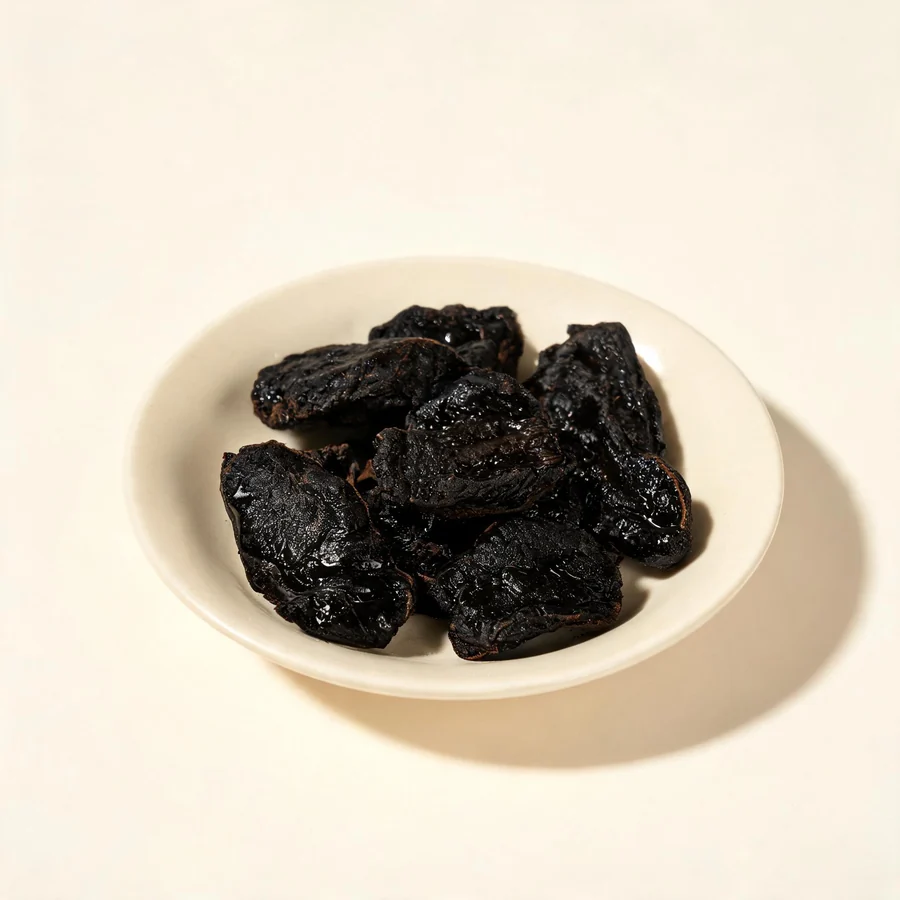
- Identity and preparation are part of the evidence question. The commonest fault is root that has not been steamed through: the interior stays brown, the taste is bitter and the texture hard instead of sticky, and the sweet, glossy, wine-scented article is what the formulas were built on.
PubMed records
Selected real PubMed records for this herb's species or its constituents, chosen by species name and title relevance. They are references for the non-TCM discussion above, not proof that the herb treats any skin condition.
- Rehmannia glutinosa for perimenopausal syndrome in patients with breast cancer: A systematic review and meta-analysis.. Saudi medical journal, 2025. PMID: 40628433 (pharmacology or review record).
- Rehmannia glutinosa: review of botany, chemistry and pharmacology.. Journal of ethnopharmacology, 2008. PMID: 18407446 (pharmacology or review record).
Dose and forms
Skin-practice dosing and the preparations that suit skin complaints.
| Form | Dose and notes |
|---|---|
| Decoction | 9 to 15 g of the prepared root a day, taken in a formula for ordinary Blood deficiency, sliced small or thin because the material is dense and sticky. |
| Higher range | 15 to 30 g is used where Yin and Essence are badly depleted, with night sweats, knees that give way and ringing in the ears. Figures above that belong to supervised practice and to severe depletion, and the dose is built up as the digestion allows. |
| Preparation | It spends longer in the pot than most herbs, is kept out of iron and copper vessels, and is often given with Sha Ren or stir-fried in ginger juice to soften its cloying quality. |
| Course length | Weeks to months for a structural effect, with review. Reduce the dose or stop if bloating, a coated tongue or loose stools appear. |
The dose follows the aim and the digestion: a moderate amount inside a balanced formula for ordinary Blood deficiency, a larger one for deep Yin and Essence depletion under supervision. Two practical points matter more here than with most herbs. The first is tolerance: the root is rich, and fullness, a coated tongue or a loose stool means it is too much for that person whatever the formula says. The second is processing, because under-steamed root is bitter, hard and not the medicine the classical formulas describe. It is started low and increased slowly, and an aromatic herb is added rather than the dose being cut.
Citations and further reading
Only real sources are listed: the classical materia medica passages quoted above, and the source works behind the botanical and safety statements.
- Classical materia medica summary for the prepared root - the entry on marrow, Essence and the hair is given in translation above.
- Ben Cao Gang Mu (Compendium of Materia Medica), Li Shizhen, 1578 - the passage on the steamed root is given in translation above.
- Zhen Zhu Nang (Pearl Bag of Drug Properties) - the passage contrasting the raw and the steamed root is given in translation above.
- Pharmacopoeia of the People's Republic of China, Radix Rehmanniae Preparata monograph - source for the accepted botanical source, prepared part and quality requirements.
- Processing literature on the repeated steaming of Rehmannia glutinosa with rice wine - source for the change in taste, colour and clinical use described here.
- Modern evidence statement: based on laboratory literature on rehmannia polysaccharides and on the absence of identified skin trials, stated as a level of evidence rather than as a cited finding.
Educational reference for qualified practitioners. This page is not medical advice, and skin conditions should be diagnosed by a clinician before treatment.