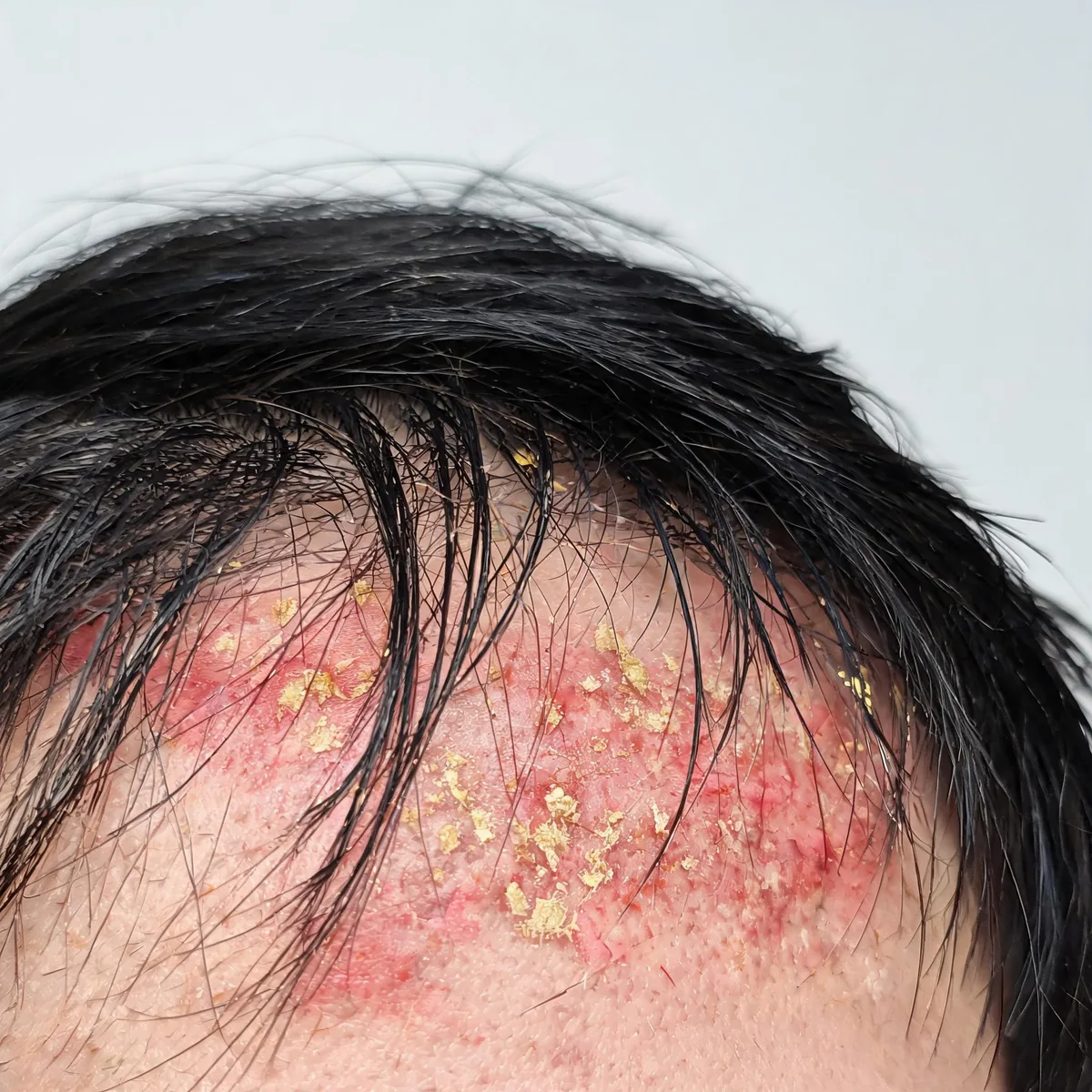
Understanding Dandruff
The classical literature reads dandruff through digestion and the quality of the Blood. The commonest pattern is Damp-Heat in the Stomach and Spleen.
Rich, greasy, sweet or spicy food is said to overload digestion, so dampness and heat accumulate and rise to the scalp. That produces the familiar greasy type: oily yellowish flakes, scalp redness and itching, bloating and a sticky taste.
The dry type is quite different. Fine white or silvery flakes with red inflamed patches, burning or prickly itch and a feeling of body heat are read as Heat in the Blood. Fine dry white scales with itch worse at night and in dry windy weather, a pale complexion and brittle nails are read as Blood deficiency with external wind.
Where patches are dark red rather than bright, with itch worse in the evening, night sweats and a dry mouth, the pattern is Empty-Heat from Yin deficiency. The direction reverses from draining to nourishing.
The four pictures are not variations on a single theme. In two of them the problem is too much: dampness and heat thrown off by slow digestion, or heat that has entered the Blood. In the other two the problem is too little: Blood that cannot nourish the surface, or Yin that can no longer keep warmth in its place. That is why the direction of treatment reverses. Clearing, draining and cooling suit the excess pictures, while nourishing, moistening and settling suit the deficient ones, and applying one where the other belongs tends to make the scalp worse rather than better.
What the four share is that the scalp is where an internal situation becomes visible, not where it begins. Turbid heat rises from digestion, heat in the Blood rises to the head, and in the deficient pictures the surface simply loses the nourishment that keeps it intact and then has to contend with wind-dryness as well. The flake is residue, the visible end of a process that started elsewhere, which is why a shampoo can remove it for a few days without changing the tendency behind it. It is also why the pattern is re-read at each visit: sleep, stress, diet and season can move a person from one picture to another over months.
Conventional view
Dandruff is a very common scalp condition with visible white or yellowish flakes and itching, considered a mild form of seborrhoeic dermatitis linked to overgrowth of the yeast Malassezia that lives on most scalps. It flares with stress, cold dry weather, hormonal shifts and a diet high in sugar or processed fats, though why some people are more susceptible is not fully understood. Diagnosis is usually a look at the scalp, with stubborn cases checked against psoriasis or eczema.
The mainstay is medicated shampoo with actives such as zinc pyrithione, ketoconazole, selenium sulfide, salicylic acid or coal tar, used a few times a week to control yeast, reduce inflammation and loosen flakes, with topical corticosteroid lotions or antifungal creams for more severe seborrhoeic dermatitis. These manage symptoms effectively but usually need continuous use, and dandruff returns within days or weeks of stopping.
Anti-dandruff shampoos reduce flakes and calm itching temporarily but work only on the surface and do not address the internal imbalances that keep producing dandruff, flakes often return on stopping and products may gradually lose effect. They also treat all dandruff alike, whether oily and yellow or dry and white, while TCM sees opposite internal causes requiring cooling and drying in one case and nourishing and moistening in the other.
Selected PubMed records
Real PubMed records for the conventional discussion above, selected by condition name and title relevance. They are references, not a claim that any treatment is proven for this condition.
- Skin microbiome alterations in seborrheic dermatitis and dandruff: A systematic review.. Experimental dermatology, 2021. PMID: 34415635.
- Seborrheic Dermatitis and Dandruff: A Comprehensive Review.. Journal of clinical and investigative dermatology, 2015. PMID: 27148560.
How it connects
Dandruff and acne often appear together because both are driven by Damp-Heat in the Stomach and Spleen. When digestion is overloaded by rich, greasy or spicy food, the turbid Heat and Dampness rise, showing as greasy scales on the scalp and pustules or papules on the face, and clearing the root often clears both. Blepharitis, inflammation of the eyelid margins, frequently co-occurs too, because the same Damp-Heat or Blood Heat that affects the scalp can steam upward to the delicate eye area; the sticky secretion and redness along the lash line mirror the greasy yellowish flakes on the scalp. What links these companions is the middle burner. Turbid dampness and heat thrown off by slow digestion do not choose a single outlet: they show as greasy scales on the scalp, inflamed papules on the face and sticky secretion along the eyelid margins, which is why acne and blepharitis so often keep company with dandruff. That also makes the scalp a useful gauge. When digestion improves, the eyelids and the face usually settle at the same time. The distinction worth making is with scalp eczema, where the scales are dry and the itch intense, because drying treatment that suits greasy dandruff can aggravate that skin.
How it is assessed
The practitioner looks at the flakes, the scalp and the digestion.
What a practitioner looks for
- Flake texture: oily yellowish flakes suggest Damp-Heat; dry white flakes suggest Blood deficiency or Heat in the Blood.
- Scalp colour: red inflamed patches suggest heat; dull dark red suggests Empty-Heat.
- Digestive signs: bloating, sticky taste and loose stools support the damp pattern.
- Timing: itch worse at night and in dry weather supports Blood deficiency.
Questioning follows the flake. The practitioner asks whether the scales feel greasy or dry, whether they cling to the scalp or fall onto the shoulders, and whether the skin beneath is bright red, dull red or pale. Timing comes next, because itch that peaks at night and in dry windy weather behaves differently from itch that follows a spicy meal or a stressful week. Distribution matters too: flaking confined to the hairline points one way, while flaking that also reaches the face, the chest or the eyelid margins broadens the picture beyond a scalp problem.
Only then are the tongue and pulse read, because they separate pictures that look alike on the surface. A thick yellow greasy coat with a soggy, rapid pulse supports Damp-Heat. A red tongue with a thin dry yellow coat and a rapid, wiry pulse supports Heat in the Blood. A pale, thin tongue with a fine pulse supports Blood Deficiency, while a red, cracked tongue with little or no coat and a fine, rapid pulse supports Empty-Heat. Since two pictures often coexist, the reading decides which one dominates and therefore which formula leads.
TCM patterns in Dandruff
Dandruff is not one condition here, because the same flakes can come from four quite different internal situations, each with its own treatment. Flake texture comes first. Thick, yellowish, greasy scales that cling to the scalp point to Damp-Heat in the Stomach and Spleen, where turbid heat from digestion rises. Fine, dry, white or silvery flakes suggest Heat in the Blood, where heat has entered the blood and stirred internal wind. Oiliness decides the matter when both make the scalp red and itchy. Timing adds a second question: itch that builds at night or in dry, windy weather, after overwork or poor sleep, leans towards Blood Deficiency with External Wind, an undernourished surface that wind can enter. Colour separates the two heat pictures, bright red pointing to excess and dull dark red with night sweats to Empty-Heat from Yin Deficiency. The tongue and pulse settle the rest.
| Pattern | Key signs | The itch | Tongue | Main formula |
|---|---|---|---|---|
| Damp-Heat in Stomach and Spleen | Not specified | Scalp redness and itching | Body: Red, possibly swollen with teeth marksCoat: Thick, yellow and greasy in the centre and root | Not specified |
| Heat in the Blood | Fine dry white or silvery flakes; Red inflamed patches on the scalp | Burning or prickly itch | Body: Deep red, often with red points or pricklesCoat: Thin, yellow and dry | Not specified |
| Blood Deficiency with External Wind | Fine dry white scales; Brittle nails and dry rough hair | Itch worse at night or in dry windy weather | Body: Pale and thin, sometimes slightly dryCoat: Thin, white and a little dry | Not specified |
| Empty-Heat caused by Yin Deficiency | Dark red rather than bright patches; Dry mouth and throat | Itch worse in the evening or at night | Body: Red, thin and dry, often crackedCoat: Little or none; the tongue may look peeled | Not specified |
Damp-Heat in Stomach and Spleen
Oily yellowish greasy flakes with scalp redness and digestive signs.
Rich, greasy, sweet or spicy food asks more of the Stomach and Spleen than they can process, and what is left over is stored as dampness and heat. The mixture is heavy and it rises. It travels up the channels to the head, settles where the hair follicles open onto the skin and blocks them, so oil accumulates and the surface becomes inflamed. The flakes are thick, yellowish and greasy, the scalp is red and itchy, and the digestive clues belong to the picture rather than sitting beside it: bloating after meals, a sticky or bitter taste in the mouth, a heavy feeling in the limbs, and stools that are sticky or incomplete.
The tongue is red and may be swollen with teeth marks, carrying a thick yellow greasy coat that sits heaviest at the centre and root. The pulse is soggy and rapid, often slippery, the signature of dampness and heat in the middle burner. Fried food, alcohol, irregular eating and humid weather make it worse, while cooling drinks, light meals, a clean scalp routine and well-formed bowels make it better. Bi Xie Shen Shi Tang leads, with Long Dan Xie Gan Tang as the alternative when marked redness, severe itch and a bitter taste show Liver and Gallbladder heat. The herbs named are Huang Lian, Huang Qin, Ku Shen and Bai Zhu, and the points are Pishu (BL-20), Geshu (BL-17), Hegu (LI-4) and Baihui (DU-20).
Signs
- Oily yellowish greasy flakes
- Scalp redness and itching
- Bloating and upper abdominal fullness
- Sticky or incomplete bowel movements
- Bitter or sticky taste
Diet and lifestyle for this pattern: Avoid greasy, fried, spicy and heavily sweet food as well as alcohol, which feed Damp-Heat directly. Favour cooling, light food such as bitter greens, barley, mung beans and lightly steamed vegetables, cleanse the scalp with a gentle non-drying wash without over-washing, and eat at regular times in an unhurried way so the Spleen and Stomach are not overloaded.
Heat in the Blood
Fine dry white or silvery flakes with red inflamed patches and body heat.
Heat that has entered the Blood behaves differently from heat sitting in the digestion. Blood is a deeper level, so the heat is steadier, and it rises to the head where it scorches the thin skin of the scalp and stirs up an internal wind. The surface is dry, red and inflamed and sheds fine white or silvery flakes rather than greasy ones, with a sharp prickly itch and a burning sensation that lingers. Because heat consumes fluids, the person is often thirsty, prefers cold drinks, has dry stools and may look flushed. A stressful week or a hot spicy meal is often remembered as the trigger.
The tongue is red, sometimes with red prickles, and carries a thin yellow dry coat. The pulse is rapid and wiry, and often slippery as well. Hot weather, alcohol, coffee and emotional strain feed the heat, while a cool room, cooling food and adequate rest quieten it. Pi Pa Qing Fei Yin is the formula named for this presentation: it cools the Blood, dispels wind and resolves toxicity while cooling the Lungs and Stomach, which is why it suits a dry red itchy scalp with burning. Mu Dan Pi and Chan Tui are the herbs singled out, the first for blood heat and the second for the itch, and the points are Quchi (LI-11), Fengchi (GB-20), Sanyinjiao (SP-6) and Shenmen (HT-7).
Signs
- Fine dry white or silvery flakes
- Red inflamed patches on the scalp
- Burning or prickly itch
- Body heat worse at night
- Thirst for cool drinks
Diet and lifestyle for this pattern: Steer clear of spicy, fried and greasy food and cut back on alcohol and coffee, which add Heat to the Blood. Eat cooling, hydrating food such as cucumber, watermelon, mung beans and leafy greens, keep living spaces cool, take gentle stress relief such as walking or meditation, and avoid over-washing with harsh shampoo, using a mild cooling rinse instead.
Blood Deficiency with External Wind
Fine dry white scales with night itch and a pale complexion.
When Blood is short, the scalp loses the moisture it depends on. The skin becomes thin and dry, fine white bran-like flakes form, and the surface can no longer mount a firm defence. That is when external wind-dryness finds a way in, and the itch begins to come and go, moving about and settling for a while before it shifts elsewhere. The picture is constitutional as much as local: a pale or sallow complexion, brittle nails, dry rough hair, light-headedness and an aversion to drafts usually accompany the flaking.
The tongue is pale and thin with a thin white, slightly dry coat, and the pulse is fine, sometimes floating at the surface. Dry windy weather, overwork, short sleep and harsh stripping shampoos make the scalp worse, while moisturising oils, adequate rest, warm humid air, blood-building foods and a gentle head massage settle it. Dang Gui Yin Zi is the classic choice, nourishing Blood, moistening dryness and dispelling wind to stop the itch, and it also consolidates the exterior while tonifying Qi. The herbs named are Dang Gui, Bai Shao, He Shou Wu and Fang Feng, with Xuehai (SP-10), Zusanli (ST-36), Sanyinjiao (SP-6) and Fengchi (GB-20) as the points.
Signs
- Fine dry white scales
- Itch worse at night or in dry windy weather
- Pale or sallow complexion
- Brittle nails and dry rough hair
- Dizziness or light-headedness
Diet and lifestyle for this pattern: Concentrate on deeply nourishing, blood-building food such as dark leafy greens, beetroot, black sesame, eggs and small amounts of organ meat. Avoid very spicy, fried or drying food that uses up Blood and fluids, protect the scalp from dry cold wind with a hat or scarf, choose gentle moisturising shampoo, and protect sleep so Blood can be replenished.
Empty-Heat caused by Yin Deficiency
Dark red patches with evening itch and night sweats.
Yin is the body's cooling and moistening reserve. When it is depleted, warmth is no longer anchored below and drifts upward as empty heat, which is not the same as true excess heat. It reaches the scalp, dries and inflames the tissue, and leaves dark red patches, oily scaling and an itch that is hard to settle. Because Yin is rebuilt during rest, the discomfort often gathers in the evening and interferes with sleep, and the accompanying signs carry the same mark: night sweats, a dry mouth and throat with a wish to sip, a sense of heat across the palms and soles and in the chest, and restlessness.
The tongue is red, thin and dry, often cracked, with little or no coat, and the pulse is fine and rapid. Late nights, overwork, emotional strain, hot dry weather, coffee and alcohol deepen the depletion, while sleep, cooling moistening foods, a cool environment and gentle movement that does not cause sweating help rebuild it. Er Zhi Wan is the formula named, a gentle pair that nourishes Liver and Kidney Yin and clears empty heat without burdening digestion. Nu Zhen Zi and Mo Han Lian are the herbs, and the points are Taixi (KI-3), Sanyinjiao (SP-6) and Fengchi (GB-20).
Signs
- Dark red rather than bright patches
- Itch worse in the evening or at night
- Night sweats
- Dry mouth and throat
- Feeling of heat in palms and soles
Diet and lifestyle for this pattern: Put rest first and avoid staying up late, when the body rebuilds Yin. Eat cooling, moistening food such as pear, tofu, cucumber, black sesame and spinach, cut out coffee, alcohol, spicy food and deep-fried food that fan internal Heat, and keep exercise gentle, since heavy sweating depletes fluids further.
Treatment approach
How the tradition treats dandruff, with the herbs, formulas and points used for it.
Principles
- Drain dampness and clear heat in the greasy pattern, and treat the digestion as the source.
- Cool the Blood where patches are red and inflamed.
- Nourish Blood and Yin where the scalp is dry and the itch is at night.
- Reduce the foods that feed the pattern, since diet is described as the main driver.
- The order of treatment matters as much as the choice of formula. Where there is excess, the first task is to clear what has gathered, and only afterwards to strengthen digestion so that dampness and heat are not rebuilt within weeks. Where there is deficiency there is nothing to clear: the work is to rebuild Blood or Yin at a pace the digestion can carry, and the scalp settles as the reserves return. Acupuncture runs alongside in both cases, using head and neck points to calm the surface while body points address the root. The formula is reviewed as the picture shifts, because a damp-heat presentation often becomes a drier one once the acute phase has passed.
Herbs used
Formulas
Acupoints
- BL-20 (Pishu)
- BL-17 (Geshu)
- LI-4 (Hegu)
- DU-20 (Baihui)
- LI-11 (Quchi)
- GB-20 (Fengchi)
- SP-6 (Sanyinjiao)
- HT-7 (Shenmen)
- SP-10 (Xuehai)
- ST-36 (Zusanli)
- KI-3 (Taixi)
What to expect
- Flaking and itching are described as improving within two to four weeks with treatment and dietary change.
- Recurrence is common if the digestive pattern is not maintained.
- A suddenly red, painful, swollen scalp needs medical review for infection.
- Timelines differ by pattern, and it helps to know which one applies. Excess pictures such as Heat in the Blood and Damp-Heat usually respond first, with less oiliness and itch inside two to four weeks. Deficiency pictures are slower, often six to twelve weeks, because Blood and Yin are rebuilt gradually. Fluctuation is normal: a humid week, a stressful month or a run of late nights can bring flakes back briefly without undoing the work. Once the scalp has settled, many people continue a lighter formula or a seasonal course rather than stopping abruptly.
Safety and when to get help
Seek medical help urgently for
- Sudden severe redness, swelling and pain of the scalp with warmth.
- Oozing pus, foul smell or spreading crusts.
- Hair loss with scalp inflammation that is spreading.
For anything severe, sudden or spreading quickly, read when a skin problem needs urgent care.
Cautions
- Persistent scalp scaling that does not respond should be medically reviewed.
- Do not use strong topical treatments on inflamed scalp skin without advice.
- Children with scalp scaling need review for other causes.
Using this alongside conventional care
- TCM is described as complementary to conventional care: medicated shampoo and prescribed topical treatment can continue alongside herbs.
- Medicated shampoo can continue exactly as directed while herbs are introduced, and many people reduce its use gradually as the scalp settles rather than stopping at once. A topical herbal wash is best patch-tested on a small area first. The interaction to flag is Dang Gui, which has mild anticoagulant activity, so anyone taking warfarin, aspirin or clopidogrel should tell both the herb prescriber and the doctor managing the medication. Flaking with spreading redness, oozing, crusting or pus, or hair loss in patches, needs a dermatologist rather than more shampoo, because infection, psoriasis and fungal scalp conditions can all imitate dandruff.
Diet and lifestyle
- Reduce greasy, deep-fried and spicy food, sugar and dairy, since these are said to generate dampness and heat.
- One rule covers most of the ground: keep meals warm, cooked and regular, and go easy on what is greasy, fried, very sweet or heavily spiced, since these are the foods that generate the dampness and heat the scalp is expressing. Pattern adds detail. With Damp-Heat, favour steamed vegetables, bitter greens, mung beans and barley, and cut alcohol and fried food. With Heat in the Blood, add cucumber, watermelon and leafy greens and reduce coffee. With Blood Deficiency, build in dark leafy greens, beetroot, black sesame, eggs and a little liver or other organ meat. With Empty-Heat, choose pear, cucumber, tofu, black sesame and spinach, and avoid deep-fried food, coffee and alcohol, which dry the fluids further.
If you're pregnant
In pregnancy the rise of Blood and Yin to nourish the fetus can change how dandruff presents: Damp-Heat patterns may become less pronounced while Blood or Yin deficiency patterns with dry flakes emerge. Many herbs used to clear Heat and drain Dampness, such as those in Long Dan Xie Gan Tang including Long Dan Cao and Zhi Zi, are considered potentially harmful in pregnancy and should be avoided.
Safer alternatives include gentle cooling herbs such as Huang Qin under professional guidance, acupuncture points such as Fengchi (GB-20) and Quchi (LI-11) used cautiously, and topical herbal washes are often preferred to internal formulas in the first trimester.
If you're breastfeeding
When breastfeeding, bitter-cold herbs that drain Damp-Heat, such as Huang Lian and Da Huang, can pass into milk and cause loose stools or colic in the infant. For Damp-Heat dandruff, milder alternatives such as Fu Ling and Yi Yi Ren gently leach out Dampness without the harsh cold, and acupuncture is commonly used, although trial evidence is limited.
If the dandruff comes from Blood deficiency, nourishing herbs such as Dang Gui are generally safe and can even support milk production.
If treating a child
Dandruff in infants and young children, often called cradle cap, is extremely common and usually shows as greasy yellowish scales on the scalp. In TCM it is typically seen as Damp-Heat from the mother's diet in pregnancy or from the child's immature Spleen failing to transform fluids.
Treatment is gentle: topical oils such as sesame or olive oil soften the scales, combined with mild herbal washes. Internal herbs are rarely used in infants, and in older children doses are reduced to a third to a half of the adult dose, with formulas such as Shen Ling Bai Zhu San adapted to strengthen the Spleen and dry Dampness without harshness.
If treating an elderly patient
In older people dandruff often shifts from the oily Damp-Heat pattern to a dry flaky presentation rooted in Blood deficiency or Yin deficiency, with a pale scalp, fine white scales and mild itching that reflect lack of nourishment rather than excess Heat.
Treatment nourishes Blood and Yin with formulas such as Dang Gui Yin Zi or Er Zhi Wan at about two-thirds of the adult dose to suit a slower metabolism, and acupuncture points such as Zusanli (ST-36) and Sanyinjiao (SP-6) build Blood and Yin gently. Interactions with multiple medications need watching, and topical treatment is favoured where internal herbs pose a risk.
Urgent-sign guidance is based on standard sources: NHS anaphylaxis, NHS cellulitis, NHS Stevens-Johnson syndrome, NHS melanoma.
Evidence
Evidence status
Compiled for this page from the classical and modern literature; not a systematic review, so treat it as a pointer to sources rather than clinical guidance.
Evidence is growing but still limited in rigorous English-language trials. A 2010 review in the Indian Journal of Dermatology noted that formulas containing heat-clearing and damp-draining herbs show promise for dandruff, though most studies are small and lack placebo controls. A case series of 170 patients treated with pattern-based decoctions reported improvement in scaling and itching, and a Singapore study examined Jian Pi Chu Shi Tang for the damp-heat pattern of scalp seborrhoeic dermatitis.
Read together, the reports are encouraging rather than conclusive. The 2010 review found the rationale and the early results reasonable but the trial quality low, the 170-case observation reported improvement without a comparison group, and the Singapore work on Jian Pi Chu Shi Tang followed a single pattern rather than dandruff in general. Acupuncture for scalp symptoms rests on expert consensus and clinical experience rather than large trials. For a patient this means the treatment is worth trying, particularly where shampoo alone has stopped working, while expectations should stay modest about proof and generous about time.
Studies often cited
The clinical observation assessed a Spleen-fortifying, Dampness-eliminating decoction in scalp seborrheic dermatitis with a Damp-Heat pattern and reported significant reductions in scaling, itching and erythema. The report covered scaling, itching and erythema before and after treatment in scalp seborrheic dermatitis of the Damp-Heat type. Yang CW, Li FM. Clinical observation on the efficacy of Jian Pi Chu Shi Decoction in treating scalp seborrheic dermatitis of Damp-Heat type. Singapore TCM Journal. 2023;23:8-14.
The case series followed 170 patients treated with pattern-based herbal decoctions and reported marked improvement in scaling, itching and skin lesions after syndrome-differentiated therapy. The series reported improvement in scaling, itching and skin lesions after pattern-based decoctions, with the authors presenting it as support for syndrome differentiation in seborrheic dermatitis. Treatment of 170 cases of seborrheic dermatitis based on syndrome differentiation. 2013.
PubMed records for the TCM evidence
Real PubMed records for the TCM clinical evidence discussed above, selected by condition name and title relevance. They are references, not proof of benefit.
- Efficacy of probiotics in hair growth and dandruff control: A systematic review and meta-analysis.. Heliyon, 2024. PMID: 38698995.
Classical record
白屑風多生於頭面,初起微癢,久則漸生白屑,疊疊飛起,脫去又生。此皆起於熱體當風,風熱所化。
White scaling wind mostly forms on the head and face. It begins with mild itching, and later white scales appear, lifting in layers, and growing again once they have shed. All of it comes from a hot constitution exposed to wind, which then turns into wind-heat.
White scaling of the head and face (Wai Ke Zheng Zong) - Classical citation: Wai Ke Zheng Zong (Orthodox Manual of External Medicine), Chapter on Sores and Ulcers.
Common questions
Is dandruff caused by poor hygiene?
No. The classical literature reads it as an internal damp-heat or deficiency pattern; washing more does not fix the cause.
Why are my flakes greasy rather than dry?
Greasy yellowish flakes are described as Damp-Heat in the Stomach and Spleen, with digestive signs alongside.
Can herbs reduce dandruff?
The tradition describes treating the pattern with improvement over weeks, alongside dietary change.
When should I see a doctor?
If the scalp becomes red, painful, swollen or oozes pus, or if scaling does not improve.
Why does spicy or greasy food make my dandruff flare?
In TCM those foods generate Damp-Heat in the digestive system. The mixture is heavy and rises, so it reaches the scalp, overheats the skin and blocks the follicles, which produces the oily red scalp and thick yellowish flakes. Cutting back is among the fastest ways to calm a flare, and it is usually the first change a practitioner asks for.
My flakes are dry and white, yet my scalp feels hot. What does that mean?
That combination usually points to Heat in the Blood. The flakes are dry because heat has consumed the fluids that would otherwise keep the surface supple, and the heat itself produces the burning and the prickly itch. Emotional stress and a diet of hot spicy food commonly set it off. Cooling herbs and stress management do much of the work, and greasy, heavy food tends to make it worse.
How long does treatment take before the flaking settles?
Most people see the itch and the flaking ease over the first few weeks, though the deeper change takes one to three months because it depends on correcting the internal imbalance. Excess patterns such as Damp-Heat tend to move faster than deficiency patterns, where Blood or Yin has to be rebuilt. The timeline also depends on how long the dandruff has been present and on how consistently herbs, diet and sleep are kept up.