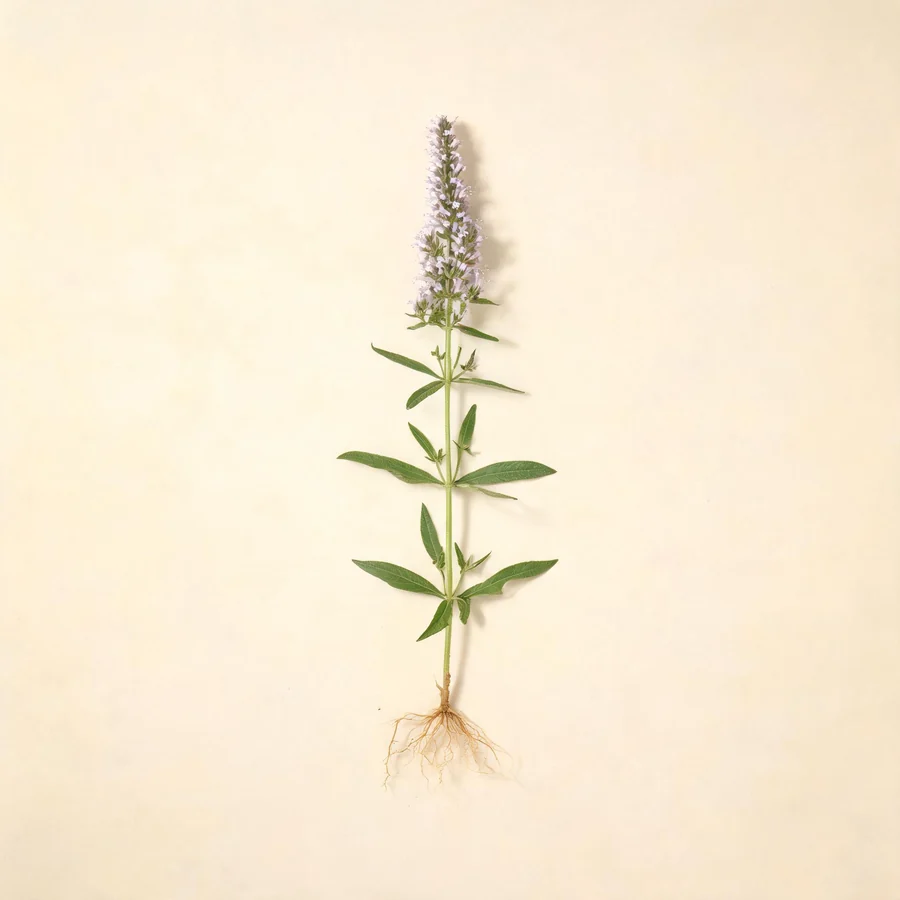
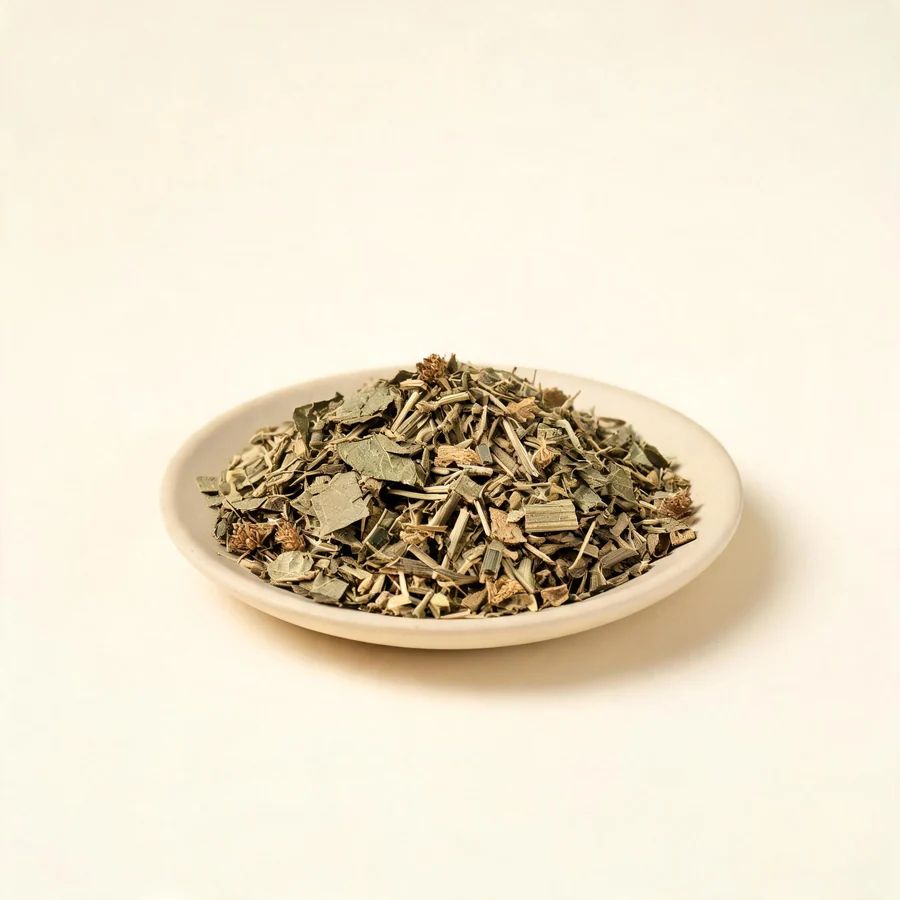
Skin profile
Where this herb sits in skin practice: the pattern it corrects, the skin signs it suits, and what it should not be used for.
Xiang Ru is a summer herb for a closed surface and trapped dampness: it opens the pores, dries the clamminess and moves water down. It is short, sharp and warm, so it is kept away from heat with sweating and from dry, fluid-short skin.
Skin signs that suggest it
- Sudden puffiness around the eyes and face after a chill, with scanty urine and a feeling of cold (wind-water)
- Soft, cool, non-red swelling of the limbs that is worse in humid weather (dampness)
- Skin that is clammy and heavy with no sweat despite the heat, and a wish to stay covered (surface closed by cold)
- A dull red or pale rash that returns each hot damp season, with poor appetite, loose stools and a greasy tongue (summer dampness)
- A heavy head, no thirst, nausea and a greasy white or yellow coating on the tongue
When it is not the right herb
Not in heat stroke, nor in the true summer-heat pattern with a soaring temperature, raging thirst and drenching sweat, where warmth and dispersal only add to the trouble. Not for anyone who sweats without effort, or who has night sweats from Yin deficiency, because opening the pores further loses fluid that is already short. Not for dry skin with a dry mouth and scanty concentrated urine. Not for a red, hot, pustular or weeping rash, which is Heat rather than cold-damp. And not for the severe end of summer illness: vomiting that will not stop, blood in the stool, a high fever in a child or signs of dehydration need medical care, and a decoction has no place in that.
What it does for skin
Skin-relevant actions only. Each one describes a mechanism in TCM terms and what it looks like on the skin.
Opens pores that heat and cold have closed
The paradox of a summer cold is that the weather is hot and the surface is shut: the person has chills, no sweat, a heavy head and a rash that will not come out. The aromatic warmth is described as opening that closure and producing a light sweat, which lets the trapped dampness move. It is the same logic as using a warming herb in winter, applied to a season where the cold has come from iced drinks, air conditioning or a wet night rather than from frost.
Dries dampness and lifts the heaviness
Aromatic herbs are held to cut through turbidity, and warmth to evaporate it. That is why the herb is chosen when the skin is clammy and heavy rather than dry, when the tongue carries a greasy coat, and when the person feels drowsy after eating. On the surface it reduces the clamminess and the puffiness, and it is used with other aromatic herbs that settle the Stomach at the same time.
Moves water downward and reduces swelling
Water pooling beneath the skin is attacked from two directions. Opening the Lung at the top restores the downward flow that organ is said to govern, while warmth lower down gives the bladder an exit. The effect is gentle, which is why the herb suits an early, exterior stage of swelling and not the established swelling of the legs. The classical comparison is with Ma Huang, which is stronger and belongs to winter.
Revives a Spleen that dampness has stalled
Bumps that return with each hot spell, alongside little appetite and a soft stool, are read as damp overpowering the Spleen's transforming work. The warm aroma is used to restore that work, so that the Stomach descends and the Spleen ascends again. It is a supporting action, and a person with a long-standing Spleen weakness needs the tonifying herbs as well.
Skin conditions it is used for
Mapped to the condition pages on this site. The pattern column shows what the skin is doing when this herb is the right choice.
| Condition | Pattern | Why it suits | Typical setting |
|---|---|---|---|
| Facial swelling | Wind-Cold-Water invading the Lung: puffiness after a chill, with no sweat | Puffiness that appears within hours of a chill, worst around the eyes, with scanty urine, no sweating and a wish for warmth, is read as Wind and Cold closing the Lung's water passages. The herb opens the surface and moves the water down, and it is used with other exterior-releasing and draining herbs. Sudden facial swelling with throat tightness or breathlessness is an emergency and needs medical care before any decoction. | Yue Bi Tang modified with Xiang Ru and Fu Ling |
| Skin swelling | Wind-Damp: soft puffy swelling with heaviness and a greasy coating | Swelling that is pale, soft and heavy, worse in humid weather and accompanied by a foggy head and a greasy tongue, is read as Wind-Damp on the surface. The herb disperses the Wind, dries the Dampness and opens the water route, and it is combined with herbs that strengthen the Spleen or move water below. Swelling with breathlessness, or swelling that pits deeply and keeps climbing, needs assessment first. | A modified Wu Ling San with Xiang Ru and Huo Xiang |
| Heat rash | Spleen deficiency with dampness: a dull seasonal rash that returns each warm season | Bumps that are dull red or pale rather than fiery, that come back with every hot spell and bring fatigue, little appetite and a soft stool, are read as a Spleen too weak to move dampness, with the surface unable to vent it. The herb is a support rather than the main treatment: it dries the dampness and opens the surface, while Spleen herbs do the deeper work. The red, greasy, oozing rash of excess damp-heat is a different pattern and needs cooling, not warming. | A modified formula with Xiang Ru, Bai Zhu and Bai Bian Dou |
| Cool or clammy skin sensation | Wind-Cold-Damp: cool clammy skin with chills and no sweat | Cool, damp skin with chills, a heavy head and aching limbs in hot weather is the summer-cold picture, read as cold that has closed the surface while dampness stays inside. The warm aromatic opens the pores and dries the clamminess, and it is taken cool in a formula with herbs that settle the Stomach. A high fever, a stiff neck or a rash that does not fade under pressure takes the case out of this pattern and into medical care. | Xiang Ru San with Huo Xiang and Hou Po |
Combinations for skin
Herbs it is paired with when the skin, not an internal organ, is the target.
| Partner | Ratio | Why the pair is used |
|---|---|---|
| Huo Xiang | 6 to 10 g each | The classic summer pair. Agastache transforms turbid dampness in the middle and settles the Stomach, while Xiang Ru opens the exterior and drives the cold out. On the skin they are used where a dull, itchy rash comes with a greasy tongue, heaviness and nausea, and neither herb alone covers both the surface and the middle. |
| Bai Zhu | 6 to 10 g Bai Zhu with 3 to 6 g Xiang Ru | Above, the aromatic opens the surface and shifts water; in the middle, atractylodes firms the Spleen and moves it on. Swelling with little appetite, soft stools and heaviness is where the two belong, and in the older literature the reduced decoction was worked into pills with the powder of the root. |
| Huang Lian | 2 to 3 g Huang Lian with 6 to 9 g Xiang Ru | The two pull in opposite directions, which is the point. One is warm, acrid and outward-moving, the other bitter, cold and downward-moving, and together they treat a summer illness where cold has shut the surface while heat is stuck inside: chills and no sweat on one hand, irritability and thirst on the other. The bitterness and cold steady the Stomach too, so the hot aromatic is less likely to set off retching. |
| Bai Bian Dou | 10 to 15 g Bai Bian Dou with 6 to 9 g Xiang Ru | The classical summer formula pairs them for balance. Dispersal and drying fall to the aromatic; the gentle food-grade bean firms the Spleen, settles the Stomach and lifts a little summer heat without introducing dryness. The result is safe for a digestion already worn down by a long wet spell, which is exactly the case the formula was designed around. |
Formulas where it leads
- Xiang Ru San (香薷散) - The three-herb formula for summer cold: Xiang Ru with Bai Bian Dou and Hou Po. It is used for chills, no sweat, a heavy head and nausea in hot weather, and in skin practice for a dull seasonal rash or clamminess in the same setting. The decoction is taken cool, and the course is short.
- Xin Jia Xiang Ru Yin (新加香薷饮) - A later version that adds a cooling element for summer-heat with more obvious heat: fever, thirst and irritability alongside the closed surface. The combination of a warming aromatic with cooling herbs is the model for using Xiang Ru where heat and dampness are mixed, and it is the version borrowed when a summer rash carries more redness.
Safety for skin use
What to check before recommending or using it, including the cautions that matter most for skin patients.
Do not use, or use with caution
- Heat stroke, or the true summerheat picture with high fever, great thirst and profuse sweating. A warming diaphoretic adds to the heat and the fluid loss.
- Spontaneous sweating, night sweats or Yin deficiency with dryness. Opening the pores further drains what is already short.
- Dry skin, a dry mouth and scanty concentrated urine, which show fluid depletion rather than dampness.
- A red, hot, pustular or weeping rash, or any lesion that looks infected. This is a warm herb for a cold-damp surface, not a treatment for Heat.
Pregnancy and breastfeeding
The old texts lodge no ban, yet a herb that sweats and moves Qi calls for care: neither heavy perspiration nor lost fluid suits pregnancy, and it belongs to a brief acute episode, never to a long course. It is used only under guidance, at a conservative dose, and never as a summer tonic. The same advice is given to nursing mothers: a short supervised course is acceptable, though a woman already low on fluid may notice her milk diminish. Children lose fluid quickly, so the sweating is watched closely and the dose reduced by age.
Interactions
- Diuretics. Laboratory work shows a diuretic effect, so extra fluid and electrolyte loss is possible when the two are combined, especially in heat.
- Blood pressure medicines. The essential oil has lowered pressure in animal work and sweating lowers it further, so dizziness is the effect to watch.
- Antiarrhythmic drugs. The oil has been reported to inhibit sodium channels in heart tissue, the same target as one class of these medicines, so concentrated preparations should not be combined without advice.
Allergy and patch testing
It is a mint-family plant, so anyone who reacts to mint, basil, oregano or other Lamiaceae herbs should be cautious, and a wash or a compress can produce contact dermatitis. Patch test a preparation before using it on a rash. The oil that does the work is also the usual source of irritation, one more argument for keeping any external use short.
General safety references
General references for herbal hepatotoxicity and herb-drug interactions; they are not specific to this herb.
- Review article: Herbal hepatotoxicity - an update on traditional Chinese medicine preparations. Alimentary Pharmacology & Therapeutics, 2014. PMID: 24844799.
- Interactions between herbal medicines and prescribed drugs: an updated systematic review. Drugs, 2009. PMID: 19719333.
- Warfarin and food, herbal or dietary supplement interactions: a systematic review. British Journal of Clinical Pharmacology, 2021. PMID: 32478963.
Evidence
The classical record is quoted with its source. The modern note states the level of evidence plainly.
Classical record
味辛,微温。主霍乱,腹痛吐下,散水肿。
Pungent to the taste and mildly warm, it is given for the violent purging and vomiting the old books call cholera-like disorder, for belly pain with vomiting and diarrhoea, and to scatter water swelling.
Ming Yi Bie Lu (名医别录), Wei-Jin period - Nothing in this first entry concerns the exterior. The herb enters the literature as a summer remedy for vomiting, diarrhoea and swelling, and the surface action is a later interpretation of the same effect.
盖香薷乃夏月解表之药,如冬月之用麻黄。气虚者尤不可多服。
In summer this is the medicine that opens the exterior, as ephedra does in winter; those whose Qi is deficient, above all, should take only a little.
Ben Cao Gang Mu (本草纲目), Li Shizhen, 1578 - One sentence set the herb's place in the scheme and handed down its usual warning at the same time. It describes a season rather than a disease.
香薷,先升后降,故热服能发散暑邪,冷饮则解热利小便。
Rising first and sinking afterwards, it scatters summer pathogenic influence when drunk hot, and clears heat and moves urine when drunk cold.
Ben Jing Feng Yuan (本经逢原), Qing dynasty - Here is the plainest explanation of why the heat of the drink matters, and the origin of the rule to let it cool. A single line turns a kitchen detail into a rationale.
Modern evidence
Evidence status
- No clinical trial of the herb in heat rash, swelling or any other skin condition was identified. The skin uses rest on the classical record and on the logic of summer dampness, not on controlled evidence.
- Laboratory work on the essential oil describes diuretic, hypotensive and smooth-muscle effects in animals and tissue, and inhibition of sodium channels in heart tissue. Those findings are pharmacology, not a demonstration of benefit in a person, and the oil content varies widely between samples.
- Identity is a practical modern issue. Several species have been sold under the name, and the pharmacopoeia now specifies a Mosla species rather than the larger Elsholtzia that was the older source. Since the oil carries everything, a batch that no longer smells of anything is worthless.
PubMed records
Selected real PubMed records for this herb's species or its constituents, chosen by species name and title relevance. They are references for the non-TCM discussion above, not proof that the herb treats any skin condition.
- Pharmacognostic Study on Elsholtzia ciliata (Thumb.) Hyl: Anatomy, Phytochemistry and Pharmacological Activities.. Pharmaceuticals (Basel, Switzerland), 2021. PMID: 34832934 (pharmacology or review record).
- Phytochemical constituents from Elsholtzia ciliata (Thunb.) Hyl. and their nitric oxide production inhibitory activities.. Natural product research, 2023. PMID: 36377760 (pharmacology or review record).
Dose and forms
Skin-practice dosing and the preparations that suit skin complaints.
| Form | Dose and notes |
|---|---|
| Mild sweat | 3 to 5 g, added late and drunk cool, where the aim is a light sweat and release of the surface. It is the smaller end of the range and the one used in a summer cold with a rash. |
| Water and swelling | 6 to 9 g when water and swelling are the target, as the effect on urine grows with the amount. Up to 15 g has been used in acute presentations with close supervision. |
| Preparation | Tossed in for the final five or ten minutes only, since boiling drives off the oil that does the work. Drink it cool or at room temperature and never hot; the point is to avoid retching, not to suit the palate. |
| Course length | A few days. The herb is drying and sweating, and a longer course loses fluid and leaves the person tired; if the swelling or the rash has not moved by then, the pattern is wrong. |
The margins are tight, because the action is sharp but limited: too little and nothing moves, too much and perspiration and fluid loss take over. Two details are easy to miss. Serve it cold, and judge an aromatic by its scent as much as by the scales, since stale stock has already lost the fraction that acts.
Citations and further reading
Only real sources are listed: the classical materia medica passages quoted above, and the source works behind the botanical and safety statements.
- Ming Yi Bie Lu (名医别录), Wei-Jin period - classical entry quoted above.
- Ben Cao Gang Mu (本草纲目), Li Shizhen, 1578 - classical entry quoted above.
- Ben Jing Feng Yuan (本经逢原), Zhang Lu, Qing dynasty - classical entry quoted above.
- Herba Elsholtziae seu Moslae monograph: Pharmacopoeia of the People's Republic of China - source for the accepted Mosla species and its quality requirements.
- Modern evidence statement: based on pharmacological literature on the essential oil, summarised as a statement about the level of evidence rather than as a cited finding.
- Botanical identity: botanical literature on Elsholtzia ciliata and on the Mosla species now specified in the pharmacopoeia.
Educational reference for qualified practitioners. This page is not medical advice, and skin conditions should be diagnosed by a clinician before treatment.