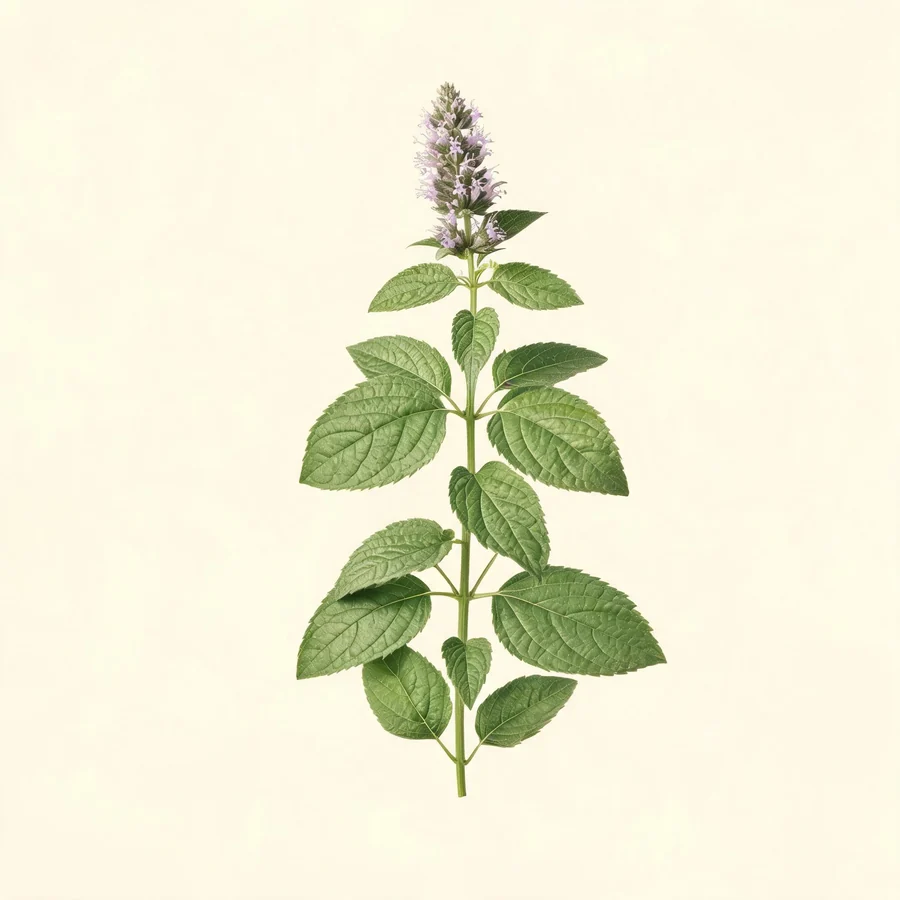
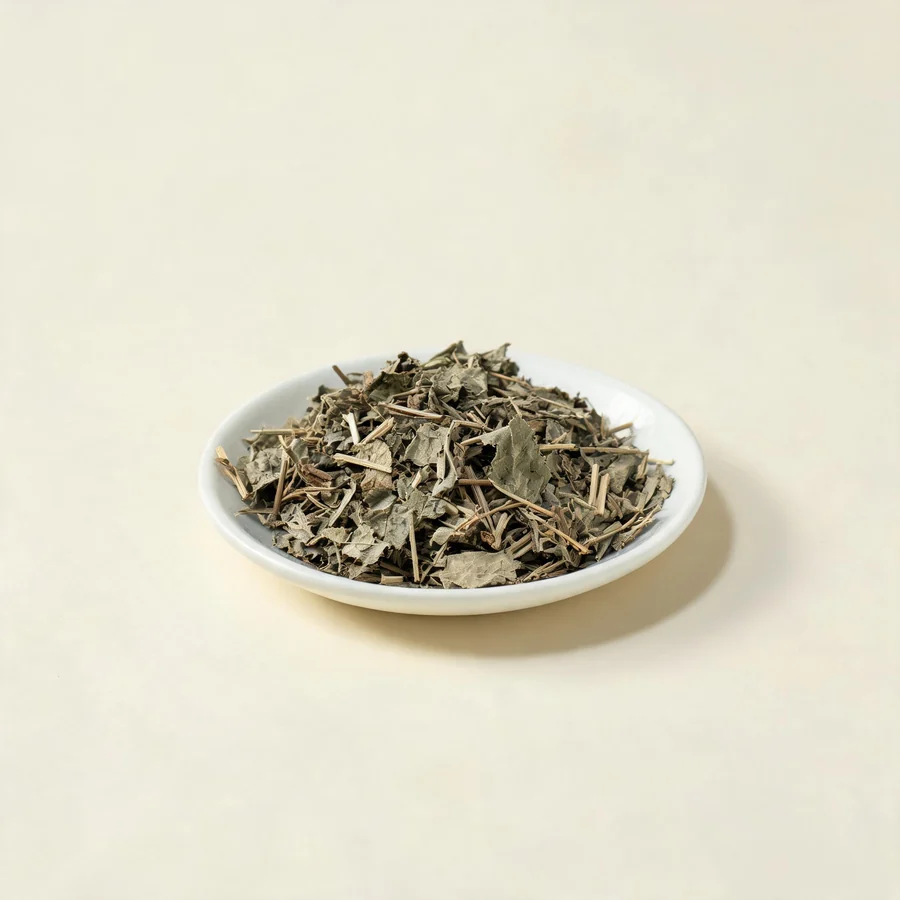
Skin profile
Where this herb sits in skin practice: the pattern it corrects, the skin signs it suits, and what it should not be used for.
Huo Xiang is the milder of the drying aromatics: it is chosen for skin that is wet, musty and heavy rather than for a lesion that is simply hot, and its particular territory is the fold, the foot and the scalp where moisture and odour collect. It works on the digestion at the same time, which is why it suits a rash that arrives with nausea and a greasy coating, and it is stopped when the surface dries.
Skin signs that suggest it
- Weeping or oozing patches with a greasy film and a musty, stale smell, rather than a clean serous surface
- Moist, pale, macerated skin between the toes, in the groin or under the breasts, worse in humid weather
- Puffy, heavy-feeling skin that holds a slight dent, with a foggy head and a thick greasy tongue coating
- A prickly rash that appears in hot damp weather, with nausea, poor appetite and a feeling of heaviness
- Greasy hair or scalp with an odour that returns soon after washing, and a stale taste in the mouth
When it is not the right herb
Not for dry skin, and not where the lesion is dry, cracked or scaling, because an aromatic drying leaf takes moisture that is already short. It is wrong in Yin deficiency, with a red peeled tongue, night sweats and a dry mouth, and wrong once a febrile illness has damaged the fluids, when dryness rather than dampness is the problem. Vomiting from Stomach heat is the classical trap, since warmth makes it worse, and the same applies to a hot spreading eruption with fever and thirst, where cooling and toxin-resolving herbs lead. It is not for a person who sweats profusely, and not for broken or ulcerated skin as a wash. A lesion that is hot, spreading and tender needs medical assessment before any herb.
What it does for skin
Skin-relevant actions only. Each one describes a mechanism in TCM terms and what it looks like on the skin.
Dries a weeping surface with its aroma
Dampness on the skin is moisture that has no way out: the surface stays wet, the crust is greasy and the area smells stale. The aroma of the leaf is read as lifting that heavy moisture and dispersing it, so a lesion dries from the base instead of being sealed over from above. It is a milder drying action than the bitter rhizomes, which makes it usable in a person whose digestion would not tolerate a harsh dryer. Progress is judged by the surface drying and the smell clearing, not by a change in colour.
Clears turbidity, which shows as odour and greasy film
Turbidity is the old word for the stale, cloudy, greasy quality that accompanies Dampness: a greasy coating, a muzzy head, a musty smell on the skin or the hair. The leaf was used to scent clothing and to freshen rooms before it was used as medicine, and the same volatile oil is why it is used where the skin smells stale rather than merely moist. It changes the surface environment. It does not sterilise an infection, and an established fungal infection still needs proper treatment.
Settles the summer rash that comes with a foggy head
The classical use is summer Dampness with an exterior component: heat and humidity outside, dampness inside, and a person who is heavy, nauseated and itchy at the same time. The leaf opens the surface mildly and dries the interior, which is why it is given when a rash appears with those general signs. It is a mild exterior release and not a sweating herb, so it does not suit a plain chill, a high fever with thirst, or a rash that is hot and spreading.
Turns the middle so that dampness stops being produced
The tradition does not treat the skin as separate from digestion: dampness is made in the middle and shows on the surface. By harmonising the Stomach and settling nausea, the leaf reduces the source, which is why it is paired with herbs that strengthen the Spleen when a skin problem keeps returning. The effect is slow and is not a substitute for treating the lesion directly, but it is the reason a recurring rash and a heavy digestion are addressed in one prescription.
Skin conditions it is used for
Mapped to the condition pages on this site. The pattern column shows what the skin is doing when this herb is the right choice.
| Condition | Pattern | Why it suits | Typical setting |
|---|---|---|---|
| Athlete's Foot | Dampness and turbidity sinking to the feet, with maceration and odour | Itchy, white, soggy skin between the toes with a stale smell is dampness that has collected at the lowest point of the body. The leaf is used for the milder, smellier version of that picture, as a soak and inside a formula, because its aroma reaches the surface without the force of a bitter dryer. An established fungal infection needs an antifungal, and the herb addresses the wet, warm environment that keeps it returning. | A cooled foot soak with Huang Bo, or within Huo Xiang Zheng Qi San when digestion is also upset |
| Jock Itch | Dampness held in the groin folds, with a musty smell and itch | The groin stays warm and occluded, so moisture collects and the skin becomes red-brown, itchy and stale-smelling. The leaf is chosen where the smell and the moisture dominate and the redness is moderate, and it is used as a dilute wash as well as internally. The folds are washed and dried carefully, a persistent rash is examined, and candidiasis and dermatophyte infection are treated specifically rather than by drying alone. | A dilute cooled wash, with Cang Zhu and Huang Bo in the internal formula |
| Foul Body Odour | Dampness and turbidity steaming through the skin | Odour that is musty or sour, worse in humid weather and after rich food, is read as turbidity pushed out through the surface. The aromatic leaf is the traditional answer because aroma is held to lift turbidity rather than mask it, and it is given with herbs that dry the middle. It is a supporting measure: washing, air to the skin and a lighter diet do as much, and a sudden change in body odour with weight loss or fever needs medical assessment. | Within a drying aromatic formula with Cang Zhu and Hou Po |
| Heat Rash | Summer heat with Dampness trapped at the surface | Prickly, itchy papules in hot humid weather, with heaviness and nausea, are read as sweat that cannot escape because dampness has blocked the surface. The leaf opens the surface a little and dries the dampness underneath, and it is given in the summer formulas that also settle the Stomach. Cooling the skin, loose clothing and a cooler room matter more than any herb, and a rash with fever or spreading redness needs assessment. | Huo Xiang Zheng Qi San, or a light summer formula with Pei Lan and Yi Yi Ren |
| Itchy Vesicular Rashes | Dampness surfacing as small blisters that weep | Small deep blisters on the palms, soles or fingers that weep and then dry are read as dampness working its way out. The leaf is a supporting dryer for the wet phase rather than a treatment for the whole pattern, and it is combined with cooling herbs when there is redness and with drying herbs when there is none. It is stopped once the vesicles have dried, because the same action then works against the skin. | A drying formula with Cang Zhu and Fu Ling, or a cooled wash for the hands |
Combinations for skin
Herbs it is paired with when the skin, not an internal organ, is the target.
| Partner | Ratio | Why the pair is used |
|---|---|---|
| Pei Lan | Equal parts, 6 to 10 g each | The aromatic pair for summer Dampness: the patchouli leaf works on the middle and the Stomach, while Pei Lan works more on the surface and the head. Together they cover a rash that arrives with a heavy head, nausea and a greasy coating, and they are the reason the summer formulas smell the way they do. Both are aromatic and both are added late, so neither is boiled hard. |
| Huang Bo | 6 to 10 g Huang Bo with 6 g Huo Xiang | The bitter cold bark drains Damp-Heat downward and the warm aromatic leaf dries and moves it, so the pair suits moist, itchy, smelly lesions of the feet and groin where heat and dampness are both present. The leaf keeps the cold bark from stagnating the dampness, and the bark keeps the warmth of the leaf from feeding the redness. It is a short course pair, not a long tonic. |
| Ku Shen | 6 to 10 g each | Ku Shen is the stronger herb for itch and for Damp-Heat in the lower body, and the leaf is the better herb for the musty smell and the heavy digestion that go with it. The pair is used internally and in washes for an itch that is worse in humidity, and the wash is kept to limited areas. Both dry, so the pair is stopped when the skin stops weeping. |
| Cang Zhu | 6 g Huo Xiang with 6 to 9 g Cang Zhu | Two drying aromatics with different force: Cang Zhu is the stronger dryer and is directed at dampness in the limbs and joints, while the patchouli leaf is milder, better for the Stomach and for odour. The pair is used when a wet lesion sits on a person with a heavy body and a greasy coating, and the proportion is adjusted to how much dryness the skin will tolerate. |
Formulas where it leads
- Huo Xiang Zheng Qi San (藿香正气散) - The summer formula built on this leaf, with Zi Su Ye, Bai Zhi, Chen Pi, Ban Xia, Hou Po, Fu Ling, Bai Zhu and Jie Geng. Its skin use is narrow and practical: a rash that appears with summer dampness, nausea, heaviness and loose stool, where the surface and the digestion are disturbed together. It is not a treatment for a hot, spreading eruption, and it is given for days rather than weeks.
Topical use
Huo Xiang is used externally as a cooled wash and soak for moist, odorous skin: the feet, the groin folds and a weeping patch on a limb. The aromatic oil carries the action, so the decoction is kept covered while it simmers, strained and used the same day. The traditional aim is to change a wet, stale surface rather than to sterilise an infection, and it is kept to limited areas and short courses.
| Preparation | How and when it is used |
|---|---|
| Cooled foot soak | 15 to 30 g of dried aerial parts simmered in 1 litre of water for 10 minutes with the lid on, then strained and cooled to skin temperature. Soak the feet for 10 minutes once daily and dry carefully between the toes. Make it fresh each time and discard what is left. |
| Dilute wash for folds | A weaker decoction, about 10 g to 1 litre, applied with clean gauze to the groin or under the breasts and left for a few minutes before the area is dried. Keep it away from the eyes and from broken skin, and stop if the area stings. |
Patch test and cautions
Patch test on a small area of normal skin for 24 hours before first use, and do not apply to broken, cracked or ulcerated skin without supervision. Stop at once if burning, stinging or spreading redness develops. Keep the preparation away from the eyes and the mouth, do not cover a treated area with an occlusive dressing, and discard leftovers rather than storing them. A wash does not treat an established infection, so a spreading or painful lesion needs medical care.
Safety for skin use
What to check before recommending or using it, including the cautions that matter most for skin patients.
Do not use, or use with caution
- Yin deficiency with dryness: a red, peeled tongue, night sweats, a dry mouth and throat, and thin dry skin. A warm drying aromatic consumes the fluids that are already short.
- Heat with damaged fluids, as in the later stage of a febrile illness, when thirst, a dry tongue and a dry cough lead and there is no greasy coating left to dry.
- Vomiting from Stomach heat, and any hot, spreading, red eruption with fever and thirst, where a warm aromatic adds to the heat instead of clearing it.
- Broken, ulcerated or infected skin for external use, and the face and eyelids, where a volatile oil stings and can irritate the eye.
Pregnancy and breastfeeding
Regarded as low risk at ordinary doses and used traditionally for morning sickness, generally paired with Sha Ren, and nothing in the leaf is described as stimulating the uterus. Skin practice still keeps the course short and the dose modest, and a wash is not applied to the breasts or the abdomen. It is not something to take every day through a whole pregnancy, and any use where a pregnancy has previously been lost belongs to a practitioner. While breastfeeding no problem is recorded, and a topical preparation is kept away from the nipple area.
Interactions
- Calcium channel blockers: in laboratory work patchouli alcohol acted as a calcium channel blocker, so in theory amlodipine or verapamil could be potentiated. No clinical interaction has been confirmed, and anyone on one of these should mention the herb rather than self-treat for weeks.
- Medicines with a narrow therapeutic range: aromatic oils may alter the way other drugs are processed and the laboratory work is thin, so a person taking warfarin, digoxin or an anticonvulsant should tell both prescribers before starting a course.
- Sedatives and alcohol: the volatile oil is mildly sedating in animal work, which is a reason for care rather than a recorded interaction, and a strong decoction taken with alcohol or a benzodiazepine may add to drowsiness.
Allergy and patch testing
The leaf is a member of the mint family, so people who react to mint, basil, lavender or other Lamiaceae plants may react to it, and contact dermatitis to the oil has been described. A wash is patch tested for 24 hours before first use, and the preparation is kept away from the eyes. Stop at once if the skin becomes more irritated rather than calmer, and remember that a reaction may be to a substitute species, since much of the material sold as patchouli is a different plant.
General safety references
General references for herbal hepatotoxicity and herb-drug interactions; they are not specific to this herb.
- Review article: Herbal hepatotoxicity - an update on traditional Chinese medicine preparations. Alimentary Pharmacology & Therapeutics, 2014. PMID: 24844799.
- Interactions between herbal medicines and prescribed drugs: an updated systematic review. Drugs, 2009. PMID: 19719333.
- Warfarin and food, herbal or dietary supplement interactions: a systematic review. British Journal of Clinical Pharmacology, 2021. PMID: 32478963.
Evidence
The classical record is quoted with its source. The modern note states the level of evidence plainly.
Classical record
藿香疗风水毒肿,去恶气,疗霍乱、心痛。
Huo Xiang treats swelling produced by wind and water with toxicity, clears foul Qi, and addresses the vomiting and diarrhoea of cholera-like illness together with pain in the heart.
Ming Yi Bie Lu (Supplement to the Classic of Materia Medica) - The swelling and the foul Qi are the two lines that matter for skin: one names a puffy, toxic surface, the other the stale quality the aroma is used to clear.
This commentary describes a faintly fragrant, slightly warm substance that clears dampness, turbidity and phlegm out of the middle burner better than most, and calls it excellent for waking the Spleen and lifting clear Yang. What is worth keeping is the last thought: an aroma rises, and the rising itself is the working principle, not decoration.
Ben Cao Zheng Yi (Correct Meaning of Materia Medica), Qing commentary - A brief justification for using an aromatic at all, and the old warrant for putting the leaf on damp skin.
What repays reading here is the list of exclusions rather than the indications: yin deficiency with fire rising, a weak stomach that tends to vomit, vomiting caused by stomach heat, raging middle burner fire, warm febrile illness, and a yangming excess with distension and vomiting. Warm aromatics of this kind were treated more warily than their homely reputation implies.
Ben Cao Jing Shu (Commentary on the Classic of Materia Medica) - Its exclusions carry the real value, and they shape the cautions given here.
Modern evidence
Evidence status
- Laboratory work on the volatile oil, chiefly patchouli alcohol and pogostone, reports antibacterial and antifungal activity, including against dermatophytes, along with anti-inflammatory effects in cell and animal models. That is a plausible reason for a drying aromatic wash on moist skin. It is not a demonstration that the leaf treats an infection.
- No controlled trial of Huo Xiang alone in a skin condition was identified. The clinical literature is largely small studies of multi-herb summer formulas and washes published in Chinese, and this page does not present them as proof of effect.
- Sourcing is part of the evidence question. The pharmacopoeial article is Pogostemon cablin from southern China, while a related mint, Agastache rugosa, has been sold under the same name since the Ming dynasty and methylchavicol rather than patchouli alcohol predominates in its oil. The two behave differently, so a supplier who can name the species and the region is the safeguard.
PubMed records
Selected real PubMed records for this herb's species or its constituents, chosen by species name and title relevance. They are references for the non-TCM discussion above, not proof that the herb treats any skin condition.
- Study on the effect of Pogostemon cablin Benth on skin aging based on network pharmacology.. Current computer-aided drug design, 2022. PMID: 36056869 (skin-related record).
- Safety and efficacy of a feed additive consisting of an essential oil derived from the leaves of Pogostemon cablin Benth. (patchouli oil) for use in all animal species (FEFANA asbl).. EFSA journal. European Food Safety Authority, 2025. PMID: 40248049 (safety record).
Dose and forms
Skin-practice dosing and the preparations that suit skin complaints.
| Form | Dose and notes |
|---|---|
| Decoction (internal) | 5 to 10 g of dried aerial parts a day for skin complaints, added in the last five minutes of decoction so that the volatile oil is not boiled away. It is given inside a formula rather than alone. |
| Fresh herb | The fresh plant is taken at about twice the dried figure, 10 to 20 g, and it suits summer best, when the oil is at its peak and the picture is summer heat combined with dampness. |
| External wash | 15 to 30 g simmered in 1 litre of water with the lid on, cooled, and used as a foot soak or a limited area wash once daily. |
The oil is the medicine, so how the herb is prepared matters more than the number on the prescription: a hard boil leaves the aroma in the kitchen and a thin, useless tea in the cup. The dried herb is added late and the pot is kept covered; the fresh plant is used when it is available; the stem is a weaker substitute for the leaf. Courses for skin run for one to two weeks and are reviewed, because the drying that helps a wet lesion will eventually work against the surface. A parched mouth, thirst that drinking does not relieve and a tongue that has shed its coating are the signs to stop.
Citations and further reading
Only real sources are listed: the classical materia medica passages quoted above, and the source works behind the botanical and safety statements.
- Ming Yi Bie Lu (Supplement to the Classic of Materia Medica), Tao Hongjing, Southern and Northern Dynasties - the entry on wind water swelling and foul Qi is quoted above.
- Ben Cao Zheng Yi (Correct Meaning of Materia Medica), Qing dynasty commentary - the passage on aroma and turbidity is summarised above.
- Ben Cao Jing Shu (Commentary on the Classic of Materia Medica), Miao Xiyong, Ming dynasty - the list of exclusions is summarised above.
- Herba Pogostemonis monograph, Pharmacopoeia of the People's Republic of China - the accepted species, the part used and quality requirements.
- Botanical literature on Pogostemon cablin and Agastache rugosa, Lamiaceae - the distinction between the official and the substitute species.
- Modern evidence statement: based on published laboratory work on the volatile oil and on the absence of identified single herb skin trials, stated as a level of evidence rather than as a cited finding.
Educational reference for qualified practitioners. This page is not medical advice, and skin conditions should be diagnosed by a clinician before treatment.