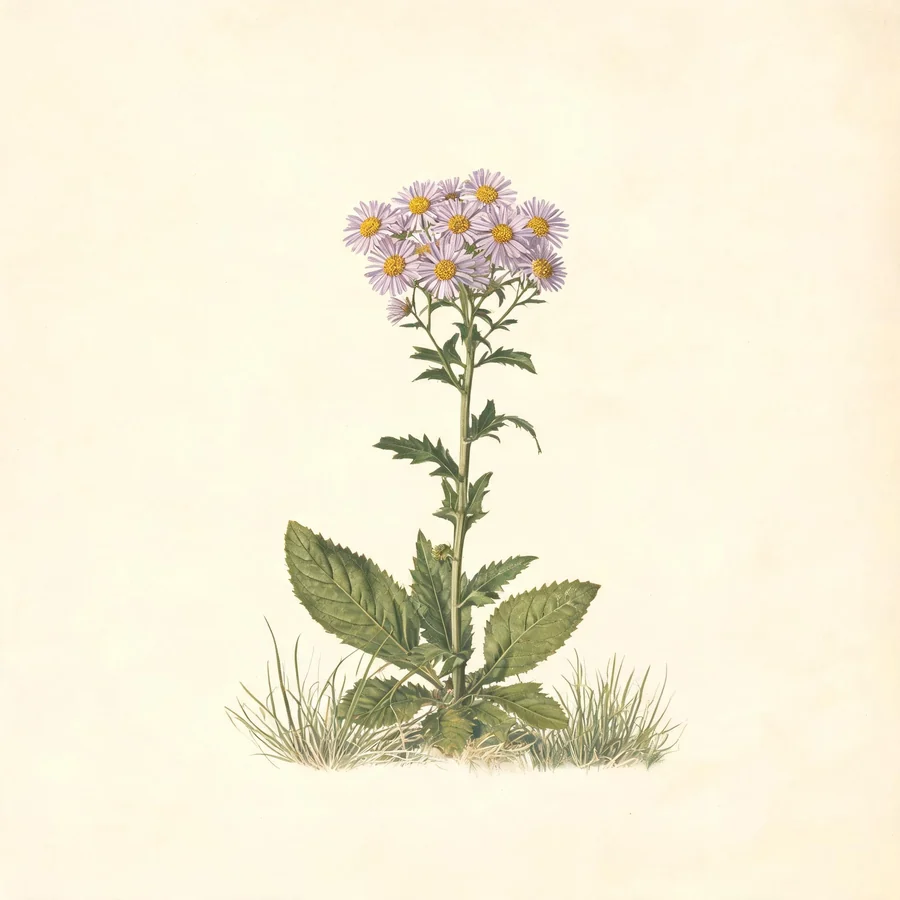
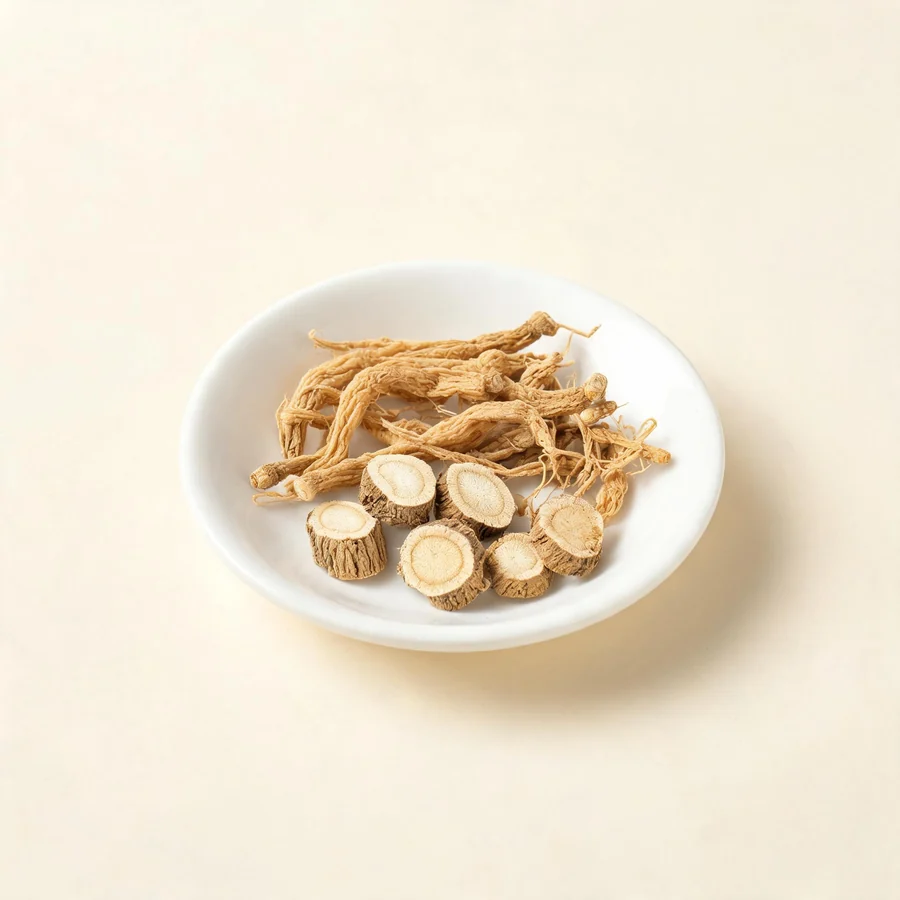
Skin profile
Where this herb sits in skin practice: the pattern it corrects, the skin signs it suits, and what it should not be used for.
Zi Wan belongs here on one argument and one caution. The argument is the classical principle that the Lung governs the skin, which makes a Lung-moistening herb plausible where dry skin and a dry chest occur together. The caution is that its entire recorded use is for cough, so the skin claim is an inference and the herb is a supporting ingredient rather than a treatment in itself. Anyone with a wet, red or infected lesion should look elsewhere.
Skin signs that suggest it
- Dry, finely scaling skin that feels tight after washing, with a dry cough or a tickly throat
- Itch that is worse in dry cold weather and settles in humid air
- Dry eczema in the elbow and knee creases of a person with asthma or allergic rhinitis
- Scanty, sticky phlegm that is hard to clear, with a dry mouth and little thirst
- A dry throat and hoarse voice in the afternoon, with a thin tongue coating
When it is not the right herb
Not for a wet, red, oozing or infected lesion, where the task is to clear heat and dry the surface. Not for heat with thick yellow phlegm and a barking cough either, and not after a lung abscess has begun to suppurate. The root is warm, so a person with clear heat signs, a red tongue and a bitter taste should have it as a minor ingredient at most. A cough still present after several weeks, or one accompanied by wasting, fever or blood, needs a doctor rather than another herbal formula, and skin that is spreading or blistering is not a Lung problem.
What it does for skin
Skin-relevant actions only. Each one describes a mechanism in TCM terms and what it looks like on the skin.
Moistens the Lung that supplies the surface
The classical principle that the Lung governs the skin and the body hair is the whole basis of this entry. When the Lung is dry, the argument runs, the moisture it is meant to spread outward fails, and the skin becomes thin, tight and finely scaled. The root moistens the Lung without richness, which is the quality that makes it usable where a richer tonic would sit heavily on a congested chest. The effect on the skin is slow and indirect.
Settles the Qi that drives a cough-provoked flare
In people whose eczema or urticaria worsens with every coughing fit, the cough is part of the mechanism rather than a coincidence: straining, flushing and broken sleep all feed the flare. By settling rebellious Lung Qi and loosening sticky phlegm, the root reduces that aggravation. It is a supporting move, and the skin still needs its own treatment.
Thins phlegm so the chest, and the complexion, clear
The tradition rates the phlegm-moving power of the root above its cough-settling power, and that order matters here. A chest full of sticky phlegm produces a sallow, dull, slightly puffy face, and clearing it changes the way the surface looks. This is cosmetic only in the old sense of the word: the complexion follows the chest, and no one should expect a skin lesion to resolve because a cough improved.
Softens dryness without cloying
Warm rather than hot, moistening rather than greasy, is how the old commentators described it, and that balance is why it can be used where a dry surface sits alongside a damp chest. Rich Yin tonics would help the dryness and worsen the congestion; drying herbs would do the reverse. The root occupies the narrow middle, and its honey-fried form pushes it further towards moisture.
Skin conditions it is used for
Mapped to the condition pages on this site. The pattern column shows what the skin is doing when this herb is the right choice.
| Condition | Pattern | Why it suits | Typical setting |
|---|---|---|---|
| Skin dryness | Body Fluids Deficiency with Lung dryness | Dry skin is read as a supply problem, and the Lung is one of the organs that spreads moisture to the surface. Where the dryness comes with a dry cough, a dry throat and a tongue with little coating, the root is used to moisten the Lung so that the outward supply improves. It is a supporting herb in a formula that also nourishes Blood and Yin, and it is far too mild to correct dry skin on its own. | Bai He Gu Jin Tang with Zi Wan and Mai Men Dong |
| Atopic dermatitis | Lung and Spleen Deficiency with dry, lichenified eczema | The atopic constitution often runs from dry eczema in the creases to asthma and allergic rhinitis, and the tradition reads that as one weakness showing in two places. In the dry, thickened, itching phase the root is added to a Lung-moistening formula, particularly where a night cough disturbs sleep and scratching follows. It is not a treatment for the weeping, red flare, and honey-frying suits the dry phase better. | Modified Si Jun Zi Tang with Zi Wan and Bai Xian Pi |
| Senile pruritus | Lung and Yin dryness with Wind in later life | Itch in later life that comes with dry, thin, scaling skin and a dry throat is read as moisture failing to reach the surface. The root adds a mild moistening action in the Lung, and it is used beside Blood-nourishing and Wind-settling herbs rather than as the leading one. Itch with weight loss, jaundice or a new rash needs investigation, and this herb has no place in that work-up. | Dang Gui Yin Zi with Zi Wan and Bai Ji Li |
| Cracked skin | Dryness of the Lung and the surface in cold dry weather | Cracks that appear each winter at the heels, knuckles and lips are read as a surface that has lost its moisture and flexibility. The root is a minor addition to a moisturising formula when the person also has a dry cough or a chronic dry throat, on the reasoning that the Lung supplies the surface. It cannot replace emollient care, and a fissure that bleeds or becomes infected needs proper treatment. | Dang Gui Yin Zi with Zi Wan and Mai Men Dong |
Combinations for skin
Herbs it is paired with when the skin, not an internal organ, is the target.
| Partner | Ratio | Why the pair is used |
|---|---|---|
| Mai Men Dong | 6 to 10 g each | Ophiopogon is cool and nourishing and the aster root is warm and moistening, so each corrects the other: the rich herb keeps the warm one from drying, while the phlegm-moving half stops the rich herb from sitting heavy. For skin this is the pairing used when the surface is dry and the chest is congested at the same time, which is common in the dry eczema of an atopic adult. The honey-fried root is usual in this pairing. |
| Bai Bu | 6 to 10 g each | Both are Lung herbs that are warm and moist, and together they are the core of the classic prescription for the cough a cold leaves behind. For a skin page the relevance is timing: a flare that follows every respiratory infection is a pattern worth treating at the chest as well as at the skin. Stemona is the stronger cough quietener, the aster root the better phlegm mover, and the pair covers both. |
| Kuan Dong Hua | 6 to 10 g each, honey-fried | Coltsfoot descends Lung Qi and settles the cough, while the aster root thins the phlegm behind it. The combination is the classic answer to a cough that will not clear, and it is used on this page where scratching follows a coughing fit in a dry-skinned person. Coltsfoot belongs to a genus with a pyrrolizidine alkaloid concern that the aster root does not share, which is one more reason to keep courses short. |
| E Jiao | 6 to 10 g Zi Wan with 6 to 9 g E Jiao | Donkey-hide gelatin nourishes Blood and settles the small bleeding that dry tissue produces, and the aster root moistens the Lung where the dryness started. The pair is used where sputum or the skin surface shows blood-streaked dryness, and for dry, cracked, easily bleeding skin in a depleted person. It is a formula decision under supervision rather than a combination to assemble at home. |
Formulas where it leads
- Zhi Sou San (止嗽散) - The prescription for the cough left behind once a cold has cleared, with the aster root beside stemona, schizonepeta and platycodon. Its skin relevance is indirect and practical: where a flare follows each respiratory infection, treating the chest is part of settling the skin, and the formula is used only after the acute infection has gone.
- Bai He Gu Jin Tang (百合固金汤) - A Lung-moistening formula for dryness that has reached the Blood aspect, with lily bulb, ophiopogon and rehmannia. The aster root is added where the dryness is accompanied by sticky phlegm that will not clear, and the skin reading is a dry, tight, finely scaling surface in a person who is also hoarse and thirsty.
Safety for skin use
What to check before recommending or using it, including the cautions that matter most for skin patients.
Do not use, or use with caution
- A cough that is dry and unproductive, arising from Yin deficiency with heat in the Lung, so that there is nothing to expectorate. The root is warm and dispersing and can parch the throat further; honey-frying softens that effect without removing it.
- An active wet, red, oozing skin lesion, or a chest with thick yellow phlegm and fever. Warming a hot picture is the wrong direction, and a flare of that kind should be assessed.
- Material sold as mountain Zi Wan, which is the root of a different plant containing hepatotoxic pyrrolizidine alkaloids. It should never be taken, and the source of supply matters more than the dose.
- A long course without review. Laboratory work has shown liver-cell toxicity from the astins at high exposure, so months of continuous use are avoided even though ordinary decoction doses have not been linked to liver injury.
Pregnancy and breastfeeding
There is no specific documented contraindication, and the root appears in old formulas for a cough that will not settle in pregnancy, which is reassuring rather than a green light. The descending action still argues for care: use it only on a clear indication, at moderate dose, and in the honey-fried form, which is gentler. Formal study of safety in pregnancy is lacking, as it is for most herbs. For the skin in pregnancy, a dry itchy patch is better managed with emollients and assessment than with a Lung herb taken internally.
Interactions
- Expectorants and mucolytics such as guaifenesin or ambroxol. The root thins mucus in its own right, so the two together may loosen more than was intended; this is seldom troublesome, and no confirmed interaction has been recorded.
- Medicines that stress the liver when taken for months, including high-dose paracetamol, methotrexate and statins. The laboratory signal from the astins makes a long herbal course worth reviewing rather than continuing automatically, and liver function is worth checking.
- Medicines that affect red cell stability, and any haemolytic condition. The saponins rupture red cells in the laboratory, which does not happen at oral doses because they are poorly absorbed, but the combination deserves to be mentioned.
Allergy and patch testing
Allergy to the root is not documented, and the realistic hazards are the wrong species and the wrong pattern rather than an immune reaction. Asteraceae sensitivity is worth asking about, since the plant is a daisy, and anyone who reacts to other members of that family should be cautious with any new herb. A new rash, wheeze or swelling after starting it should stop the course.
General safety references
General references for herbal hepatotoxicity and herb-drug interactions; they are not specific to this herb.
- Review article: Herbal hepatotoxicity - an update on traditional Chinese medicine preparations. Alimentary Pharmacology & Therapeutics, 2014. PMID: 24844799.
- Interactions between herbal medicines and prescribed drugs: an updated systematic review. Drugs, 2009. PMID: 19719333.
- Warfarin and food, herbal or dietary supplement interactions: a systematic review. British Journal of Clinical Pharmacology, 2021. PMID: 32478963.
Evidence
The classical record is quoted with its source. The modern note states the level of evidence plainly.
Classical record
辛,无毒。疗咳唾脓血,止喘悸,五劳体虚,补不足,小儿惊痫。
Acrid and non-toxic. It is used for cough bringing up pus or blood, checks wheezing and palpitations, treats the five taxations and general depletion, makes good what is insufficient, and is given for fright and fits in the young.
Ming Yi Bie Lu (Supplement to the Classic of Materia Medica) - Two things matter for this page: the root is recorded as supplementing insufficiency, and its use in the depleted is centuries older than the honey-frying method that now serves dryness.
紫菀,柔润有余,虽曰苦辛而温,非爆烈可比……惟其温而不热,润而不燥,所以寒热皆宜,无所避忌。
Softness and moisture are present here in abundance. It is described as bitter, acrid and warm, but nothing about it is fierce or violent. Its warmth does not burn and its moisture does not cloy, which is why cold and heat alike can take it, with little to avoid.
Ben Cao Zheng Yi (Orthodox Meaning of Materia Medica), Qing dynasty - The best statement of the quality that makes the root usable on a dry surface: it moistens without richness. It is a statement about character, not about any skin indication.
Modern evidence
Evidence status
- Laboratory and animal studies of shionone, the saponins and the cyclic peptides called astins report antitussive, expectorant and anti-inflammatory activity. They do not measure skin, and none of them shows that the root changes a dermatosis.
- The same astins have injured liver cells in the laboratory, and that finding is why a long course is reviewed rather than renewed automatically. At ordinary decoction doses there are no reports of liver damage in people, and the gap between the two statements is worth keeping in view.
- No controlled trial of Zi Wan in eczema, pruritus or any other skin disease is cited on this page. The skin claim is an inference from the Lung and skin relationship, and it should be read as traditional reasoning rather than as evidence.
PubMed records
Selected real PubMed records for this herb's species or its constituents, chosen by species name and title relevance. They are references for the non-TCM discussion above, not proof that the herb treats any skin condition.
- Identification of potential inflammatory inhibitors from Aster tataricus.. Bioorganic chemistry, 2019. PMID: 31473471 (skin-related record).
- Aster tataricus L. f.: a review on the botany, phytochemistry, ethnopharmacology, pharmacology, toxicology and comprehensive utilization.. Frontiers in pharmacology, 2025. PMID: 40271061 (safety record).
Dose and forms
Skin-practice dosing and the preparations that suit skin complaints.
| Form | Dose and notes |
|---|---|
| Decoction, raw | Five to ten grams of dried root daily, in a formula. Raw root is the stronger mover of phlegm and suits a cough with plentiful sputum; fifteen grams is recorded for a cough that will not shift, under guidance. |
| Honey-fried | Fried with honey, five to ten grams. Honey deepens the moistening and soothing quality and sits more kindly on the stomach, which is why this is the form chosen for dry skin accompanied by a dry cough. |
| Course length | Two to three weeks with review for a cough, and no longer than that for the skin use. A dry skin that has not improved after a month of treatment will not improve with more of the same. |
| Children | Roughly a third to half of the adult amount, around two to five grams for a school-age child, in the honey-fried form. A child with a persistent cough, breathlessness, or a rash with fever should be seen by a doctor. |
Raw when the cough is wet and recent, honey-fried for the dry chronic picture that is the only one relevant to the skin, and a modest weight when it supports a larger formula. Identity matters more than dose: what is traded as mountain aster is another plant altogether, and one with a liver toxin in it.
Citations and further reading
Only real sources are listed: the classical materia medica passages quoted above, and the source works behind the botanical and safety statements.
- Shen Nong Ben Cao Jing (Divine Husbandman's Classic of Materia Medica) - the earliest entry, which records the root as bitter, warm and calming to the five viscera.
- Ming Yi Bie Lu (Supplement to the Classic of Materia Medica), Tao Hongjing - classical entry quoted above.
- Ben Cao Zheng Yi (Orthodox Meaning of Materia Medica), Qing dynasty - classical entry quoted above.
- Radix et Rhizoma Asteris monograph: Pharmacopoeia of the People's Republic of China - accepted botanical source, part used, and the shionone requirement used to detect substitutes.
- Modern evidence statement: based on laboratory literature on shionone, the saponins and the astins, summarised as a statement about the level of evidence rather than as a cited finding.
- Botanical description and identification: botanical literature on Aster tataricus, Asteraceae.
Educational reference for qualified practitioners. This page is not medical advice, and skin conditions should be diagnosed by a clinician before treatment.