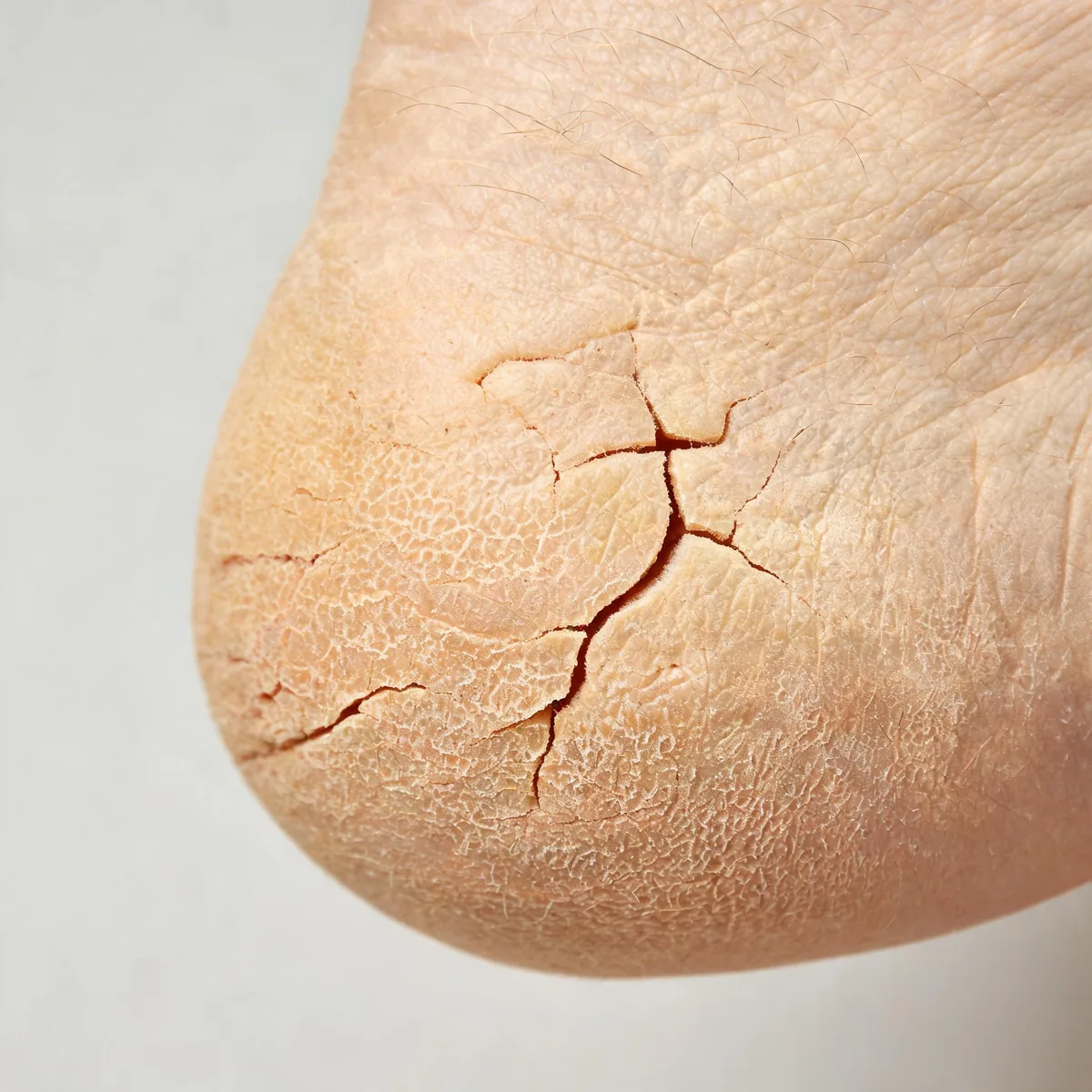
Understanding Cracked skin
The tradition describes skin moisture and flexibility as depending on the smooth flow of Qi and the nourishing power of Blood and Body Fluids.
When those resources run low the skin becomes dry, brittle and prone to splitting, in the same way dry ground cracks. The commonest picture is Blood deficiency with external wind: dry fissures that are not weepy, itch that shifts and worsens at night and in dry windy weather, a pale complexion and an aversion to drafts.
Spleen Blood deficiency gives pale dry cracks that are not inflamed, with fatigue, poor appetite and loose stools. When the cracks are red, inflamed and burning with pus or weeping, the pattern is Toxic-Heat and the focus changes to clearing.
Cold invading the channels gives cracks that feel cold, dark or purplish, with pain worse in cold and better with warmth. The classical literature treats this as a circulation problem rather than dryness alone.
Two questions organise the picture. The first is whether the skin is short of nourishment or under attack. Blood and body fluids keep the surface supple, and when they run low the skin thins, loses elasticity and splits along the lines where it is pulled, most often on heels, knuckles and fingertips. The second is what else is present, because colour, temperature and moisture separate pictures that look almost identical at a glance.
Colour and temperature decide quickly. Cracks that are pale and dry, with no redness or heat, belong to deficiency. Cracks that are red, swollen and burning, sometimes weeping or discharging pus, belong to heat and toxin. Cracks that feel cold, look dusky or purplish and ache in cold weather belong to cold obstructing the channels. Underneath the deficiency pictures sits the Spleen, the organ that turns food into Blood, so poor appetite, loose stools and fatigue alongside widespread dryness point to a digestive root, and treatment has to strengthen production rather than only moisten the surface.
Conventional view
Cracked skin, or skin fissures, occurs when the outer layer loses moisture and becomes dry, thickened and inflexible. Common triggers include cold dry weather, frequent hand washing, harsh soaps and underlying conditions such as eczema, psoriasis or athlete's foot, and cracks can be painful, bleed and raise infection risk. Diagnosis is usually from appearance and history, sometimes with patch testing or blood work.
Standard care restores the skin barrier with thick moisturisers, ointments and barrier creams, topical corticosteroids to reduce inflammation and itch, and antifungal or antibiotic creams if infection is present. For chronic conditions such as eczema, doctors may advise avoiding irritants, gentle cleansers and sometimes oral medication or light therapy.
Moisturisers and steroid creams soothe temporarily but do not address why the skin keeps drying and cracking, overuse of topical steroids may thin the skin further, and where the trigger is an internal imbalance such as poor circulation, chronic inflammation or a weak digestive system unable to produce nourishing Blood, creams alone cannot reach the root.
Selected PubMed records
Real PubMed records for the conventional discussion above, selected by condition name and title relevance. They are references, not a claim that any treatment is proven for this condition.
- Diagnosis and treatment of xerosis cutis - a position paper.. Journal der Deutschen Dermatologischen Gesellschaft = Journal of the German Society of Dermatology : JDDG, 2019. PMID: 31738016.
- Xerosis and pruritus in the elderly: recognition and management.. Dermatologic therapy, 2003. PMID: 14510882.
How it connects
Co-occurrence is explained by a shared shortage rather than by coincidence. Atopic dermatitis and cracked skin both rest on Blood that cannot feed the surface and on wind-dryness taking advantage of it, so the same person often has dry scaly patches that itch and skin that splits at the heels and knuckles. Fatigue and a pale complexion usually travel with both, which points to the same underlying lack of Blood, or to a Spleen too weak to make it, and building that up tends to settle the eczema and soften the cracks at the same time.
How it is assessed
The practitioner examines the cracks, their temperature and the person constitution.
What a practitioner looks for
- Appearance: dry non-weepy cracks suggest Blood deficiency; inflamed cracks with pus suggest Toxic-Heat.
- Temperature: cold dark cracks suggest cold in the channels.
- Constitutional signs: fatigue with poor appetite suggests Spleen Blood deficiency.
- Red flags: spreading redness, warmth or pus around cracks, especially with fever.
Onset is the first question. Cracks that have appeared gradually over months, with dry scaly itchy skin and no change in colour, suggest Blood Deficiency with External Wind. Cracks that arrived suddenly with redness, swelling and burning pain usually follow exposure to harsh chemicals, a medication or an acute inflammation, and point to Toxic-Heat. Cracks that ache with cold, look darker or purplish and settle with warmth point to Cold invading the Channels. If the person also tires easily, has a poor appetite and a pale puffy tongue with teeth marks, Spleen Blood Deficiency is likely to be the root.
The tongue and pulse confirm what the history suggests. A pale thin tongue with a thin white coat and a fine, wiry pulse supports Blood Deficiency with wind; a red tongue with a yellow coat and a rapid pulse supports Toxic-Heat; a pale or dusky tongue with a deep, slow pulse supports Cold; a pale puffy tongue with a weak thready pulse supports a Spleen origin. Getting this right matters because the treatments pull in opposite directions: warming herbs that suit cold will aggravate toxic heat, and cooling herbs that suit heat will deepen a deficiency.
TCM patterns in Cracked skin
Cracked skin is differentiated by how the crack looks and feels and what comes with it. Colour and temperature come first. Cracks that are pale and dry, with no redness or heat, belong to deficiency, either Blood Deficiency with External Wind or Spleen Blood Deficiency. Cracks that are red, swollen and burning, sometimes weeping or discharging pus, belong to Toxic-Heat, where an irritant or acute inflammation has driven heat and toxin into the skin. Cracks that feel cold, look dusky or purplish and ache in cold belong to Cold invading the Channels. When the skin is dry and itchy, the itch shifts about and the person is pale and dizzy, Blood itself is short. When fatigue, poor appetite and loose stools accompany widespread dryness, the Spleen is too weak to make Blood from food. Night-time and windy weather aggravate the wind picture, while skipped meals and overwork aggravate the Spleen.
| Pattern | Key signs | The itch | Tongue | Main formula |
|---|---|---|---|---|
| Blood Deficiency with External Wind | Dry cracks and fissures that are not weepy; Worse at night and in dry windy weather | Itch that comes and goes or shifts | Body: Pale and thin, sometimes slightly dryCoat: Thin, white and a little dry | Not specified |
| Toxic-Heat | Red inflamed cracks with burning pain; Pus or weepy discharge from fissures | Not specified | Body: Red, often with raised red pointsCoat: Yellow, dry, sometimes thick | Not specified |
| Cold invading the Channels (Joints and Muscles) | Pain worse with cold and better with warmth; Skin appears dark or purplish | Not specified | Body: Pale, moistCoat: Thin white | Not specified |
| Spleen Blood Deficiency | Pale dry non-inflamed cracks | Not specified | Body: Pale, possibly thinCoat: Thin white | Not specified |
Blood Deficiency with External Wind
Dry non-weeping fissures with a wandering night itch.
Blood keeps skin supple. When there is not enough of it, the surface loses moisture and elasticity, becomes fragile and splits along the lines where the skin is pulled most, commonly the heels, knuckles and fingertips. A dry surface with gaps in its defences is also an open door for external wind, which strips moisture further and produces the itch and flaking that accompany the crack. The cracks are dry and not weepy, the itch comes and goes and moves about, and it is worse during the night and in dry weather with wind. A pale or sallow complexion, light-headedness and an aversion to drafts belong to the same picture.
The tongue is pale and thin with a thin white, slightly dry coat, and the pulse is fine, sometimes wiry or floating. Overwork and exhaustion, poor nutrition, long hot showers and stress and anxiety all deepen the deficiency, while regular moisturising, a warm humid environment, rest and gentle exercise help. Dang Gui Yin Zi is the classic formula: it nourishes Blood, dispels wind, moistens dryness and calms the itch, and it also tonifies Qi and consolidates the exterior so the surface holds its moisture. Dang Gui and Fang Feng are the herbs named, and Xuehai (SP-10), Sanyinjiao (SP-6) and Quchi (LI-11) are the points.
Signs
- Dry cracks and fissures that are not weepy
- Itch that comes and goes or shifts
- Worse at night and in dry windy weather
- Pale or sallow complexion
- Aversion to wind and drafts
Diet and lifestyle for this pattern: Apply a rich, fragrance-free moisturiser straight after bathing to hold the water in. Build Blood with dark leafy greens, black sesame seeds and moderate amounts of red meat or bone broth, shield the skin from cold wind with gloves and a scarf, and avoid long hot showers that strip its oils.
Toxic-Heat
Red inflamed cracks with burning and possible pus.
Toxic-Heat arrives from outside. Harsh chemicals, strong soaps, medications or an acute inflammation introduce heat-toxin that rises to the skin and damages its integrity, so the surface becomes red and swollen and cracks open with a burning pain rather than a simple dryness. Fluid is consumed in the process, which is why the cracks may weep or discharge pus, why there is such thirst for cold drinks, and why the urine turns dark and scanty or the bowels constipate. It comes on quickly after exposure, and the pain is sharp and hot rather than dull.
The tongue is red with prickly thorns and a dry yellow coat, and the pulse is rapid and forceful, often full or overflowing. Spicy, fried and greasy food, alcohol and coffee, hot humid weather, chemical irritants, harsh soaps and anger all add heat, while cool compresses, cold water or herbal teas, plain food and mild cleansing cool it down. Wu Wei Xiao Du Yin clears heat, resolves toxin, cools the Blood and reduces swelling; Huang Lian Jie Du Tang is used when systemic signs such as fever, thirst and irritability are present. Jin Yin Hua, Ku Shen and Huang Lian are the herbs, and Dazhui (DU-14), Quchi (LI-11) and Xuehai (SP-10) are the points.
Signs
- Red inflamed cracks with burning pain
- Pus or weepy discharge from fissures
- Intense thirst for cold drinks
- Dark scanty urine or constipation
Diet and lifestyle for this pattern: Leave out spicy, greasy and deep-fried food that adds Heat, and eat cooling, moistening food such as cucumber, watermelon, mung beans and pear. Drink plenty of water and keep the skin away from harsh chemicals and irritants.
Cold invading the Channels (Joints and Muscles)
Cold dark cracks with pain worse in cold.
Cold contracts. When it invades the channels and joints, Qi and Blood slow and congeal, and the nourishment that should reach the skin arrives in short supply. The skin becomes dry, brittle and painful, feels cold to the touch, and may look dark or purplish because blood is not moving as it should. The pain is fixed and severe, joint stiffness or aching often sits near the cracked skin, and there is a cold sensation in the limbs. It reliably worsens with cold weather, air conditioning, cold water, raw cold food and prolonged inactivity, and eases with warmth.
The tongue is pale with a thin white coat and a moist surface, and the pulse is tight, often wiry and slow. Warmth is part of the treatment as much as the formula: a heating pad or warm soak, warm dry clothing, gentle exercise to restore circulation and warm cooked meals all relax the channels. Huang Qi Gui Zhi Wu Wu Tang warms the channels, harmonises the nutritive and defensive Qi, tonifies Qi and dispels obstruction, which is why it suits cold-induced pain and cracking. Gui Zhi and Dang Gui are the herbs named, and Zusanli (ST-36) with Yanglingquan (GB-34) are the points, the first often warmed with moxibustion.
Signs
- Cracks feel cold to the touch
- Pain worse with cold and better with warmth
- Skin appears dark or purplish
- Joint stiffness near the cracked skin
Diet and lifestyle for this pattern: Keep the affected skin warm and out of draughts. Soak in warm water with fresh ginger slices, pat dry and apply a nourishing balm, and eat warming cooked food such as lamb stew with cinnamon and ginger while avoiding raw, cold food and iced drinks.
Spleen Blood Deficiency
Pale dry cracks with fatigue and loose stools.
The Spleen is the organ that turns food into Blood. When it is weak, production falls, and the skin is the first place to notice: it becomes pale and dry, and it cracks without any heat or redness, because there is no excess to clear, only a shortage to fill. The deficiency shows elsewhere too, with fatigue and physical weakness, a poor appetite with loose stools, a sallow complexion and light-headedness. The cracks tend to be widespread rather than confined to one area, and the whole surface feels dry.
The tongue is pale and may be thin, with a thin white coat, and the pulse is fine and choppy, weakest at the right Guan position. Skipping meals, irregular eating, raw or chilled food and greasy food, overwork, mental strain and worry all weaken the Spleen further, while rest, warm cooked meals, blood-nourishing foods such as red dates and liver, and gentle exercise such as walking or tai chi rebuild it. Gui Pi Tang tonifies Qi, nourishes Blood and strengthens the Spleen, addressing the root of the malnutrition rather than the crack itself. Dang Gui, Bai Zhu and Huang Qi are the herbs named, and Zusanli (ST-36), Sanyinjiao (SP-6), Pishu (BL-20) and Xuehai (SP-10) are the points.
Signs
- Pale dry non-inflamed cracks
- Fatigue and physical weakness
- Poor appetite with loose stools
- Pale or sallow complexion
- Dizziness or light-headedness
Diet and lifestyle for this pattern: Eat warm cooked food such as soups, stews and congees to support the Spleen, with blood-nourishing ingredients such as red dates, goji berries, black sesame and small amounts of liver. Avoid raw, cold and greasy food, keep meals regular, avoid skipping meals or overworking, and keep exercise gentle so Qi and Blood circulate without draining you.
Treatment approach
How the tradition treats cracked skin, with the herbs, formulas and points used for it.
Principles
- Nourish Blood and fluids where the skin is dry and splitting.
- Strengthen the Spleen where the deficiency originates in digestion.
- Clear Toxic-Heat promptly where cracks are inflamed, weeping or discharging pus.
- Warm the channels where the cracks are cold and painful, since that is a circulation problem.
- Nourishment and protection are done together, and the balance between them depends on the pattern. In the deficiency pictures the formula builds Blood and strengthens the Spleen, and the external routine is rich and occlusive so the surface keeps what it is given. In Toxic-Heat the formula clears and cools, and external care stays gentle and non-irritant, since scrubbing or strong soap adds to the toxin. In Cold the formula warms and moves, and warmth, moxibustion on the lower leg points and warm food do much of the work. Progress is judged by the crack closing from its base rather than by the skin feeling softer for a day.
Herbs used
Formulas
Acupoints
- SP-10 (Xuehai)
- SP-6 (Sanyinjiao)
- LI-11 (Quchi)
- DU-14 (Dazhui)
- ST-36 (Zusanli)
- GB-34 (Yanglingquan)
- BL-20 (Pishu)
What to expect
- Dry fissures are described as softening over weeks with internal treatment and emollient care.
- Inflamed or infected cracks need medical treatment and heal more slowly.
- Cracks recur in dry cold weather unless the internal pattern is addressed.
- Change is usually felt before it is seen. Itching eases and the skin feels less tight within a fortnight, and shallow cracks begin to close after that. Deep heel fissures take longer, often six to twelve weeks, because the skin has to rebuild across a thick weight-bearing surface. Winter is the test: many people heal in summer and crack again at the first cold snap, so the protective routine is continued through the cold months rather than stopped when the skin looks better. Where a crack has been present for years, the aim is skin that stays intact rather than skin that never dries.
Safety and when to get help
Seek medical help urgently for
- Spreading redness, warmth or pus around the cracks.
- Fever with painful skin cracks.
- Cracks on the feet in someone with diabetes.
For anything severe, sudden or spreading quickly, read when a skin problem needs urgent care.
Cautions
- Do not use strong acids or peeling agents on cracked skin.
- Diabetic foot cracks need prompt medical review.
- Emollients and barrier protection are part of care in both frameworks.
Using this alongside conventional care
- TCM is described as complementary to conventional care: emollients and prescribed topical treatment continue, and infected cracks need medical care.
- Barrier creams, emollients and prescribed topical steroids can all continue while herbs are taken, and the external routine usually does more of the work early on. Steroid creams should be tapered rather than stopped suddenly as the skin improves, with both the dermatologist and the TCM practitioner aware of the plan. Dang Gui appears in several of the formulas used here and has mild anticoagulant activity, so anyone on warfarin should tell both prescribers. A crack with spreading redness, warmth, pus or fever needs medical review rather than more ointment, and a crack with numbness, especially in diabetes, needs assessment before it is treated as dryness.
Diet and lifestyle
- Favour warm cooked easily digestible food such as soups, stews and congee to support the Spleen and Blood production.
- The dietary principle is warmth and digestibility. Cooked food, soups, stews and congees are easier for the Spleen to turn into Blood than raw salads and iced drinks, and this holds whether the pattern is deficient or excess. Moistening foods such as pear, sweet potato and spinach support the surface. For Blood Deficiency add dark leafy greens, black sesame, red dates and a little red meat or bone broth, and for Spleen Blood Deficiency add red dates, goji berries and small amounts of liver. In Toxic-Heat keep fried, spicy and greasy food low and favour cucumber, watermelon, mung beans and pear. In Cold favour warm cooked meals with ginger and cinnamon, and avoid raw cold food and icy drinks.
If you're pregnant
In pregnancy Blood deficiency becomes more pronounced as blood is directed to the fetus, so cracked skin may appear or worsen. Dang Gui Yin Zi is generally considered safe when prescribed by a qualified practitioner, but the dose of Dang Gui needs monitoring because in large amounts it can mildly stimulate uterine contractions.
Acupuncture is a safe alternative, avoiding Sanyinjiao (SP-6) and Hegu (LI-4), and gentle topical treatments with lanolin or sesame oil are safe first-line options. If Toxic-Heat is present, strong bitter-cold herbs such as Huang Lian are avoided in favour of milder heat-clearing herbs such as Jin Yin Hua under guidance.
If you're breastfeeding
Blood-nourishing formulas such as Dang Gui Yin Zi are safe and can even support postpartum recovery and milk supply. Where cracked skin arises from Toxic-Heat, avoid formulas containing Huang Lian, such as Huang Lian Jie Du Tang, because its bitter-cold compounds pass into milk and may cause infant diarrhoea or jaundice, and topical washes with Ku Shen or Jin Yin Hua are a safer option for localised heat and cracking.
Acupuncture is well tolerated and carries no risk of transfer to the infant, and the practitioner should be told that the mother is nursing so the prescription can be adjusted.
If treating a child
In children cracked skin most often comes from Spleen Blood deficiency, a weak digestive system that cannot produce enough blood to moisten the skin. These children tend to be picky eaters with pale faces, fatigue and dry skin that cracks easily in winter, and this pattern is far more common than Toxic-Heat or Cold invasion in paediatric cases.
Doses are reduced to a quarter to a half of the adult dose by age and weight, gentle blood-nourishing formulas such as Gui Pi Tang in low doses work well, and acupuncture at points such as Zusanli (ST-36) can be very shallow or replaced with acupressure. Topical emollients are always a safe first step, and warm cooked foods to strengthen the Spleen are essential.
If treating an elderly patient
Older patients almost always present with Blood and Yin deficiency, so cracked skin is a common complaint: the skin thins and loses its natural oils, so fissures appear easily and heal slowly.
The principle is to nourish Blood and Yin, with doses lowered to about two-thirds of the adult dose to spare weaker digestion, and polypharmacy means interactions must be screened. Acupuncture is often better tolerated and can improve peripheral circulation to the skin, points such as Xuehai (SP-10) and Zusanli (ST-36) are particularly helpful, and courses may need to be longer.
Urgent-sign guidance is based on standard sources: NHS anaphylaxis, NHS cellulitis, NHS Stevens-Johnson syndrome, NHS melanoma.
Evidence
Evidence status
Compiled for this page from the classical and modern literature; not a systematic review, so treat it as a pointer to sources rather than clinical guidance.
Trials specific to cracked skin are scarce; the evidence comes from chronic eczema, hand-foot syndrome and psoriasis. A systematic review of Chinese herbal medicine for atopic eczema found possible reductions in itch and lesions, limited by small samples and methodological flaws, and one randomised trial of Dang Gui Yin Zi for blood-deficiency wind-dryness eczema reported significant improvement in fissures and dryness.
The review behind this material pooled randomised trials of Chinese herbal medicine in atopic eczema and appeared in the British Journal of Dermatology in 2007; it concluded that some preparations reduced itching and lesion severity, while small samples and weak design kept the findings tentative. The second study, reported in the Journal of Traditional Chinese Medicine in 2016, compared Dang Gui Yin Zi with control care in chronic eczema where dryness and Blood deficiency predominate, and described higher rates of improvement with less scaling, itching and fissuring. Beyond those two, support comes from small observational reports of herbal washes and acupuncture in chemotherapy-related hand-foot syndrome, which is a different population and a weaker design. Little of this is specific to cracked skin, so the evidence is best read as indirect.
Studies often cited
Herbal treatment may reduce itching and skin lesions, with overall evidence limited by small samples and methodological flaws. Systematic review (as recorded in the source)
A randomised trial reported significant improvement in skin fissures and dryness. Randomised controlled trial (as recorded in the source)
Classical record
血虛風燥,肌膚失養,故令皴裂。
When Blood is deficient and wind-dryness prevails, the skin and flesh lose their nourishment, and chapping and cracking follow.
Chapping and cracking (Zhu Bing Yuan Hou Lun) - Classical citation: Zhu Bing Yuan Hou Lun (Treatise on the Causes and Symptoms of Diseases), Volume 35, Chapter on Chapped Skin.
Common questions
Why do my heels crack in winter?
The classical literature reads it as Blood and fluid deficiency worsened by cold and dryness, sometimes with cold obstructing the channels.
Can herbs heal cracked skin?
The tradition describes nourishing Blood and fluids, with improvement over weeks alongside emollient care.
When are cracks an infection risk?
When redness, warmth, pus or fever develop around them; diabetic foot cracks need prompt review.
Is it just a cosmetic problem?
No. Deep fissures are painful, can bleed, and create a route for infection.
Will I need to take herbs forever?
No. The course is finite: once the imbalance has been corrected and the skin has healed, the formula is tapered off. A person with a long-standing deficiency may come back for the occasional tune-up, but the aim is to leave the body feeding its own skin again rather than to create dependence on a product.
Can I keep using my usual moisturiser alongside the herbs?
Yes, and a plain fragrance-free moisturiser is part of the plan rather than a rival to it. The herbs work on the internal cause while the cream protects the barrier on the outside. Products with harsh chemicals or heavy perfume are best left alone, since they can irritate skin that is already split.
Is acupuncture painful on cracked skin?
The needles are hair-thin and most people feel only a brief pinch, or a sensation of warmth and heaviness. For cracked skin the points sit on the limbs, abdomen or back rather than on the fissures, so a session is comfortable, and many people find it deeply relaxing.
How soon will the cracks close?
It depends on the pattern. A crack caused by a chemical irritant can settle within one to three weeks once that irritant is removed, while the dry and itchy kind rooted in deficient Blood usually softens in two to four weeks and heals over a couple of months. Where cold or a weak Spleen is involved, expect three to six months of steady work.