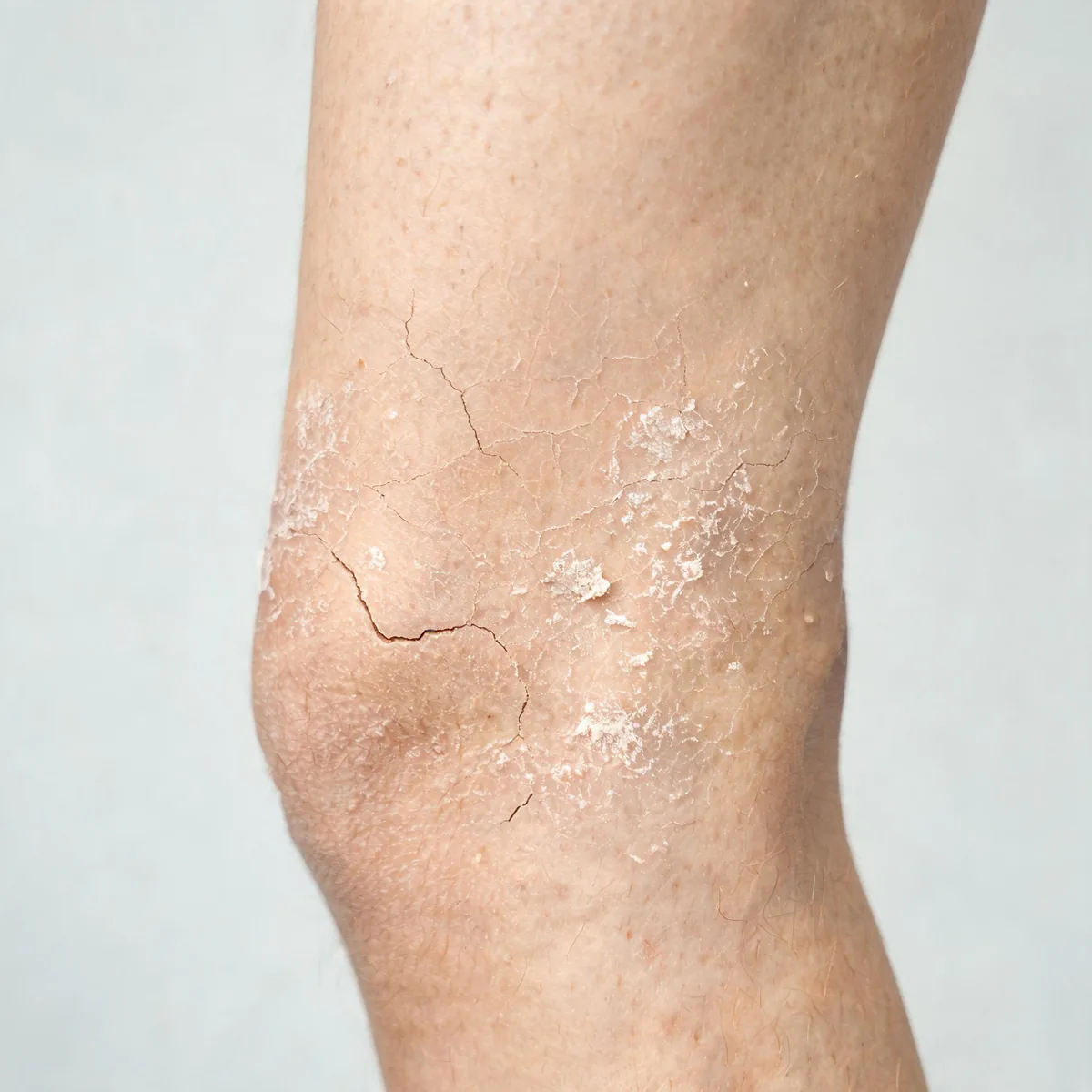
Understanding Skin dryness
The tradition describes the skin as a mirror of the internal organs, with dryness arising when the systems that produce and distribute moisture are depleted or blocked.
Blood deficiency with external wind gives dry rough flaky skin with a wandering itch that worsens at night, a pale complexion and brittle nails. Empty-Heat from Yin deficiency gives skin that feels hot to the touch in the evening, with night sweats and heat in the palms and soles.
Qi and Yin deficiency gives tiredness with dryness: dry mouth, shortness of breath on exertion, night sweats and five-palm heat. Body fluids deficiency is the simplest picture: thirst, dry lips, dry skin, scanty dark urine and dry stools, without itch or heat.
A different pattern is also described: Damp-Phlegm, where the skin is dry but the body is heavy and foggy, with a greasy coating and poor appetite. The classical literature treats that as fluids failing to reach the surface because dampness is blocking them, not because supply is low.
In this framework the Lungs govern the skin and body hair, and their dispersing action is what carries moisture out to the surface. The Spleen turns food into Qi and into the fluids that moisten tissue, the Liver stores the Blood that carries that nourishment, and the Kidneys are treated as the root of Yin and of all fluids. Dryness appears when one link in that chain fails: too little fluid is produced, too little Blood carries it, or something blocks the route to the skin. That is why the same cream can help one person and do almost nothing for another, and why the pattern matters more than the surface finding.
The quality of the dryness is itself a clue. Flaking that wanders and stings in wind belongs to Blood deficiency with internal Wind. Dryness that feels hot towards evening, with night sweats, belongs to Yin deficiency, where empty heat simmers the moisture away. Deep parched dryness with unquenchable thirst points to simple Body Fluids depletion, and exhaustion alongside the dryness points to a combined depletion of Qi and Yin. The classical literature also describes a paradox: when the Spleen is too weak to transform fluids they thicken into Phlegm that blocks the channels, leaving the surface dry even though the person feels heavy and sluggish inside.
Conventional view
Western medicine calls ordinary dry skin xerosis: the skin holds too little water, so it feels rough, tight or flaky and may itch. It is common and usually environmental, arising from low humidity, frequent washing with harsh soap, central heating, sun and age, and it is sometimes secondary to eczema, psoriasis or an underactive thyroid. Assessment is by inspection and history, with attention to any underlying condition.
Treatment is aimed at the barrier. Emollients and moisturisers are applied regularly, soap is kept mild and humidifiers help in dry air. Itching may be treated with a topical corticosteroid or an antihistamine, and where an internal cause such as thyroid disease is found, that condition is treated in its own right.
The gap is that a moisturiser replaces what the skin lacks rather than restoring the body's own supply, so many people find they must reapply constantly and that the dryness comes back the moment they stop. The classical literature presents TCM as a complement rather than a replacement: identifying the internal pattern aims to improve the body's own hydration over time, while emollients continue to protect the surface in the meantime.
Selected PubMed records
Real PubMed records for the conventional discussion above, selected by condition name and title relevance. They are references, not a claim that any treatment is proven for this condition.
- The terminology of skin disorders. Primary Care, 2000. PMID: 10815043.
How it connects
Patterns commonly overlap rather than exclude one another. Long-standing Blood deficiency can slide into Yin deficiency, so dry itchy skin comes with night-time warmth and sweats. Qi and Yin deficiency often sits alongside Body Fluids deficiency, which makes the dryness deeper and the tiredness more marked. Damp-Phlegm can coexist with any deficiency, which is why someone can be dry, bloated and exhausted at the same time. The strongest sensation is the practical guide: itch points to Blood deficiency with Wind, heat to Yin deficiency, and a thick greasy coat to Damp-Phlegm. Confirm it on the tongue and pulse rather than by guesswork.
How it is assessed
The practitioner asks what kind of dryness it is: dry and itchy, dry and hot, dry and tired, or dry with a heavy body.
What a practitioner looks for
- Itch and heat: a wandering itch suggests Blood deficiency; heat in the skin at night suggests Empty-Heat.
- Fatigue: dryness with tiredness and breathlessness suggests Qi and Yin deficiency.
- Simple dryness: thirst, dry lips, scanty urine and dry stools without itch suggest Body Fluids deficiency.
- Blockage: dry skin with a heavy foggy body and greasy coating suggests Damp-Phlegm rather than deficiency.
The consultation starts with the character of the dryness: does it flake and itch, or is it merely rough and tight? Timing matters as much, so the practitioner asks whether it is worse at night, worse in winter, worse after washing, or present whatever the weather. Associated clues then decide the pattern, which is why thirst, energy, sleep, sweating, appetite and bowel habit are all reviewed, along with how long the problem has been present. An itch that wanders, a pale complexion and brittle nails pull towards Blood deficiency, while heat at night and a dry throat point to Yin deficiency.
Tongue and pulse settle the question. A pale tongue with a thin white coat and a fine, weak pulse fits the Blood picture. A red, thin, cracked tongue with little coating, together with a fine rapid pulse, fits empty heat. A dry tongue with almost no coat and a fine rapid pulse fits Body Fluids depletion, and a red or pale-red tongue with a weak, often rapid pulse fits the combined Qi and Yin picture. Damp-Phlegm is the exception: the dryness sits on the surface while the tongue looks pale, swollen and thickly coated, and the pulse feels slippery rather than thin.
TCM patterns in Skin dryness
Five patterns are described for skin dryness, and the distinctions matter because the treatments pull in opposite directions. Four describe a failure of supply: Blood too thin to nourish the surface, Yin too depleted to cool and moisten it, Body Fluids that have simply run low, or Qi and Yin falling together. The fifth, Damp-Phlegm, describes a blockage. Here the body holds fluid, but thick Phlegm has settled in the channels and moisture never arrives, so the skin is dry while the person feels heavy, foggy and bloated. That single pattern explains why moistening herbs can make some people worse. Reading which one fits means weighing the itch, the sensation of heat, the level of tiredness and the state of the digestion together, then confirming the picture on the tongue and the pulse. No single sign decides it, because the same dryness can sit on top of very different internal states.
| Pattern | Key signs | The itch | Tongue | Main formula |
|---|---|---|---|---|
| Blood Deficiency with External Wind | Dry rough or flaky skin | Wandering itch that comes and goes | Body: Pale and thin, sometimes slightly dryCoat: Thin, white and a little dry | Not specified |
| Empty-Heat caused by Yin Deficiency | Skin feels hot to touch, especially evening; Dry mouth and throat at night | Not specified | Body: Red, thin and dry, often crackedCoat: Little or none; the tongue may look peeled | Not specified |
| Qi and Yin Deficiency | Persistent tiredness and weakness; Dry mouth with little desire to drink | Not specified | Body: Red or pale-red, thin and dry, possibly crackedCoat: Thin or absent | Not specified |
| Damp-Phlegm | Not specified | Not specified | Body: Pale, swollen and teeth-marked, wet-lookingCoat: Thick, white and greasy | Not specified |
| Body Fluids Deficiency | Dry mouth and cracked lips; Dry rough flaky skin | Not specified | Body: Red, dry and thin with cracksCoat: Little or none | Not specified |
Blood Deficiency with External Wind
Dry rough flaky skin with a wandering night itch.
Blood is what moistens and lubricates the skin, so when it is deficient the surface loses its natural suppleness and turns rough, dry and flaky. The deficiency also stirs up internal Wind, and Wind is defined by movement and sudden change, which is why the itch wanders from place to place instead of settling. At the same time the protective layer at the surface weakens, so external Wind can enter easily, bringing sensitivity to drafts, sudden flare-ups and itching that is usually worse at night.
The tongue is pale and thin with a thin white, slightly dry coat, and the pulse is fine, sometimes wiry under the left middle finger and floating near the surface. Stress and worry, exposure to wind, dry cold weather, late nights and spicy fried food all aggravate it, while rest, a warm sheltered environment, blood-building food, gentle movement and a plain natural moisturiser help. Dang Gui Yin Zi is the formula named for this pattern, and the points used are ST-36 (Zusanli), SP-6 (Sanyinjiao), LI-4 (Hegu) and GB-20 (Fengchi).
Signs
- Wandering itch that comes and goes
- Dry rough or flaky skin
- Pale or sallow complexion
- Aversion to wind and drafts
- Dull brittle nails
Diet and lifestyle for this pattern: Eat blood-nourishing food such as dark leafy greens, beetroot, black sesame, eggs and bone broth, and avoid spicy, fried or very drying food. Protect the skin from wind and cold with gentle clothing and natural moisturisers, and keep stress low, since stress consumes Blood and Qi.
Empty-Heat caused by Yin Deficiency
Dry skin that feels hot in the evening, with night sweats.
Yin is the cooling, moistening half of the body, and it keeps the warming Yang in check. When Yin runs low it can no longer anchor Yang, so a low-grade heat rises and slowly simmers the remaining moisture away, much as a small flame dries out a pot. The skin loses its lubrication and becomes dry, and it often feels warm to the touch, most noticeably as the day turns to evening. Night sweats, heat in the palms, soles and chest, flushed cheekbones and restless sleep belong to the same picture.
The tongue is red, thin and dry with cracks and little or no coating, and the pulse is fine and rapid. Spicy and fried food, alcohol, coffee, late nights, hot dry weather and anger or stress all add heat and consume what Yin is left, while a cool moist room, proper sleep, pears and other moistening food and gentle movement help rebuild it. Zhi Bai Di Huang Wan is the formula named here, with BL-23 (Shenshu), SP-6 (Sanyinjiao) and LI-11 (Quchi).
Signs
- Skin feels hot to touch, especially evening
- Night sweats
- Five-palm heat
- Dry mouth and throat at night
- Flushed cheekbones
Diet and lifestyle for this pattern: Eat more moistening, cooling food such as pear, snow fungus, lily bulb and cucumber, and avoid spicy, fried or barbecued food as well as alcohol and coffee, which generate Heat. Be in bed before eleven and protect rest, and choose gentle non-sweaty movement such as tai chi or yin yoga so the mind settles without depleting fluids.
Qi and Yin Deficiency
Dryness with tiredness, breathlessness and night sweats.
Qi supplies the push that carries moisture outwards, and Yin is the cool, moist ground it travels through. When both are depleted the body neither makes enough fluid nor pushes it to the surface, so the skin stays persistently dry and can feel rough or papery. The person is usually drained and parched at the same time, with a dry mouth and little real thirst, breathlessness on exertion, night sweats and heat in the palms and soles.
The tongue is red or pale-red with a thin or absent coat, sometimes cracked, and the pulse is fine, weak and often rapid. Overwork and lost sleep, dry heated rooms, spicy fried meals, overthinking and stress, and long stretches of talking all make it worse, while rest, warm moistening drinks, a cool moist room, gentle movement and pears help. Sheng Mai San is the formula named for this pattern, with ST-36 (Zusanli), SP-6 (Sanyinjiao), KI-3 (Taixi) and REN-6 (Qihai).
Signs
- Persistent tiredness and weakness
- Dry mouth with little desire to drink
- Shortness of breath on exertion
- Five-palm heat
- Night sweats
Diet and lifestyle for this pattern: Eat moistening food such as pear, honey and congee, and avoid spicy, fried and drying food. Rest well and avoid overexertion, and a humidifier at night helps prevent fluid loss.
Damp-Phlegm
Dry skin with a heavy foggy body and greasy coating, from blockage rather than deficiency.
When the Spleen is too weak to transform and transport fluids, they gather first as Dampness and later thicken into Phlegm, a sticky substance that obstructs the channels. Because the route is blocked, moisture never arrives at the surface even though the body is holding fluid. The result is a paradox: the skin is dry while the person feels heavy, foggy and bloated underneath. Moisturising treatment alone tends to make that heaviness worse, which is why this pattern is cleared by removing the blockage rather than by adding moisture.
The tongue looks pale and puffy, its edges scalloped by the teeth, and it carries an oily white coat. The pulse is slippery, like a bead sliding through oil, sometimes soggy at the right middle position. Greasy fried food, cold raw food and iced drinks, humid weather, inactivity and overeating all worsen it, while warm cooked meals, gentle daily movement and a dry, airy room help. Er Chen Tang is the formula named here, with ST-36 (Zusanli), SP-9 (Yinlingquan), ST-40 (Fenglong) and SP-6 (Sanyinjiao).
Signs
- Heaviness in body and limbs
- Thick white greasy coating
- Chest and upper abdominal stuffiness
- Poor appetite with loose sticky stools
- Dizziness or brain fog
Diet and lifestyle for this pattern: Eat warm cooked food such as soups and stews, and avoid cold, raw, greasy or dairy-heavy meals that create more Dampness. Gentle daily walking, yoga or stretching helps Qi circulate and moves the sluggish Dampness, and keep living space dry and aired.
Body Fluids Deficiency
Simple dryness with thirst, dry lips and dry stools.
Body Fluids are the body's ordinary moisture, and they are what keeps the skin supple and lubricated. They are depleted by a long illness, by heavy sweating, or by simply not drinking enough over a long period, and the skin then loses its lustre and turns dry, rough and slightly rough to the touch. This is the plainest of the patterns: there is no marked heat and no prominent itching, only a straightforward shortage of moisture.
The tongue is red, dry and thin with cracks and little or no coating, and the pulse is fine and rapid. Spicy, fried and roasted food, coffee and alcohol, heated indoor air that is very dry, heavy sweating and recent illness or dehydration all make it worse, while warm water through the day, pears and other moistening food, a humidifier and proper rest help. Zeng Ye Tang is the formula named for this pattern, with SP-6 (Sanyinjiao) and KI-6 (Zhaohai).
Signs
- Thirst with desire to drink
- Dry mouth and cracked lips
- Dry rough flaky skin
- Scanty dark urine
- Dry hard stools
Diet and lifestyle for this pattern: Drink warm water regularly through the day and include moistening food such as pear, honey, cucumber and congee. Avoid spicy, fried and very dry food as well as alcohol and coffee, which deplete fluids further, and use a humidifier in dry environments to protect the skin's moisture.
Treatment approach
How the tradition treats skin dryness, with the herbs, formulas and points used for it.
Principles
- Nourish Blood and Yin where dryness comes from depletion, and generate fluids where the fluids are low.
- Resolve damp-phlegm where dryness comes from blockage, since moistening alone would worsen that pattern.
- Protect the barrier with emollients, which both frameworks treat as basic care.
- Address the cause: harsh soaps, dry air, overheating and dehydration.
- The root strategy is the same in every case: restore the body's capacity to make moisture and to deliver it. That means supporting the Spleen and Stomach so that fluids are produced from food, and the Lungs so that they are spread outwards. The branch then differs by pattern, which is why a formula is chosen rather than a single moistening herb: Dang Gui Yin Zi for Blood deficiency with Wind, Zhi Bai Di Huang Wan for empty heat, Sheng Mai San where Qi and Yin have both fallen, Er Chen Tang where Phlegm must be cleared before anything can reach the skin, and Zeng Ye Tang where fluids alone are low.
Herbs used
Formulas
- Dang Gui Yin Zi
- Zhi Bai Di Huang Wan
- Sheng Mai San
- Er Chen Tang
- Zeng Ye Tang
Acupoints
- ST-36 (Zusanli)
- SP-6 (Sanyinjiao)
- LI-4 (Hegu)
- GB-20 (Fengchi)
- BL-23 (Shenshu)
- LI-11 (Quchi)
- KI-3 (Taixi)
- qihai-ren-6
- SP-9 (Yinlingquan)
- ST-40 (Fenglong)
- KI-6 (Zhaohai)
What to expect
- Dryness from fluid depletion is described as improving within weeks.
- Blood and Yin deficiency patterns take months to change.
- The Damp-Phlegm pattern needs the blockage treated before the skin softens.
- Progress is usually gradual and uneven. Itching and tightness commonly ease first, within two to four weeks, and the skin then becomes smoother over the weeks that follow. Long-standing dryness in a deeper deficiency pattern can take two to three months, and treatment is normally continued for a while after the skin settles so that the gain holds. Flare-ups in cold, windy or very dry weather are common, and a return to the habits that caused the problem will usually bring the dryness back.
Safety and when to get help
Seek medical help urgently for
- Sudden severe dryness with cracking and bleeding that will not stop.
- Dry skin with unexplained weight loss, fever or generalised itch.
- Dryness with signs of infection in cracked skin.
For anything severe, sudden or spreading quickly, read when a skin problem needs urgent care.
Cautions
- Do not use strong exfoliants or hot water on very dry skin.
- Persistent generalised dryness needs medical review.
- Long-term internal herbs should be supervised.
Using this alongside conventional care
- TCM is described as complementary to conventional care: emollients and prescribed topical treatment continue alongside herbs, and systemic causes need medical review.
- Herbal treatment works from the inside and does not conflict with emollients, medicated creams or prescribed topical treatment, so both usually continue together. The important step is disclosure: tell the TCM practitioner about diuretics, which alter fluid balance, and about anticoagulants, because herbs such as Dang Gui have mild blood-moving effects. Tell the doctor about the herbs in the same way. Nothing prescribed should be stopped abruptly, and dryness that begins abruptly after a new medicine is started needs that medicine reviewed rather than another cream.
Diet and lifestyle
- Favour moistening foods such as pear, apple, honey, congee, bone broth and dark leafy greens, with adequate warm water, and avoid overly drying or spicy food.
- Across all patterns the principle is to favour food that moistens rather than dries: pears, apples, honey, congee, bone broth, dark leafy greens and a steady intake of warm water through the day. Spicy, fried and roasted food, alcohol and too much coffee deplete fluids, so they are kept to a minimum. The pattern then changes the detail. Blood deficiency benefits from beetroot, black sesame, eggs and dark greens. Empty heat does better with snow fungus, lily bulb and cucumber. Damp-Phlegm is the exception again, because rich, greasy and dairy-heavy meals add to the blockage, so warm cooked soups and stews are preferred over raw food and heavy sauces.
If you're pregnant
During pregnancy the growing baby draws heavily on the mother's reserves of Blood and Yin, so dryness often intensifies and the Blood deficiency picture becomes more common. Dang Gui Yin Zi needs real caution here, because Dang Gui and Chuan Xiong are traditionally avoided in the first trimester for fear of stimulating the uterus. Food therapy using walnuts, black sesame and bone broth nourishes Blood and Yin more gently, and acupuncture is a reasonable option using points such as ST-36 (Zusanli) and KI-3 (Taixi) to build Qi and Yin. SP-6 (Sanyinjiao) is usually avoided in early pregnancy. Work with a practitioner who treats pregnant patients regularly.
If you're breastfeeding
Breastfeeding sends a good share of the mother's fluids into milk, which can leave Yin deficiency and dryness more pronounced. Bitter, cold formulas are usually avoided, and Zhi Bo Di Huang Wan is one of them because it contains Huang Bai: it may reduce milk supply and can cause loose stools in the baby. Small amounts of Dang Gui are generally regarded as safe and help build Blood. Acupuncture is low risk, and gentle food therapy suits nursing mothers, for example pear juice or congee with lily bulb. Any internal herb should be supervised by someone experienced in postpartum care.
If treating a child
In children the classical literature links dry skin most often to Spleen weakness, with Damp-Phlegm accumulating and blocking moisture from the surface. That pattern is commoner in childhood than in adults, and the tongue usually looks pale and puffy and carries a greasy coat. The formula used is Er Chen Tang, at a reduced dose: usually between a quarter and a half of an adult dose, set by age and weight. Many cases are simpler than that, coming from too little fluid or a very dry room, in which case more soups, stewed fruit and water are the first step, and a little sesame oil on the skin gives immediate comfort.
If treating an elderly patient
In older patients the root is almost always a shortfall of Yin and Blood, since the body's reserves decline with age. Dang Gui Yin Zi suits this group, and so does Zeng Ye Tang, though the dose is often cut to roughly two thirds of the usual adult amount so that a weaker Spleen is not overloaded. Strongly dispersing herbs, Chuan Xiong and Fang Feng among them, are used sparingly because frail people can react with dizziness or fatigue. Needling is often tolerated better than herbal medicine, particularly where several drugs are already being taken, and points such as SP-6 (Sanyinjiao) and KI-6 (Zhaohai) gently nourish Yin. Progress is slower and should be judged over months.
Urgent-sign guidance is based on standard sources: NHS anaphylaxis, NHS cellulitis, NHS Stevens-Johnson syndrome, NHS melanoma.
Evidence
Evidence status
Compiled for this page from the classical and modern literature; not a systematic review, so treat it as a pointer to sources rather than clinical guidance.
There are no clinical studies recorded for this condition, so the evidence is classical and formula-based. The traditional texts approach dryness through fluid generation, using formulas such as Zeng Ye Tang for dryness with constipation in people who cannot tolerate purgatives. That is a classical rationale, not trial evidence, and persistent generalised dryness can reflect systemic illness or medication effects that need medical assessment.
The classical literature evidence is modest and mostly indirect. Research concentrates on related conditions such as atopic dermatitis and dryness in older skin, and several small randomised trials report that Dang Gui Yin Zi improved hydration, reduced scaling and relieved itching when compared with placebo or a moisturiser. Acupuncture has been examined for barrier function, with some studies finding better surface hydration after a course of treatment. The classical literature is candid about the limits: samples are small, follow-up is short and blinding is often absent, so the findings are promising rather than conclusive.
Classical record
Zeng Ye Tang is for Yangming warm disease without upper burner signs, with several days of constipation. If the patient has pre-existing Yin deficiency and cannot tolerate purgatives, this formula is indicated. It increases fluid and lubricates dryness.
- Wen Bing Tiao Bian (Systematic Differentiation of Warm Diseases).
当归饮子治血燥皮肤瘙痒,或生疮疥,脓水淋漓。
Dang Gui Yin Zi treats blood-dryness with itching of the skin, or with sores and scabies that ooze pus.
Yi Zong Jin Jian (Golden Mirror of Medicine) - Classical citation: from the volume on skin diseases.
The Lungs govern the skin and body hair; when Lung Qi is deficient, the skin and body hair become withered and dry.
Huang Di Nei Jing, Su Wen - Classical citation: chapter 10 on the generation of the five Zang.
Common questions
Can herbs moisturise the skin from inside?
The tradition describes nourishing Blood, Yin and fluids, with improvement over weeks to months. Emollients remain part of care.
Why is my skin dry but my body heavy?
That is the Damp-Phlegm pattern, where fluids are blocked rather than absent. Moistening treatment alone would make it worse, which is why the pattern matters.
Does drinking more water help?
Hydration helps, but the framework treats the body ability to transform and distribute fluids, not the amount drunk alone.
When should I see a doctor?
Dryness with unexplained weight loss, fever or generalised itch needs medical review.
How long does treatment take to work?
Most people notice itching and tightness easing within two to four weeks. Deeper deficiency patterns can take one to three months, and consistency with herbs and acupuncture matters more than speed.
Does the dryness come back after treatment?
It can. The aim is to correct the internal imbalance so that the gain holds, but if the habits that caused the problem return, the dryness tends to return with them, so your practitioner will explain what to maintain.