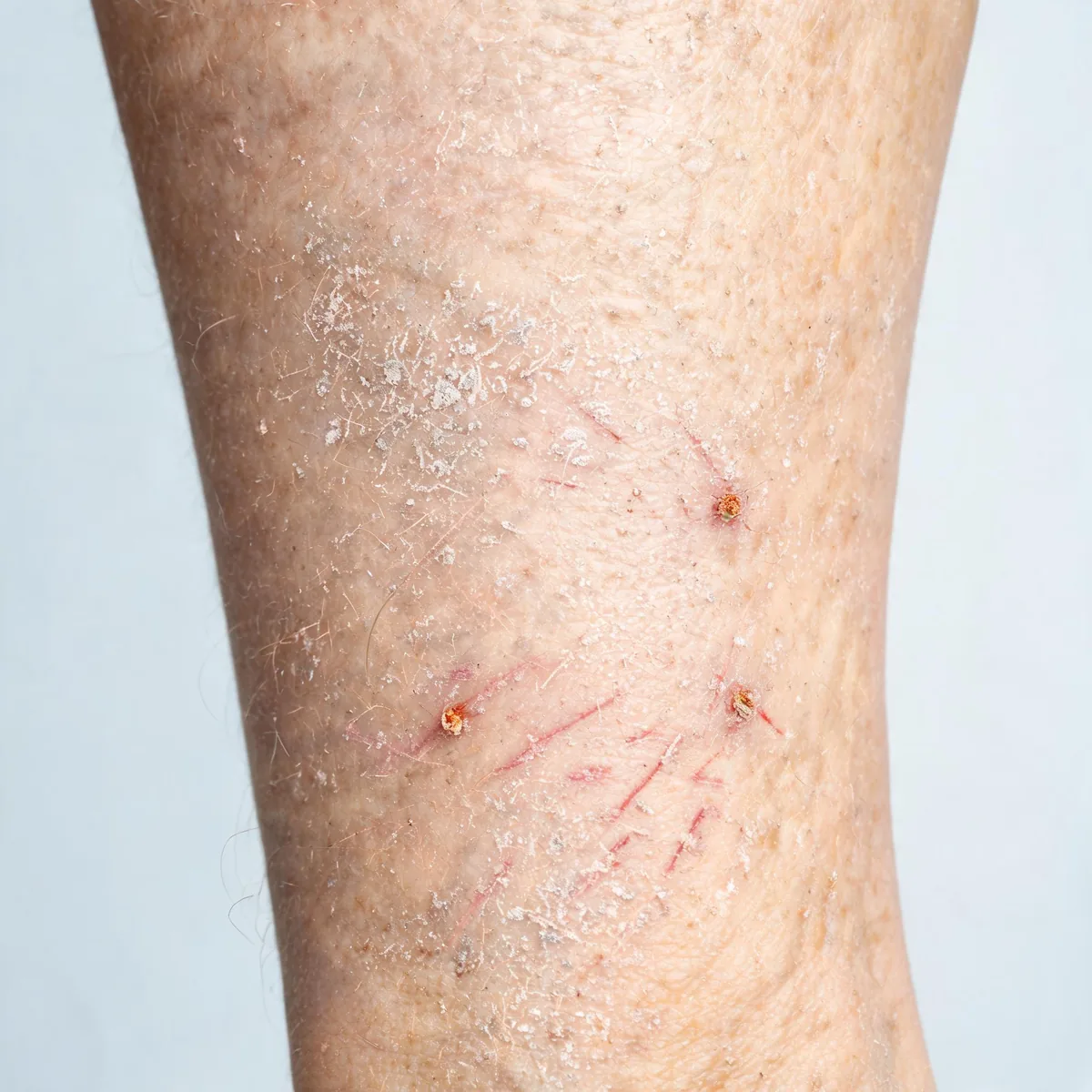
Understanding Senile pruritus
The tradition describes the skin as nourished by Blood and moistened by Yin fluids, both of which naturally decline with age. When Blood cannot reach the skin, or Yin dries up, the skin loses suppleness and itches.
Blood deficiency with external wind is the classic ageing picture: itching worse at night, dry rough or scaly skin, a dull pale complexion, fatigue and poor memory, and scratching that leaves white marks. Worse in cold dry weather and after overwork.
Deficiency of the Liver and Kidney Yin gives night sweats or feeling hot at night, dry eyes, mouth and throat, low back and knee soreness, with itch worse on the shins or genitals.
Wind-Heat gives a different picture: red raised welts or hives, sudden onset of itching, heat in the skin, thirst for cold drinks and restlessness. Damp-Heat gives weeping, oozing or crusted skin, greasy thickened skin, itch worse in humid weather and a heavy body.
Dryness is what lets Wind in. The tradition calls the result Wind arising from deficiency, an internal draft moving through skin that no longer has the moisture to resist it, and it can be joined by external dryness, heat or dampness. That is why one Western diagnosis appears as flaking skin in one person, hot red welts in another and a weeping rash in a third, and why treatment is not one formula for the diagnosis but a different strategy for each presentation.
Three organs carry the explanation. Blood is held by the Liver and Essence by the Kidneys, and it is Essence that generates Yin and Blood, so when those reserves run down with age the skin loses the anchor that kept it supple. The Spleen and Stomach are the second half of the story: an ageing digestion may extract too little Qi and Blood from food, so the deficiency is often doubled, one part from depletion and one part from poor production. Either way the surface is left undernourished and dry.
Conventional view
Senile pruritus is chronic itching in people over sixty five, usually without a primary rash. The skin is dry, a change that comes with age: fewer natural moisturising factors, a less acidic surface, and less ceramide and surface lipid, while sweat and sebum also fall away, so the barrier is weaker. The itch may be generalised or localised, and it commonly disrupts sleep and quality of life.
Diagnosis is clinical. The history of the itch is weighed and other skin disease is excluded, then a systemic cause is looked for, such as kidney disease, liver disease, thyroid disorder, iron deficiency or a medication effect. Management starts with emollients used often enough to restore the barrier, adds topical corticosteroids or calcineurin inhibitors for flares, and uses oral antihistamines mainly for sleep, since they do little for the itch itself. Stubborn cases may be offered gabapentin, a selective serotonin reuptake inhibitor or phototherapy.
Relief from these measures is often temporary. Long-term topical steroids thin skin that is already fragile, systemic drugs are less well tolerated in older people, and the itch tends to return once the cream stops because the internal reason for the vulnerability has not changed, whether the reason is depleted Blood, depleted Yin or Damp-Heat that has gathered.
Selected PubMed records
Real PubMed records for the conventional discussion above, selected by condition name and title relevance. They are references, not a claim that any treatment is proven for this condition.
- Pathophysiology and Treatment of Pruritus in Elderly.. International journal of molecular sciences, 2020. PMID: 33375325.
- Prevalence and risk factors of senile pruritus: a systematic review and meta-analysis.. BMJ open, 2022. PMID: 35210338.
- A Literature Review of Senile Pruritus: From Diagnosis to Treatment.. Acta dermato-venereologica, 2017. PMID: 27840888.
How it connects
Senile pruritus often travels with conditions sharing the same root patterns. Kidney Yin deficiency, more common with age, leads to dry itchy skin and also underlies many cases of diabetes, insomnia and chronic kidney disease. Blood deficiency fails to nourish the skin, causing dryness and itch, and at the same time can leave the Heart Shen unsettled, leading to anxiety and poor sleep. Damp-Heat, another frequent pattern, may show as itching and also contribute to liver or digestive disorders. Because these are not separate problems but different expressions of the same underlying imbalance, treating the core pattern often improves the skin and the associated health issues together. The clustering follows the shared root rather than chance. Kidney Yin deficiency becomes more common with age and shows as dry itchy skin, yet it also sits behind many cases of diabetes mellitus, insomnia and chronic kidney disease, and a similar thread runs through liver disease, hypothyroidism and iron deficiency anaemia, all of which can produce itch. Blood deficiency that fails to nourish the skin can also leave the Heart Shen unsettled, so anxiety and poor sleep arrive with the dryness, and low mood and depression may follow. Damp-Heat shows on the skin and can also disturb the liver and the digestion, and atopic dermatitis belongs to the same group. Treating the core pattern is intended to help the skin and these companions together.
How it is assessed
The practitioner examines the skin and, importantly, looks for systemic causes.
What a practitioner looks for
- Dryness: dry scaly skin with night itch suggests Blood or Yin deficiency.
- Heat: night heat and sweats suggest Liver and Kidney Yin deficiency.
- Welts: sudden red welts with heat suggest Wind-Heat.
- Red flags: itch with weight loss, jaundice, or generalised persistent itch.
The consultation begins with the character of the itch: whether it is worse by night or by day, whether the skin is dry and scaly or has red oozing patches, and whether the itching wanders or stays in one place. Energy, sleep, digestion, and any sense of heat or cold are asked about as well, because in this framework the skin reports on the state of the internal organs rather than standing apart from them.
Tongue and pulse then narrow the field. A dry red tongue with little coat and a thin rapid pulse suggests that Blood or Yin is depleted and that internal Wind has arisen from the dryness; a yellow greasy coat on a red tongue, with a pulse that is slippery and rapid, suggests Damp-Heat; a dark tongue with purple spots and a choppy pulse raises Blood Stasis. Because several patterns can coexist in an older person, the practitioner decides which is primary, so a baseline of Blood deficiency with a new flare of Damp-Heat after a rich meal gives two answers rather than a contradiction.
TCM patterns in Senile pruritus
Four patterns are described, and the skin itself does most of the sorting. Dry, rough or scaly skin with night itch, a dull pale complexion and scratching that leaves white marks is Blood deficiency failing to nourish the surface, so internal Wind takes hold. Dryness with night heat and sweats, dry eyes and mouth, sore lower back and itch on the shins or genitals points to depletion of Liver and Kidney Yin, where the deep reserves have run low. Sudden red raised welts with heat in the skin, thirst and restlessness are Wind-Heat, often an acute flare laid over an older deficiency. Weeping, oozing or crusted skin that thickens and itches more in humid weather, with a heavy body and loose stools, is Damp-Heat. Most older people carry more than one at once, so the practitioner addresses whichever pattern is newest or most acute before turning to nourish the root.
| Pattern | Key signs | The itch | Tongue | Main formula |
|---|---|---|---|---|
| Blood Deficiency with External Wind | Dry rough or scaly skin | Itching worse at night | Body: Pale and thin, sometimes slightly dryCoat: Thin, white and a little dry | Not specified |
| Deficiency of the Liver and Kidney Yin | Dry eyes, mouth and throat | Itching worse on the shins or genitals | Body: Red, thin and dryCoat: Scanty or absent | Not specified |
| Wind-Heat | Red raised welts or hives; Feeling of heat in the skin | Itching comes on suddenly | Body: Red at the tip and edgesCoat: Thin yellow or white turning yellow | Not specified |
| Damp-Heat | Weeping, oozing or crusted skin; Greasy thickened skin | Itching worse in damp or humid weather | Body: Red, often swollen with teeth marksCoat: Yellow, greasy and thick, usually in the middle and at the root | Not specified |
Blood Deficiency with External Wind
Dry scaly skin with night itch, pallor and fatigue.
Blood is what carries moisture to the surface, and when it is insufficient, whether through age, a digestion that produces too little or a long illness, the skin is left dry, rough and cracked. Dryness opens a space that internal Wind fills, in the way wind finds its way through a bare landscape, and the itch that follows is relentless and often widespread, worse at night when circulation slows. Scratching brings relief for a moment only, and the marks of it show as white lines on the skin.
The tongue is pale and dry, sometimes with a thin white coat, and the pulse is thin, choppy or wiry. Cold dry weather, overwork, missed sleep and too much spicy or drying food all make it worse, while oil-based moisturiser, warm nourishing soups and gentle exercise that brings blood to the surface ease it. Dang Gui Yin Zi is the formula named for this pattern, with Dang Gui, He Shou Wu and Sheng Di Huang among the key herbs, and the points are Xuehai (SP-10), Sanyinjiao (SP-6) and Quchi (LI-11).
Signs
- Itching worse at night
- Dry rough or scaly skin
- Dull pale complexion
- Fatigue and poor memory
- Scratching leaves white marks
Diet and lifestyle for this pattern: Focus on blood-nourishing, moistening food: bone broth, black sesame, spinach, beetroot, eggs and moderate amounts of lean red meat. Avoid drying food such as coffee, alcohol and overly roasted nuts, use a humidifier in dry environments, and apply a natural oil-based moisturiser after bathing.
Deficiency of the Liver and Kidney Yin
Night heat and sweats with itch on the shins or genitals.
The Liver and Kidneys are the body's deep reservoirs, and with age those reserves thin. When Yin is too weak to hold Yang in place, the Yang rises and carries heat and Wind outward to the skin, so the itch comes in waves, often at night or when the person is warm, on skin that is dry but also faintly red. Because the Kidneys govern the lower half of the body, itch that settles on the shins, the lower back or the genitals is a particular clue to this pattern.
The tongue is red and dry with little or no coat and may be cracked, and the pulse is thin and rapid. Hot rooms and hot weather, spicy fried or stimulating food, and frustration all consume Yin and stir the rising Yang, while a cool calm environment, moistening food and regular sleep let the reserves rebuild. Zuo Gui Yin and Liu Wei Di Huang Wan are the formulas named here, with Shu Di Huang, Gou Qi Zi and Shan Zhu Yu among the herbs, and the points are Taixi (KI-3), Ganshu (BL-18) and Quchi (LI-11).
Signs
- Night sweats or feeling hot at night
- Dry eyes, mouth and throat
- Soreness or weakness in the lower back and knees
- Itching worse on the shins or genitals
Diet and lifestyle for this pattern: Emphasise deeply nourishing Yin food such as black beans, walnuts, goji berries, yam, duck, pork and congee. Avoid late nights and overwork, which burn Yin, keep the bedroom cool and avoid hot baths, and meditation or gentle yoga can calm the internal Wind.
Wind-Heat
Sudden red welts with heat and restlessness.
The tongue is red, often redder at the tip, with a thin yellow coat, and the pulse is rapid and floating. Spicy, rich or fried food, hot showers and saunas, and anger or emotional upset all set it off, while cold compresses, cool baths, chrysanthemum or mint tea and a calm cool room settle it. Xiao Feng San is the formula named for this presentation, with Jing Jie, Fang Feng and Sheng Di Huang among its herbs, and the points are Quchi (LI-11), Xuehai (SP-10) and Dazhui (DU-14).
In this pattern Wind and Heat reach the body from outside or are generated inside by stress and rich food. Heat stirs the Blood, and Wind carries that irritation to the surface, which is why the itching arrives suddenly, the welts are red and raised, and they can come and go quickly. Cold soothes it and warmth makes it worse, and in an older person it usually sits on top of a longstanding deficiency rather than replacing it.
Signs
- Red raised welts or hives
- Itching comes on suddenly
- Feeling of heat in the skin
- Thirst for cold drinks
- Restlessness and irritability
Diet and lifestyle for this pattern: Avoid spicy, greasy and pungent food such as chilli, garlic, lamb and alcohol that add Heat. Eat cooling food such as cucumber, watermelon, mung beans and chrysanthemum tea, keep the skin cool and avoid hot showers, and manage stress, since emotional Heat fuels this pattern.
Damp-Heat
Weeping crusted skin worse in humid weather.
The tongue is red with a thick yellow greasy coat, and the pulse is slippery and rapid. Dairy, sugar, greasy fried food, alcohol and too much raw or cold food add to the dampness, while a dry well ventilated room, light easily digested meals and gentle sweating through exercise help move it. Long Dan Xie Gan Tang is the formula named here, with Long Dan Cao, Huang Qin and Ku Shen among its herbs, and the points are Yinlingquan (SP-9), Fenglong (ST-40) and Quchi (LI-11).
When the Spleen's transforming work weakens, as it often does in older age, fluids are no longer moved properly and gather as dampness. If heat is added, from diet, from a humid climate or from an internal imbalance, the two combine into a sticky, turbid pathogen which works its way into the skin, so the surface weeps, oozes or crusts and feels thickened and greasy rather than simply dry. Humid weather and rich or sweet food make it worse, and the body feels heavy with it.
Signs
- Weeping, oozing or crusted skin
- Greasy thickened skin
- Itching worse in damp or humid weather
- Heavy sensation with poor appetite
- Loose stools
Diet and lifestyle for this pattern: Avoid Dampness-producing food such as dairy, sugar, greasy fried food, alcohol and excessive raw or cold food. Favour lightly cooked vegetables, barley, adzuki beans and aromatic herbs such as basil and cardamom, and keep the skin clean and dry in breathable fabrics.
Treatment approach
How the tradition treats senile pruritus, with the herbs, formulas and points used for it.
Principles
- Nourish Blood and Yin, which is the main direction in this age group.
- Settle Wind where itch is the dominant symptom.
- Clear damp heat where skin is weeping and greasy.
- Examine for systemic causes before assuming simple dryness.
- Where deficiency and pathogen are both present, the order of work matters more than the list of herbs. An acute flare of Wind-Heat or Damp-Heat is cleared first, because settling it quickly stops the scratching that further damages thin skin, and the underlying Blood or Yin is built up afterwards, since a rich nourishing formula given during a damp flare can make the skin weep more. Many older patients need both threads at once, in which case the clearing herbs are kept light and the tonics are chosen so they moisten without cloying.
Herbs used
Formulas
Acupoints
- SP-10 (Xuehai)
- SP-6 (Sanyinjiao)
- LI-11 (Quchi)
- KI-3 (Taixi)
- BL-18 (Ganshu)
- DU-14 (Dazhui)
- SP-9 (Yinlingquan)
- ST-40 (Fenglong)
What to expect
- The tradition describes improvement over weeks to months as Blood and Yin are nourished.
- Dryness returns without ongoing skin care.
- Itch with weight loss, jaundice or other systemic symptoms needs medical investigation.
- The speed of response follows the pattern. When Wind-Heat or Damp-Heat is driving the flare, it often settles within two to four weeks of herbs and dietary change, while deficiency patterns take one to three months to rebuild what has been lost, with the itch easing gradually as nourishment returns. Acupuncture is usually given once or twice a week for six to eight weeks to hold the gain, and the itch often fluctuates as treatment goes on instead of falling in a straight line.
Safety and when to get help
Seek medical help urgently for
- Severe itching with unexplained weight loss.
- Itching with yellowing of the skin or eyes.
- Itch with a new widespread rash, fever or feeling very unwell.
For anything severe, sudden or spreading quickly, read when a skin problem needs urgent care.
Cautions
- Use tepid water and gentle cleansers; hot showers worsen itch.
- Persistent generalised itch needs blood tests.
- Keep nails short to reduce skin damage from scratching.
Using this alongside conventional care
- TCM is described as complementary to conventional care: emollients and prescribed treatment continue alongside herbs.
- Nothing in the herbal treatment replaces the emollient that keeps the skin barrier intact, and the two work well together. Where a topical corticosteroid is prescribed, it is applied at a different time of day from any herbal ointment so the two do not compete on the same skin. Oral antihistamines generally sit comfortably with Chinese herbs, but both the prescriber and the practitioner need the complete medication list, and Dang Gui and similar herbs may need adjusting or avoiding where blood-thinning medication is in use. Nothing prescribed should be stopped without medical agreement.
Diet and lifestyle
- Avoid spicy, greasy and drying food, and favour moistening foods and adequate fluids.
- Two rules apply whatever the pattern: nothing that stirs heat and nothing that dries, and plenty of moisture from food and drink. Spicy dishes are set aside, along with alcohol, coffee, strong tea and anything fried or greasy, and seafood and other known allergens are watched for because they can aggravate itching. The plate is built instead around black sesame and walnuts, mulberries and goji berries, pears and honey, lily bulb and tremella, and pork, all of which moisten and nourish, with enough healthy fat and water to support the skin barrier and regular light meals to keep damp-heat from gathering. The pattern sharpens this further: bone broth, spinach and beetroot for Blood deficiency, black beans, yam and duck for Yin deficiency, cooling cucumber and watermelon with no hot showers for Wind-Heat, and no dairy, sugar or raw cold food with barley and adzuki beans for Damp-Heat.
If treating an elderly patient
Age is the defining feature of this condition, so treatment is tailored to it from the start. Blood, Yin and Kidney deficiency dominate the picture, doses are usually cut to roughly two thirds of an adult dose, allowing for slower metabolism and for the several prescriptions many older people take, and strongly cooling or moving herbs are used sparingly so as not to injure a Spleen that is already weak.
Acupuncture, dietary change and topical care are often preferred to strong internal medicine, timelines are longer, and the interaction question is asked every time, with the primary care provider kept informed of what is being taken.
Urgent-sign guidance is based on standard sources: NHS anaphylaxis, NHS cellulitis, NHS Stevens-Johnson syndrome, NHS melanoma.
Evidence
Evidence status
Compiled for this page from the classical and modern literature; not a systematic review, so treat it as a pointer to sources rather than clinical guidance.
There are no clinical studies recorded for this condition, so the evidence is classical and clinical rather than trial-based. The classical texts attribute stubborn itching in older people to a combination of wind-heat, damp-heat and blood-heat, or to blood deficiency generating dryness and wind. Any claim of efficacy should be presented as traditional reasoning, not as trial evidence.
The classical literature goes further than a purely classical reading: Dang Gui Yin Zi has been examined in Chinese-language randomised trials and reported to relieve itching better than antihistamines, and reviews of TCM for itch in older adults describe the results as promising but small in scale. Most of the trials are single-centre and unblinded, English-language randomised evidence remains scarce, and the systematic reviews recorded here call for larger and better designed studies before effectiveness and safety in this age group can be confirmed.
PubMed records for the TCM evidence
Real PubMed records for the TCM clinical evidence discussed above, selected by condition name and title relevance. They are references, not proof of benefit.
- [Treatment of Guishen Zhiyang Recipe for Senile Pruritus Patients with Blood Deficiency and Hy- peractivity of Gan-yang Syndrome].. Zhongguo Zhong xi yi jie he za zhi Zhongguo Zhongxiyi jiehe zazhi = Chinese journal of integrated traditional and Western medicine, 2016. PMID: 30650290.
- Effects and safety of acupuncture versus non-penetrating sham acupuncture for senile pruritus: Rationale and design for a randomized controlled trial.. Contemporary clinical trials communications, 2025. PMID: 40027278.
Classical record
Blood-wind sores arise from a combination of wind-heat, damp-heat and blood-heat. When they erupt there is uncontrollable itching, and scratching breaks the skin, oozing fluid and blood.
- Wai Ke Zheng Zong (Orthodox Manual of External Medicine), Volume 4.
风瘙痒者,是体虚受风,风入腠理,与血气相搏,而俱往来于皮肤之间。邪气微,不能冲击为痛,故但瘙痒也。
Wind itch comes when a body that is depleted is invaded by wind, which enters the pores and striae, meets the qi and blood, and together they move about within the skin. The pathogen is faint and cannot strike hard enough to cause pain, so the only symptom is itching.
On wind itch - Classical citation: Zhu Bing Yuan Hou Lun, Volume 35, the section on wind itch.
Common questions
Why does my skin itch more as I age?
The classical literature reads it as declining Blood and Yin failing to moisten the skin, so Wind moves in. Conventional medicine points to dry skin and systemic causes.
Can herbs stop the itch?
The tradition describes nourishing Blood and Yin, with gradual improvement over weeks to months.
When should I be checked?
Itch with weight loss, jaundice, or persistent generalised itch needs medical investigation.
Do hot baths help?
No. Hot water strips the skin and worsens itch; tepid water and emollients are better.
Will the itching return when I stop the herbs?
If the deficiency has genuinely been replenished, the improvement tends to hold, especially with diet and lifestyle support. If the trigger returns, such as a run of rich food or a cold dry winter, the itch can come back, and many people need only occasional booster formulas in winter or during stressful periods after an initial course of two to three months.
How long does TCM take to stop the itching?
For a flare where Wind-Heat or Damp-Heat is driving it, noticeable relief often comes within one to two weeks. Itch rooted in Blood or Yin deficiency is slower, usually a matter of four to eight weeks on herbs and diet before the skin settles, and acupuncture gives short-term relief while the reserves are rebuilt.
Can I keep using my usual moisturiser?
Yes. A gentle fragrance-free emollient keeps the skin comfortable while the herbs work on the root and does not interfere with them, and the classical literature treats external moisturising as a helpful part of the whole approach rather than a rival to it.
Can TCM help alongside diabetes or high blood pressure?
Yes, and the same treatment often supports both, since a good number of Yin and Blood tonics also support metabolic and cardiovascular health. All diagnoses and medications still need to be declared, because some herbs have to be adjusted or avoided for safety.