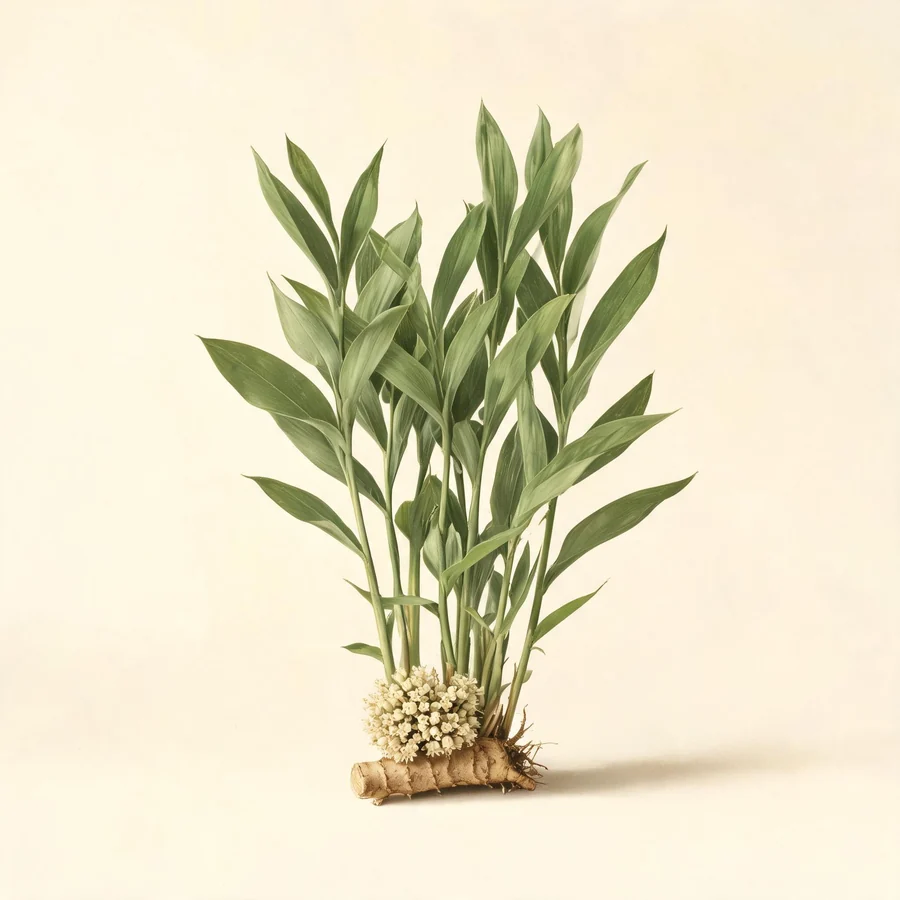
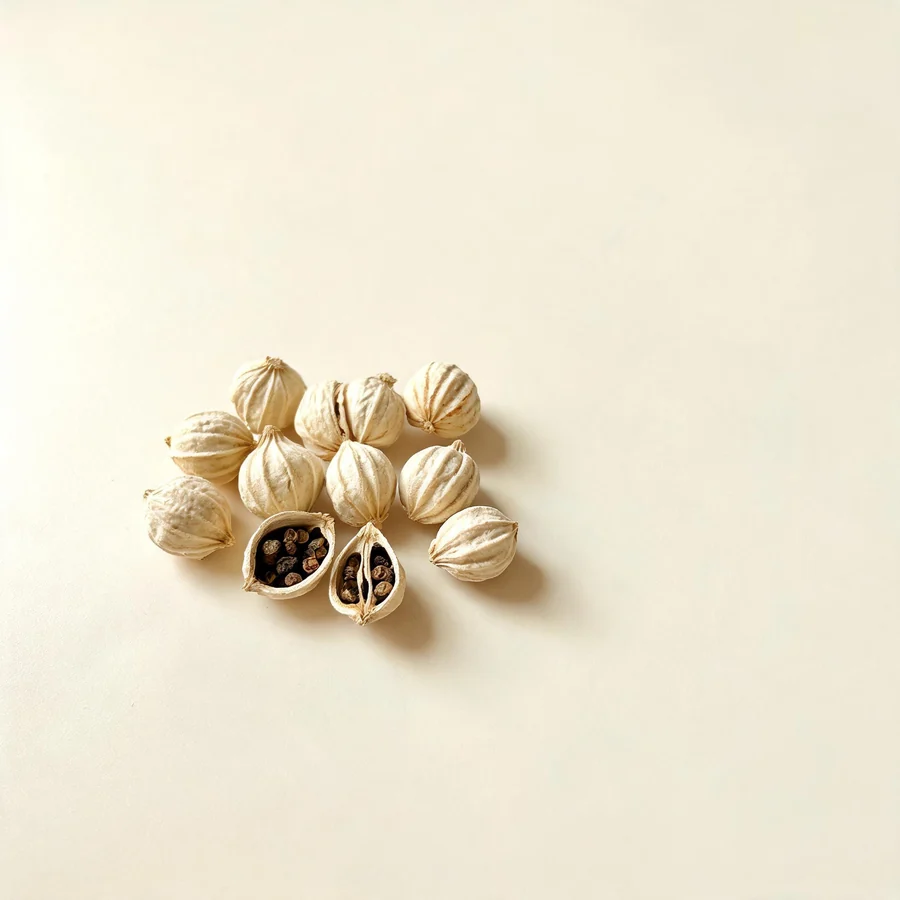
Skin profile
Where this herb sits in skin practice: the pattern it corrects, the skin signs it suits, and what it should not be used for.
Bai Dou Kou is a helper for damp, greasy skin and a heavy digestion. It is judged by what it is combined with, and it is left out when the skin is dry, hot or already short of fluid.
Skin signs that suggest it
- A greasy shine, coarse pores and a dull, sallow complexion, worse in humid weather
- Yellow greasy scaling at the scalp, the eyebrows or the sides of the nose
- Pale, puffy, slightly boggy skin with a heavy body and a muzzy head
- Bloating, a sticky taste and a coated tongue alongside the skin problem
- A greasy white or yellow tongue coat and a slippery pulse
When it is not the right herb
Not where there is no Dampness. Dry, flaky, thin skin, a dry mouth, night sweats and a red tongue with little coat all point the other way, and aromatic warmth will only dry a picture that is already short of fluid. Not for a hot, red, weeping flare, where cooling herbs are needed and the seed is at most a bystander. Not for vomiting driven by heat or fire. Not for a chronic dry eye or a dry throat. And not as a long-term daily habit in a dry constitution, because the drying accumulates quietly.
What it does for skin
Skin-relevant actions only. Each one describes a mechanism in TCM terms and what it looks like on the skin.
Transforms the Dampness that shows as grease and scale
The greasy yellow scale of seborrhoeic skin is read as Dampness thickened by Heat, and the seed's aromatic warmth disperses the Dampness while its bitterness drains downward. It is not strong enough to carry that job alone, so it sits with Huang Qin, Fu Ling and Chen Pi, and its contribution is to keep the drying moving. On the skin that means less shine and a finer scale.
Moves Qi so Dampness does not settle
Dampness that stays in one place is Dampness with stagnant Qi, and the sign is a boggy, greasy texture that does not shift with washing. The aroma moves that Qi so fluid is carried away instead of pooling, which is why a formula rich in moistening or tonifying herbs is easier to tolerate with the seed in it.
Opens the Stomach so skin formulas are tolerated
A person with eczema and a weak digestion often cannot take the nourishing herbs the pattern seems to need, because they bring on bloating and a stuffed feeling. A small amount of the seed keeps the middle turning, and it is the reason the aromatic appears in long formulas that would otherwise be abandoned.
Clears turbidity from the surface and the mouth
Turbidity is the murky, stale quality that Dampness leaves behind: a thick coating, bad breath and a complexion that looks dull rather than merely pale. Aromatics are the traditional answer because their fragrance disperses exactly that quality, and the seed is one of the clearest examples.
Skin conditions it is used for
Mapped to the condition pages on this site. The pattern column shows what the skin is doing when this herb is the right choice.
| Condition | Pattern | Why it suits | Typical setting |
|---|---|---|---|
| Seborrhoeic dermatitis | Damp-Heat in Stomach and Spleen | Greasy yellow scale on a red base, with a coated tongue and a heavy feeling after eating, is read as Damp-Heat in the middle. The seed warms and dries the Dampness while the cooling herbs deal with the Heat, so it is a supporting partner rather than the main medicine. Scalp and eyebrow involvement fits the upper-body reach of its aromatic action. | A damp-transforming formula such as San Ren Tang, with Huang Qin and Zhi Zi |
| Dandruff | Damp-Heat in Stomach and Spleen, with greasy scale | Greasy dandruff with an oily scalp and a coated tongue fits the damp pattern, and the seed is used internally to dry the Dampness and move the Qi. It is not rubbed into the scalp and it is judged over weeks. Dry, tight, flaking dandruff is the wrong kind, and the aromatic would make it worse. | San Ren Tang, modified with Huang Qin |
| Oily skin | Damp-Phlegm with a greasy shine | An oily shine with coarse pores and a dull colour is the surface sign of Dampness that the Spleen has not transformed. The seed dries that Dampness and moves the stagnation behind it, and it is a modest herb for a modest problem. Oily skin with active inflammation needs a cooling herb, because the seed is warm. | Er Chen Tang with Cang Zhu and Yi Yi Ren |
| Acne | Damp-Heat in Stomach and Spleen | Papules and pustules on oily skin, with a coated tongue and a heavy feeling after eating, are read as Damp-Heat in the middle rather than simple Lung heat. The seed transforms the Dampness so the Heat is left exposed, and the cooling and toxin-resolving herbs do the local work. Deep nodules and scarring need medical treatment rather than a herbal decoction alone. | San Ren Tang with Huang Qin and Lian Qiao |
| Moist skin sensation | Spleen Deficiency with Dampness | A persistent feeling that the skin is damp or clammy, without visible moisture, is read as Dampness at the surface with a weak Spleen behind it. The seed dries and moves the Dampness and is used with Spleen-strengthening herbs in a short course. A cold, clammy skin with breathlessness or chest pain is a medical emergency and not this pattern. | San Ren Tang with Bai Zhu and Fu Ling |
Combinations for skin
Herbs it is paired with when the skin, not an internal organ, is the target.
| Partner | Ratio | Why the pair is used |
|---|---|---|
| Hou Po | 1 to 1, about 6 g of each | Magnolia bark moves Qi downward and relieves fullness, while the cardamom transforms the Dampness behind that fullness. The pair addresses both halves of the problem, the turbidity to be transformed and the Qi to be descended, and it is used for greasy skin with a bloated, heavy middle. |
| Chen Pi | 1 to 1, about 6 g of each | Both herbs work on Dampness with Qi stagnation, but they divide the labour: the cardamom warms the Stomach and calms nausea, while the tangerine peel regulates Qi and dries Dampness. The pair suits a person who feels full in the upper abdomen, loses their appetite and belches, with a greasy skin and a coated tongue. |
| Xing Ren | 1 to 2.5, about 6 g to 15 g | Apricot kernel opens the upper burner by sending Lung Qi downward, and the cardamom releases the middle by transforming Dampness there, so the chest feels less oppressed while the abdomen feels less full. The logic is that Dampness follows once Qi moves, and the pair is the core of the three-seed formula. |
| Huang Qin | 6 g Bai Dou Kou with 9 g Huang Qin | The warm aromatic and the bitter cold herb are opposites that make a damp-heat formula work. Skullcap clears the Heat and dries the ooze, while the cardamom keeps the Dampness moving so the cold herbs do not stagnate the middle. The pair suits greasy, red, slightly weeping skin with a coated tongue. |
Formulas where it leads
- San Ren Tang (三仁汤) - The signature formula for early Damp-Warmth, with almond, cardamom and Job's tears as the three seeds, plus magnolia, pinellia, bamboo leaf, talcum and tetrapanax. In skin practice it is used for greasy, boggy, dull skin with a coated tongue, modified with cooling herbs when there is redness and drying herbs when there is ooze.
Safety for skin use
What to check before recommending or using it, including the cautions that matter most for skin patients.
Do not use, or use with caution
- A dry constitution with no Dampness to transform: a parched mouth, night sweats, a tongue that is red and almost uncoated, and a fine rapid pulse. The warm, aromatic, drying quality spends fluid that is already low.
- Vomiting caused by Heat or Fire rising rather than by Cold. To warm a Stomach that is already hot is to increase the rebellion the herb is meant to calm.
- Fire in the Lung and Stomach together with deficient Qi, where a dispersing herb would spend Qi that is already scarce.
- Long-standing eye complaints due to Blood deficiency or Blood Heat, where a warm, dispersing aromatic is wrong for a dry, deficient eye.
Pregnancy and breastfeeding
Generally regarded as acceptable at standard doses, and classical formulas use it for nausea and vomiting in early pregnancy. It does not belong to the Blood-moving or downward-purging groups, so no classical prohibition applies, and the caution is about dose and supervision rather than avoidance. Three to six grams is the usual range, and vomiting that will not settle in pregnancy should be assessed medically rather than treated at home. While breastfeeding nothing is recorded against it, but a small amount of the volatile oil may enter milk, so the infant is watched and the course kept short.
Interactions
- Medicines handled by liver enzymes. 1,8-Cineole, the main constituent of the oil, has induced some cytochrome P450 enzymes in laboratory work, so the levels of drugs cleared by those pathways could in theory fall. The effect has not been shown in patients.
- Anticoagulants and antiplatelet medicines. Several aromatic herbs show mild platelet effects in laboratory work, and this combination has never been studied, so anyone on warfarin or clopidogrel should tell their prescriber about the herb.
- Diabetes medicines. Early laboratory work on the volatile oil points to a slight glucose-lowering action that could add to insulin or a sulfonylurea. Blood readings should be watched if a course is started.
Allergy and patch testing
Allergy is uncommon, but the aromatic oil can irritate sensitive skin and mucous membranes. People who react to camphor, eucalyptus or other cineole-rich products should be cautious. Any preparation applied to the skin is patch tested for 24 hours first, and a burning or spreading redness is a reason to stop.
General safety references
General references for herbal hepatotoxicity and herb-drug interactions; they are not specific to this herb.
- Review article: Herbal hepatotoxicity - an update on traditional Chinese medicine preparations. Alimentary Pharmacology & Therapeutics, 2014. PMID: 24844799.
- Interactions between herbal medicines and prescribed drugs: an updated systematic review. Drugs, 2009. PMID: 19719333.
- Warfarin and food, herbal or dietary supplement interactions: a systematic review. British Journal of Clinical Pharmacology, 2021. PMID: 32478963.
Evidence
The classical record is quoted with its source. The modern note states the level of evidence plainly.
Classical record
主积冷气,止吐逆,反胃,消谷下气。
Treats accumulated cold Qi, stops vomiting and retching, relieves rebellious Stomach Qi, and helps digest food and move Qi downward.
Kai Bao Ben Cao (Materia Medica of the Kai Bao Era), Song dynasty - The Song entry is a warming digestive line, with the cold accumulation and the vomiting that the seed still treats. Nothing in it is about the skin.
破肺中滞气,退口中臭气,散胸中冷气,补上焦元气。
It breaks up stagnant Qi in the Lung, clears foul breath, disperses cold Qi collected in the chest and supplements the original Qi of the upper burner.
Zhen Zhu Nang Bu Yi Yao Xing Fu (Supplement to the Pearl Pouch on Drug Properties), Yuan dynasty - This is the closest the classical record comes to a surface use: the foul breath and the stagnant Qi in the chest are signs of turbidity that the aromatic is said to disperse, and the same reasoning is applied to a greasy skin.
白豆蔻,其功全在芳香之气,一经火炒,便减功力;即入汤液,但当研细,待诸药煎好,乘沸点服尤妙。
The merit of white cardamom lies entirely in its aromatic Qi; once roasted over fire its strength is reduced. Even when it is added to a decoction it should be finely ground and stirred in only after the other herbs have boiled, then taken while still hot, which is the better method.
Ben Cao Tong Xuan (Comprehensive Explanation of Materia Medica), Ming dynasty - The processing instruction is the one still followed: the seed is ground and stirred into the finished decoction, because heat destroys the aroma that carries the action.
Modern evidence
Evidence status
- The volatile oil is dominated by 1,8-cineole, together with pinene, borneol, camphor and terpineol in lesser amounts. Laboratory work on the oil and on cineole reports anti-inflammatory and antimicrobial activity, and some of it concerns skin organisms. These are experimental findings and do not show that the seed treats seborrhoeic dermatitis or acne in people.
- No controlled clinical trial of Bai Dou Kou in a skin condition was identified. Its skin place rests on the classical reasoning about Dampness and turbidity and on its role within the damp-transforming formulas, where the combination rather than the single seed is the subject.
- Regulatory status: the fruit is an accepted article in the Chinese Pharmacopoeia as Amomi Fructus Rotundus. Identity is the practical problem, because Cao Dou Kou, nutmeg and other cardamom-named fruits are sold under similar names. What this page describes is traditional practice and the state of the evidence, not a claim of proven benefit.
PubMed records
Selected real PubMed records for this herb's species or its constituents, chosen by species name and title relevance. They are references for the non-TCM discussion above, not proof that the herb treats any skin condition.
- Nephroprotective effects of Amomum kravanh essential oil by inhibition of ferroptosis regulated by Nrf2/HO-1 signaling pathway.. Phytomedicine : international journal of phytotherapy and phytopharmacology, 2025. PMID: 40305973 (safety record).
Dose and forms
Skin-practice dosing and the preparations that suit skin complaints.
| Form | Dose and notes |
|---|---|
| Decoction | 3 to 6 g of dried seed daily inside a formula, crushed and stirred in during the final five to ten minutes so that the volatile oil is not driven off. |
| Powder | 2 to 5 g of ground seed stirred into a strained decoction, which is the classical method and preserves more of the aroma than boiling. |
| Chewing | About 1 g of the seed chewed slowly is the traditional breath-freshening use, and it is not a substitute for treating a skin condition. |
| Course length | Two to four weeks with review. Above six grams there is little extra benefit, and a bigger dose is more apt to dry the mouth and the Stomach. |
The seed coat holds the oil, so crush the fruit just before use and add it at the end. It must never be dry-fried, since heat destroys the aroma on which the action depends. The dose is small because the effect rests on the fragrance rather than on any single constituent, and in skin work the seed is usually the smallest quantity in the formula.
Citations and further reading
Only real sources are listed: the classical materia medica passages quoted above, and the source works behind the botanical and safety statements.
- Kai Bao Ben Cao (Materia Medica of the Kai Bao Era), Song dynasty - the passage on cold accumulation and vomiting is quoted in the original above.
- Zhen Zhu Nang Bu Yi Yao Xing Fu (Supplement to the Pearl Pouch on Drug Properties), Yuan dynasty - the passage on stagnant Lung Qi and foul breath is quoted in the original above.
- Ben Cao Tong Xuan (Comprehensive Explanation of Materia Medica), Ming dynasty - the processing passage is quoted in the original above.
- Amomi Fructus Rotundus monograph, Pharmacopoeia of the People's Republic of China - accepted source, part and quality requirements.
- Modern evidence statement: based on published laboratory work on the volatile oil and on 1,8-cineole, presented as a statement about the level of evidence.
- Botanical description and identification: botanical literature on Amomum kravanh, Zingiberaceae, and on the cardamom-named fruits sold in its place.
Educational reference for qualified practitioners. This page is not medical advice, and skin conditions should be diagnosed by a clinician before treatment.