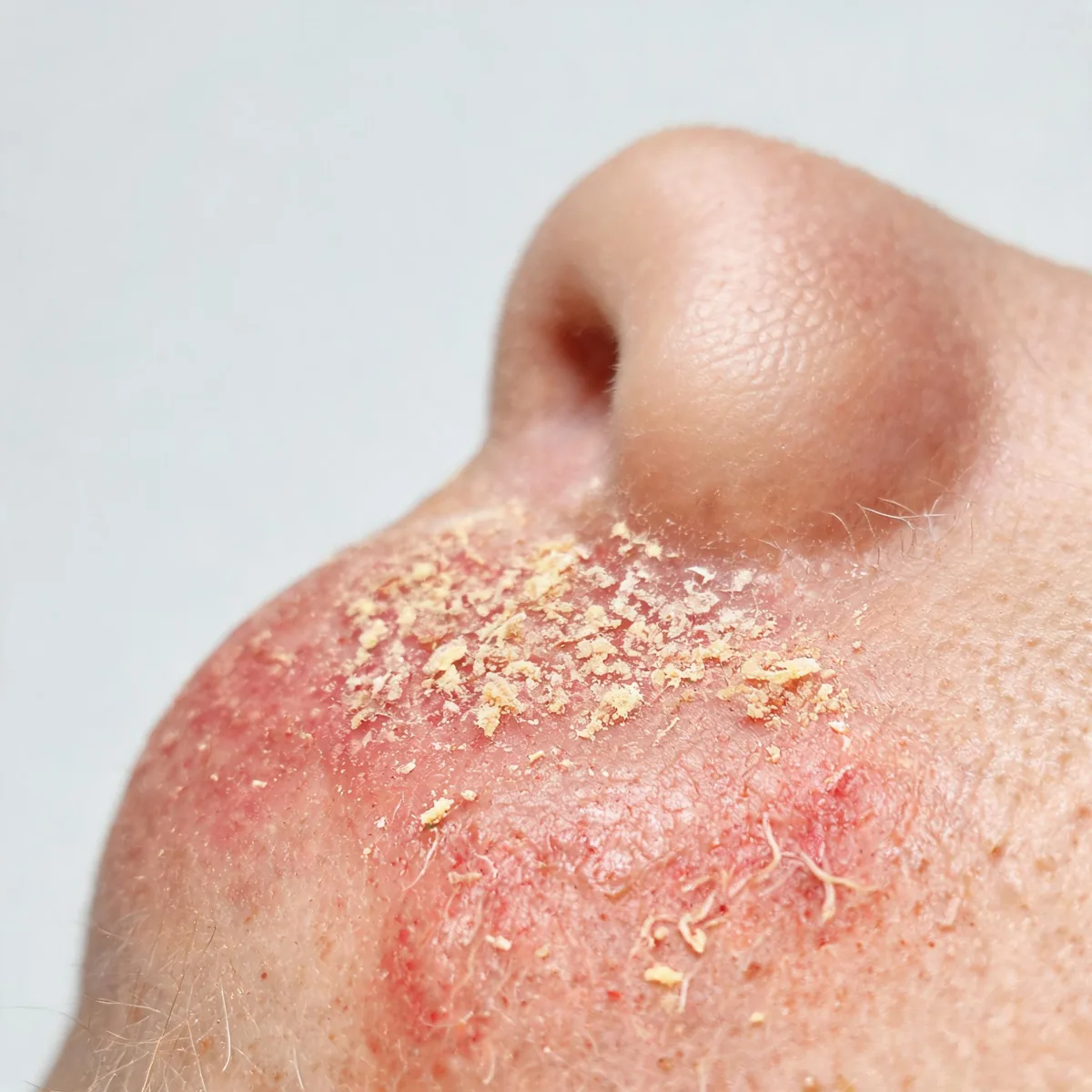
Understanding Seborrheic dermatitis
The tradition describes the condition as a surface sign of a deeper disharmony, primarily involving the Stomach and Spleen.
The Stomach channel runs directly across the face, so internal heat or dampness is said to rise along that pathway and irritate the skin. When digestion is weakened by stress, diet or constitution, fluids are poorly transformed and dampness accumulates.
That produces the characteristic picture: oily red or yellowish patches with greasy scaling, itching when the skin is oily, and digestive signs such as bloating, a sticky taste and incomplete bowel movements.
A dry variant is also described, where the scaling is fine and dry rather than greasy, and the picture is one of Blood deficiency or Empty-Heat from Yin deficiency. The distinction matters because the treatment direction reverses.
A second dry route runs through Stomach Fire. Here the heat is not a lack of moisture but an excess that burns it off, so the face and scalp scale while the person feels hot, wants cold drinks, feels hungry and is constipated. Here the tongue shows a red body beneath a thin yellow coat, with a pulse that runs rapid or wiry. Telling this apart from deficiency dryness matters, because one picture needs cooling and the other needs building, yet on the skin they can look almost the same.
The practical result is that matching patches can call for opposite herbs. A greasy yellow coating with a slippery pulse supports draining and drying, while a narrow dry tongue and a quick pulse support moistening and nourishing. A person may also move from one picture to the other over months, especially after a long course of drying treatment, so the formula and the diet advice are reviewed at follow up rather than fixed for good.
Conventional view
Seborrheic dermatitis is a chronic inflammatory rash, and a very common one, of the oily areas: scalp, eyebrows, nasolabial folds, chest and occasionally the groin. It shows as red scaly patches, stubborn dandruff and itch, and in infants as cradle cap. The cause is not settled, but three factors are implicated: overgrowth of the yeast Malassezia, increased sebum production and an exaggerated immune response to that yeast. Flares are linked to stress, cold dry weather and hormonal change, and the condition runs a relapsing course rather than resolving once.
Conventional care aims at the yeast, the inflammation and the oil. Medicated shampoos built on zinc pyrithione, selenium sulfide or ketoconazole are used on a schedule, with topical corticosteroids or antifungal creams for inflamed facial patches. Severe or resistant cases may be offered oral antifungals or low dose isotretinoin. Treatment is usually effective while it is used, and the standard approach is to step down to a maintenance rhythm rather than stop altogether.
The limitation is that these measures suppress flares without asking why sebum production rises or why the skin reacts to the yeast. Prolonged steroid use thins the skin, and patches often return soon after treatment stops. Conventional care also makes no distinction between the oily weeping picture and the dry flaky one, which TCM treats as opposite imbalances, one needing to be dried and cooled and the other moistened and nourished. That difference is the space this page works in.
Selected PubMed records
Real PubMed records for the conventional discussion above, selected by condition name and title relevance. They are references, not a claim that any treatment is proven for this condition.
- The Global Prevalence of Seborrheic Dermatitis: A Systematic Review and Meta-Analysis.. JAMA dermatology, 2024. PMID: 38958996.
- Nutrition, Obesity, and Seborrheic Dermatitis: Systematic Review.. JMIR dermatology, 2024. PMID: 39102684.
- Seborrheic Dermatitis and Dandruff: A Comprehensive Review.. Journal of clinical and investigative dermatology, 2015. PMID: 27148560.
How it connects
Seborrheic dermatitis often appears alongside acne because both share a root in excess Heat and Dampness within the Stomach and Spleen. When rich greasy food overwhelms digestion, Damp-Heat rises to the face, overstimulating oil glands and inflaming the skin, and the same Damp-Heat can clog pores and produce the red inflamed pimples of acne, especially along the chin and jawline where the Stomach channel runs. Eczema also frequently co-occurs where there is an underlying tendency to Dampness and Heat in the skin; both are outward signs of internal disharmony, with seborrheic dermatitis leaning more toward Damp-Heat or Stomach Fire while eczema often mixes Damp-Heat, Blood Heat or Blood deficiency. Treating the shared Damp-Heat often calms both.
How it is assessed
The practitioner distinguishes greasy from dry scaling, and looks for the digestive pattern behind it.
What a practitioner looks for
- Scale quality: greasy yellowish crusts point to Damp-Heat; fine dry scaling points to deficiency.
- Site: the face, scalp, brows and nasolabial folds follow the Stomach channel described in the reference.
- Digestive signs: bloating, sticky taste, loose incomplete stools support Damp-Heat.
- Constitutional signs: night-time heat, dry mouth and heat in palms and soles suggest Empty-Heat.
The consultation usually opens at the surface and works inward. The practitioner asks whether the scaling is greasy or dry, what colour the redness is and where it began, since the brows, nasolabial folds, scalp and chest are the oily areas described. Then come the questions that separate the patterns: appetite, thirst, bowels, sleep, stress and how long the complaint has been present. Oiliness that returns quickly after washing, with a sticky taste in the morning, points one way; a face that feels tight and dry after washing points another.
Four pictures are separated this way. Greasy yellow crusts with bloating, a yellow greasy coating and a slippery rapid pulse indicate Damp-Heat in the Stomach and Spleen. Dry redness with thirst for cold drinks, hunger and constipation, a red tongue with a thin yellow coat and a rapid pulse indicate Stomach Fire. Dull redness with fine bran-like scaling, a pale thin tongue and a thin choppy pulse indicate Blood Deficiency with External Wind. Muted redness with dry mouth at night, five-palm heat and night sweats, a red thin cracked tongue with little coating and a thin rapid pulse indicate Empty-Heat from Yin Deficiency.
TCM patterns in Seborrheic dermatitis
Three patterns are described, and the first question is whether the skin is wet or dry. Wet means oily patches with yellowish greasy crusts, itch that rises when the skin is oily, and a thick yellow tongue coating. Dry means fine white scale without grease, on a red or dull base with a thin dry tongue. The distinction matters because draining herbs that help the first picture leave the second more brittle. Wet skin is read as Damp-Heat in the Stomach and Spleen, confirmed by fullness after eating, a sticky taste and loose stools. Dry skin splits in two. Dull redness with a wandering itch, a pale tongue and a thin pulse is Blood Deficiency with External Wind, while redness that worsens in the evening with dry mouth, night sweats and heat in the palms is Empty-Heat from Yin Deficiency. A greasy flare can also dry out over months, so the tongue and pulse are reviewed at each visit.
| Pattern | Key signs | The itch | Tongue | Main formula |
|---|---|---|---|---|
| Damp-Heat in Stomach and Spleen | Oily red or yellowish patches with greasy scales | Itch worse when skin is oily | Body: Red, possibly swollen with teeth marksCoat: Thick, yellow and greasy in the centre and root | Not specified |
| Blood Deficiency with External Wind | Dry fine flaky scaling on face or scalp | Itch that shifts or comes and goes | Body: Pale and thin, sometimes slightly dryCoat: Thin, white and a little dry | Not specified |
| Empty-Heat caused by Yin Deficiency | Dull-red or dark-red patches; Fine dry scaling rather than greasy | Itch worse in the evening | Body: Red, thin and dry, often crackedCoat: Little or none; the tongue may look peeled | Not specified |
Damp-Heat in Stomach and Spleen
The common picture: oily red or yellowish patches with greasy scales and digestive signs.
Rich, greasy and sweet food, alcohol and long stretches of worry give the Spleen more than it can process. Fluids are not transformed, dampness gathers in the middle and heat builds along with it. That damp heat rises along the Stomach channel, which crosses the face, and settles where the oil glands are densest: the scalp, the brows, the folds beside the nose and the chest. Oil production rises, the surface inflames, and the scale turns yellow and greasy. The digestive signs are not incidental, they show where the pattern started.
The tongue is red, often swollen with teeth marks, with a thick yellow greasy coat over the centre and root; the pulse is soggy and rapid, often slippery too. Flares follow fried and spicy meals, alcohol, humid weather, overeating and stressful weeks, while light bland meals, a cool dry room, regular bowels and daily walking ease them. Wei Ling Tang warms and dries, strengthens the Spleen and drains dampness through urine, and Yin Chen Hao Tang adds a cold clearing action for yellow greasy crusts. Yin Chen, Yi Yi Ren and Cang Zhu carry the main work, with ST-36 Zusanli, SP-9 Yinlingquan, SP-6 Sanyinjiao and LI-4 Hegu supporting digestion and calming itch.
Signs
- Oily red or yellowish patches with greasy scales
- Itch worse when skin is oily
- Bloating and fullness
- Sticky incomplete bowel movements
- Bitter or sticky taste
Diet and lifestyle for this pattern: Cut out greasy, fried and sugary food, which directly feeds Dampness and Heat, and avoid alcohol and late-night eating. Focus on lightly cooked vegetables, whole grains such as barley and millet and legumes that support the Spleen, and walk daily so Qi moves and Dampness drains.
Blood Deficiency with External Wind
The dry, fine-scaling picture with night itch.
When Blood is short the skin is fed thinly. It becomes dry, thin and flaky, and that weakness lets external Wind take hold. Wind produces an itch that moves from place to place and arrives without warning, and the patches are pale pink or dull rather than angry red. Fine dry scaling sits on the surface and the face feels tight after washing. Because the lack is in Blood rather than on the surface, the picture tends to be chronic or mild rather than sudden.
The tongue is pale and thin with a thin white, slightly dry coat; the pulse is fine, wiry at the left Guan and floating at the right Cun. Cold wind, dry indoor air, long hours of work, emotional strain, spicy fried meals, too much alcohol or coffee and broken sleep all make it worse, while rest away from draughts, warm nourishing soups, a steady sleep schedule and gentle walking help. Dang Gui Yin Zi nourishes Blood, moistens dryness, dispels Wind and stops itch, and also tonifies Qi and consolidates the exterior. Dang Gui, Bai Shao, He Shou Wu, Fang Feng and Bai Xian Pi are the named herbs, with SP-6 Sanyinjiao, ST-36 Zusanli, GB-20 Fengchi, LI-11 Quchi and SP-10 Xuehai as points.
Signs
- Dry fine flaky scaling on face or scalp
- Itch that shifts or comes and goes
- Worse at night or after stress
- Pale or sallow complexion
- Aversion to wind and drafts
Diet and lifestyle for this pattern: Eat warm, cooked, blood-nourishing food such as bone broth, dark leafy greens, black sesame, eggs and small amounts of good quality red meat. Avoid overly spicy, fried or drying food that consumes Blood and fluids, protect the face and scalp from wind with a scarf, keep indoor air from getting too dry, and walk gently so Qi and Blood circulate without exhausting you.
Empty-Heat caused by Yin Deficiency
Dull-red patches with dry scaling and signs of depleted Yin.
Yin is the cooling, moistening reserve, and when it runs low over years the skin loses its internal water supply. What remains is not enough to balance the body's ordinary warmth, so a low grade heat rises to the face. The patches are dull or dark red rather than bright, the scaling is fine and dry, and there is no greasy crust. Evening and night are worse because the cooling, quiet phase of the day governs both, and those hours also bring dry mouth, night sweats and heat in the palms, soles and chest.
The tongue is red, thin and dry with cracks and little or no coating; the pulse is fine and rapid. Spicy and fried food, alcohol, coffee, late nights, overwork and heated indoor air all consume more Yin and sharpen the flare, while a cool humidified room, early nights, moistening foods such as pear and congee and sipping warm water support it. Er Zhi Wan nourishes Liver and Kidney Yin as the base, usually modified with Zhi Mu and Huang Bai to reach the skin. Nu Zhen Zi and Zhi Mu are the named herbs, with SP-6 Sanyinjiao, KI-3 Taixi and BL-23 Shenshu as points.
Signs
- Dull-red or dark-red patches
- Fine dry scaling rather than greasy
- Itch worse in the evening
- Dry mouth with thirst for small sips
- Heat in palms, soles and chest
Diet and lifestyle for this pattern: Favour moistening, cooling food such as pear, cucumber, tofu and a little honey. Avoid late nights and overwork, which burn Yin, sip warm water through the day, and keep the living space gently humidified.
Treatment approach
How the tradition treats seborrheic dermatitis, with the herbs, formulas and points used for it.
Principles
- Drain dampness and clear heat in the greasy pattern, and address digestion as the source.
- Nourish Blood and Yin where the scaling is dry, since drying treatment would worsen it.
- Review diet and stress, which the classical literature names as the common triggers of the Stomach and Spleen pattern.
- Treat the scalp and face gently; harsh degreasing is described as aggravating the cycle.
- The strategy is always two part: clear what has risen to the surface and correct the source that keeps producing it. Bitter cold draining suits the greasy excess, cooling the Stomach while drying the middle. Sweet moistening suits the dry deficiency, rebuilding Blood or Yin so the surface can hold moisture. Because the direction reverses between these pictures, a formula that helped in one phase can aggravate the next, and review matters as much as the first choice.
Herbs used
Formulas
Acupoints
- ST-36 (Zusanli)
- SP-9 (Yinlingquan)
- SP-6 (Sanyinjiao)
- LI-4 (Hegu)
- ST-44 (Neiting)
- LI-11 (Quchi)
- PC-6 (Neiguan)
- GB-20 (Fengchi)
- SP-10 (Xuehai)
- KI-3 (Taixi)
- BL-23 (Shenshu)
What to expect
- Itching and greasy scaling are described as improving within weeks of treatment and dietary change.
- Recurrence is common when the digestive pattern is not maintained.
- The dry pattern is expected to respond more slowly.
- Excess pictures usually settle first, with itching and redness easing inside two weeks and oily scaling taking three to six weeks. Blood or Yin deficiency responds more slowly, often over six to twelve weeks, because reserves have to be rebuilt. Flares still happen with stress, diet and weather, so many people keep a maintenance formula or a short course at the first sign rather than expecting a permanent end to the tendency.
Safety and when to get help
Seek medical help urgently for
- Rapidly spreading redness and swelling that may indicate bacterial infection.
- Fever or chills with the rash.
- Severe pain or burning.
For anything severe, sudden or spreading quickly, read when a skin problem needs urgent care.
Cautions
- Do not use strong topical steroids on the face without medical advice.
- Long-term internal herbs should be supervised.
- Persistent scaling that does not respond should be medically reviewed.
Using this alongside conventional care
- TCM is described as complementary to conventional care: antifungal and anti-inflammatory topical treatment can continue alongside herbs and acupuncture.
- Medicated shampoos and topical antifungals can continue while herbs and acupuncture are added, and most practitioners simply space the applications apart. Oral antifungals and isotretinoin need to be declared to both the dermatologist and the TCM practitioner, since several cooling and blood cooling herbs are mildly blood thinning and anticoagulant use deserves a conversation before starting. Nothing prescribed should be stopped suddenly, and a full medication list at the first consultation avoids most of these problems.
Diet and lifestyle
- Reducing greasy, fried and sugary food is described as essential, along with dairy, which is considered damp-forming. Light cooling foods are favoured.
- The general rule is to remove what feeds dampness and heat: fried and greasy food, sugar, rich dairy and alcohol, with late eating and heavy evening meals also worth cutting. Light cooling foods such as leafy greens, cucumber, mung beans, pear and congee suit most pictures. For the greasy pattern, add barley, millet and cooked vegetables and keep meals plain. For dry scaling from Blood deficiency, include warm soups, dark greens, eggs, black sesame and small amounts of red meat. For Empty-Heat, favour pear, honey, tofu and sesame, and avoid chillies, coffee and late nights.
If you're pregnant
The damp heat and Stomach Fire pictures often become more active in pregnancy, because the body runs warmer and holds more fluid. Treatment still has to be gentle so the fetus is protected. Bitter cold herbs of the Huang Lian and Da Huang type are avoided, and milder heat clearing options such as Jin Yin Hua and Yi Yi Ren are preferred. Acupuncture is used cautiously, avoiding lower abdominal points and points known to encourage uterine contractions, including Sanyinjiao SP-6 and Hegu LI-4. Cooling bland foods such as mung bean soup and pear carry much of the work, and a practitioner experienced in pregnancy care should guide the plan.
If you're breastfeeding
Many herbs pass into breast milk, so the same bitter cold group, Huang Lian and Zhi Zi in particular, is avoided because it can loosen an infant's stools. Milder dampness clearing herbs and foods such as Yi Yi Ren and Fu Ling are preferred and also reduce oiliness. A mild Jin Yin Hua wash applied to the scalp or face is low risk, and acupuncture introduces nothing into the milk, with ST-36 Zusanli and SP-9 Yinlingquan, which support the Spleen and dry dampness. Watch the baby's digestion and skin when anything new is started.
If treating a child
In infants it usually shows as cradle cap, a layer of thick yellowish greasy scale on the scalp, which the classical literature reads as damp heat from digestive immaturity or from the mother. Treatment is gentle: a mild wash of Jin Yin Hua and Ju Hua applied to the scalp, and dietary adjustment for a breastfeeding mother. Older children usually show the damp heat or Stomach Fire picture on a diet heavy in greasy and sweet food, and doses run between a third and a half of the adult amount, with formulas such as Wei Ling Tang modified to be milder. The key sign to look for is a red tongue carrying a thick greasy coat.
If treating an elderly patient
In older people the picture drifts towards dryness as Yin and Blood decline, so fine dry scaling replaces heavy greasiness and Empty-Heat or Blood deficiency becomes more likely. The skin has thinned and grown more fragile, which makes harsh drying herbs a poor choice. Formulas such as Er Zhi Wan and Dang Gui Yin Zi, which nourish while gently clearing Wind, fit better, at about two thirds of the adult dose and for longer courses. Polypharmacy needs checking, and gentle acupuncture at points such as KI-3 Taixi and SP-6 Sanyinjiao is often better tolerated than strong decoctions.
Urgent-sign guidance is based on standard sources: NHS anaphylaxis, NHS cellulitis, NHS Stevens-Johnson syndrome, NHS melanoma.
Evidence
Evidence status
Compiled for this page from the classical and modern literature; not a systematic review, so treat it as a pointer to sources rather than clinical guidance.
The evidence is moderate and mostly observational or consensus-based. A large case series of 170 patients treated by pattern reported high response rates, an expert consensus standardises three patterns with recommended formulas, and a case report describes resolution with a combined formula. There are few placebo-controlled trials, so the published figures should be read as practice reports rather than proof of efficacy.
The published base is thin and largely observational. The largest report followed 170 people treated by pattern, grouped into damp heat, blood dryness with wind heat, and internal heat from yin deficiency, and recorded a 70.6 percent cure rate and a 100 percent total effective rate over one or two courses of twenty days each, without randomisation or blinding. A 2020 consensus statement from the Chinese Society of Dermatology standardises three patterns and their formulas, and a case report describes clearance with a combined formula. None of this replaces controlled trials, so the figures describe practice rather than proven effect.
Studies often cited
Patients were divided into damp-heat, wind-heat with blood dryness, and yin deficiency with internal heat patterns. The report describes a 70.6 percent cure rate and a 100 percent total effective rate after one to two courses of 20 days. The report gives no randomisation or blinding, so the cure rate reflects routine practice rather than a controlled comparison. Liang Shangcai, Zheng Hongwei. Jilin Journal of Traditional Chinese Medicine. 2006;26(9):40.
A consensus document recognises three patterns (blood-heat with wind-dryness, spleen-stomach damp-heat, and blood deficiency with wind-dryness) and recommends corresponding formulas. The document sets out diagnostic criteria, treatment principles and formula choices for each of the three patterns, giving practitioners a shared framework rather than individual preference. Chinese Society of Dermatology, China Association of Chinese Medicine. Chinese Journal of Integrated Traditional and Western Medicine Dermatology. 2020;19(3):283-284.
A case report describes complete resolution of erythema, scaling and itching with oral and topical herbal treatment combining two formulas with additional herbs. The pairing was Ma Xing Gan Shi Tang with Yin Chen Hao Tang, with Ban Lan Gen and Pu Gong Ying added, and the oral decoction was combined with topical treatment before the erythema, scaling and itch cleared. Zhang Y, et al. Herald Open Access. 2023.
PubMed records for the TCM evidence
Real PubMed records for the TCM clinical evidence discussed above, selected by condition name and title relevance. They are references, not proof of benefit.
- Tanshinone Capsules Combined With Prednisone for Facial Seborrheic Dermatitis: A Systematic Review and Meta-Analysis of Randomized Clinical Trials.. Frontiers in medicine, 2022. PMID: 35572959.
- Role of immune cells in seborrheic dermatitis: a two-sample bidirectional Mendelian randomization study.. Archives of dermatological research, 2025. PMID: 39994123.
Classical record
White scale wind mostly arises on the head and face; at first there is slight itching, and over time white scales gradually form, layer upon layer flying up; when they fall off, they grow again.
- Wai Ke Zheng Zong (Orthodox Manual of External Medicine).
面游风,初发面目浮肿,痒若虫行,肌肤干燥,时起白屑。
Facial wandering wind begins with swelling of the face and eyes, an itch like insects crawling, dry skin and white scales that appear from time to time.
Facial wandering wind (Yi Zong Jin Jian) - Classical citation: for this page: Yi Zong Jin Jian, Essence of External Medicine, volume 64 on the face.
Common questions
Why does it keep coming back?
The tradition describes recurrence as returning dampness and heat, usually when diet and stress revert. That is why dietary change is treated as part of the treatment rather than an optional extra.
Can herbs help the scalp as well as the face?
The same patterns are described for scalp and face, and internal treatment is directed at the pattern rather than at one site.
Is it caused by poor hygiene?
No. The tradition describes an internal pattern of dampness and heat, and conventional medicine links it to yeast and sebaceous activity, not hygiene.
Can I use medicated shampoo at the same time?
Yes. The classical literature treats conventional topical treatment as compatible with TCM.
How do the wet and dry types differ?
Wet means oily patches with greasy yellowish crusts, read as Damp-Heat rising from the Stomach and Spleen. Dry means fine white scale without grease, which can come from Stomach Fire burning off fluids or from Blood and Yin deficiency leaving the skin undernourished. The first needs draining and cooling, the second moistening and building.
How quickly will herbs help?
Itching and redness often ease within two weeks. Oily scaling takes longer, usually three to six weeks. Deficiency pictures move more slowly, with steady change over six to twelve weeks, because the body has to rebuild reserves rather than simply clear heat.
Is stress really part of it?
The classical literature treats stress as a direct driver. It knots Liver Qi, which lets heat build and rise to the face, and it weakens the Spleen, which lets dampness gather. Many people date their flares to a stressful period, and acupuncture is used to calm that response as well as to treat the skin.
Can acupuncture ease the itching?
Acupuncture is described as moving stagnant Qi and Blood locally and calming the internal Wind behind the itch. Points on the limbs clear heat and drain dampness, and local face points are avoided during an active flare to prevent irritation. Many people report relief after the first session.