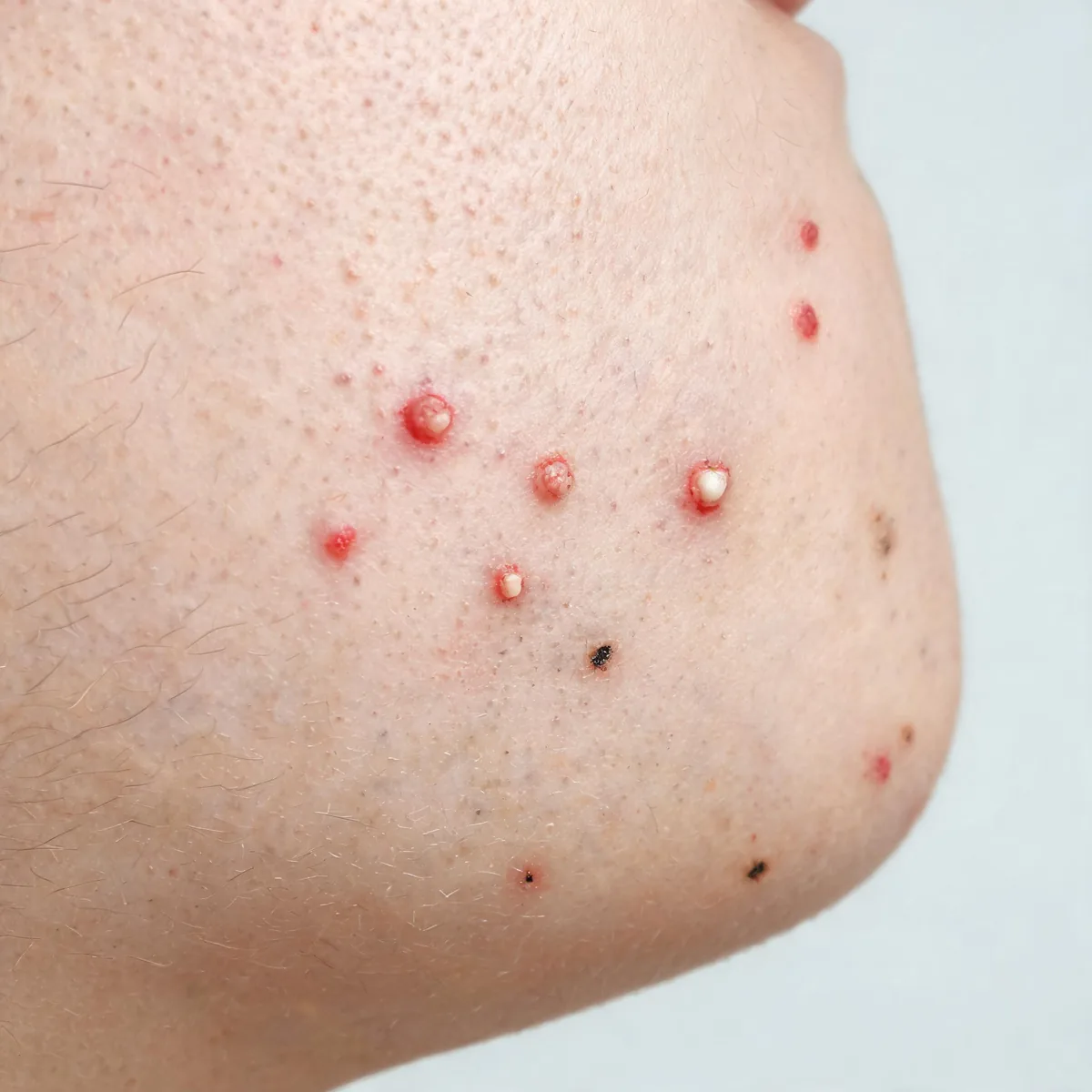
Understanding Acne
The skin is described as the Lungs territory, which is why the first pattern for acne is an exterior one: Wind-Heat that has become trapped in the skin and rises to the face.
Diet accounts for the second picture. Greasy, spicy and sweet food is said to create Damp-Heat in the Stomach and Spleen, which then rises along the channels to the face and chest. The result is oily skin, inflamed pustules, bad breath and a sticky taste in the mouth.
Long-standing or deep acne is read as Phlegm-Heat, where nodules and cysts form and scarring follows. A fourth picture, Empty-Heat from Yin deficiency, is described for jawline and chin breakouts that worsen before menstruation, with night sweats and a dry mouth.
The classical literature notes that the same spot can be reached by more than one route, so location alone is not enough; the accompanying signs decide the pattern. It also stresses that prescribed herbs are matched to the pattern, not to the word acne.
Conventional view
Conventional medicine describes acne vulgaris as a disorder of hair follicles and oil glands. Dead skin cells and excess sebum clog the pore, creating an environment where Cutibacterium acnes thrives, and the resulting inflammation produces blackheads, whiteheads, papules, pustules and in more severe cases nodules and cysts. Diagnosis is visual, based on the type and distribution of lesions, and androgens are recognised as a key driver, which is why acne flares at puberty, around menstruation and under stress.
Mild acne is usually treated topically with benzoyl peroxide, salicylic acid or retinoids, moderate cases add topical or oral antibiotics, and persistent or severe acne may be treated with oral contraceptives, spironolactone or isotretinoin. Chemical peels, light therapy and extractions are also used, with the choice depending on severity, preference and previous response.
Topical treatments can dry and irritate the skin, long-term antibiotics raise concerns about resistance, and isotretinoin, though highly effective, carries significant risks including birth defects, mood changes and severe dryness that require monitoring. Even successful treatment usually suppresses breakouts rather than changing the tendency behind them, so acne often returns when treatment stops.
Selected PubMed records
Real PubMed records for the conventional discussion above, selected by condition name and title relevance. They are references, not a claim that any treatment is proven for this condition.
- Guidelines of care for the management of acne vulgaris.. Journal of the American Academy of Dermatology, 2024. PMID: 38300170.
- A systematic review and network meta-analysis of topical pharmacological, oral pharmacological, physical and combined treatments for acne vulgaris.. The British journal of dermatology, 2022. PMID: 35789996.
How it connects
Acne seldom travels alone. When Damp-Heat settles in the Stomach and Spleen, the same oily, inflamed skin is usually joined by bad breath, a sticky taste in the mouth, bloating and irregular bowels, because the turbid Heat that rises to the face is the same that disturbs the middle burner. With Yin deficiency the pattern shifts: jawline and chin breakouts tend to arrive with anxiety, broken sleep and an afternoon flush, and may flare in the premenstrual week. Clearing the shared root often eases the skin and the companion symptoms together. The clustering is not coincidental. Damp-Heat that produces oily skin in the middle burner also disturbs digestion, so bad breath, a sticky taste and bloating travel with the pustules, and both improve when the same turbidity is cleared. When Yin deficiency is the root, the unmoored heat that reaches the jawline also disturbs sleep and mood, so broken nights, anxiety and an afternoon flush arrive with the cyclical breakout. Seeing them together is useful clinically: if treating the skin also improves the digestion or the sleep, the pattern has been read correctly, and if it does not, the formula is probably aimed at the wrong root.
How it is assessed
The practitioner reads where the lesions sit, what they contain, and what else is going on in the body.
What a practitioner looks for
- Site: forehead, nose and cheeks are read as Lungs and Wind-Heat; jawline and chin as Empty-Heat or hormonal; chest and back as Damp-Heat.
- Lesion type: small inflamed papules point to heat; deep nodules and cysts to Phlegm-Heat; scarring and pigmentation to stasis.
- Associated signs: oiliness, bad breath, taste in the mouth, bowels, menstrual timing, night sweats, sleep.
- Tongue and pulse: a greasy yellow coating supports Damp-Heat; a red tongue with a peeled coating supports Empty-Heat.
The consultation starts with a map of the face. Forehead, nose and cheeks belong to the Lung channel, so lesions clustered there in a young person with oily skin suggest Wind-Heat. Cheeks, chest and back with large pustules point to the Stomach and Spleen and to Damp-Heat, especially when bad breath, a sticky taste and constipation accompany them. Jawline and chin lesions that arrive before a period and settle afterwards point to the Kidney and Chong channels, where empty heat from Yin deficiency collects.
Lesion type narrows it further: superficial red papules that feel hot behave differently from deep nodules that never come to a head and leave scars. The tongue and pulse then confirm the reading. A greasy yellow coat with a slippery rapid pulse supports Damp-Heat, a red tongue tip and thin yellow coating with a floating rapid pulse supports Wind-Heat, a thin cracked red tongue with little coat and a fine rapid pulse supports Empty-Heat, and a swollen red tongue with a thick greasy coat and a slippery rapid pulse supports Phlegm-Heat. Mixed pictures are common, so the practitioner treats the dominant one and watches how the skin responds.
TCM patterns in Acne
Acne is read from three clues at once: where the lesions sit, what they contain and what else is happening in the body. Site comes first. Forehead, nose and cheeks follow the Lung channel, so red papules there in a young person with oily skin are read as Wind-Heat invading the Lungs. Cheeks, chest and back, especially with large pustules, bad breath and constipation, point to Damp-Heat in the Stomach and Spleen, where turbid heat rises along the channels. Jawline and chin, particularly when breakouts arrive before a period and settle after it, point to Empty-Heat caused by Yin Deficiency. Lesion type comes next. Superficial papules that feel hot behave differently from deep nodules and cysts that leave scars, which indicate Phlegm-Heat, where dampness and heat have thickened into phlegm and blocked the pores. Because pictures often overlap, the tongue and pulse decide which dominates.
Wind-Heat invading the Lungs
The adolescent picture: red papules and pustules on forehead, nose and cheeks with oily skin.
The Lungs have charge of the skin and the body hair, and they open into the exterior, so an external pathogen lodged in the Lung channel shows on the surface. When wind-heat is carried in, the Lung's power to diffuse and descend is disturbed, the heat has nowhere to go and becomes trapped in the skin of the face. The lesions are superficial and fiery: red papules and small pustules, often with oily skin and mild sensitivity, grouped on the forehead, nose and cheeks where the Lung channel runs. It is the commonest picture in adolescence, and a mild sore throat, thirst or a flare after a hot windy day often accompanies it.
The tongue has a red tip and a slightly red body with a thin yellow coat, and the pulse is floating and rapid. Spicy, greasy and fried food adds internal heat, while stress, overexertion and hot windy weather aggravate the exterior pathogen; cool washing, rest, cooling foods such as cucumber and pear, and gentle exercise in fresh air help the Lung Qi descend and the pores clear. Pi Pa Qing Fei Yin is the formula, chosen to release the exterior, cool the skin and clear Lung heat, and the herbs named are Pi Pa Ye, Sang Bai Pi and Huang Qin. The points are Hegu (LI-4), Yuji (LU-10) and Quchi (LI-11).
Signs
- Red papules and pustules on forehead, nose and cheeks
- Oily facial skin
- Mild itch or sensitivity
- May have mild sore throat or thirst
Diet and lifestyle for this pattern: Ease off spicy, fried and greasy food while the Lungs are holding Heat. Cleanse the face with a mild product instead of a stripping one, keep it out of strong wind and direct sun, and take a short daily walk in fresh air so Lung Qi can spread.
Damp-Heat in Stomach and Spleen
The diet-linked picture: oily skin, inflamed pustules and a digestive signature.
A diet heavy in rich, fried, sweet or spicy food leaves the Spleen and Stomach unable to transform and transport fluids efficiently. Dampness accumulates, heat gathers with it in the middle burner, and the mixture rises through the channels towards the face and chest. The skin becomes oily and shiny, the pores look large, and inflamed pustules and papules appear where the turbidity settles. The digestive signs are usually present and give the strongest confirmation: bad breath, a bitter or sticky taste, bloating with a sense of fullness above the navel, and bowels that are sticky or incomplete.
The tongue is red and may be swollen with teeth marks, carrying a thick yellow greasy coat that sits heaviest at the centre and root. The pulse is soggy and rapid and often slippery. Alcohol, humid weather and irregular eating make the skin worse, while light cooling food, regular bowel movements, gentle exercise and warm water with lemon help clear it. Lian Po Yin is the primary formula, clearing heat and draining dampness while regulating the middle burner, and Yin Chen Hao Tang is used when the damp-heat needs to be drained through the urine and bowels. Huang Lian, Fu Ling and Yi Yi Ren are the herbs, with Quchi (LI-11), Zusanli (ST-36), Neiting (ST-44) and Yinlingquan (SP-9) as the points.
Signs
- Oily shiny skin on face and chest
- Inflamed pustules and red papules
- Bad breath
- Bitter or sticky taste
- Bloating and fullness
- Sticky or incomplete bowel movements
Diet and lifestyle for this pattern: Cut back on greasy, fried and very sweet food, alcohol and dairy, which all build Dampness. Favour light cooling food such as mung beans, cucumber, bitter gourd and leafy greens, eat at regular times, chew well and sip warm water through the day so digestion and bowels stay regular.
Empty-Heat caused by Yin Deficiency
The jawline and premenstrual picture, with signs of depleted Yin.
Kidney Yin is the cooling reserve that keeps warmth in its place. Overwork, late nights and hormonal shifts draw it down, and the warm Yang it should anchor drifts upward instead. The face is where that unmoored heat collects, and because the Kidney and Chong channels run through the jaw and chin, the breakout settles there: small pustules and red papules that feel hot, arriving in the days before a period and receding afterwards. It is common in adult women with irregular cycles, and the associated signs are those of depletion rather than excess: night sweats, a dry mouth and throat at night, a sense of heat across the palms and soles and in the chest, and light broken sleep.
The tongue is red and dry, thin and cracked, with little or no coating, and the pulse is fine and rapid and grows weaker on deep pressure, particularly at the left rear position. Stress and overwork, insufficient sleep and the premenstrual phase bring the heat up, while rest, cooling moistening foods such as cucumber and pear, and gentle exercise settle it. Zhi Bai Di Huang Wan nourishes Kidney Yin and drains empty heat, often with Er Zhi Wan added for a gentler build, and Nu Zhen Zi is the herb named. The points are Taixi (KI-3), Sanyinjiao (SP-6), Shenshu (BL-23) and Quchi (LI-11).
Signs
- Acne along jawline and chin
- Worse before menstruation
- Night sweats
- Heat in palms, soles and chest
- Dry mouth and throat at night
Diet and lifestyle for this pattern: Protect sleep with a regular bedtime, since late nights drain Yin fastest. Choose moistening food such as pear, cucumber, tofu and black sesame, avoid spicy and fried food that stirs the flames, and keep exercise gentle, with walking or yoga rather than training to exhaustion.
Phlegm-Heat
The deep, nodular picture with scarring and congestion.
When dampness and heat are left long enough, they thicken. The result is phlegm, a sticky substance that combines with heat and rises, obstructing the pores and the channels of the skin. Qi and blood are trapped beneath the blockage, so instead of a pustule that comes to a head there is a deep, painful nodule or cyst that is slow to resolve and leaves a scar. The skin is oily with large pores, there may be a sense of oppression or fullness in the chest, and the lesions resist ordinary acne treatment because the mass has to be softened before it can clear.
The tongue body is red and swollen, coated thickly in yellow grease, the pulse comes up slippery and rapid. Greasy fried food, dairy and sweets feed the phlegm and heat, stress stirs heat and stagnates Qi, and hot humid weather with insufficient sleep makes the nodules more active. Cooling foods such as pear and cucumber, gentle movement, less stress and clean but unharsh skin care help keep it in check. Hai Zao Yu Hu Tang transforms phlegm, softens hardness, dissipates nodules and moves Qi and blood, and the herbs named are Hai Zao, Kun Bu, Xia Ku Cao and Dan Shen. The points are Fenglong (ST-40), Quchi (LI-11), Hegu (LI-4) and Sanyinjiao (SP-6).
Signs
- Deep painful nodules and cysts
- Scarring from past breakouts
- Oily skin with large pores
- Fullness or oppression in the chest
- Thick yellow greasy coating
Diet and lifestyle for this pattern: Reduce greasy, fried, spicy and very sweet food, especially dairy, which thickens Dampness and phlegm. Add cooling, phlegm-resolving food such as radish, pear, cucumber and mung beans, cleanse the skin without harsh scrubbing, and manage stress, since frustration generates Heat and worsens phlegm.
Treatment approach
How the tradition treats acne, with the herbs, formulas and points used for it.
Principles
- Match the formula to the pattern: clear Wind-Heat, drain Damp-Heat, nourish Yin or transform Phlegm-Heat.
- Treat the digestion when there is a digestive signature, since diet-generated Damp-Heat is described as the engine of the second pattern.
- Address the surface gently; the tradition describes harsh topical drying as aggravating the skin barrier.
- Give it time: nodular acne is expected to respond over months, not weeks.
- Two principles sit underneath the formula choices. The first is to match the strategy to the lesion: superficial red papules are cleared and released, oily pustules are drained and dried, deep nodules are softened and broken up, and cyclical jawline lesions are nourished and settled. The second is to protect digestion while doing it, because bitter cold herbs used for too long can weaken the Spleen and leave the skin dependent on them. That is why a course is reviewed every few weeks and why the formula is lightened once the lesions flatten rather than continued at full strength.
Herbs used
Formulas
- Pi Pa Qing Fei Yin
- Lian Po Yin
- Yin Chen Hao Tang
- Zhi Bai Di Huang Wan
- Er Zhi Wan
- Hai Zao Yu Hu Tang
Acupoints
- LI-4 (Hegu)
- LU-10 (Yuji)
- LI-11 (Quchi)
- ST-36 (Zusanli)
- ST-44 (Neiting)
- SP-9 (Yinlingquan)
- KI-3 (Taixi)
- SP-6 (Sanyinjiao)
- BL-23 (Shenshu)
- ST-40 (Fenglong)
What to expect
- Inflammatory papules and pustules are expected to settle before nodules and scarring do.
- Hormonal jawline patterns are described as improving over successive cycles rather than within one.
- Relapse after stopping is common if the dietary and lifestyle factors are not addressed.
- Expect the first change in texture rather than in lesion count: oiliness usually settles before the papules flatten. Superficial breakouts can calm within two weeks, while cystic lesions may take two to three months before they soften, and the marks they leave fade more slowly still. A brief flare in the first fortnight is common as the circulation changes and is not a reason to stop. Once the skin is clear, a lighter formula or occasional acupuncture is usually enough to hold the result, and the tendency to flare often returns to what it was rather than disappearing altogether.
Safety and when to get help
Seek medical help urgently for
- A sudden widespread rash with fever or blistering - this can indicate a serious drug reaction and is an emergency.
- A painful, hot, rapidly spreading red swelling - possible bacterial skin infection needing antibiotics.
- Sudden acne-like lesions with systemic symptoms on a new medication.
For anything severe, sudden or spreading quickly, read when a skin problem needs urgent care.
Cautions
- Do not pick or squeeze deep lesions; scarring is described as following from it.
- Some herbal formulas used for acne are strong; internal use should be supervised, with liver function checked where indicated.
- Pregnancy and breastfeeding require practitioner review before internal herbs.
Using this alongside conventional care
- TCM is described as complementary to conventional care: gentle topical care and prescribed acne treatment can continue alongside herbs and acupuncture. Prescribed treatments should not be stopped abruptly.
- Topical benzoyl peroxide, salicylic acid and retinoids can be used alongside herbs, though the skin may be more sensitive at first, so introduce one change at a time. Oral antibiotics and hormonal treatments are compatible too, and part of the point of the herbs is to shorten the period for which antibiotics are needed. Isotretinoin is the exception that needs care: both the drug and several blood-moving herbs place demands on the liver, so the combination belongs under medical supervision with liver function checked. Never stop a prescribed medicine in order to start herbs, and tell both practitioners the full list of what you take.
Diet and lifestyle
- The single most repeated advice is to reduce greasy, fried, spicy and sweet food and dairy, since these are the foods the framework associates with Damp-Heat. Reducing refined sugar is named specifically for the oily patterns.
- Diet is treated as part of the prescription rather than as background advice. The general rule is to reduce what generates heat and dampness, namely fried food, very spicy dishes, sugar, dairy and alcohol, and to keep meals regular so the Spleen is not asked to process large irregular loads. Pattern refines it. Wind-Heat improves with cucumber, pear and leafy greens and with less fried food. Damp-Heat improves when mung beans, bitter gourd, cucumber and warm water replace dairy and sweets. Empty-Heat needs moistening foods such as pear, tofu, black sesame and cucumber, plus sleep. Phlegm-Heat calls for radish, pear, mung beans and less dairy, since dairy is the food most often named as thickening phlegm.
If you're pregnant
Acne often flares in pregnancy as Qi and Blood shift to support the growing fetus. The usual pattern is Yin deficiency with empty heat, since Kidney nourishment is channelled to the uterus, and the hormonal surge reads as a Chong and Ren vessel imbalance, producing jawline and chin breakouts.
Safety of the fetus comes first: herbs that strongly move Blood, such as Dan Shen and Tao Ren, are contraindicated, as are many bitter-cold herbs that drain downward aggressively. Mild Yin-nourishing formulas such as Zhi Bo Di Huang Wan are used only cautiously under professional guidance, at reduced doses.
Acupuncture is often the safer route, but points traditionally avoided in pregnancy, including Hegu (LI-4), Sanyinjiao (SP-6) and lower abdominal points, must be omitted. Gentle facial acupuncture and a cooling, moistening diet with cucumber and pear are the first line of defence.
If you're breastfeeding
During breastfeeding a mother's Qi and Blood remain taxed and Yin deficiency may persist or deepen. Topical treatment is preferred to limit what reaches breast milk, and if internal herbs are needed the rule is to avoid anything excessively cold, bitter or toxic, since these can pass into milk and upset the infant's digestion.
Huang Lian and Da Huang are generally avoided, while milder food-grade herbs such as Yi Yi Ren and Fu Ling can drain Dampness without harming the baby. Acupuncture is widely used during lactation, although trial evidence in this group is limited, and the pregnancy point precautions no longer apply. Treatment is best arranged with a practitioner experienced in postnatal care.
If treating a child
Acne in adolescents is overwhelmingly Wind-Heat invading the Lungs. The teenage surge of Yang energy, combined with a diet rich in greasy and spicy food, creates the conditions for red, oily skin and inflamed pimples on the forehead, nose and cheeks.
Diagnosis leans heavily on observation, since teenagers may not describe symptoms clearly: a red tongue tip with a thin yellow coating and a floating rapid pulse. Formulas such as Pi Pa Qing Fei Yin are effective at half to two-thirds of the adult dose, adjusted for age and weight, and acupuncture using points such as LI-4 and LU-10 clears Lung Heat with shorter needle retention for younger patients.
If treating an elderly patient
Acne is uncommon in older people, and when it appears it is rarely the fiery pustular type of youth. It tends to form deep, stubborn nodules or cystic lesions along the jawline and chin, driven by Yin deficiency with empty heat, or occasionally lingering Damp-Heat in the context of medication or metabolic disorders.
Kidney Yin is naturally diminished with age and the resulting false Heat flares easily, so treatment favours gentle Yin-nourishing formulas such as Zhi Bo Di Huang Wan at about two-thirds the standard adult dose to spare digestion. Acupuncture is often the best tolerated option, with mild stimulation and care to avoid points that over-disperse Qi in a constitution already prone to deficiency.
Urgent-sign guidance is based on standard sources: NHS anaphylaxis, NHS cellulitis, NHS Stevens-Johnson syndrome, NHS melanoma.
Evidence
Evidence status
Compiled for this page from the classical and modern literature; not a systematic review, so treat it as a pointer to sources rather than clinical guidance.
The evidence is moderate and growing, but concentrated in Chinese-language journals. Several randomised trials report that herbal formulas reduce inflammatory lesion counts and skin oiliness, and acupuncture trials report response rates comparable to topical benzoyl peroxide or antibiotics with fewer side effects. Sample sizes are small and blinding is often weak.
The pattern across these trials is consistent but the quality is uneven. Most are single-centre studies from Chinese hospitals with modest numbers, short follow-up and outcome measures that are hard to compare, and few are blinded or placebo-controlled. The direction of the results is the same, however: prescribing by pattern outperforms one formula for everybody, and acupuncture adds to herbs for the damp-heat picture. For practical purposes that supports using TCM as an adjunct where conventional treatment has plateaued or cannot be tolerated, rather than as a replacement for care in severe, scarring acne.
Studies often cited
The observational study treated 120 acne patients according to three patterns, Wind-Heat invading the Lungs, Damp-Heat in the Stomach and Spleen, and Phlegm-Heat, with matching herbal decoctions. After eight weeks the total effective rate exceeded 90 percent, with significant reductions in inflammatory lesions and skin oiliness, suggesting that syndrome differentiation outperforms a one-size-fits-all herbal approach. Wang L, Zhang H. Clinical observation on TCM syndrome differentiation treatment of acne. Frontiers in Chinese Medicine Research. 2021;3(1):45-50. https://cn.front-sci.com/index.php/fcmr/article/view/4617/4663
In the randomised trial, 80 patients with damp-heat acne received either acupuncture plus modified Lian Po Yin or conventional topical therapy alone. The combination group had a significantly higher clearance rate, 78 percent against 52 percent, and fewer recurrences at three-month follow-up, with Quchi LI-11 and Neiting ST-44 said to enhance the heat-clearing and dampness-draining effect of the herbs. Li X, Chen Y, Zhao M. Clinical study on acupuncture combined with herbal medicine for damp-heat type acne. Chinese Journal of Dermatology and Venereology.
Classical record
Facial blisters: this refers to blisters on the face generated by wind-heat qi, the heads as big as rice grains or millet, white in colour.
- Zhu Bing Yuan Hou Lun (Treatise on the Causes and Symptoms of Diseases), Volume 35, Facial Sores. The Chinese original is not reproduced here because the source record could not be relied on for the characters.
肺風粉刺,此由肺經血熱而成。
Lung wind pimples are formed when heat lodges in the blood of the Lung channel.
Lung wind pimples (Wai Ke Zheng Zong) - Classical citation: Wai Ke Zheng Zong (Orthodox Manual of External Medicine), Volume 4, Chapter on Sores and Ulcers.
Common questions
How does acupuncture help acne?
The tradition describes it as clearing heat, moving Qi and Blood, and reducing inflammation, prescribed by pattern. Evidence is limited and mixed; this page records the traditional selection rather than a proven result.
Can Chinese herbs really clear my skin?
The classical literature says herbs target the internal imbalance when they are matched to the pattern. It does not promise clearance for everyone, and nodular or scarring acne needs medical review in addition.
Do I have to change my diet?
The classical literature treats diet as significant for the Damp-Heat pattern in particular, pointing at greasy, fried, spicy and sweet food, dairy and alcohol.
Will my acne come back after treatment?
It can. The framework expects recurrence if the underlying pattern, diet and lifestyle are not maintained, which is why the plan includes ongoing dietary guidance.
Is TCM safe for teenage acne?
Generally yes, and the picture is well recognised. The surge of Yang energy at puberty combined with a diet of greasy and spicy food produces the red oily skin and inflamed pimples of Wind-Heat invading the Lungs. Gentle formulas and acupuncture can settle that heat, and doses for adolescents are reduced according to age and body weight. This is often welcome in families who would rather not keep a teenager on antibiotics for years.
Can I combine TCM with my dermatologist's treatments?
In most cases yes. Topical benzoyl peroxide, salicylic acid, retinoids and oral antibiotics can all run alongside herbs and acupuncture, and reducing the need for long-term antibiotics is one of the practical reasons people combine them. Isotretinoin is the exception: both it and several Chinese herbs load the liver, so the combination needs medical supervision and regular liver function checks. Never stop a prescribed medicine without speaking to the doctor who prescribed it.
What if my signs fit more than one pattern?
That is the usual situation rather than the exception. Oily skin and pustules turn up in Damp-Heat as well as Wind-Heat, but the digestion and the tongue coating separate them: bad breath, bloating and a greasy yellow coat point to Damp-Heat. An adult with jawline acne may have Yin deficiency and also eat heavily, in which case damp-heat is mixed in. Note which feature dominates, whether digestive, cyclical or cystic, and let a practitioner confirm it with the tongue and pulse.