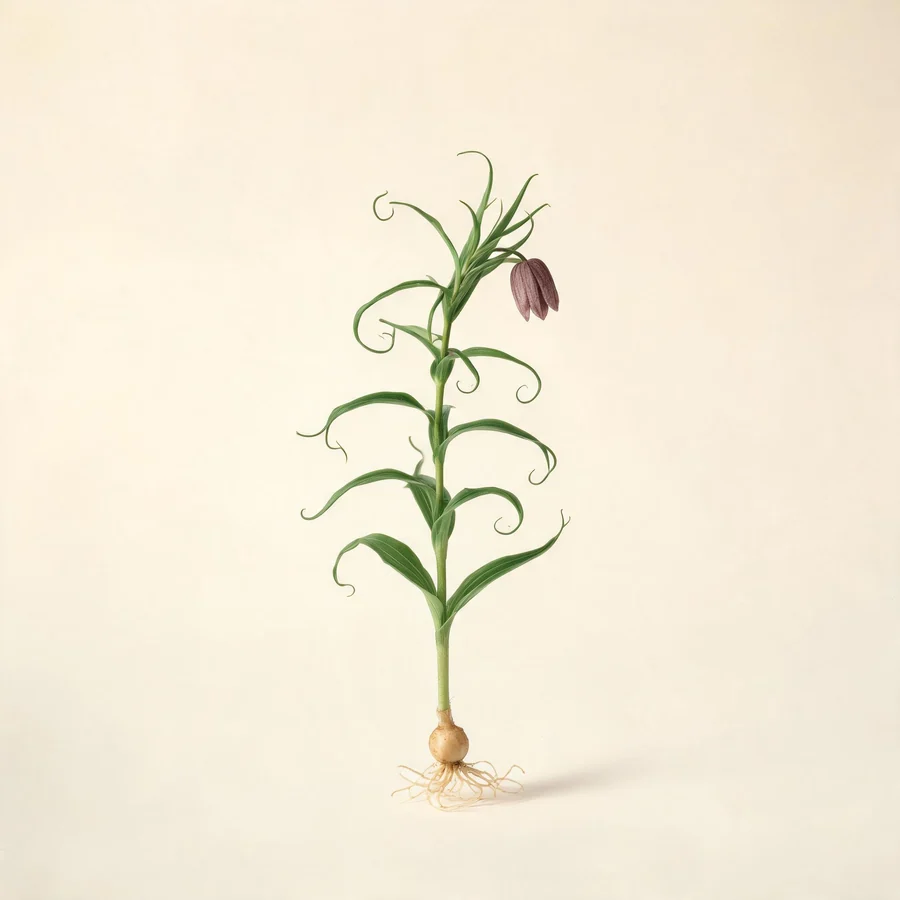
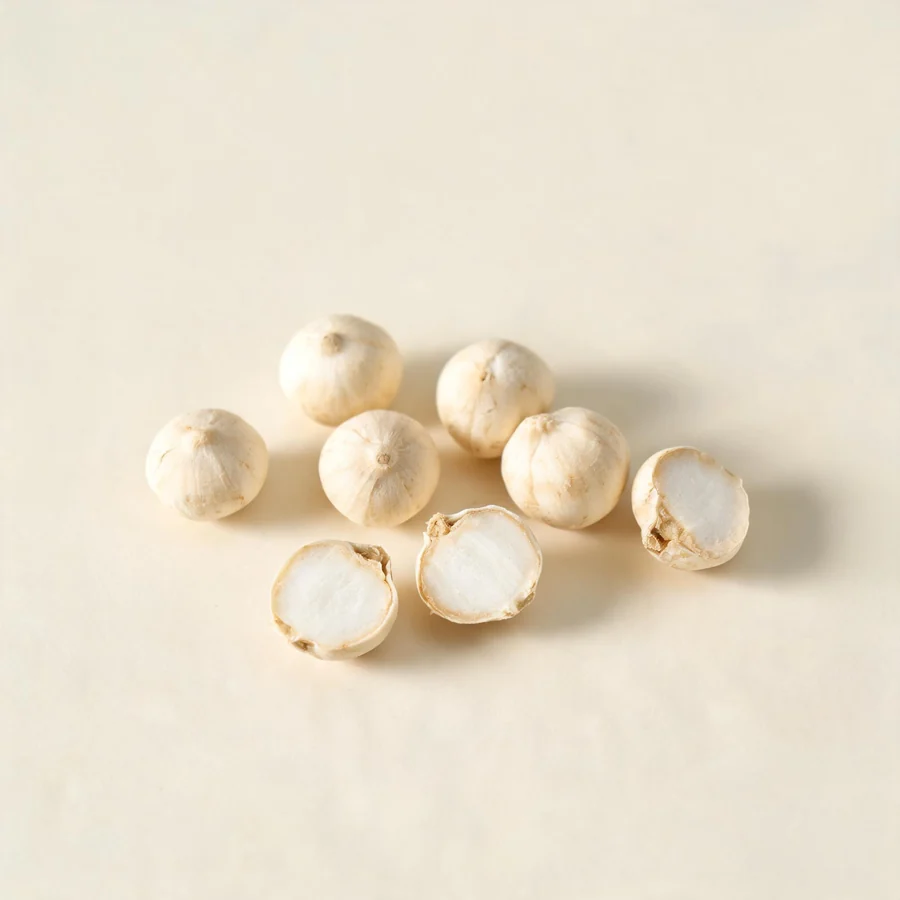
Skin profile
Where this herb sits in skin practice: the pattern it corrects, the skin signs it suits, and what it should not be used for.
Chuan Bei Mu reaches the skin from two directions, a cool phlegm nodule and a dry surface, and neither is a first-line indication. What matters most on a skin page is the aconite rule and the substitution problem, both of which have to be settled before the herb is dispensed.
Skin signs that suggest it
- Dry, rough, slightly tight skin on the face and limbs in a person with a dry cough and a dry throat
- A firm, cool, painless nodule under the skin that has been present for months and shows no redness
- Fine scaling and a papery feel to the skin in dry weather, with little or no oil
- A dry cough with scanty sticky sputum, a dry nose and thirst alongside the skin change
- A red tongue with a thin or absent coating, and a fine rapid pulse
When it is not the right herb
Not for a red, hot, weeping or pustular lesion, and not for a nodule that is warm, tender and growing: those need heat-clearing herbs and, more importantly, a diagnosis. It is wrong where the phlegm is cold, with thin white sputum in quantity, a feeling of chill and no thirst, and for a cold digestion with a poor appetite and loose stools, which the cool moistening bulb makes worse. It is wrong during the opening days of a cough from wind-cold, with chills, a runny clear nose and an itch in the throat. Nothing containing aconite may be taken with it, at any time and in any form.
What it does for skin
Skin-relevant actions only. Each one describes a mechanism in TCM terms and what it looks like on the skin.
Softens a phlegm nodule under the skin
Phlegm that thickens rather than dispersing becomes a lump, and the bulb is used on the cool, firm, unmoving kind: a small nodule in the subcutaneous fat, a cyst that refills, a rubbery gland that has been there for months. Its sweetness moistens the dried tissue, so the mass loosens rather than being forced, which is why it is preferred to the harsher dispersing herbs in a thin or dry person. The honest limit is that a slow fatty lump rarely dissolves, and a lump that is new, hard or enlarging belongs to imaging rather than to herbs.
Moistens dryness that reaches the skin through the Lungs
The tradition holds that the Lungs spread moisture to the skin, so dryness in the Lungs is read on the surface as rough, tight, finely scaling skin, worse in dry weather and in a person with a dry cough and a dry throat. The bulb is a moistening Lung herb rather than a skin herb, and this use is an inference from that relationship rather than a recorded skin application. It is given with herbs that nourish fluids, it is not applied to the skin, and severe or persistent dryness with weight loss needs assessment.
Clears mild Lung heat that is drying the surface
Where a low-grade heat has dried the fluids, the skin is dry and yet warm, the throat is sore and the sputum is scanty and sticky. The bulb's coolness is gentle enough to clear that heat without the drying that the stronger bitters cause, which is the whole point of choosing it in a dry picture. It is a supporting herb in such a formula and is not used where there is marked redness, ooze or infection, because a moistening herb in a wet lesion is the wrong tool.
Skin conditions it is used for
Mapped to the condition pages on this site. The pattern column shows what the skin is doing when this herb is the right choice.
| Condition | Pattern | Why it suits | Typical setting |
|---|---|---|---|
| Subcutaneous lipomas and nodules | Phlegm congealed into a cool, firm nodule | A lipoma is read as phlegm the Spleen has failed to transform, collecting under the skin, and the gentle moistening bulb is chosen when the lump is cool, soft to firm and not inflamed. It works with herbs that soften hardness, and its role is to loosen the phlegm rather than to dry it, which suits a thin or dry person better than the harsher dispersing bulbs. A lump that is growing quickly, fixed or painful needs imaging first, and no herb should stand in the way of that. | Modified Er Chen Tang with Chuan Bei Mu and Mu Li |
| Sebaceous cysts | Phlegm nodule with a blocked follicle and no inflammation | A cyst that refills is read as a pocket of damp-phlegm with a stubborn wall, and the bulb is used to soften the contents when the cyst is quiet. Because it moistens rather than dries, it suits a cyst in dry skin better than the drying dispersing herbs do. An inflamed, red or rapidly enlarging cyst is a different problem and needs assessment, and no herb replaces drainage of a collection that keeps coming back. | Modified Er Chen Tang with Chuan Bei Mu, Mu Li and Xuan Shen |
| Dry and hot skin | Lung heat drying the fluids while heat remains | Dry and hot at once means fluids are low while heat is still present, and the bulb answers both halves gently: it clears without the harsh drying of a bitter cold herb and it moistens without adding dampness. It is chosen where the skin is dry and warm, the throat is dry and sore, and the tongue is red with a thin coating, and it is a supporting herb in a formula rather than the leading one. Heat with redness, ooze or pustules is not this pattern and needs stronger cooling. | Modified Bei Mu Gua Lou San with Mai Dong and Tian Hua Fen |
| Skin dryness | Lung dryness with low fluids showing on the surface | Dry skin is read as a supply problem, and the Lung link is the one this bulb addresses: dry cough, dry nose, dry throat and a surface that is rough and tight. It moistens the Lungs so that moisture reaches the surface, and it is paired with herbs that nourish blood and fluids for a more durable effect. The bulb alone will not correct dry skin, and dryness that is severe, persistent or accompanied by weight loss should be assessed rather than treated with a moistening herb for months. | Modified Bai He Gu Jin Tang with Chuan Bei Mu and Mai Dong |
Combinations for skin
Herbs it is paired with when the skin, not an internal organ, is the target.
| Partner | Ratio | Why the pair is used |
|---|---|---|
| Zhi Mu | 1:1, often 6 g each | This is the Er Mu pairing: Zhi Mu addresses deficiency heat and adds moisture while the bulb resolves phlegm and moistens the Lungs, so one cools the source and the other clears what the heat has dried. For the skin it suits a dry, warm surface with a dry throat and a red thin-coated tongue. It is gentler than the toxin-clearing pairs and better suited to a thin, dry person. |
| Mu Li | 2:1, Mu Li 30 g with Chuan Bei Mu 10 g | Oyster shell softens hardness and settles rising fire while the bulb loosens the phlegm inside the mass, so one works on the texture of the lump and the other on what it is made of. In skin practice the pair is used for firm, cool nodules and cysts that have not responded to drying herbs alone. Both are used inside a formula, neither is applied to broken skin, and a lump that is changing still needs a diagnosis. |
| Xuan Shen | 1:1, often 15 g each | Xuan Shen nourishes Yin and clears deficiency fire, and the bulb moistens the Lungs and loosens phlegm, which is the combination for a nodule in a dry person with a red tongue and night thirst. Together they treat the dryness that allowed the phlegm to congeal as well as the mass itself. It is the reasoning behind Xiao Luo Wan, and it is a slow treatment measured in months rather than weeks. |
| Xing Ren | 1:1, often 6 g each | The bulb is cool and moistening while apricot seed is slightly warm and moves downward, so the pair balances moisture against movement. For a skin picture the value lies in the accompanying dry cough that keeps the Lung dryness going, since settling the cough is part of settling the skin. It is used where the skin is dry and the person is coughing, not where the skin is red, weeping or infected. |
Formulas where it leads
- Bei Mu Gua Lou San (贝母瓜蒌散) - The defining formula for a dryness-phlegm cough, with the bulb as the leading moistening and phlegm-resolving herb. It is on this page as the clearest picture of what the bulb is good at: phlegm that is dry, sticky and hard to shift, rather than phlegm that is copious and cold. The skin use follows the same logic, a cool dry nodule or a dry warm surface, and it is the reason the bulb is chosen in a dry person rather than a damp one.
Safety for skin use
What to check before recommending or using it, including the cautions that matter most for skin patients.
Do not use, or use with caution
- Aconite in any form. Bei Mu is listed against Wu Tou in the Eighteen Incompatibilities, which covers Chuan Wu, Cao Wu and Fu Zi, in a decoction or in a patent medicine. Co-decoction increases the release of toxic diester alkaloids, so the combination is refused rather than monitored.
- Cold phlegm and a cold digestion: thin white copious sputum, a poor appetite, loose stools and cold limbs. The cool moistening bulb makes that picture worse rather than better.
- Red, hot, weeping or pustular skin. There is no nodule to soften and no dryness to moisten, and a moistening herb is the wrong tool for an infected surface.
- The opening days of a cough from wind-cold, with chills, a runny clear nose and an itch in the throat. Cooling the surface at that stage is said to lock the pathogen in and prolong the illness.
Pregnancy and breastfeeding
Used only under practitioner supervision. The bulb is not a strong blood-moving or toxic herb, but its alkaloids have been shown in laboratory work to raise the tone of uterine muscle, and some Chinese sources list pregnancy as a contraindication, especially in the early months and where a pregnancy has been lost before. It sits well short of the stasis-breaking herbs, but it is not something to take unsupervised while pregnant, and no data exist on how its alkaloids behave in breast milk. For skin use there is no topical exemption worth arguing, so the same reserve applies.
Interactions
- Aconitum-containing medicines. The prohibition is classical, and there is a laboratory basis for it as well, since boiling the two together puts more of the toxic diester alkaloids into solution, which makes the mixture more dangerous than either herb on its own.
- Sedatives and opioid analgesics. Peimine-type alkaloids show central depressant effects in animals and can depress respiration at high doses, so the combination is avoided in a frail, elderly or breathless person.
- Blood pressure medicines. The alkaloids lower blood pressure at larger doses in animal work, so an additive fall is possible in someone already on antihypertensives, particularly an older person prone to dizziness on standing.
- Medicines that are strongly alkaline, sodium bicarbonate among them, can change how the alkaloids dissolve and how much is absorbed, and medicines handled by cytochrome P450 may have their metabolism changed in theory.
Allergy and patch testing
Contact reactions to the bulb are uncommon but possible, and the powder is more likely to irritate than a decoction. A previous reaction to a herb-containing powder or to another Fritillaria is a reason not to use it again. If a preparation is applied to the skin, patch test on normal skin for twenty-four hours first, keep it to a small area and stop at once if the skin becomes redder or itchier. A reaction that spreads beyond the treated area suggests a true allergy and needs assessment.
General safety references
General references for herbal hepatotoxicity and herb-drug interactions; they are not specific to this herb.
- Review article: Herbal hepatotoxicity - an update on traditional Chinese medicine preparations. Alimentary Pharmacology & Therapeutics, 2014. PMID: 24844799.
- Interactions between herbal medicines and prescribed drugs: an updated systematic review. Drugs, 2009. PMID: 19719333.
- Warfarin and food, herbal or dietary supplement interactions: a systematic review. British Journal of Clinical Pharmacology, 2021. PMID: 32478963.
Evidence
The classical record is quoted with its source. The modern note states the level of evidence plainly.
Classical record
贝母,味辛平。主伤寒烦热,淋沥邪气,疝瘕,喉痹,乳难,金疮风痉。
Bei Mu is acrid and neutral. It treats Cold Damage with irritability and heat, strangury with pathogenic Qi, hernia and masses, throat obstruction, difficult labour, and metal wounds with wind convulsion.
Shen Nong Ben Cao Jing (Divine Husbandman's Classic of Materia Medica) - This entry covers the whole Bei Mu group rather than one species, and it already includes both a mass and a wound, the two ends of the bulb's reach onto the skin.
贝母,开郁、下气、化痰之药也。润肺消痰,止咳定喘,则虚劳火结之证,贝母专司首剂。
Bei Mu is a medicine that opens constraint, descends Qi and transforms phlegm. For moistening the Lung, dissolving phlegm, stopping cough and settling wheezing in consumptive conditions with knotted fire, Bei Mu is the first choice.
Ben Cao Hui Yan (Collected Sayings on Materia Medica) - The plainest classical account of the moistening, deficiency-oriented role, and the basis for choosing the bulb where dryness rather than heat is the problem.
半夏兼治脾肺,贝母独善清金。半夏用其辛,贝母用其苦;半夏用其温,贝母用其凉。
Ban Xia treats both Spleen and Lung, while Bei Mu is good only at clearing Metal. Ban Xia is used for its acridity and Bei Mu for its bitterness; Ban Xia for its warmth and Bei Mu for its coolness.
Ben Cao Zheng (The Correct Materia Medica) - A couplet that fixed the contrast between the two phlegm herbs, and the reason a cool bulb is chosen for a hot or dry picture and never for a cold one.
Modern evidence
Evidence status
- Laboratory work on the isosteroidal alkaloids of the bulb, including imperialine and verticine, describes antitussive, expectorant and mild blood-pressure-lowering activity. None of it tests the bulb against a nodule, a cyst or dry skin in a person, and expectorant activity in an animal model says nothing about the skin.
- No controlled clinical trial of Chuan Bei Mu in any skin condition is available to cite. Its skin use is recorded formula practice built on the nodule-dispersing action, and the honest position is that a lump should be diagnosed before it is treated.
- Regulatory status: the dried bulb is an accepted herbal substance in the Chinese Pharmacopoeia, classified as non-toxic at ordinary doses, with the aconite incompatibility and a serious substitution problem as the practical concerns. Nothing here is a claim of proven benefit.
PubMed records
Selected real PubMed records for this herb's species or its constituents, chosen by species name and title relevance. They are references for the non-TCM discussion above, not proof that the herb treats any skin condition.
- Peimine suppresses collagen-induced arthritis, activated fibroblast-like synoviocytes and TNFα-induced MAPK pathways.. International immunopharmacology, 2022. PMID: 36027853 (skin-related record).
- Utilization of Chinese herbal medicine and its association with the risk of fracture in patients with Parkinson's disease in Taiwan.. Journal of ethnopharmacology, 2018. PMID: 30118835 (safety record).
Dose and forms
Skin-practice dosing and the preparations that suit skin complaints.
| Form | Dose and notes |
|---|---|
| Decoction | Three to ten grams of the dried bulb, crushed, inside a formula. It goes in towards the end of cooking, or is powdered and stirred into the strained decoction, because a long boil carries the alkaloids off. |
| Powder | One to two grams of the fine powder, two or three times daily, taken with warm water. Powder is the usual route, because the bulbs are costly and the alkaloids extract poorly in water. |
| Steamed pear | Three to five grams of powder packed into a pear with the core removed and steamed until soft, a gentle traditional preparation for a dry cough with dry skin. It is a home remedy for dryness and not a treatment for a nodule. |
| Course length | About a week for a dry cough, and months for a nodule under review. Stop and reassess if the appetite falls, the stool loosens or the lump changes. |
The dose is small because the bulbs hold little alkaloid and cost a great deal, so powder delivers the same constituents at a fraction of the weight and loses nothing to a long boil. No sharp toxic threshold exists to respect, which is why the cautions on this page concern the aconite incompatibility, substitution with cheaper bulbs, and the way a cool moistening quality sits on a cold digestion. It is nearly always given inside a formula, and it is not pushed above the standard range for a skin complaint.
Citations and further reading
Only real sources are listed: the classical materia medica passages quoted above, and the source works behind the botanical and safety statements.
- Shen Nong Ben Cao Jing (Divine Husbandman's Classic of Materia Medica), attributed compilation of the Han period - classical entry quoted above.
- Ben Cao Hui Yan (Collected Sayings on Materia Medica), 1624 - classical entry quoted above.
- Ben Cao Zheng (The Correct Materia Medica) - classical entry quoted above.
- Chuan Bei Mu monograph: Pharmacopoeia of the People's Republic of China - accepted botanical sources, part used, the non-toxic classification and the identification methods.
- Eighteen Incompatibilities (shi ba fan) - the classical list behind the prohibition on combining Bei Mu with Wu Tou.
- Modern evidence statement: based on pharmacological literature on the isosteroidal alkaloids of Fritillaria, summarised as a statement about the level of evidence rather than as one cited finding.
- Botanical description, identification and substitution: botanical and pharmacognostic literature on Fritillaria cirrhosa, Liliaceae.
Educational reference for qualified practitioners. This page is not medical advice, and skin conditions should be diagnosed by a clinician before treatment.