Skin profile
Where this herb sits in skin practice: the pattern it corrects, the skin signs it suits, and what it should not be used for.
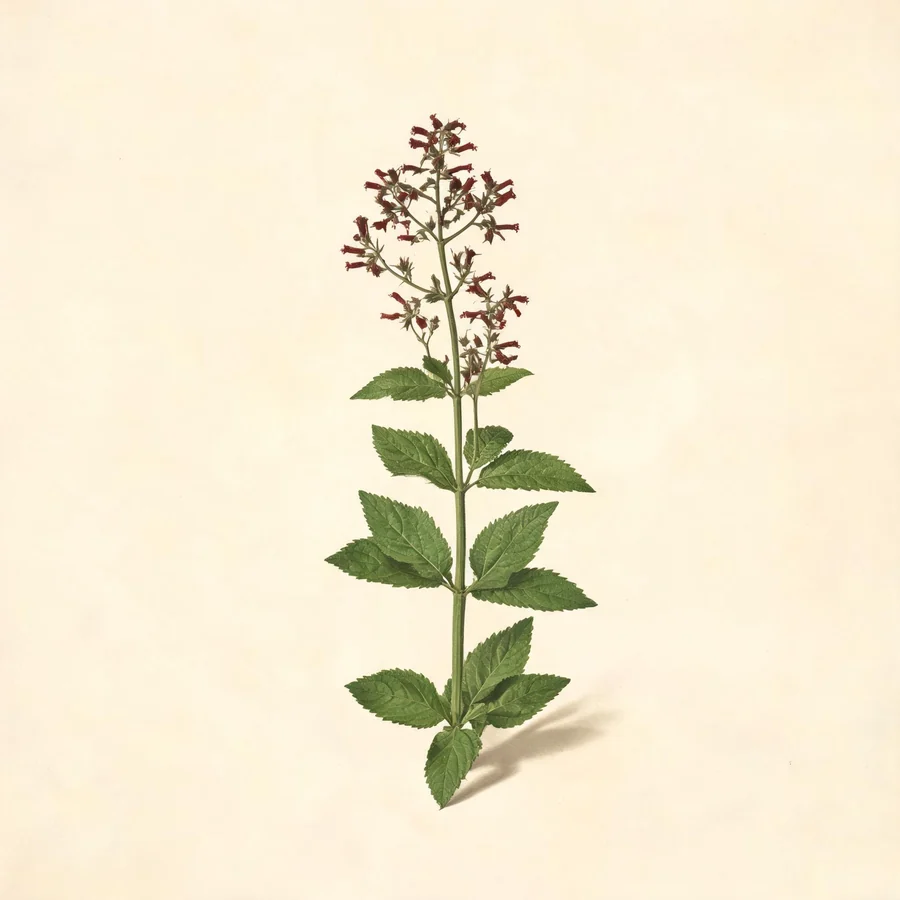
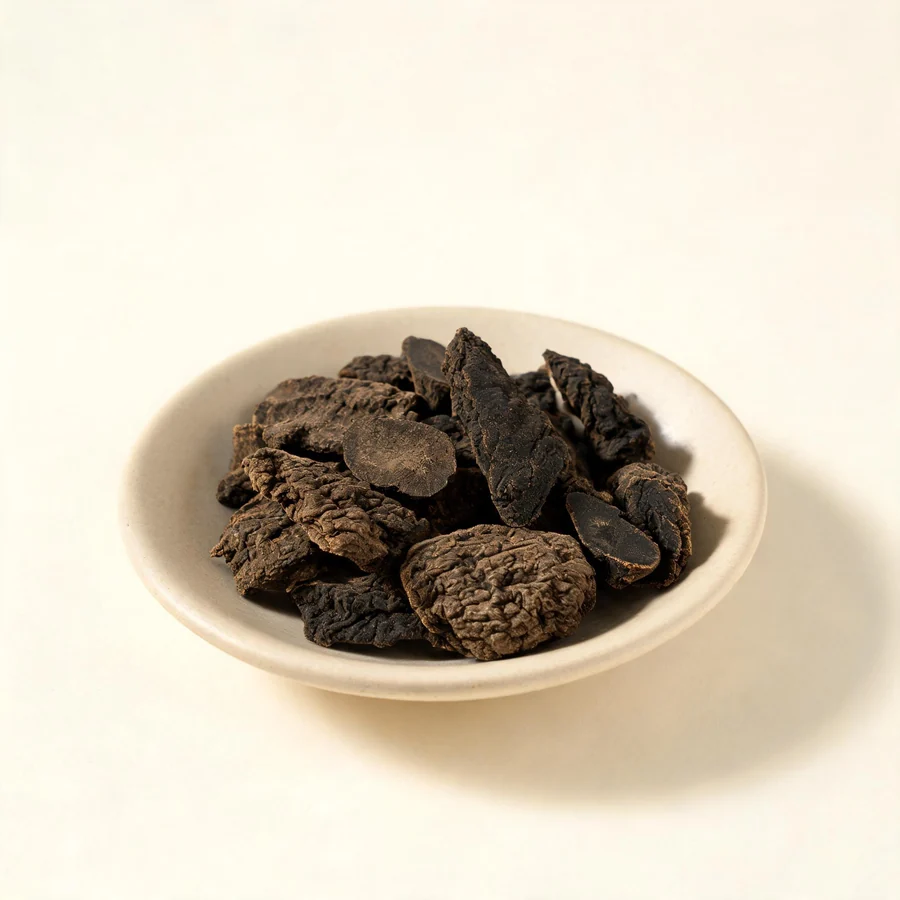
Xuan Shen is chosen when heat and dryness appear together: a dusky rash in a thin, thirsty person, or a boil that stays hard because the fire behind it will not disperse. It cools the Blood and moistens what the heat has dried, and it is kept out of cold, wet, pale skin pictures.
Skin signs that suggest it
- Dull red or purplish patches that feel hot and dry rather than wet, often in a depleted or feverish person
- A hard, tender swelling or boil that is slow to point, soften or discharge
- Dryness with heat: the skin is tight and rough while the face flushes and the mouth is dry
- A rash that has spread while the patient is thin, thirsty and restless, with a dark red tongue and little coating
- An itch that scratches to a dry, excoriated surface instead of producing ooze
When it is not the right herb
Not for cold, pale, damp skin, and not for the weeping, greasy damp-heat lesion where drying is the whole point. The root is cold and moistening, so a person with a poor appetite, loose stools and a cold abdomen tolerates it badly. It is not a herb for long-term use once the tongue has regained its coating and the heat has gone, and it is not the first choice for a fresh, spreading pustular infection, where a stronger toxin-resolving herb is needed.
What it does for skin
Skin-relevant actions only. Each one describes a mechanism in TCM terms and what it looks like on the skin.
Cools the Blood and settles a heated rash
Heat that has moved into the Blood shows as a rash that is deep red or purplish, does not fade on pressure, and arrives with fever, thirst and restlessness. Xuan Shen is chosen for that level rather than for the surface, and its salty, cold nature is read as carrying it into the vessels. It is paired with Sheng Di Huang and Mu Dan Pi, which cool and move the Blood, so that the deep heat is cleared without leaving the skin parched.
Nourishes Yin and moistens skin dried by heat
A long fever, a chronic eruption or a course of strong drying herbs can leave the skin hot and papery at once, with a dry mouth, a thin pulse and a tongue without coating. This is the pattern the root suits best: the heat is still present but the fluid that would keep the skin supple has gone. Because it moistens as it cools, it can be continued where a bitter drying herb would have to be stopped, and it is often what allows a cooling formula to be given to a thin, dry person at all.
Resolves toxin and softens hard swellings
A boil or an abscess that stays hard and does not come to a head is read as heat toxin that has congealed with Phlegm and Blood. The salty taste is said to soften, the cold to clear the fire behind the swelling, and the result is used for hard, deep or recurrent boils, for swollen glands beside an infected area, and for the indurated edge that outlasts the acute phase of an abscess. It is not a substitute for drainage once pus has collected.
Skin conditions it is used for
Mapped to the condition pages on this site. The pattern column shows what the skin is doing when this herb is the right choice.
| Condition | Pattern | Why it suits | Typical setting |
|---|---|---|---|
| Boils | Heat toxin congealed into a hard, slow boil in a dry or depleted person | A boil that stays hard, aches deeply and takes days to point is read as heat toxin that has thickened rather than dispersed. Xuan Shen contributes two things: it clears the fire that keeps the swelling angry, and its salty softening quality is said to loosen the hard centre. It is chosen particularly when the person is thin, thirsty or recovering from illness, since the usual bitter drying herbs would leave them drier still. | Si Miao Yong An Tang, or a modified toxin-resolving formula with Jin Yin Hua and Gan Cao |
| Skin abscess | Toxin with stasis, the swelling hard and the skin unbroken | An abscess that has not yet liquefied presents as a hard, red, tender mass, and the tradition treats that stage by dispersing rather than by cutting. The root cools the Blood, resolves the toxin and softens the induration, which is why it appears alongside herbs that move Blood and clear heat. Once pus is established the priority changes to drainage, and the herb becomes an assistant rather than the answer. | Si Miao Yong An Tang with Dang Gui, or a modified formula with Mu Dan Pi and Chi Shao |
| Dry and hot skin | Yin deficiency with empty fire reaching the skin | Skin that is hot to the touch yet rough, tight and finely scaly is the surface signature of fluid depleted by heat. The face may flush in the afternoon, the mouth is dry, the tongue is red with hardly any coating, and the pulse is thin and rapid. Xuan Shen addresses both halves of that picture: it clears the low-grade fire and restores the moisture the skin has lost, and it is paired with Sheng Di Huang and Mai Men Dong for the purpose. | Zeng Ye Tang, or Xuan Shen with Sheng Di Huang and Mai Men Dong |
| Neurodermatitis | Blood heat with dryness in a long-standing itch-scratch plaque | A lichenified plaque is the end point of years of scratching, and by the time it is thick and leathery the heat is usually low grade while the Blood and Yin are depleted. The root suits the dry, hyperpigmented plaque in a thin, dry person better than the strong drying herbs, because it cools without further dehydrating the skin. It is given with Blood-nourishing and itch-settling herbs, and the plaque is expected to soften slowly rather than quickly. | Modified Dang Gui Yin Zi with Xuan Shen and Sheng Di Huang |
| Psoriasis | Blood heat with dryness rather than thick scale | Psoriasis is treated mainly by cooling and moving the Blood, and Xuan Shen is added when the plaques are red, thin and dry, the patient is thirsty and the tongue is dark red. It is not a herb for the cold, pale, thick-scaled presentation, and it does not replace the blood-moving herbs that address the stasis in the plaque. Its role is to keep the cooling part of a formula from drying the skin further. | A Wen Qing Yin style blood-cooling formula with Xuan Shen and Mu Dan Pi |
| Drug rash | Blood-level heat with a spreading, dusky eruption | A drug eruption that spreads quickly, looks dusky or purplish and comes with fever and restlessness is read as heat that has entered the Blood. Xuan Shen is one of the herbs used to cool that level, and it is given with Sheng Di Huang, Mu Dan Pi and Shui Niu Jiao where the heat is severe. The first step in any drug rash is to stop the suspected medicine and have it assessed, and herbs are an adjunct to that rather than a substitute for it. | Qing Ying Tang, modified for a spreading blood-heat eruption |
Combinations for skin
Herbs it is paired with when the skin, not an internal organ, is the target.
| Partner | Ratio | Why the pair is used |
|---|---|---|
| Sheng Di Huang | 10 to 15 g Sheng Di Huang with 9 to 15 g Xuan Shen | The standard pair for heat in the Blood with dryness. Sheng Di Huang is colder and heavier and nourishes Yin more strongly, while Xuan Shen adds the softening of hard swellings and the moistening of a dry throat. Together they cool the deep heat without leaving the skin parched, and the pair underlies most formulas for a dusky, spreading rash in a depleted person. |
| Mu Dan Pi | 6 to 10 g Mu Dan Pi with 9 to 15 g Xuan Shen | Mu Dan Pi cools the Blood and moves it, which Xuan Shen does not do on its own, so the two together clear heat that has both stagnated and dried. The combination is used for purplish patches, for a rash that is slow to fade, and for the low-grade inflammation left after an acute eruption. Mu Dan Pi also keeps a cold formula from becoming cloying in a person who tends to stagnation. |
| Zhe Bei Mu | 9 g each | The working pair for hard lumps in the neck and for a boil that will not soften. Zhe Bei Mu clears heat and resolves Phlegm, and Xuan Shen's salty, cold nature loosens what has congealed. One breaks up the Phlegm, the other loosens the induration, and the pair is the core of the classical formulas for scrofula, which is why it is borrowed for indurated skin swellings. |
| Jin Yin Hua | 15 to 30 g Jin Yin Hua with 9 to 15 g Xuan Shen | Jin Yin Hua clears heat and resolves toxin at the surface of the lesion, while Xuan Shen works on the Blood beneath it. The pair is the heart of Si Miao Yong An Tang, used for a hot, swollen, dusky limb where the skin is threatened, and it is the combination to think of when an infection has a dark or violaceous edge rather than a bright red one. |
| Mai Men Dong | 9 to 12 g each | Both moisten, but they moisten different levels: Mai Men Dong nourishes Lung and Stomach fluid while Xuan Shen cools the Blood and the deeper Yin. The pair is chosen when the skin is dry and hot and the person is thirsty, with a dry cough or a raw throat, and it is the reason the root is tolerable in a thin patient where a plain bitter cooling herb would not be. |
Formulas where it leads
- Si Miao Yong An Tang (四妙勇安汤) - The formula in which Xuan Shen carries the largest load: with Jin Yin Hua, Dang Gui and Gan Cao it treats a hot, swollen, dusky limb or a stubborn ulcer with a violaceous edge. Xuan Shen supplies the Blood cooling and the softening, Jin Yin Hua the toxin-resolving, and Dang Gui keeps the Blood moving so that the cold herbs do not freeze what is already stagnant.
- Qing Ying Tang (清营汤) - A formula for heat that has entered the Ying level, with fever at night, restlessness and a rash that does not fade on pressure. Xuan Shen sits with Sheng Di Huang, Mai Men Dong and Shui Niu Jiao to cool the Blood and protect the fluid, which is why the formula is borrowed for acute blood-heat eruptions.
Safety for skin use
What to check before recommending or using it, including the cautions that matter most for skin patients.
Do not use, or use with caution
- Cold, damp or deficient digestion: a poor appetite, loose stools, a cold abdomen and a pale wet tongue. The root is cold and moistening, so it can deepen diarrhoea and leave the person feeling heavy and bloated.
- Skin that is cold, pale and dry without heat, and the cold-damp type of eczema where the lesion is soggy but not inflamed. There is no fire for the herb to clear, and the moistening quality adds to the dampness.
- Blood deficiency with cramping and blurred vision without heat signs, and patterns of cold with severe weakness and cold limbs, where a cold herb is said to risk putting out the remaining Yang.
- Any preparation containing Li Lu (Veratrum), which the Eighteen Incompatibilities rule bars, and long unsupervised courses, since the root is a treatment for a hot, dry pattern rather than a maintenance tonic.
Pregnancy and breastfeeding
Only under practitioner supervision, and only where the heat pattern is clear. A cold root that moistens the bowel and encourages the Blood to move is a poor fit for a threatened pregnancy, or for a woman whose limbs are cold and whose stools are loose, and some prepared products carry a warning for that reason. A correctly prescribed short course has not been linked to harm, but it is not something to use casually in pregnancy. A breastfeeding mother should keep any course short and watch the infant's stools.
Interactions
- Blood pressure medicines. Extracts have lowered blood pressure and relaxed vessels in animal work, so a person on antihypertensives should check their readings in the first week rather than assume the combination is neutral.
- Anticoagulants and antiplatelet drugs. Platelet clumping has been reduced in laboratory work, so anyone on warfarin, aspirin or clopidogrel should tell the prescriber before starting a course.
- Blood sugar medicines. Some extracts have lowered glucose in animal models, which matters at high extract doses for people on insulin or a sulphonylurea more than at ordinary decoction strength.
- Laxatives and antibiotics that loosen the bowel. Because the root moistens the bowel, it may add to the gut effects of either, and the stool is the practical guide to whether the dose is too high.
Allergy and patch testing
Reactions are uncommon but recognised. Iridoids such as harpagoside release histamine from mast cells in laboratory work at high concentration, which offers a plausible route for the occasional itchy rash or sneezing after a dose. Stop at once if a rash, wheeze, lip swelling or faintness develops, since the last three are a medical emergency. A previous reaction to a herb-containing wash or cream is a reason to patch test before any topical preparation is tried.
General safety references
General references for herbal hepatotoxicity and herb-drug interactions; they are not specific to this herb.
- Review article: Herbal hepatotoxicity - an update on traditional Chinese medicine preparations. Alimentary Pharmacology & Therapeutics, 2014. PMID: 24844799.
- Interactions between herbal medicines and prescribed drugs: an updated systematic review. Drugs, 2009. PMID: 19719333.
- Warfarin and food, herbal or dietary supplement interactions: a systematic review. British Journal of Clinical Pharmacology, 2021. PMID: 32478963.
Evidence
The classical record is quoted with its source. The modern note states the level of evidence plainly.
Classical record
It nourishes Yin and lowers fire, clears the toxicity of rashes, benefits the throat and frees the stagnation of blood in the urinary passage.
Ben Cao Gang Mu (Compendium of Materia Medica), Li Shizhen - Li Shizhen ties the Yin-nourishing action to the clearing of rash toxicity, which is the sentence behind the modern skin use.
Its nature is deeply Yin and it governs heat disease; the bitter taste drains downward and the salty taste takes it straight into the blood to free what is stuck. It is cold without being fierce and moistening without being cloying.
Ben Cao Zheng Yi (Correct Meaning of Materia Medica) - The Qing commentary explains why a cold root can be given to an exhausted patient: it reaches the Blood without the harshness of the drying herbs.
It clears heat, cools the Blood and softens hardness.
Classical materia medica - The summary line that joins the cooling and the softening actions, the two that make the root useful for indurated skin lesions.
Modern evidence
Evidence status
- Laboratory work on the iridoids and phenylpropanoid glycosides of Scrophularia ningpoensis, including harpagoside and acteoside, reports anti-inflammatory and antioxidant activity in cell and animal models. Some of it examines mediators relevant to skin inflammation, but laboratory activity is not clinical benefit.
- Clinical trial evidence for Xuan Shen in skin disease is very limited. The root is studied mainly inside multi-herb formulas for inflammatory and infectious conditions, rarely as a single substance, and no trial has established it as a treatment for eczema, psoriasis or boils.
- Regulatory status: the dried root is an accepted herbal substance in the Chinese Pharmacopoeia. The statements on this page describe traditional practice and the state of the evidence, not proof of effect.
PubMed records
Selected real PubMed records for this herb's species or its constituents, chosen by species name and title relevance. They are references for the non-TCM discussion above, not proof that the herb treats any skin condition.
Dose and forms
Skin-practice dosing and the preparations that suit skin complaints.
| Form | Dose and notes |
|---|---|
| Decoction (internal) | 9 to 15 g of dried root daily in a formula, taken between meals. The lower end suits a thin, dry person and the upper end a clear blood-heat picture, and the course stops when the tongue has recovered its coating and the dryness has gone. |
| Short-term higher dose | 15 to 30 g is a short-term measure for a severe sore throat, deep febrile heat or a swelling that refuses to soften. It is not for maintenance, and doses above the standard range tend to loosen the stool. |
| Pills and powder | The root is also dispensed as pills or powder when a course is long or the decoction is too bulky. Follow the maker's label, because concentrations differ widely between products and between prepared forms. |
| Course length | Days to a few weeks, with review. The herb is stopped as soon as the heat settles, since a cold, moistening root has nothing to offer once the coating has returned to the tongue. |
Digestive tolerance sets the dose as much as the pattern does. The root is cold and mucilaginous, so a large or repeated dose softens the stool and takes the edge off the appetite, which is what injury to the Spleen and Stomach means in practice. Reduce or stop when the stool loosens. It is a treatment for a hot, dry picture, not a sweet, warm tonic that can be taken indefinitely.
Citations and further reading
Only real sources are listed: the classical materia medica passages quoted above, and the source works behind the botanical and safety statements.
- Ben Cao Gang Mu (Compendium of Materia Medica), Li Shizhen, 1578 - classical passage quoted above.
- Ben Cao Zheng Yi (Correct Meaning of Materia Medica), late Qing period - classical passage quoted above.
- Xuan Shen monograph: Pharmacopoeia of the People's Republic of China - source for the accepted botanical source, part used and quality requirements.
- Modern evidence statement: based on laboratory literature on the iridoids and phenylpropanoid glycosides of Scrophularia ningpoensis, summarised as a statement about the level of evidence rather than as a cited finding.
- Botanical description and identification: botanical literature on Scrophularia ningpoensis, Scrophulariaceae.
Educational reference for qualified practitioners. This page is not medical advice, and skin conditions should be diagnosed by a clinician before treatment.