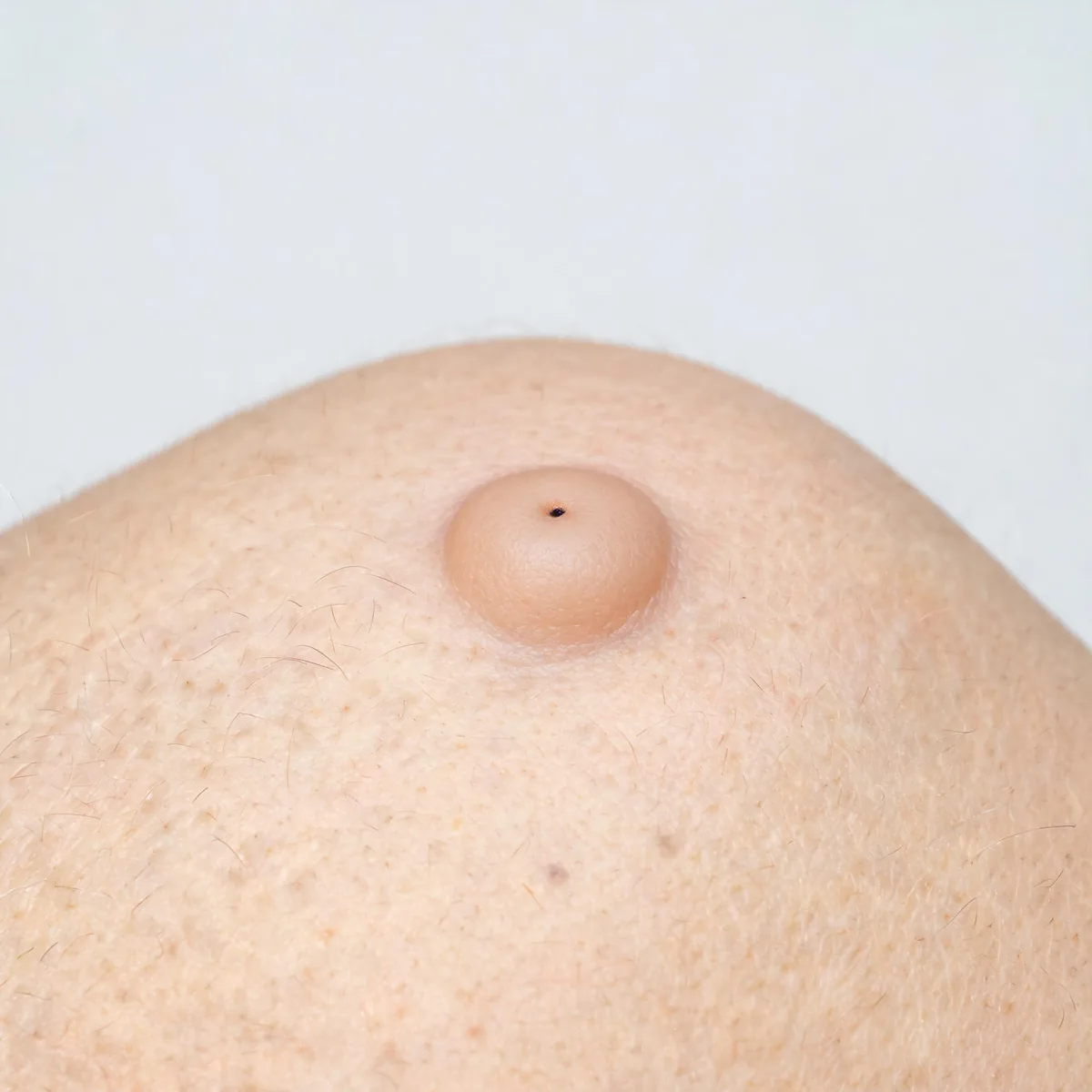
Understanding Sebaceous cysts
The tradition describes sebaceous cysts as a form of phlegm nodule. The Spleen transforms and transports fluids; when weakened by diet, stress or constitution, dampness accumulates and thickens into a nodule.
Phlegm in the channels gives the typical cyst: painless, movable, a nodule under the skin with a central blackhead or plugged pore, firm but not rock-hard like a small rubber ball, without redness, heat or pain.
Toxic-Heat stagnation gives the inflamed cyst: painful, hot, red, with pus or cheesy discharge and foul odour, fever, thirst and restlessness. That is an infected cyst and needs medical drainage rather than herbal treatment.
Blood stagnation with heat gives a firm fixed lump that does not move easily, with dark or purplish skin over it, tenderness and a sensation of heat, worse at night. The classical literature treats a fixed hard lump differently from a mobile benign one.
A cyst begins as a problem of fluid handling rather than of the skin. The Spleen is said to govern the transformation and transport of fluids, and when that work is inefficient the leftover moisture gathers as dampness and then thickens into phlegm. Phlegm of this kind drifts with the channels and can settle in the loose tissue beneath the skin, where it forms a rounded, painless swelling that moves under the finger.
Nothing in that description is fixed. A quiet nodule may sit for months and then become hot, red and tender when heat and toxin gather in it, which is why the same lump can be read as one pattern this year and another after a flare. Long-standing lumps that never quite settle are read as stagnation of blood, because phlegm that stays in one place eventually impedes the local circulation. Practitioners therefore treat the phase in front of them rather than the diagnostic label.
Conventional view
A sebaceous cyst, often called an epidermoid cyst, is a benign and slow-growing lump formed when skin cells and keratin are trapped beneath the surface. It is usually round and smooth and does not hurt, though it can become inflamed or infected and then turn red, painful and discharging. The face, neck, upper back and chest are the usual sites. The diagnosis is made by examination, and imaging is rarely needed unless the lump is unusually large or deep.
Small cysts that cause no trouble are often left alone. An inflamed or infected one may be treated with warm compresses, incision and drainage, or antibiotics, and a steroid injection is sometimes used to settle inflammation. For cysts that keep returning, or that the person wants removed, excision of the whole sac is the definitive treatment, because a sac left partly in place tends to refill.
The limit of this approach is that it deals with the lump and not with why it formed. Recurrence is common after incomplete excision, surgery can leave a scar, and repeated procedures are a burden for anyone prone to many cysts. A pattern-based approach works on the tendency instead, aiming at the phlegm-dampness, toxic-heat or blood stasis behind it, and can be used before surgery to settle inflammation or afterwards to reduce the chance of another.
Selected PubMed records
Real PubMed records for the conventional discussion above, selected by condition name and title relevance. They are references, not a claim that any treatment is proven for this condition.
- Sonographic appearance of sebaceous cysts. Our experience and a review of the literature.. International journal of dermatology, 2019. PMID: 31209860.
How it connects
Sebaceous cysts and acne often appear together because they share a root in TCM: Phlegm-Dampness and Heat accumulating in the skin. When the Spleen fails to transform fluids, Dampness congeals into Phlegm, which can show as both deep painless nodules and superficial inflamed lesions; this dual presentation is especially common in people with a constitutional tendency toward Damp-Heat, often aggravated by a diet rich in greasy, sweet or spicy food. Treating the underlying Spleen deficiency and clearing Damp-Heat can resolve both, reducing the frequency of new cysts and breakouts.
How it is assessed
The practitioner palpates the cyst and assesses heat, fixation and discharge.
What a practitioner looks for
- Mobile and painless suggests Phlegm in the channels.
- Hot, red and painful with pus suggests Toxic-Heat stagnation and needs medical care.
- Fixed and hard with night pain suggests Blood stagnation with heat.
- Red flags: rapid growth, fixation, or ulceration.
The examination begins with the lump itself. A practitioner notes its colour, whether it feels warm, whether it slides under the fingers, and whether pressure hurts. A fleshy, skin-coloured nodule that moves freely and causes no discomfort is read as phlegm sitting in the channels, the commonest and least troublesome presentation. The rest of the picture is then checked: a pale, slightly swollen tongue carrying a thick white greasy coat, together with a deep, slippery pulse, often with a sense of heaviness in the limbs.
A cyst that has turned red, hot, swollen and painful, especially if it is discharging pus, has moved into toxic-heat. Here the tongue is red and carries a thick, yellow greasy coat, while the pulse is rapid and slippery, and the person may report thirst, irritability and a general feeling of heat. The distinction matters, because a quiet phlegm nodule is treated gently while an inflamed one needs heat and toxin cleared and usually needs medical assessment as well.
A lump that has sat there for a long time and feels firm and fixed, with dark or purplish skin over it and perhaps a dull redness around it, suggests that stagnation has reached the blood. The tongue looks dark purple, sometimes with stasis spots, while the pulse feels wiry or choppy. The low-grade heat in this picture is what makes the area stubborn: it is not the fierce heat of an infection but a slow, persistent warmth that keeps the lump from settling.
TCM patterns in Sebaceous cysts
The three patterns describe one lump at different stages rather than three separate diseases, and the signs that separate them are mostly local. What the cyst feels like decides the matter: a soft, mobile, painless nodule with no colour change points to phlegm gathering in the channels, while heat, redness and throbbing point to toxin collecting in the same place. Between those poles sits the firm, fixed, darker lump, where long-standing obstruction has begun to involve the blood. Tongue and pulse confirm what the fingers find. A thick white greasy coating with a deep slippery pulse supports phlegm, a red tongue with yellow grease and a rapid pulse supports toxic-heat, and a purple tongue with a wiry or choppy pulse supports blood stagnation. Because a cyst can move from one phase to another, the pattern is reviewed at each visit and treatment is chosen for the phase that is active now.
| Pattern | Key signs | The itch | Tongue | Main formula |
|---|---|---|---|---|
| Phlegm in the Channels (Joints and Muscles) | Painless movable nodule under the skin; No redness, heat or pain | Not specified | Body: Purple, with stasis spots and distended sublingual veinsCoat: White and greasy | Not specified |
| Toxic-Heat Stagnation | Painful hot red cyst | Not specified | Body: Deep red or crimson with raised red pointsCoat: Thick, dry and yellow | Not specified |
| Blood Stagnation with Heat | Dark or purplish skin over the cyst; Pain worse at night | Not specified | Body: Reddish-purple, with stasis spots and dark sublingual veinsCoat: Thin, dry and yellow | Not specified |
Phlegm in the Channels (Joints and Muscles)
The typical painless mobile cyst with a central pore.
This is the quiet form of the condition, and the one the classical texts describe as a phlegm nodule. When the Spleen cannot transform fluids properly, dampness gathers and then condenses into phlegm, and phlegm with no outlet drifts into the channels of the skin and settles there. What forms is a smooth, rounded lump that is not attached to the surface, is neither red nor warm, and does not hurt. If it stays a long time it can impede the local movement of Qi and blood, so it feels firmer and looks slightly darker, though it does not become inflamed.
The tongue is often purple with stasis spots and a white greasy coating, with distended veins beneath it, and the pulse is wiry and choppy, or, where phlegm dominates, wiry and slippery. Damp living conditions, rich and greasy food, dairy, long sitting and worry favour this picture, while warmth, gentle daily exercise, light warm meals, a dry environment and cutting back on dairy and sweets help. Er Chen Tang is the formula named for it, described as drying dampness and transforming phlegm, with Dan Shen added when the lump has grown firmer and darker; the points are ST-40 Fenglong, SP-9 Yinlingquan, SP-6 Sanyinjiao and ST-36 Zusanli.
Signs
- Painless movable nodule under the skin
- Central blackhead or plugged pore
- Firm but not rock-hard, like a small rubber ball
- No redness, heat or pain
Diet and lifestyle for this pattern: Avoid dairy, greasy, fried and sweet food that creates Dampness and Phlegm. Eat warm cooked meals such as congee, steamed vegetables and moderate amounts of ginger and garlic, and keep exercise regular and gentle such as walking or yoga so the Spleen transforms fluids and Phlegm does not settle under the skin.
Toxic-Heat Stagnation
The inflamed cyst with pain, heat and pus.
A cyst that has been quiet can turn angry when heat and toxin build up inside it. Spicy food, alcohol, stress or a low-grade infection all feed that process, and the trapped phlegm becomes a red, hot, painful swelling that may discharge pus with a foul smell. This is an acute defensive reaction rather than a new disease: the body is walling off and trying to expel something it reads as toxic, and if the heat is not cleared it can spread into the surrounding tissue.
The tongue in this phase is deep red or crimson with a dry yellow coating and raised papillae, and the pulse is rapid, forceful and often overflowing. Thirst for cold drinks, restlessness, irritability, constipation and dark scanty urine commonly accompany it. Spicy or fried food, coffee, alcohol, hot weather, stress and squeezing the cyst all make it worse, while a cool compress, plenty of water, cooling food and rest in a cool place ease it. Wu Wei Xiao Du Yin is the formula usually cited, with Xian Fang Huo Ming Yin where swelling and pain are marked; the points are DU-14 Dazhui, LI-11 Quchi, LI-4 Hegu and SP-10 Xuehai.
Signs
- Painful hot red cyst
- Pus or cheesy discharge with foul odour
- Fever or feeling of intense heat
- Intense thirst with restlessness
Diet and lifestyle for this pattern: Avoid all spicy, greasy and fried food as well as alcohol and coffee, which fan the flames of Heat. Eat plenty of cooling, water-rich food such as cucumber, watermelon and mung beans, keep the area clean and never squeeze the cyst, which can push infection deeper, and a cool compress can soothe inflammation.
Blood Stagnation with Heat
A firm fixed lump with dark skin and night pain.
When a cyst remains for months or years, the phlegm and the stagnant Qi around it begin to obstruct the small vessels. Blood that cannot move becomes stasis, and the lump turns firm, fixed and darker than the skin around it. Stasis then generates a low-grade heat of its own, so the area becomes tender and warm and sometimes looks red at the edges. This is the most stubborn presentation, because the obstruction is deep and the heat is fed by the blockage itself.
The tongue is reddish purple and carries stasis spots, with prominent sublingual veins and a coating that is thin, dry and yellow, and the pulse is choppy and rapid, often wiry at the left guan position. Pain that is worse at night, restlessness, irritability and a thirst that wants the mouth rinsed rather than filled belong to the picture. Stress, spicy food, alcohol, long sitting and squeezing the lump make it worse, while a cool compress, gentle exercise, loose clothing, stress reduction and cooling blood-moving food help. Xue Fu Zhu Yu Tang is the formula named, with Dan Shen and Tao Ren among its key herbs, and the points are SP-10 Xuehai, SP-6 Sanyinjiao and LR-3 Taichong.
Signs
- Firm fixed lump that does not move easily
- Dark or purplish skin over the cyst
- Tenderness and heat over the cyst
- Pain worse at night
Diet and lifestyle for this pattern: Avoid spicy, greasy and deep-fried food that generates Heat and Phlegm. Eat more cooling, blood-moving food such as cucumber, celery, hawthorn berry and moderate amounts of vinegar, and keep exercise gentle and daily such as walking or tai chi so Qi and Blood keep moving and stasis does not set in.
Treatment approach
How the tradition treats sebaceous cysts, with the herbs, formulas and points used for it.
Principles
- Have the cyst examined before treating it as benign phlegm.
- Transform phlegm and drain dampness where the cyst is soft and mobile.
- Resolve toxicity and seek medical drainage where the cyst is hot, red and painful.
- Move Blood where the lump is fixed and tender, with medical review for a hard lump.
- The strategy follows the phase of the lump: transform phlegm and support the Spleen while the cyst is quiet, clear heat and resolve toxin when it is inflamed, and invigorate blood with a little cooling when it is hard and fixed. Herbal medicine carries most of that work, with acupuncture used to support digestion and the local circulation.
Herbs used
Formulas
Acupoints
- ST-40 (Fenglong)
- SP-9 (Yinlingquan)
- SP-6 (Sanyinjiao)
- ST-36 (Zusanli)
- DU-14 (Dazhui)
- LI-11 (Quchi)
- LI-4 (Hegu)
- SP-10 (Xuehai)
- LR-3 (Taichong)
What to expect
- Benign cysts often persist; the tradition describes gradual softening over months at best.
- Infected cysts need drainage and resolve faster after it.
- Surgical removal remains the definitive conventional treatment.
- Expect slow change. A quiet phlegm cyst may soften over weeks but often holds its size, an inflamed one settles within days of the right treatment, and a hard old lump can take months. Flares are common when diet or stress slips, and keeping the phlegm tendency under control usually means periodic herbal courses rather than one finished course.
Safety and when to get help
Seek medical help urgently for
- Rapid enlargement over a few days.
- Severe pain with spreading redness and warmth.
- A hard fixed lump, or one that ulcerates or discharges blood.
For anything severe, sudden or spreading quickly, read when a skin problem needs urgent care.
Cautions
- Do not squeeze or attempt to pop a cyst; this causes infection and scarring.
- Any new lump should be examined.
- Recurrent cysts at the same site may need surgical excision.
Using this alongside conventional care
- TCM is described as complementary to conventional care: surgical or medical management where indicated, with herbs for the constitutional pattern.
- Herbs can run alongside antibiotics for an infected cyst, and alongside observation or a planned excision for a quiet one. Two cautions matter. Remedies that move blood, among them Dan Shen and Tao Ren, may increase bleeding, so tell your surgeon if you are using them before an operation and expect to pause them for about a week beforehand. If you take anticoagulants or have a bleeding disorder, do not start herbal formulas on your own.
Diet and lifestyle
- Avoid dairy, greasy food, refined sugar and excessive cold or raw food, and favour warm cooked meals.
- The general rule is to eat in a way that does not ask the Spleen for extra work: warm cooked meals, vegetables, whole grains and modest amounts of protein, with dairy, greasy and fried food, refined sugar and a lot of raw or cold food kept low. Radish, pear, water chestnut and seaweed are named as foods that help transform phlegm. Where the cyst runs hot, add cooling foods such as cucumber, watermelon and mung beans; where it is hard and fixed, cooling blood-moving foods such as celery and hawthorn berry suit better. Alcohol, coffee and spicy food are best avoided in every phase.
If you're pregnant
Treatment in pregnancy shifts towards external measures. Herbs that transform phlegm, such as Ban Xia, and the stronger herbs that resolve toxin are used with caution or left out, and points traditionally avoided in pregnancy, including LI-4 and SP-6, are not needled. A warm poultice of mashed Pu Gong Ying can be used on an inflamed cyst, and simple dietary changes that reduce dampness, such as cutting back on dairy and sugar, are encouraged. Any internal formula should be prescribed by a practitioner experienced in pregnancy care.
If you're breastfeeding
The concern here is that cold, bitter herbs may reach breast milk and upset an infant's digestion. Wu Wei Xiao Du Yin, being cold in nature, is best used briefly and only under professional guidance, and external applications are preferred first. Jin Yin Hua powder mixed into a paste with water can be applied to an inflamed cyst without meaningful absorption. Plenty of fluid and a clean, light diet support healing without affecting milk supply.
If treating a child
In children a cyst usually reflects phlegm-dampness arising from an immature Spleen, and irregular eating or too many cold and sweet foods often play a part. The lump tends to be small, painless and on the face or scalp, and it flares less often than in adults. Care centres on regular meals and gentle external measures; if herbs are used the dose is roughly a third to a half of the adult dose, and acupressure at ST-36 and SP-9 can replace needling.
If treating an elderly patient
In older people a cyst often mixes phlegm stagnation with an underlying deficiency of Qi or blood, so the lump may be firmer and darker from long-standing stasis. Healing is slower, which makes any inflammation worth watching closely. Doses usually come down to roughly two thirds of the adult standard, warming herbs that strengthen the Spleen may be added to support digestion, and acupuncture is kept modest in the number of needles and the length of a session.
Urgent-sign guidance is based on standard sources: NHS anaphylaxis, NHS cellulitis, NHS Stevens-Johnson syndrome, NHS melanoma.
Evidence
Evidence status
Compiled for this page from the classical and modern literature; not a systematic review, so treat it as a pointer to sources rather than clinical guidance.
There are no clinical studies recorded for this condition, so the evidence is classical and surgical rather than pharmaceutical. The texts describe these as phlegm-Qi congealing into a mass, treated by resolving phlegm and dissipating masses. In practice a sebaceous cyst is a structural lesion; herbs may address the pattern around it but do not remove the cyst, and a changing or inflamed cyst should be assessed.
What has been published is mostly observational. Several Chinese-language reports describe fire needle therapy, in which a heated needle punctures and drains the cyst, used together with topical herbal pastes, and they record high rates of success. None of these series used a control group, so the results cannot be separated from the natural course of a cyst or from the paste applied with the procedure, and the overall quality of evidence is low. Nothing in the literature shows that internal formulas prevent new cysts from forming.
Classical record
A fatty tumour is formed by phlegm-Qi congealing; treatment should resolve phlegm and dissipate masses.
- Yi Zong Jin Jian (Golden Mirror of Medicine), Volume 6, section on skin tumours.
粉瘤多生于耳项前后,... 此乃痰气凝结而成。
Lumps of this kind most often arise in front of and behind the ears and the neck, and they form because phlegm and Qi congeal there.
Wai Ke Zheng Zong on phlegm nodules around the ears and neck - Classical citation: Wai Ke Zheng Zong (Orthodox Manual of External Medicine), Volume 2, section on phlegm nodules.
Common questions
Can herbs dissolve a cyst?
The tradition describes transforming phlegm with limited effect over months. Cysts are usually removed surgically if troublesome.
Should I squeeze it?
No. Squeezing causes infection, inflammation and scarring.
When should a cyst worry me?
Rapid growth, hardness, fixation, pain, or ulceration and bleeding.
Why does it keep coming back?
If the cyst sac is not removed it can refill, which is why recurrence often needs excision.
Can acupuncture alone treat a sebaceous cyst?
Not on its own. Acupuncture is described as supporting treatment by improving local circulation, easing inflammation and strengthening the Spleen, but herbs are the main tool because they act on phlegm, heat or stasis directly. The two together are usually described as giving the best result.
How long does it take to see results?
An inflamed cyst may settle in a few days, while a small, soft one can start to shrink within 2 to 4 weeks, while a hard chronic lump may need 6 to 12 weeks or longer. Stopping treatment early is one reason cysts return.