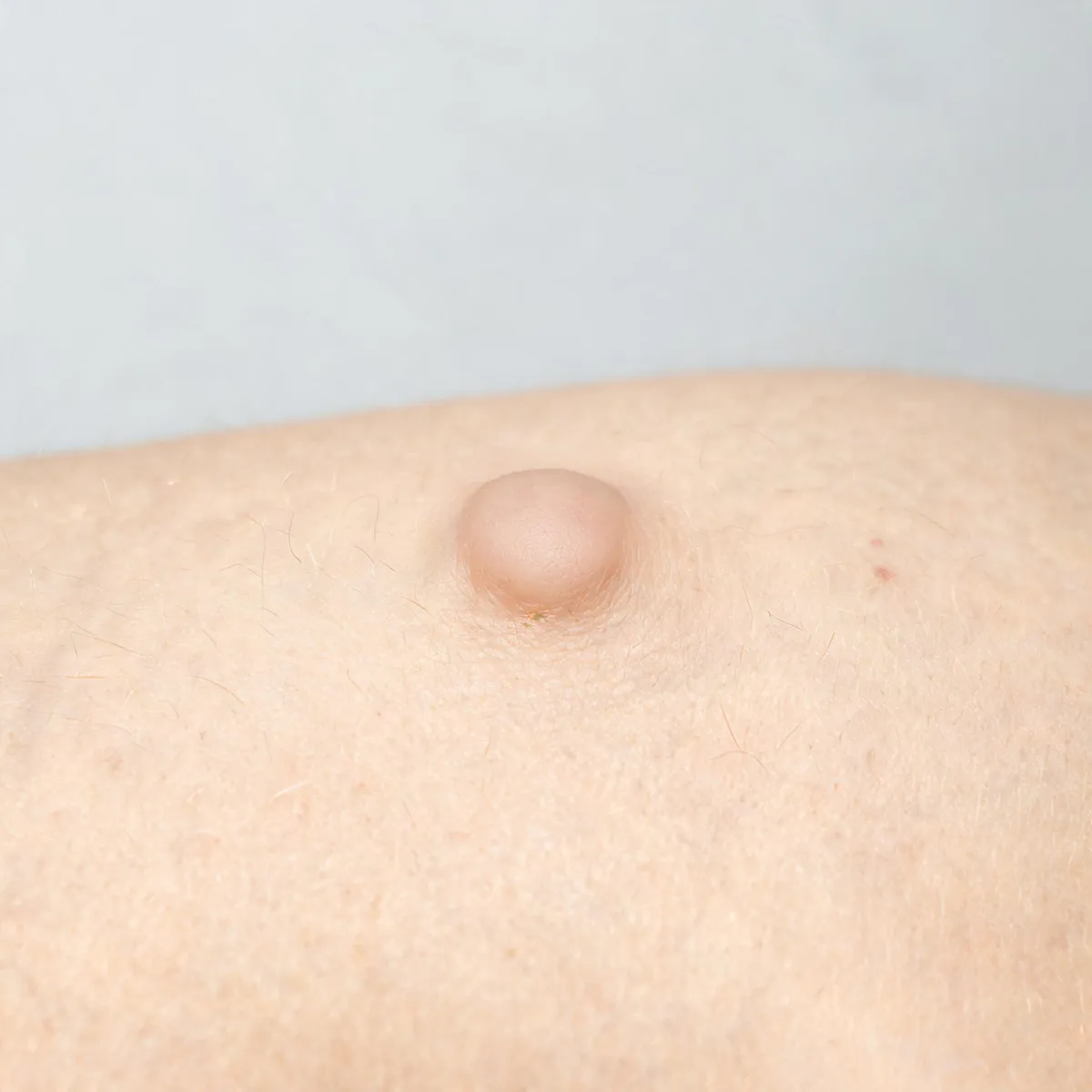
Understanding Subcutaneous lipomas and nodules
The tradition describes lipomas as a form of Phlegm, a thicker and more stubborn pathological fluid that can accumulate anywhere in the body, with a weak Spleen at the root.
Damp-Phlegm gives soft movable painless lumps under the skin with heaviness, poor appetite, bloating and a thick white greasy coating. Spleen deficiency with dampness gives the same soft painless lumps with more marked digestive weakness.
Qi and Blood stagnation gives a different kind of nodule: firm, fixed, possibly tender, with stabbing pain worse with pressure and dark or purplish skin over the lump. That is the pattern to take seriously, because a hard fixed nodule is a different clinical proposition from a soft mobile lipoma.
Toxic-Heat stagnation gives a hot red painful lump with fever, thirst and possible pus. That is infection or inflammation in the lump, and it needs medical assessment.
The classical literature is careful with the word phlegm. It does not mean the mucus of a cough but a pathological fluid that has thickened and stayed, able to collect anywhere fluids should move and do not. The Spleen transforms and transports, so when its work is weakened by poor food, overwork or stress, moisture gathers, thickens and finally condenses, and the lump under the skin is where it has settled.
The distinction between the soft lump and the firm one is treated as clinically important. Phlegm alone moves under the fingers and does not hurt. Where stagnant Qi and congealed blood have joined it, the lump becomes fixed, firmer and sometimes tender, with darker skin over it. The quiet lump that turns hot, red and painful is described as phlegm that has transformed into toxic heat, and that one needs prompt attention.
Conventional view
Conventional medicine describes a lipoma as a benign, slow-growing tumour of fat cells that feels soft and doughy, is usually painless and slides under the skin when pressed. Most sit on the trunk, and on the shoulders, neck and arms. The diagnosis is clinical, with ultrasound or biopsy reserved for anything atypical, and the cause is not fully understood, though inheritance and minor injury are both implicated.
Treatment is offered only when a lipoma is painful, restricts movement or is cosmetically troublesome. Excision is the definitive option, liposuction can reduce the bulk, and steroid injection can shrink the lump. None of these prevents others forming elsewhere.
That is the limitation the classical literature points to. Removing the lump leaves the internal conditions that produced it untouched, which is why new ones often appear after successful surgery, and there is no conventional framework that links digestion, energy or emotional state with a tendency to form them.
Selected PubMed records
Real PubMed records for the conventional discussion above, selected by condition name and title relevance. They are references, not a claim that any treatment is proven for this condition.
- Scapular swelling: "subcutaneous cysticercosis unveiled"-a case report.. Journal of medical case reports, 2024. PMID: 39716254.
How it connects
Lipomas rarely appear in isolation: they are a visible sign of a deeper imbalance that often produces digestive and metabolic symptoms too. When Damp-Phlegm accumulates under the skin, the same turbid substance frequently congests the middle burner, leading to abdominal bloating, distention and heaviness, and because the Spleen's transport function is weak, food is not properly transformed, causing poor appetite and sometimes nausea. Afternoon fatigue is another common companion: a Spleen that cannot extract pure Qi from food leaves the body under-fuelled, while the heavy sticky nature of Dampness drags down body and spirit. Excess abdominal weight often develops for the same reason, the metabolic fire too weak to burn off fluids, so they settle as fat and Phlegm, and treating the root pattern often resolves the digestive complaints and fatigue alongside the lipomas.
How it is assessed
The practitioner palpates the lump and assesses the digestive and constitutional picture.
What a practitioner looks for
- Texture and mobility: soft and movable suggests Damp-Phlegm; firm and fixed raises concern and needs medical review.
- Pain: painless lumps are typical of lipoma; painful or tender ones need assessment.
- Temperature: a hot red lump suggests inflammation or infection.
- Red flags: rapid growth, hardness, fixation, or new symptoms.
The examination begins with the hands. Texture, temperature, mobility and tenderness are noted before many questions are asked, because the lump itself narrows the field quickly. Soft, squishy and free-moving points to phlegm. Firm, rubbery or tender, with skin that looks slightly darker, points to stagnation of Qi and blood, and the classical literature notes that such a lump may change size with mood.
The history then explains why that lump formed. Rich, greasy or sweet food with heaviness and fullness supports damp phlegm, and the tongue is pale with a white slippery coat while the pulse is full and rolling. If appetite is poor, stools loose and bloating follows eating, the Spleen is the root of it. A hot red swollen lump with thirst, fever and a bitter taste is toxic heat, and the tongue is deep red with a dry yellow coat while the pulse is rapid and slippery. That last picture is treated as urgent rather than routine.
TCM patterns in Subcutaneous lipomas and nodules
Four patterns are described here, and the lump itself does most of the separating. Soft, movable and painless means phlegm has collected but nothing else has joined it yet. The same lump with bloating, loose stools and fatigue points to the Spleen as the origin, and the distinction matters because the formula has to strengthen as well as transform. Firm, fixed and tender, with darker skin and pain that worsens on pressure, means Qi and blood have stagnated with the phlegm. Hot, red, swollen and painful, with fever and thirst, is phlegm that has smouldered into toxic heat and needs prompt care. The tongue and pulse are what finally separate them, since the same soft lump can sit on two very different constitutions.
| Pattern | Key signs | The itch | Tongue | Main formula |
|---|---|---|---|---|
| Damp-Phlegm | Soft movable painless lumps under the skin | Not specified | Body: Pale, swollen and teeth-marked, wet-lookingCoat: Thick, white and greasy | Not specified |
| Spleen Deficiency with Dampness | Soft movable painless lumps | Not specified | Body: Pale and swollen, often with teeth marks along the edgesCoat: White, greasy and moist, thick in the middle | Not specified |
| Qi And Blood Stagnation | Stabbing pain worse with pressure; Dark or purplish skin over the lump | Not specified | Body: Purple or dark, with stasis spots; sublingual veins dark and distendedCoat: Thin white | Not specified |
| Toxic-Heat Stagnation | Hot red painful lump | Not specified | Body: Deep red or crimson with raised red pointsCoat: Thick, dry and yellow | Not specified |
Damp-Phlegm
Soft movable painless lumps with heaviness and a greasy coating.
This is the baseline picture on the page. The Spleen is meant to separate fluid into what the body can use and what it can pass, and when that work weakens, the fluid left over does not disappear. It gathers, thickens into dampness, and over time becomes turbid and sticky enough to be called phlegm. Because that substance can lodge anywhere, it settles in the loose tissue under the skin and takes the shape of a lump. The classical literature is specific that the same phlegm also produces the heaviness in the limbs, the poor appetite and the foggy head, so the lump is one expression of a wider problem rather than a local accident.
The tongue is pale and swollen with scalloped edges, beneath a coat that is thick, white and greasy, oily to look at and hard to scrape away. The pulse is slippery, rolling like beads in oil, and may be soggy at the right middle position. Damp humid weather, rich fatty meals, cold and raw food, long sitting and excessive worry all worsen it. Light regular exercise, a warm dry environment, warm cooked meals, less dairy and sugar, and barley or adzuki bean congee help. Er Chen Tang is the formula named, with Ban Xia, Chen Pi, Fu Ling and Zhe Bei Mu, and the points are ST-40 Fenglong, SP-9 Yinlingquan, BL-20 Pishu and SP-6 Sanyinjiao.
Signs
- Soft movable painless lumps under the skin
- Heaviness in body and limbs
- Poor appetite with bloating and loose stools
- Thick white greasy coating
Diet and lifestyle for this pattern: Avoid cold, raw, greasy, sweet and dairy-rich food, which create Dampness and Phlegm. Favour warm, cooked meals with barley, adzuki beans, winter melon and lightly cooked vegetables, keep exercise regular and moderate such as brisk walking to move Qi and transform Dampness, and keep living space dry and aired so external Dampness cannot invade.
Spleen Deficiency with Dampness
Soft painless lumps with marked digestive weakness.
Where the lumps are the same but the digestion is clearly failing, the classical literature reads the deficiency as the root and the dampness as its product. The Spleen's digestive power is not enough to transform and transport what arrives, so fluid accumulates as internal dampness, and the dampness thickens into phlegm in its own time. Because the weakness comes first, this pattern is slower and more stubborn than simple phlegm, and it tends to return whenever the digestion is put under strain, which is why the formula strengthens as well as drains.
The tongue is pale and swollen with teeth marks, with a white greasy coating and a moist surface. The pulse is soggy and slow, possibly slippery. Cold and raw food, meals that are dairy-heavy or greasy, overeating, weather that is humid and damp, and inactivity all make it worse. Warm cooked meals, light regular exercise, a warm dry environment and smaller, more frequent meals help. Cang Fu Dao Tan Wan is the formula named, with Cang Zhu, Fu Ling and Ban Xia, and the points are SP-9 Yinlingquan, ST-36 Zusanli, SP-6 Sanyinjiao and BL-20 Pishu.
Signs
- Soft movable painless lumps
- Bloating worse after eating
- Loose unformed stools
- Heaviness with poor appetite and fatigue
Diet and lifestyle for this pattern: Favour warm, cooked, easy food such as soups, stews and congees, and minimise cold, raw, greasy and dairy-rich meals that burden the Spleen. Gentle daily walking helps Qi circulate and dries internal Dampness.
Qi And Blood Stagnation
Firm fixed tender nodules with stabbing pain.
Some lumps are not merely phlegm. The classical literature explains that when stress, frustration or an old injury stops Liver Qi from spreading, Blood stops moving with it, and what congeals under the skin is phlegm mixed with stagnant blood. That mixture feels different: firmer, more fixed, sometimes tender. The dark colour over the lump and the stabbing pain that worsens with pressure come directly from blood that is not circulating, and the way the lump changes with mood is the clearest sign that emotion is part of the mechanism.
The tongue is dark purple with stasis spots and distended sublingual veins, and the pulse is wiry and choppy, taut with rough edges. Emotional stress and frustration, cold weather, long sitting, and greasy heavy or cold food all contribute. A warm compress over the nodule, exercise kept light and regular, deliberate stress reduction and lightly spiced warming meals help. Gui Zhi Fu Ling Wan and Xue Fu Zhu Yu Tang are the formulas named, with Dan Shen, Tao Ren and Chuan Xiong, and the points are SP-10 Xuehai, LR-3 Taichong and SP-6 Sanyinjiao.
Signs
- Firm fixed nodules that may be tender
- Stabbing pain worse with pressure
- Dark or purplish skin over the lump
- Irritability or chest tightness
Diet and lifestyle for this pattern: Eat warm, lightly spiced food that moves Blood, such as turmeric, ginger and black pepper, and avoid greasy, cold and raw food that congeals Qi and Blood. Gentle daily walking or tai chi prevents stagnation, and breathing exercises or meditation keep Liver Qi flowing.
Toxic-Heat Stagnation
A hot red painful lump with fever.
The tradition describes this as the turn that should never be managed at home. Phlegm and dampness that have lain beneath the skin for years can smoulder, and smouldering becomes toxic heat: a previously quiet lump grows red, hot and painful, and the body may run a fever as it reacts to what is happening locally. The classical literature reads the fever as the system's response to the toxicity rather than as a separate illness. The change in a lump from silent to inflamed is the signal, and it is the one picture on this page where assessment comes before treatment.
The tongue is deep red with papillae raised like thorns, and a coat that is thick, dry and yellow. The pulse is rapid and forceful. Spicy greasy or fried food, alcohol, emotional stress and anger, and hot weather or overheating all feed it. Cold compresses, cooling food and drink, and rest in a cool environment help. Wu Wei Xiao Du Yin is the formula named, with Jin Yin Hua and Lian Qiao, and the points are LI-4 Hegu, LI-11 Quchi and LR-3 Taichong, used to clear the heat and settle the irritability.
Signs
- Hot red painful lump
- Fever or intense heat
- Intense thirst for cold drinks
- Restlessness
- Possible pus or discharge
Diet and lifestyle for this pattern: Avoid spicy, greasy and deep-fried food that fuels Heat. Eat plenty of cooling vegetables such as cucumber, bitter melon and celery, drink chrysanthemum or dandelion tea to clear Heat gently, and keep the affected area clean without squeezing the lump.
Treatment approach
How the tradition treats subcutaneous lipomas and nodules, with the herbs, formulas and points used for it.
Principles
- Have any new, enlarging, hard or fixed lump assessed medically first.
- Transform phlegm and drain dampness where the lumps are soft and multiple.
- Strengthen the Spleen, which the classical literature treats as the origin of phlegm.
- Clear heat and resolve toxicity where a lump is hot, red and painful.
- Two things are held together in every case. The branch is the lump: transform phlegm, soften what has hardened, and move what has congealed. The root is why fluid stopped moving at all, and that decides which formula is used, since a Spleen formula and a blood-moving formula are not interchangeable. The classical literature is also clear about sequence: an inflamed lump is calmed before anything is transformed, and a lump that is growing, hard or fixed is diagnosed before it is treated.
Herbs used
Formulas
Acupoints
- ST-40 (Fenglong)
- SP-9 (Yinlingquan)
- BL-20 (Pishu)
- SP-6 (Sanyinjiao)
- ST-36 (Zusanli)
- SP-10 (Xuehai)
- LR-3 (Taichong)
- LI-4 (Hegu)
- LI-11 (Quchi)
What to expect
- The tradition describes gradual reduction in soft lumps over months with constitutional treatment.
- Lipomas often persist despite treatment, and surgical removal remains the conventional option.
- Rapid growth or hardness needs assessment, not treatment by assumption.
- The classical literature sets out an order. The first four to six weeks are usually noticed in digestion, energy and a lighter feeling rather than in the lumps; softening tends to begin around eight to twelve weeks, and new lumps commonly stop appearing before existing ones change. Firmer nodules from stagnation may take three to six months, and an inflamed one settles in days to a week while the tendency behind it still needs longer care. Progress is slow because phlegm is thick, so consistency matters more than intensity.
Safety and when to get help
Seek medical help urgently for
- A lipoma that grows rapidly over days or weeks.
- A lump that becomes hard, fixed and immobile.
- A hot red painful lump with fever.
For anything severe, sudden or spreading quickly, read when a skin problem needs urgent care.
Cautions
- Any new lump should be examined before being assumed benign.
- Do not attempt to drain or massage a lump.
- Multiple new lumps need medical review.
Using this alongside conventional care
- TCM is described as complementary to conventional care: diagnosis of the lump comes first, with herbs for the constitutional pattern.
- Treatment can run alongside conventional care, and the classical literature suggests it is most useful after a lipoma has been removed, when the point is to change the tendency that produced it. Everything being taken should be disclosed to both clinicians, because herbs that move blood, Dan Shen, Tao Ren and Chuan Xiong among them, can interact with anticoagulants such as warfarin. A lump that becomes acutely inflamed or infected is a medical matter first, with herbs used afterwards as support alongside antibiotics or other treatment. Nothing here replaces the assessment of a new lump.
Diet and lifestyle
- Avoid foods that create dampness and phlegm: greasy, fried, sweet and dairy-heavy food.
- Because dampness and phlegm are involved in almost every case, one principle covers the page: stop adding to them. The classical literature asks for dairy, greasy and fried food, refined sugar and excess cold or raw food to be reduced, and for warm cooked meals to replace them, since those are easier to digest and do not douse the digestive fire. Barley and millet, adzuki beans and vegetables that are lightly cooked all help to drain dampness, and small amounts of ginger, cardamom and black pepper support the Spleen. Regular meals at consistent times and no overeating matter as much as the ingredients do.
If you're pregnant
Herbs commonly used to dissolve these lumps are considered unsuitable in pregnancy, San Leng, Chuan Xiong, Tao Ren and Ban Xia among them, since they move blood, break stasis or dry dampness strongly, and points such as Sanyinjiao (SP-6), Hegu (LI-4) and any lower abdominal point are avoided too. Herbal treatment is therefore generally postponed until after delivery unless a lump becomes acutely inflamed. Diet and gentle walking remain safe support, and a lump that turns hot and painful is managed with the mildest cooling herbs and external applications under close supervision.
If you're breastfeeding
The same caution applies while breastfeeding, since the active constituents of phlegm-transforming and blood-moving herbs can pass into milk, and bitter-cold herbs such as Huang Lian may cause diarrhoea in the baby. Where treatment is needed, the gentlest formula is chosen, often built on food-grade herbs such as Fu Ling and Yi Yi Ren, with points chosen on the limbs instead of the trunk. Dietary change is the safest first step, and any herb should be agreed with a practitioner who works with lactation.
If treating a child
These lumps are uncommon in children. When they appear, the classical literature links them to a congenital weakness of the Spleen with dampness collecting, or to a family tendency toward a phlegm-damp constitution, and the nodules are usually smaller and softer; the child often has a poor appetite and a tongue that is pale and puffy, and catches colds easily. Doses are scaled to between a quarter and a half of the adult amount, and a gentle Spleen formula such as Shen Ling Bai Zhu San can be adjusted, while strong blood-moving or phlegm-cutting herbs are avoided. Diet for the whole family is usually the centre of management.
If treating an elderly patient
In older patients the pattern is more often mixed, with Spleen and Kidney Yang too weak to transform fluids and damp phlegm accumulating as a result. Lumps may be multiple and slow-growing, and there is often fatigue, an aversion to cold and a pulse that is deep and weak. Doses are cut to around two thirds of the standard adult amount, drying and dispersing herbs are handled with care so as not to damage Yin and blood, and formulas which tonify while transforming are preferred, such as a modified Er Chen Tang. Acupuncture is well tolerated and is the safer choice where several medicines are already in use.
Urgent-sign guidance is based on standard sources: NHS anaphylaxis, NHS cellulitis, NHS Stevens-Johnson syndrome, NHS melanoma.
Evidence
Evidence status
Compiled for this page from the classical and modern literature; not a systematic review, so treat it as a pointer to sources rather than clinical guidance.
There are no clinical studies recorded for this condition, so the evidence is classical rather than trial-based. The texts describe these lumps as Damp-Phlegm gathering between skin and membranes, forming kernels that are neither red nor hot, neither painful nor ulcerating. That describes a benign-feeling nodule; a new, growing, painful or fixed lump needs medical assessment to confirm what it is.
The classical literature is candid that the research is scarce. Most of what is published is in the form of case reports and small series without controls, which describe Er Chen Tang with Cang Fu Dao Tan Wan, given alongside acupuncture, reducing the number and size of lipomas over months. A few Chinese-language observational studies report good outcomes from combined herbal and acupuncture protocols, particularly in the damp phlegm and Spleen deficiency pictures, but without blinding or sham controls the size of any real effect is unknown.
Classical record
Phlegm nodules arise when Damp-Phlegm flows and gathers between the skin and the membranes, forming kernel-like lumps that are neither red nor hot, neither painful nor ulcerating.
- Yi Zong Jin Jian (Golden Mirror of Medicine), Surgical Heart Methods, chapter on phlegm nodules.
肉瘤者,軟若綿,硬似饅,皮色不變,不緊不寬,終年不潰,此痰氣凝結而成。
A fleshy tumour is soft like cotton and firm like steamed bread, its colour the same as the skin around it, neither drawn tight nor slack, and it does not ulcerate for years. It forms when phlegm and Qi congeal.
Wai Ke Zheng Zong, volume 2, chapter on fleshy tumours - Classical citation: for this condition, where the quotation appears in the understanding section.
Common questions
Can herbs shrink a lipoma?
The tradition describes transforming phlegm with gradual change over months. Lipomas often persist, and surgical removal remains an option.
When should a lump worry me?
Rapid growth, hardness, fixation, pain, or any new lump should be medically assessed.
Why does TCM call it phlegm?
Because phlegm in this framework means pathological fluid that has thickened and collected, not respiratory mucus.
Do multiple lipomas mean a systemic problem?
Multiple lipomas can be hereditary and are usually benign, but a medical review is sensible.
Can TCM make a lipoma disappear?
Lumps already present often become softer and smaller with several months of steady treatment, though complete disappearance is not promised. The more reliable outcome is that no new lumps form and the old ones grow less obvious, since the aim is the imbalance that produces them.
How long does treatment take?
The tradition describes change appearing within eight to twelve weeks, the first sign usually being that no new lumps form. Softening and reduction follow over the next two to four months, and firmer, older nodules of the Qi and Blood Stagnation kind may take up to six months.
Will the lumps come back?
If the underlying imbalance is corrected and the diet and habits are maintained, the tendency to form new lumps can be greatly reduced. A return to old dietary patterns or to unrelieved stress is described as the usual reason for new ones appearing.
Can children be treated?
Yes, with doses adjusted for age and weight, and acupressure or gentle massage in place of needles where a child is needle-averse. Diet matters most in this group, since many childhood cases are linked to dairy, sugar and processed food.
What if a lump suddenly hurts or changes?
Growth that is sudden, or a lump that hardens, hurts, reddens or feels warm, should be assessed by a doctor before anything else, because these can indicate infection, inflammation or, very rarely, malignancy. Once serious causes are excluded, the pattern behind it can be treated.