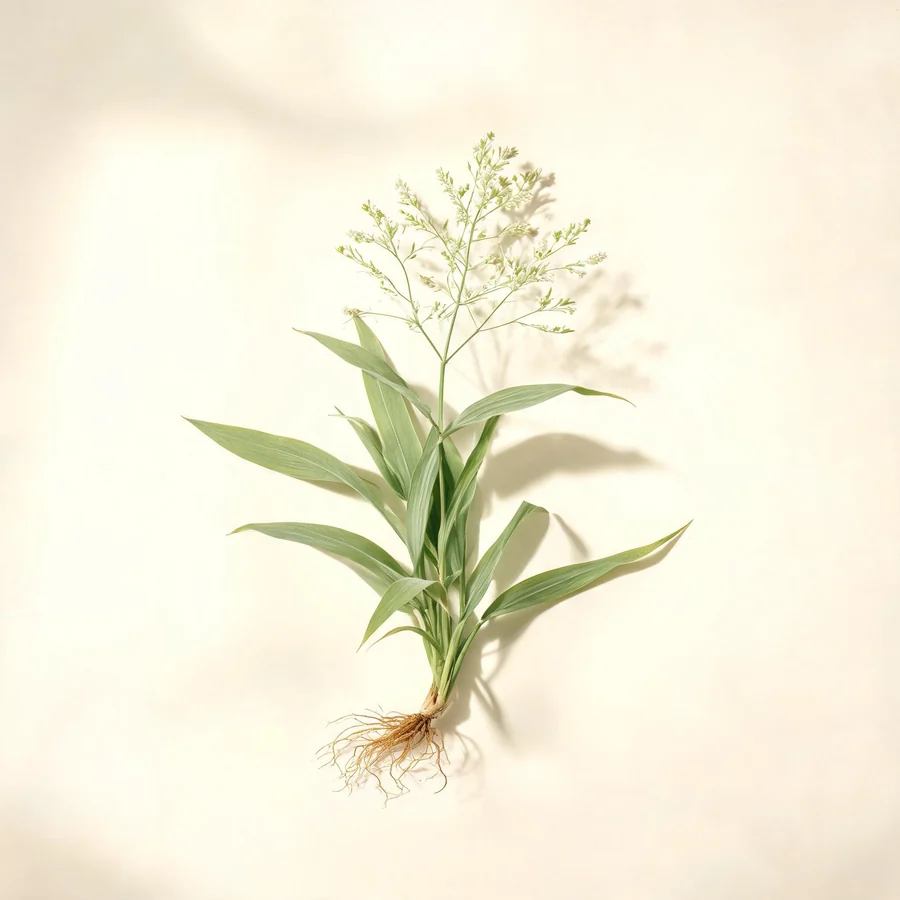
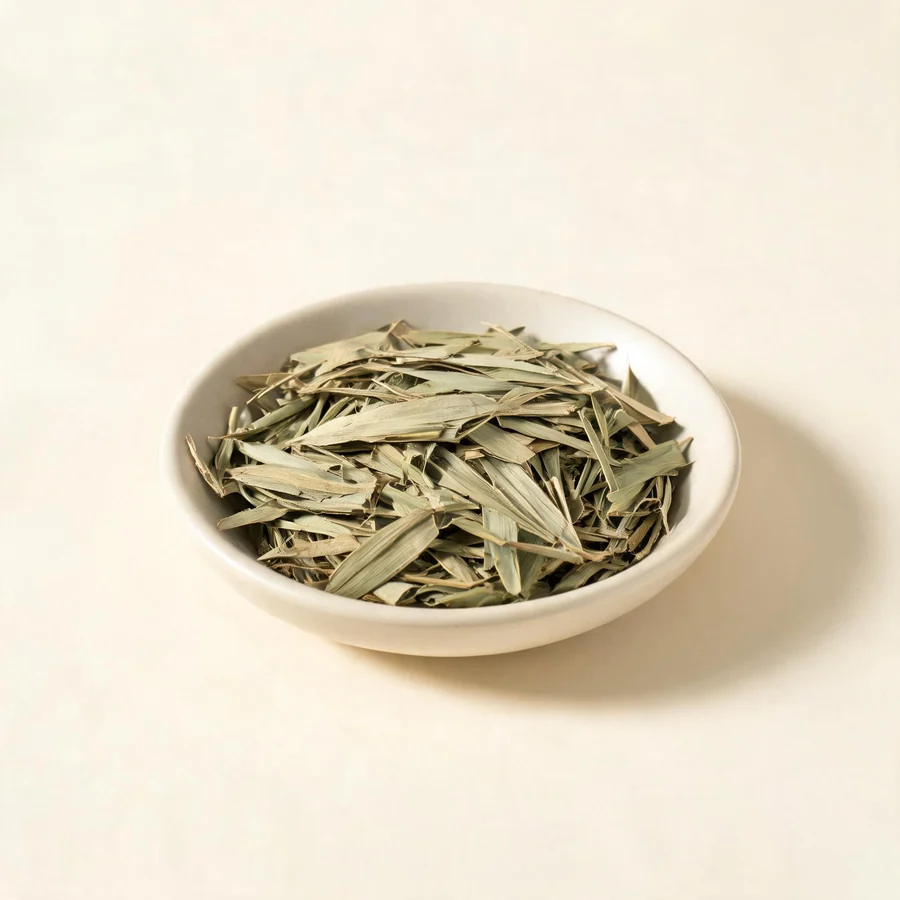
Skin profile
Where this herb sits in skin practice: the pattern it corrects, the skin signs it suits, and what it should not be used for.
Dan Zhu Ye is the mild end of cooling skin practice. It suits the hot, prickly, thirsty rash of summer and the excoriated nappy area of a hot infant, and it is expected to be given for days rather than months. Anything with fever, spreading redness or systemic illness is outside its scope.
Skin signs that suggest it
- Fine red or clear prickly bumps in the folds of the neck, chest or groin, or under clothing, in hot humid weather
- Skin that is hot and dry to the touch, with thirst, restlessness and a short temper
- A bright red nappy area with small eroded spots in a hot, fretful infant
- Small red papules on the face or chest that flare in heat and fade in a cool room
- Scanty dark urine and a red tongue tip alongside the rash
- Mouth or tongue ulcers at the same time as the skin eruption
When it is not the right herb
Not for pale, cold skin, and not for the dry thickened eczema of long standing. Not where urine is already copious and pale, since there is no heat to lead away and the draining action costs fluid. Not in pregnancy. Not a substitute for cooling, fluids and shade in heat illness, and not for a fever in an infant without medical advice. Because the leaf is mild, the temptation is to give it for anything hot; the test is whether the skin is hot and the urine is scanty and dark, not whether the weather is warm.
What it does for skin
Skin-relevant actions only. Each one describes a mechanism in TCM terms and what it looks like on the skin.
Clears heat from the Heart and Stomach
The rash of summer heat, the red nappy area and the small red papules of a hot child are all read as heat in the upper and middle body showing on the skin. The leaf is sweet and cold and enters both channels, so it cools the source rather than the surface alone. It is a mild herb, used where the heat is moderate or beside stronger herbs when the main problem lies elsewhere.
Drains heat down and out through the urine
Its bland quality is described as percolating: it increases urine so that heat is carried out of the body instead of being pushed deeper into it. That is the practical reason it suits a rash with dark scanty urine and not a rash with copious clear urine. It is a gentler version of the draining that the bitter cold herbs perform, and it is why it can be given to a child for a few days.
Eases the restless, thirsty state that goes with hot skin
A hot, itchy child who will not sleep and keeps asking for drinks is a familiar picture, and the herb is chosen for the whole of it rather than for the rash alone. Cooling the Heart is the traditional explanation for the calm that follows, and generating fluids is the explanation for the thirst settling. Neither is a substitute for giving the child something cool to drink.
Cools without drying, so a short course suits mild cases
The distinction that matters in practice is between the bitter cold herbs, which dry and can upset the digestion, and this leaf, which is cold but not bitter and does not dry. That is why it is used for an infant's heat rash or a child's summer itch when a stronger herb would be too much. Mild does not mean indefinite: a long course at a high dose still cools the digestion and drains fluid.
Skin conditions it is used for
Mapped to the condition pages on this site. The pattern column shows what the skin is doing when this herb is the right choice.
| Condition | Pattern | Why it suits | Typical setting |
|---|---|---|---|
| Heat Rash | Summer heat and dampness congesting the skin | Prickly heat appears when sweat cannot escape, and the traditional reading is summer heat with dampness trapped in the skin. The leaf clears the heat and opens the urinary route, and the practical measures, cooling the room and loosening clothing, are the other half of the treatment. It is one of the few skin problems where a mild cooling herb and simple nursing care work in the same direction. | Modified Dao Chi San with Hua Shi and Bo He |
| Diaper Rash | Damp-heat in the skin of a hot infant | A bright red, excoriated nappy area in a fretful, thirsty baby is read as damp-heat, and a mild cooling leaf suits an infant better than a bitter cold herb. It is given as a weak decoction or used in a dilute wash, alongside frequent nappy changes and a barrier cream. A rash with satellite pustules, a fever or a baby who is unwell needs medical review rather than herbs. | A weak decoction with Lu Gen and Gan Cao, or a dilute wash |
| Skin Inflammation | Heat in the skin with thirst and restlessness | Where an eruption is hot, red and dry rather than weeping, and the person is thirsty and unsettled, the leaf is used to lower the heat gently. It is an adjunct and is not expected to settle a severe inflammation on its own. Redness that is spreading, tender or accompanied by fever belongs to a different category and needs assessment. | With Shi Gao and Zhi Mu in a heat-clearing formula |
| Burning Hot Skin To The Touch | Heat at the qi level with hot dry skin | Skin that feels hot and dry to the hand, with thirst, irritability and a rapid pulse, is read as heat at the qi level, and the leaf is a mild support to the heavier cooling herbs used for it. It contributes by cooling the Heart and by giving the heat a route out through the urine. A high fever, a stiff neck, drowsiness or a rash that does not blanch on pressure is an emergency and not a case for a leaf. | Zhu Ye Shi Gao Tang style formulas with Shi Gao and Mai Men Dong |
Combinations for skin
Herbs it is paired with when the skin, not an internal organ, is the target.
| Partner | Ratio | Why the pair is used |
|---|---|---|
| Deng Xin Cao | 6 to 10 g Dan Zhu Ye with 3 to 6 g Deng Xin Cao | The two share a sweet, bland, cold nature, and both cool Heart fire while moving water, so the pair strengthens the downward route without adding harshness. It is gentle enough for a child with night restlessness, a sore mouth and slightly dark urine, where a stronger cold herb would be too much. Together they illustrate the herb's method: not overpowering heat, but giving it an exit. |
| Shi Gao | 6 to 10 g Dan Zhu Ye with 15 to 30 g Shi Gao | Gypsum is the heavy clearer of Stomach heat and the leaf is the light one, so the pairing covers a hot, thirsty, restless picture from both ends. Gypsum does the bulk of the cooling and the leaf eases the irritability and drains what is left through the urine. It is used after a fever, once the temperature has dropped but appetite and sleep are still poor. |
| Lu Gen | 10 to 15 g each | Reed rhizome clears heat and generates fluids, and it is the other mild herb of the summer-heat repertoire; together they suit hot dry skin with thirst and scanty urine. Both are gentle and neither is drying, which is why the pair can be given for several days to someone depleted by heat. It is a drink as much as a medicine. |
| Hua Shi | 6 to 10 g each | Talc drains damp-heat through the urine and has its own long use in powders for irritated, sweating skin, while the leaf adds the cooling of Heart and Stomach heat. The pair suits prickly heat in a humid summer, where the problem is both heat and trapped moisture. Talc is for intact skin only and is never applied to an open or weeping lesion. |
Formulas where it leads
- Dao Chi San (导赤散) - The classical formula for Heart fire moving to the small intestine, with mouth and tongue ulcers, restlessness and dark scalding urine. The text names zhu ye, the true bamboo leaf, and dispensaries often supply dan zhu ye instead; they are different plants with a similar role, and the substitution should be stated rather than assumed. It is included because the urinary and mucosal logic it demonstrates is the logic behind the skin use.
Safety for skin use
What to check before recommending or using it, including the cautions that matter most for skin patients.
Do not use, or use with caution
- Pregnancy. The old materia medica forbids it outright, one text saying in four characters that a woman expecting a child must not take it, and the root has its own record of breaking blood and unsettling a pregnancy. The leaf is left out through all three trimesters.
- Spleen and Stomach deficiency cold: loose stools, poor appetite and a cold aching abdomen. A cold bland leaf further weakens a digestion that is already cool.
- No heat at all: a tired, cold person with pale copious urine. Draining warmth and fluid that were not in excess costs more than it gives.
- Copious clear urine, which points to cold rather than heat and makes a diuretic leaf the wrong tool.
- Root material, or leaf with much root attached. The root has its own record of breaking blood, and good leaf material has almost no root.
Pregnancy and breastfeeding
Avoided. The classical prohibition is explicit and short, and the root has its own record of breaking blood and unsettling a pregnancy; although the medicine is prepared from leaf and stem, the cold quality and the pull downward justify leaving it out altogether. A pregnant woman with a heat rash should be managed with cooling, loose clothing and fluids, and any rash with fever or systemic symptoms needs medical review.
Interactions
- Diuretics. The leaf increases urine, so it can intensify furosemide or a thiazide, and the extra loss of water and salts matters for a frail person or one already taking a large dose.
- Diabetes medicines. Experiments suggest the extract can push glucose up, which is relevant to anyone using insulin or a sulphonylurea and calls for monitoring rather than avoidance.
- Antipyretics and anti-inflammatory drugs. The leaf has a mild cooling effect, so in theory it could amplify paracetamol or an anti-inflammatory; this is a reason to keep the dose modest rather than to avoid the combination.
Allergy and patch testing
Reactions are rare for a mild leaf, but a wash or a tea applied to broken skin can still irritate. Patch test a wash on normal skin for twenty four hours, keep a nappy-area wash weak, and stop if the skin becomes redder rather than calmer. A reaction to one ingredient in a wash does not establish which one caused it, so the whole product should be stopped.
General safety references
General references for herbal hepatotoxicity and herb-drug interactions; they are not specific to this herb.
- Review article: Herbal hepatotoxicity - an update on traditional Chinese medicine preparations. Alimentary Pharmacology & Therapeutics, 2014. PMID: 24844799.
- Interactions between herbal medicines and prescribed drugs: an updated systematic review. Drugs, 2009. PMID: 19719333.
- Warfarin and food, herbal or dietary supplement interactions: a systematic review. British Journal of Clinical Pharmacology, 2021. PMID: 32478963.
Evidence
The classical record is quoted with its source. The modern note states the level of evidence plainly.
Classical record
去烦热,利小便,清心。
It clears restless heat, opens the water passage and quiets the Heart.
Ben Cao Gang Mu (Compendium of Materia Medica), Li Shizhen - The same entry describes a plant that grows in open fields and looks like fine bamboo raised from seed, which is why the name caused confusion for centuries.
淡竹叶甘淡性寒,轻浮上达之品,解散上焦风热,清心肺炎蒸,导小肠膀胱湿热下降。
Sweet and bland, cold in nature, this is a light medicine that rises. It scatters wind-heat from the upper burner, cools the steam of heat in the Heart and Lungs, and draws damp-heat downward through the Small Intestine and Bladder. Cooling what lies above while leading below, it both ascends and descends, the yin inside the yang.
Ben Cao Bian Du (Clear Readings of the Materia Medica) - That image of cooling above while leading below explains, more neatly than anything else, how a single mild leaf serves a sore mouth and an irritable bladder alike.
孕妇勿服。
Pregnant women should not take it.
Pin Hui Jing Yao (Essentials of the Materia Medica) - Only four characters, and they are why pregnancy is an exclusion here rather than a caution.
Modern evidence
Evidence status
- Phytochemical work describes flavonoids, triterpenoids and phenolic acids in the leaf, with anti-inflammatory, antipyretic and mild diuretic activity reported in laboratory and animal studies. None of this establishes a clinical effect on skin.
- No controlled trial of Dan Zhu Ye in heat rash, nappy rash or any dermatological condition was identified. The best available evidence for cooling washes in infant prickly heat concerns other herbs, comes from small Chinese studies with weak methods, and does not transfer automatically.
- The safety position is favourable but thin: the herb counts in China as both a food and a medicine, and it has a long record of use with few reported harms. The documented caution is not toxicity but the classical pregnancy prohibition and the cooling, draining effect on a weak digestion.
PubMed records
Selected real PubMed records for this herb's species or its constituents, chosen by species name and title relevance. They are references for the non-TCM discussion above, not proof that the herb treats any skin condition.
- Ethanol extract of Lophatheri Herba exhibits anti-cancer activity in human cancer cells by suppression of metastatic and angiogenic potential.. Scientific reports, 2016. PMID: 27808120 (pharmacology or review record).
Dose and forms
Skin-practice dosing and the preparations that suit skin complaints.
| Form | Dose and notes |
|---|---|
| Decoction | 6 to 15 g of dried leaf daily. The lower end suits mild heat or a supporting role, and the upper end a pronounced heat picture with mouth sores or dark urine. |
| Upper limit | Fifteen grams in decoction is the practical top for acute heat, under guidance. Beyond it there is little to gain, since the action is gentle and more volume only adds cold. |
| Fresh leaf tea | A weak infusion of the fresh leaf is a summer drink rather than a prescription, often taken with reed rhizome or mung bean. The fresh infusion is far feebler than the dried leaf taken as a decoction and should not be relied on for a pronounced heat picture. |
| Course length | A few days to a week for a summer rash or a nappy area, then review. Long courses at high dose cool the digestion and drain fluid, which is the main thing that can go wrong with a mild herb. |
The leaf is light and its effect is gentle, so the size of the dose follows the job: a small amount to support a formula, a larger one when the aim is to carry heat out in the urine. It should not be boiled for long, since the material is thin leaf and prolonged cooking wastes what little aromatic fraction it has. The dried leaf in decoction is a medicine and the weak fresh infusion is a drink, and the gap between them deserves respect.
Citations and further reading
Only real sources are listed: the classical materia medica passages quoted above, and the source works behind the botanical and safety statements.
- Ben Cao Gang Mu (Compendium of Materia Medica), Li Shizhen, 1578 - classical passage quoted above.
- Ben Cao Bian Du (Clear Readings of the Materia Medica) - classical passage quoted above.
- Pin Hui Jing Yao (Essentials of the Materia Medica) - pregnancy prohibition quoted above.
- Pharmacopoeia of the People's Republic of China - source for the accepted species, the leaf as the part used and the quality requirements.
- Modern evidence statement: summarised from phytochemical and pharmacological literature; no dermatological trial of this herb is presented as proof of effect.
Educational reference for qualified practitioners. This page is not medical advice, and skin conditions should be diagnosed by a clinician before treatment.