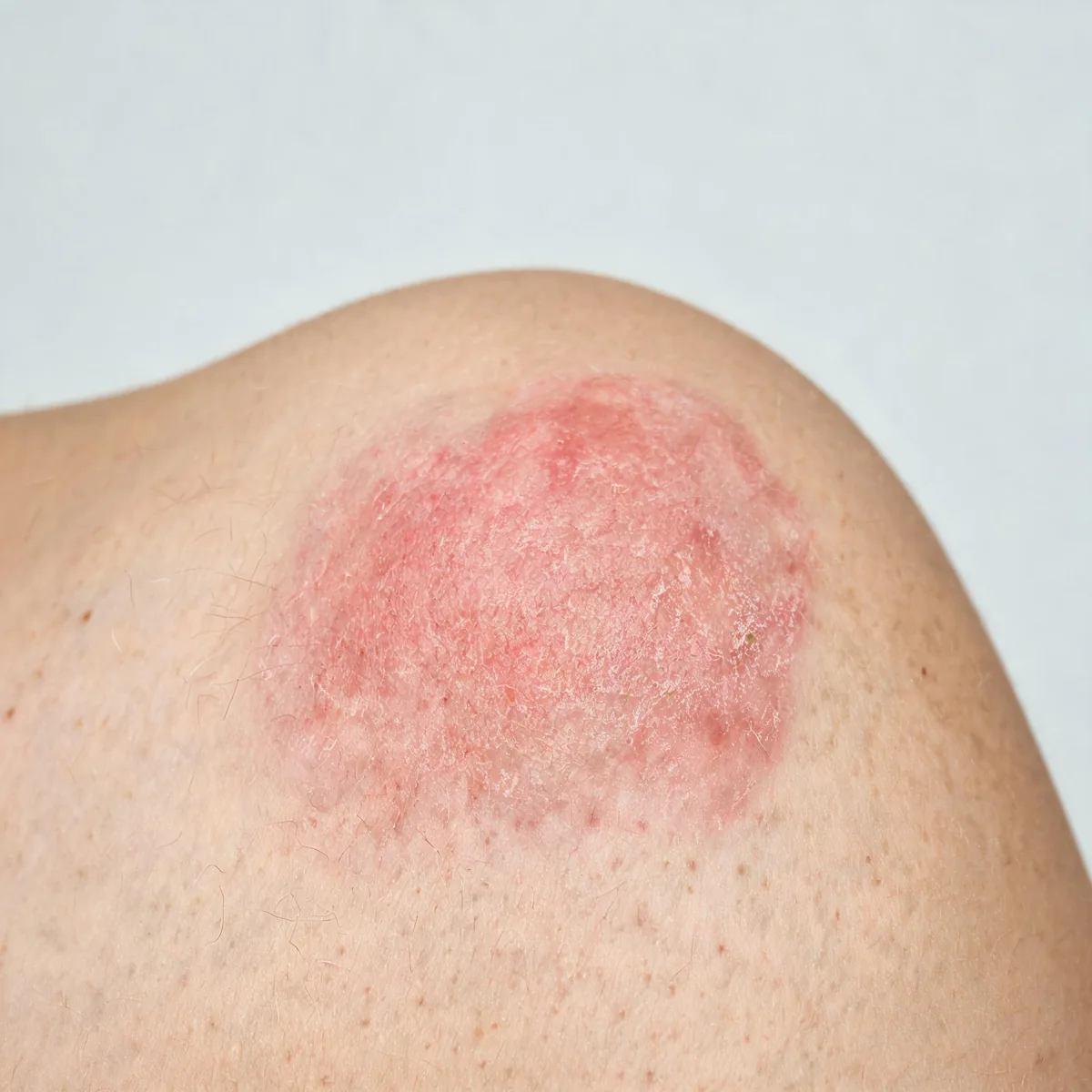
Understanding Skin inflammation
The classical literature frames skin inflammation as an exchange between internal organs and external factors, with each organ contributing a different quality to the inflamed skin.
Damp-Heat gives oozing, crusted, weeping lesions with yellow discharge, a heavy body and a sticky taste. Heat in the Blood gives bright red hot papules and patches that appear suddenly, with intense itch worse with warmth and thirst for cold drinks.
Dry flaky skin with intense night itch, rashes that come and go, and a pale complexion are read as Blood deficiency with external wind. Dull oozing lesions that are not intensely red, with bloating and loose stools, are read as Spleen deficiency with dampness.
Chronic red, dry, finely scaling skin with night sweats, warm palms and a dry mouth is read as Yin and Blood deficiency. The classical literature treats this as the depleted end of long-standing inflammation.
Four mechanisms do most of the work. Wind brings an itch that moves and arrives suddenly, Dampness leaves the surface weeping, oozing and heavy, Heat reddens, burns and speeds everything up, and Dryness makes it scaly, cracked and tight. They combine in recognisable ways: Dampness with Heat gives a moist hot itch, Wind with Dryness gives a flaky itch with little redness, and long-standing Heat eventually consumes the Blood and Yin that would have kept the skin supple.
The organs behind those mechanisms are the Lungs, which rule the surface and its barrier, the Spleen, which manages fluids, the Liver, which stores and moves Blood, and the Heart, which houses the spirit and drives heat and redness. A rash that erupts after a stressful week speaks of the Liver and the Heart, one that weeps and flares with rich food speaks of the Spleen, and a dry thickened rash that itches at night speaks of Blood that can no longer nourish the surface. The tongue and pulse settle the question, with a red tongue and a yellow greasy coat supporting Damp-Heat, a pale thin tongue supporting Blood Deficiency, and a red tongue with little coat supporting Yin Deficiency.
Conventional view
Dermatitis and eczema are broad names for skin that is red, swollen and itchy, and may blister or scale. Atopic dermatitis, contact dermatitis and seborrhoeic dermatitis are the common forms, and the diagnosis is usually made from the appearance and the history, with patch testing or a biopsy reserved for stubborn cases. Western medicine explains the condition as an overactive immune response meeting a weakened barrier and an environmental trigger.
Care begins with emollients that repair the barrier, then topical corticosteroids or calcineurin inhibitors to settle inflammation, with antihistamines for itch, especially at night. Moderate to severe disease may be treated with phototherapy or systemic drugs such as oral steroids, methotrexate, ciclosporin or a biologic such as dupilumab. The aim is to control flares and hold remission, and treatment is often long term.
Topical treatment works quickly, which makes it valuable during a flare, but it does not change why the skin keeps breaking down. Years of steroid use can thin the skin, provoke rebound flares and stop working so well, and systemic immunosuppressants carry real risks. The conventional frame also tends to treat inflammatory rashes as one problem, an immune or barrier fault, without distinguishing the hot, damp, dry or deficient terrain that TCM reads as the driver, which is where a pattern-based plan can add a layer for chronic and recurrent cases.
Selected PubMed records
Real PubMed records for the conventional discussion above, selected by condition name and title relevance. They are references, not a claim that any treatment is proven for this condition.
- The Skin and Inflamm-Aging.. Biology, 2023. PMID: 37997995.
How it connects
Skin inflammation rarely travels alone. In TCM the Lung governs the skin and body hair, so when the Lung is weakened by Wind-Heat or Damp-Heat the skin often shows the first signs, and allergic rhinitis and asthma frequently accompany dermatitis because they share a root of Lung Qi disharmony and latent Dampness: the same pathological fluid that congests nose and bronchi can seep into the skin and cause oozing, itchy lesions. Anxiety and insomnia often cluster with it too. When Heat in the Blood or Damp-Heat agitates the Heart Shen the mind becomes restless, sleep fragments and itching intensifies at night, and the frustration of chronic skin discomfort further fuels Liver Qi stagnation, which generates more Heat, a cycle that TCM breaks by cooling the Blood, soothing the Liver and calming the Shen together.
How it is assessed
The practitioner distinguishes wet from dry, hot from dull, and acute from chronic.
What a practitioner looks for
- Moisture: oozing and crusting suggest Damp-Heat; dryness and scaling suggest deficiency.
- Colour: bright red suggests heat; dull red or pale suggests deficiency or dampness.
- Duration: sudden onset suggests excess; chronic finely scaling skin suggests Yin and Blood deficiency.
- Systemic signs: fever, widespread blistering or pus-filled blisters need urgent review.
The practitioner first takes a history of the eruption: when it began, whether it appeared in one step or crept, how it looked at the start, and what makes it worse. Then comes the examination of the skin itself, followed by the tongue and pulse, which decide between patterns that can look alike on the surface. The same redness can be heat that needs clearing or deficiency heat that needs nourishing, and the wrong choice makes the skin worse.
Sudden bright red hot papules that itch more with warmth or stress, with a red tongue tip, a thin yellow coat and a rapid pulse, are read as Heat in the Blood. Lesions that weep, crust and feel heavy and sticky, with a yellow greasy coat and a slippery rapid pulse, are read as Damp-Heat, usually against a background of rich food or humid weather. Dull oozing lesions that are not intensely red, with bloating, loose stools and fatigue, a pale swollen tongue with teeth marks and a slow or deep pulse, are read as Spleen Deficiency with Dampness.
Thickened scaly skin of long standing that itches at night, with a pale thin tongue and a thin or wiry pulse, is read as Blood Deficiency with External Wind, where the surface is undernourished and open to Wind. Chronic redness with fine scaling, night heat or sweats, a red tongue with little coat and a thin rapid pulse, points to Yin and Blood Deficiency, the depleted end of a long inflammation.
TCM patterns in Skin inflammation
Five patterns are described, and they trace the same inflammation from its hot wet beginning to its dry depleted end. Damp-Heat and Heat in the Blood are the acute, excess pictures, one wet and heavy, one bright and sudden. Blood Deficiency with External Wind and Spleen Deficiency with Dampness are the recurrent middle ground, one dry and itchy, one dull and oozing. Yin and Blood Deficiency is the late picture, when years of inflammation have used up the moisture that would have kept the skin calm. Most people move between two of these rather than sitting neatly in one, so the same person can be wet and hot during a flare and dry and scaly a month later. The practitioner decides which is leading now, treats that, and adjusts as the skin shifts, because a formula that suits an acute phase will not suit the chronic one.
| Pattern | Key signs | The itch | Tongue | Main formula |
|---|---|---|---|---|
| Damp-Heat | Oozing weeping crusted lesions; Red swollen hot skin with burning | Not specified | Body: Red, often swollen with teeth marksCoat: Yellow, greasy and thick, usually in the middle and at the root | Not specified |
| Heat in the Blood | Bright red hot papules or patches | Intense itch worse with warmth | Body: Deep red, often with red points or pricklesCoat: Thin, yellow and dry | Not specified |
| Blood Deficiency with External Wind | Dry flaky rough skin; Rashes that appear and disappear | Itch worse at night | Body: Pale and thin, sometimes slightly dryCoat: Thin, white and a little dry | Not specified |
| Spleen Deficiency with Dampness | Dull oozing lesions, not intensely red | Not specified | Body: Pale and swollen, often with teeth marks along the edgesCoat: White, greasy and moist, thick in the middle | Not specified |
| Yin and Blood Deficiency | Chronic red dry finely scaling skin; Dry mouth and throat | Not specified | Body: Pale to pale-red, thin, dry and crackedCoat: Scanty or peeled | Not specified |
Damp-Heat
Oozing crusted lesions with heat, heaviness and a sticky taste.
When the body's handling of fluids weakens, Dampness gathers, and if alcohol, diet or a hot humid climate adds Heat, the two become a sticky turbid mass that surfaces on the skin. The Dampness keeps the surface oozing, crusting and weeping, while the Heat reddens and inflames it, so the lesion is both wet and angry at once.
The tongue is red with a yellow greasy coat that is hard to scrape off and may be swollen with teeth marks, and the pulse is soggy and rapid or slippery and rapid. Hot humid weather, spicy greasy food, alcohol, dairy and a sedentary routine all feed it, while cool dry weather, cooling foods, barley water and gentle movement help it drain. Long Dan Xie Gan Tang is the formula named, with Bai Xian Pi and Di Fu Zi for the skin, and treatment uses Quchi (LI-11), Yinlingquan (SP-9), Xuehai (SP-10) and Fenglong (ST-40).
Signs
- Oozing weeping crusted lesions
- Yellow discharge
- Red swollen hot skin with burning
- Heaviness in the body
- Sticky taste in the mouth
Diet and lifestyle for this pattern: Avoid greasy, fried and spicy food, alcohol and dairy, which create Dampness and Heat. Eat light, cooling food such as mung beans, bitter melon, cucumber and barley, keep the skin clean and dry in breathable fabrics, and keep moving gently so Qi flows and Dampness drains.
Heat in the Blood
Bright red hot papules appearing suddenly.
Here the Heat has gone deeper than the surface and entered the Blood, where it stirs the circulation and raises internal Wind. That combination pushes outward and upward, so bright red papules or patches appear quickly, feel hot and itch intensely, and the person feels hot inside, worse at night, with a thirst for cold drinks.
The tongue is red with spots or prickles and a thin yellow dry coat, and the pulse is rapid, often wiry and sometimes slippery. Spicy food, alcohol, hot showers and saunas, scratching and emotional upset all add heat, while cool compresses, cool drinks, cooling foods, rest and loose clothing calm it. A blood-cooling formula is used for this pattern, built on Raw Rehmannia, Mu Dan Pi and Chi Shao, with Quchi (LI-11), Xuehai (SP-10), Sanyinjiao (SP-6) and Hegu (LI-4) for support.
Signs
- Bright red hot papules or patches
- Sudden appearance
- Intense itch worse with warmth
- Internal heat worse at night
- Thirst for cold drinks
Diet and lifestyle for this pattern: Eat cooling, light food such as cucumber, watermelon, mung bean soup and leafy greens, and avoid spicy, greasy or fried food, alcohol and excessive meat, which add Heat. Keep skin cool in loose cotton and lukewarm showers, and manage stress with gentle activity such as walking or meditation, since emotional upset stirs Liver fire and heats the Blood.
Blood Deficiency with External Wind
Dry flaky skin with night itch and rashes that come and go.
Blood moistens and protects the skin, so when it is short the surface becomes dry, flaky and poorly defended, and Wind finds a way in. Wind itches, moves and appears suddenly, which is why the rash comes and goes and why the itch is worst at night, when Blood is at its quietest.
The tongue is pale and thin with a thin white slightly dry coat, and the pulse is fine, wiry where the Liver position sits on the left, floating at the right front. Draughts, dry cold air, emotional strain, spicy fried food, night-time and menstrual blood loss all worsen it, while rest, warm nourishing food, moisturising and shelter from wind help. Dang Gui Yin Zi is the formula, with Dang Gui, Bai Shao, He Shou Wu and Ji Li, and treatment uses Sanyinjiao (SP-6), Xuehai (SP-10), Hegu (LI-4), Fengchi (GB-20) and Taichong (LR-3).
Signs
- Dry flaky rough skin
- Itch worse at night
- Rashes that appear and disappear
- Pale or sallow complexion
- Aversion to wind and drafts
Diet and lifestyle for this pattern: Eat blood-nourishing food such as dark leafy greens, red meat, eggs, black sesame and goji berries, and avoid spicy, greasy and drying food that consumes Blood and generates Wind. Keep skin well moisturised with gentle fragrance-free products, protect yourself from wind and draughts, and protect restful sleep while managing stress, since overwork and strain deplete Blood and stir Wind.
Spleen Deficiency with Dampness
Dull oozing lesions with a digestive picture.
The Spleen turns food and fluid into what the body can use, and when it is weak the surplus becomes Dampness instead. That Dampness spills out to the skin, so the lesions are dull and oozing rather than bright red, and they keep returning because the source has not been corrected.
The tongue is pale and swollen, marked by the teeth, under a white greasy coat, while the pulse is soggy and slow, soft and without force. Damp humid weather, heavy greasy or cold raw food, overeating and irregular meals all add to the load, while warm cooked meals, gentle movement and avoiding overeating ease it. Wei Ling Tang is the formula, with Cang Zhu, Bai Zhu and Fu Ling, and treatment uses Zhongwan (REN-12), Zusanli (ST-36) and Yinlingquan (SP-9).
Signs
- Dull oozing lesions, not intensely red
- Bloating and loose stools
- Heaviness in body and limbs
- Poor appetite and fatigue
Diet and lifestyle for this pattern: Focus on warm, cooked, easy meals such as soups, stews and congee, and avoid cold, raw and greasy food that burdens the Spleen. Gentle daily walking or yoga circulates Qi and dries Dampness, and keeping the skin clean and dry stops external Dampness worsening the lesions.
Yin and Blood Deficiency
Chronic dry finely scaling skin with night-time heat.
Yin and Blood are the cooling and moistening reserve, and when they run low over years the skin loses both its moisture and its restraint. A low-grade heat then drifts to the surface, so the skin stays red, dry and finely scaly and never settles properly. It is not the fierce heat of an acute eruption but a slow burning that flares when the body is tired or stressed.
The tongue body is thin, dry and cracked, pale or faintly red, and the coating is scanty or peeled, while the pulse is fine and rapid. Spicy fried food, late nights, dry heated indoor air and stress spend what is left, while cool humid air, moistening foods such as pear and bone broth, rest and gentle movement rebuild it. Zuo Gui Yin and Dang Gui Yin Zi are the formulas named, with Raw Rehmannia, Dang Gui, Mai Dong and He Shou Wu, and treatment uses Taixi (KI-3), Sanyinjiao (SP-6), Ganshu (BL-18) and Quchi (LI-11).
Signs
- Chronic red dry finely scaling skin
- Night sweats
- Warm palms, soles and chest
- Dry mouth and throat
- Red thin cracked tongue
Diet and lifestyle for this pattern: Prioritise moistening, cooling food: pear, black sesame, goji berries, spinach and bone broth. Avoid spicy, fried or drying food and limit caffeine and alcohol, go to bed early and protect sleep quality, since this is when Yin and Blood are rebuilt, and choose gentle exercise such as walking or qigong over intense sweating.
Treatment approach
How the tradition treats skin inflammation, with the herbs, formulas and points used for it.
Principles
- Clear heat and drain dampness while the skin is wet and inflamed.
- Cool the Blood in sudden bright red eruptions.
- Nourish Blood and Yin once the skin has become dry and finely scaling.
- Protect the barrier throughout, with emollients regarded as part of care.
- The root and the surface are treated at once. Internal formulas clear Heat and Dampness, cool the Blood, nourish Blood and Yin, or strengthen the Spleen according to the pattern, while washes, soaks and ointments made with herbs such as Bai Xian Pi and Di Fu Zi settle the itching and dry the oozing directly. Points are chosen to match: Quchi (LI-11) clears heat from the skin, Xuehai (SP-10) cools the Blood and Zusanli (ST-36) strengthens the Spleen so that Dampness does not return. Mixed pictures are the rule rather than the exception, and the emphasis shifts as a wet acute phase gives way to a dry chronic one.
Herbs used
Formulas
Acupoints
- LI-11 (Quchi)
- SP-9 (Yinlingquan)
- SP-10 (Xuehai)
- ST-40 (Fenglong)
- SP-6 (Sanyinjiao)
- LI-4 (Hegu)
- GB-20 (Fengchi)
- LR-3 (Taichong)
- zhongwan-ren-12
- ST-36 (Zusanli)
- KI-3 (Taixi)
- BL-18 (Ganshu)
What to expect
- Acute damp heat is described as settling within one to two weeks.
- Chronic dry inflammation takes months and is managed rather than cured.
- Relapse is common if the internal pattern and triggers are not addressed.
- An acute hot eruption usually settles within a fortnight, while chronic dry eczema can take four to eight weeks before a real shift appears and then keeps improving over months. Progress is uneven, and a short flare during treatment is not a failure, particularly when a wet phase is drying up. The formula is adjusted as the skin changes, and once it is stable the visits are spaced out with a maintenance plan for the seasons when it usually flares.
Safety and when to get help
Seek medical help urgently for
- Sudden widespread blistering or peeling skin.
- Rash with fever, chills or pus-filled blisters.
- Signs of infection with spreading redness and pain.
For anything severe, sudden or spreading quickly, read when a skin problem needs urgent care.
Cautions
- Do not stop prescribed topical or systemic treatment abruptly.
- Strong topical preparations on broken skin need advice.
- Long-term internal herbs should be supervised with liver function checked where indicated.
Using this alongside conventional care
- TCM is described as complementary to conventional care: emollients and prescribed topical treatment continue alongside herbs and acupuncture.
- Creams and herbal treatment can run in parallel, with topical steroids and emollients applied at a different time of day from a herbal wash so that the two do not interfere. Oral immunosuppressants, biologics and antihistamines are never stopped abruptly; they are tapered with the dermatologist as the skin improves. Dang Gui and Chi Shao can interact with anticoagulant or antiplatelet drugs, and herbs that clear Heat may lower blood pressure or blood sugar a little, so those on related medication need monitoring. Keep both practitioners informed of everything in use.
Diet and lifestyle
- Avoid deep-fried, spicy and sugary food and excess dairy, and favour light cooked meals.
- The general principle is to avoid what generates Dampness and Heat: deep-fried food, sugar, very spicy dishes and rich dairy. Favour lightly cooked vegetables, moderate whole grains and cooling moistening foods such as mung beans, cucumber, pear and leafy greens, with warm water or mild herbal teas through the day, and eat at regular times rather than in one large meal. Where the pattern is one of deficiency, add congee, bone broth and modest amounts of good quality meat or eggs. For Damp-Heat keep dairy and fried food out, for Heat in the Blood avoid alcohol and hot spices, and for Blood or Yin Deficiency favour moistening foods over drying pungent ones.
If you are pregnant
Pregnancy draws the mother's Blood and Yin downward to nourish the fetus, which leaves the skin drier and more exposed to Heat and Wind, and Heat in the Blood or Blood Deficiency with External Wind can worsen. Herbs that move Blood strongly or cool it harshly, Da Huang and Tao Ren among them, are avoided because they may stimulate the uterus. Modified formulas are used under professional guidance, acupuncture is a good first option, especially in the first trimester, with Xuehai (SP-10) and Quchi (LI-11) used cautiously and lower abdominal and sacral points avoided, and washes with Bai Xian Pi or Di Fu Zi relieve itching without systemic risk.
If you are breastfeeding
Topical herbal preparations are generally safe while feeding because absorption is minimal. If internal herbs are needed, bitter-cold herbs that pass into milk and can cause diarrhoea or colic, such as Huang Lian and Long Dan Cao, are used sparingly, and milder heat-clearing herbs are chosen instead. A Damp-Heat or Blood Heat flare often responds to a brief low-dose course of Long Dan Xie Gan Tang in modified form, stopped once the acute phase passes. Acupuncture remains safe throughout and does not enter the milk.
If treating a child
In children the commonest picture is Spleen Deficiency with Dampness, because an immature Spleen struggles to transform fluids, and the result is crusted weepy patches in the limb folds and on the cheeks. Young children cannot describe symptoms, so the practitioner relies on the rash, on a tongue that is usually pale and swollen under a white greasy coat, and on sleep broken by itch. Doses are about a quarter to a half of the adult amount, modified Wei Ling Tang is a common formula, washes with Bai Xian Pi or Di Fu Zi dry the lesions, and acupressure or paediatric tuina at Pishu (BL-20) and Zusanli (ST-36) can replace needles.
If treating an elderly patient
In older adults the inflammation is usually chronic and dry, intensely itchy, and Yin and Blood Deficiency is the pattern that predominates, so lesions are scaly rather than weepy and the itch is worse at night and in winter. Multiple medications make interaction checks essential, since anticoagulants are potentiated by Dang Gui and blood pressure can be affected by Gan Cao. Gentle nourishing formulas such as Dang Gui Yin Zi are used at about two thirds of the adult dose with Sanyinjiao (SP-6) and Taixi (KI-3) to rebuild Yin and Blood, while harsh drying or cooling herbs are left out, and the response is slower but often lasting.
Urgent-sign guidance is based on standard sources: NHS anaphylaxis, NHS cellulitis, NHS Stevens-Johnson syndrome, NHS melanoma.
Evidence
Evidence status
Compiled for this page from the classical and modern literature; not a systematic review, so treat it as a pointer to sources rather than clinical guidance.
The evidence is moderate and comes chiefly from atopic eczema. A Cochrane review of 28 randomised trials with over 2,300 participants found some herbal preparations improved symptom severity and quality of life compared with placebo, while rating the evidence low to moderate because of methodological limitations. A meta-analysis of 11 trials found acupuncture significantly reduced itch intensity.
The 2019 meta-analysis behind the acupuncture figures pooled eleven trials and over a thousand patients and found itch intensity significantly reduced against sham acupuncture or conventional care, with no serious adverse events, though most trials were small and blinding was unclear. Almost all of this work has been done in China, and acupuncture protocols differ so widely between studies that firm conclusions are difficult. The overall position is a plausible and relatively safe adjunct, with high-quality international evidence still developing.
Studies often cited
In 28 randomised trials with over 2,300 participants, some herbal preparations improved symptom severity and quality of life compared with placebo, but evidence was rated low to moderate quality because of methodological limitations. Zhang W, Bath-Hextall F, et al. Cochrane Database of Systematic Reviews 2015, Issue 2. Art. No.: CD002291.
Pooling 11 randomised trials with 1,015 patients, acupuncture significantly reduced itch intensity compared with control. Meta-analysis of 11 randomised trials, as recorded in the classical literature source.
In a randomised trial of 120 patients with acute dermatitis, adding oral Xiao Feng San to mometasone cream reduced itching, erythema and lesion area significantly more than the cream alone at four weeks, with no serious adverse effects and mild digestive upset in about six per cent of the herbal group. Li Y, Chen X, Wang J, et al. Efficacy and safety of Xiao Feng San in acute dermatitis: a randomized controlled trial. Journal of Traditional Chinese Medicine 2020;40(2):267-273.
PubMed records for the TCM evidence
Real PubMed records for the TCM clinical evidence discussed above, selected by condition name and title relevance. They are references, not proof of benefit.
- Microbial functions in skin inflammation: a Mendelian randomization study.. AMB Express, 2026. PMID: 42463567.
- The role of short-chain fatty acids in inflammatory skin diseases.. Frontiers in microbiology, 2022. PMID: 36817115.
Classical record
When Dampness and Heat contend with each other and overflow into the skin and flesh, sores and ulcers develop, which are red, swollen and painful, or they rupture and exude oily fluid.
- Wai Ke Zheng Zong (Orthodox Manual of External Diseases).
湿热相搏,流溢肌肤,则发为疮疡,红肿作痛,或破流脂水。
When Dampness and Heat contend with each other and overflow into the skin and flesh, sores and ulcers develop, red, swollen and painful, or they rupture and exude oily fluid.
Wai Ke Zheng Zong (Orthodox Manual of External Diseases), Volume 4: Sores and Skin Eruptions - Classical citation; the translation is our own.
Common questions
Is skin inflammation the same as eczema?
Conventional medicine uses eczema or dermatitis for many inflamed skin conditions. This page records the TCM patterns rather than a diagnostic label.
Can herbs calm inflammation?
The tradition describes clearing heat and dampness for the acute patterns and nourishing Blood for the chronic ones, with improvement over weeks to months.
Why does it keep flaring?
The framework explains flares as the underlying pattern reasserting itself, usually with diet, stress or environmental triggers.
When should I worry?
Blistering, peeling, fever or rapidly spreading redness needs urgent medical care.
Can I use my steroid cream while doing TCM?
Yes. Most people keep using their prescribed cream while starting herbs and acupuncture, and the aim is to need less of it over time rather than to stop it suddenly. Any reduction is agreed with the dermatologist and made gradually. Tell both practitioners everything you are using so that the two plans are coordinated.
Are there side effects from Chinese herbs?
When a qualified practitioner matches the formula to the pattern, unwanted effects are rare and, when they do come, mild, most often a short period of digestive adjustment at the start. Some herbs interact with medication or are unsuitable in pregnancy, which is why a full health history matters. Herbs are sourced from suppliers who test for contaminants, and any new symptom is reported so that the formula can be changed.
How long before I see results?
It depends on the pattern and how long the condition has lasted. Acute hot rashes often calm within days to two weeks, while chronic dry inflammation may take four to eight weeks before a real shift, with continued improvement over months. The formula is adjusted as the skin changes, so progress can be reviewed and treatment changed if it is slow.
Are there side effects from Chinese herbs?
When prescribed by a qualified practitioner who matches the formula to the pattern, side effects are uncommon and usually mild, perhaps a little digestive adjustment at first. Some herbs can interact with medicines or be unsuitable in pregnancy, so a full health history matters, and herbs should come from a reputable supplier.
Can TCM cure my skin condition permanently?
TCM aims to bring the body back into balance so the skin can heal and stay clear without constant medication. For many people that means long-term remission rather than a permanent cure: the skin may still react under extreme stress, poor diet or strong triggers, but flares tend to be less frequent and less severe, and occasional maintenance treatment can keep it stable.